
Penn Physicists Unveil Light-Matter Chip Architecture to Solve AI's Energy Crisis
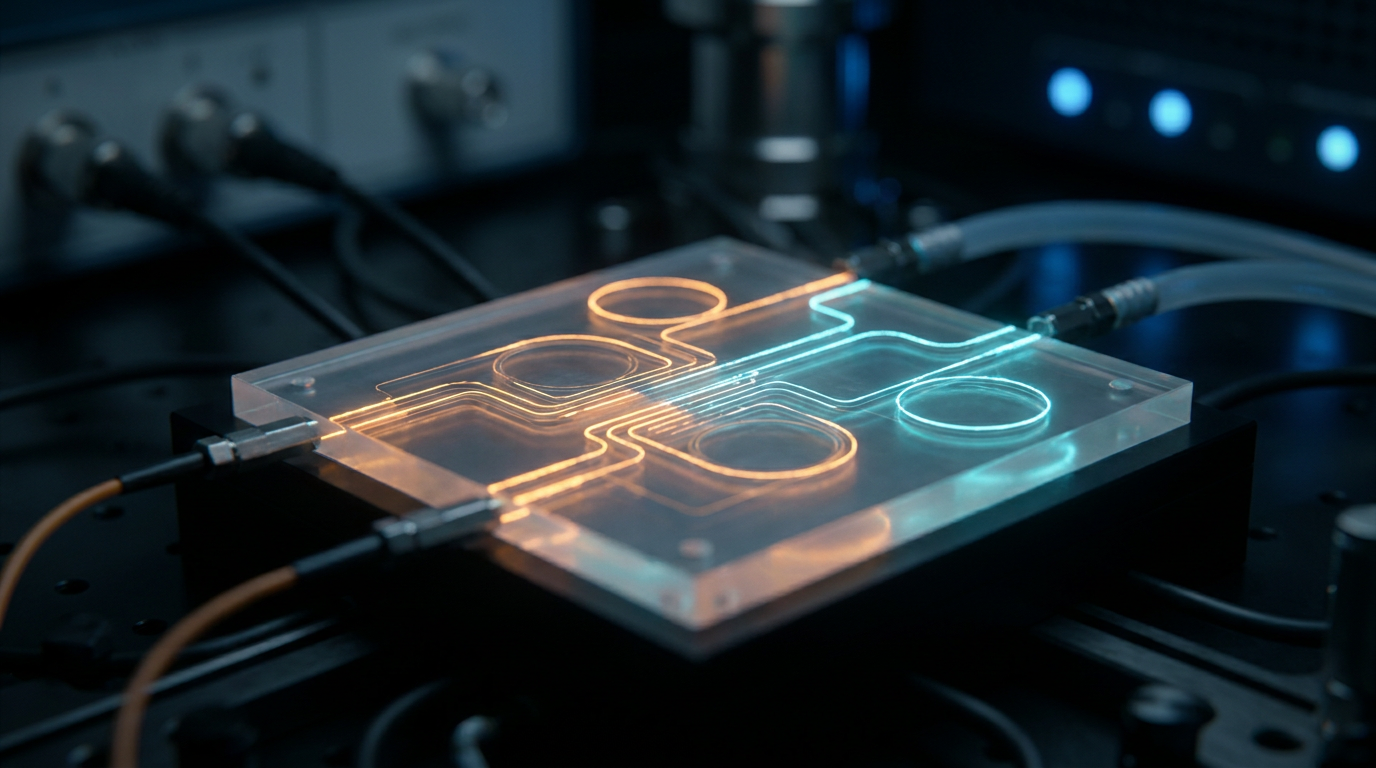
Researchers at the University of Pennsylvania have successfully used hybrid light-matter particles to perform computing logic, paving the way for ultra-efficient, all-optical AI chips.
By Factlen Editorial Team
- Photonic Computing Researchers
- Physicists view the exciton-polariton as the missing link that finally makes all-optical logic possible.
- AI Hardware Industry
- The semiconductor sector sees optical computing as a necessary escape hatch from the looming AI power crisis.
- Technology Analysts
- Analysts focus on the historical symmetry with ENIAC and the long-term implications for computing speed and efficiency.
What's not represented
- · Environmental Advocates
Why this matters
Training and running large AI models currently consumes massive amounts of electricity, straining global power grids. Shifting from electron-based chips to light-based processing could drastically reduce AI's energy footprint while simultaneously accelerating computation speeds.
Key points
- Penn physicists have demonstrated all-optical computing logic using hybrid light-matter particles.
- The breakthrough relies on exciton-polaritons, which combine the speed of light with the interaction capability of electrons.
- The new architecture performs signal switching using just 4 femtojoules of energy, drastically less than electronic chips.
- By eliminating the need to convert optical signals back to electricity, the technology removes a major bottleneck in photonic AI.
- If scaled, these chips could solve the massive energy consumption crisis currently facing the artificial intelligence industry.
The artificial intelligence industry is facing a looming physical wall. As large language models scale into the trillions of parameters, the silicon chips powering them are consuming electricity at rates that rival small nations. This energy crisis stems from a fundamental limitation of modern computing: it relies entirely on moving electrons.[4]
Moving electrons through solid materials generates friction, which manifests as heat. In massive AI data centers, cooling these electronic processors requires nearly as much power as running the calculations themselves. For years, engineers have dreamed of replacing electrons with photons—particles of light that carry no charge, generate zero heat, and travel at the universe's ultimate speed limit.[2][6]
But light has a fatal flaw when it comes to computing. Because photons are charge-neutral, they simply pass through one another without interacting. Computing requires logic gates—switches where one signal dictates the behavior of another. If signals cannot interact, they cannot compute.[1][5]
To bridge this gap, existing experimental photonic AI chips use light to transport data rapidly, but they must convert the optical signals back into electricity every time the neural network needs to make a decision—a process known as a non-linear activation step. This constant conversion between light and electricity creates a severe bottleneck, erasing much of the speed and energy efficiency that optical computing promises.[2][4]

Now, exactly eighty years after researchers at the University of Pennsylvania launched the electronic age by developing ENIAC—the world's first general-purpose electronic computer—a new team of Penn physicists has published a breakthrough that could finally sever computing's reliance on the electron.[1]
In a paper published in Physical Review Letters, a research team led by physicist Bo Zhen detailed the creation of a hybrid light-matter system capable of performing all-optical switching. By forcing light to interact with matter at the nanoscale, they have engineered a way to perform computing logic entirely within the optical domain.[3][5]
The secret lies in a specialized quasiparticle known as an exciton-polariton. To create it, the Penn researchers coupled photons with electrons inside an atomically thin semiconductor material made of molybdenum diselenide.[2][3]
The secret lies in a specialized quasiparticle known as an exciton-polariton.
When light is confined in a nanoscale optical cavity and forced into this ultra-thin material, the photons and electrons become inextricably linked. The resulting exciton-polariton is a hybrid: it retains the blistering speed and low-loss transport of a photon, but it inherits the electron's ability to interact forcefully with its environment.[5][6]
"Because they are charge-neutral and have zero rest mass, photons can carry information quickly over long distances with minimal loss," explained Li He, co-first author of the study. "But that neutrality means they barely interact with their environment, making them bad at the sort of signal-switching logic that computers depend on." The exciton-polariton solves this exact incompatibility.[2][5]
In their laboratory setup, the Penn team successfully demonstrated that these hybrid particles could perform optical signal switching using an astonishingly small amount of energy. A single switch required just four femtojoules—roughly four quadrillionths of a joule.[1][4]

To put that figure into perspective, four femtojoules is orders of magnitude less energy than what is required to briefly illuminate a microscopic LED, and a tiny fraction of the energy consumed by state-of-the-art electronic transistors performing the exact same logic operation.[2]
By eliminating the need to convert signals back into electricity for non-linear processing, the exciton-polariton architecture allows data to remain as light from the beginning of a calculation to the end. This all-optical pathway could drastically lower the thermal output of AI hardware, potentially eliminating the need for the massive liquid-cooling infrastructure that currently limits data center expansion.[4][6]
The implications extend beyond just power savings. Because the signals never have to slow down for electrical conversion, the processing speed of neural networks could theoretically approach the speed of light. This would allow AI models to process live, high-bandwidth inputs—such as raw video feeds from autonomous vehicles or complex medical imaging—in true real-time.[1][5]

While the physics have been proven in the laboratory, the challenge now shifts from theoretical physics to commercial semiconductor manufacturing. The Penn team's device currently operates at extremely low temperatures—around 4 Kelvin—to maintain the stability of the exciton-polaritons.[3][4]
Scaling this technology into commercial chips that can operate at room temperature inside a server rack will require significant advances in materials science and fabrication techniques. However, with the AI industry facing an imminent energy ceiling, the financial incentive to commercialize all-optical computing has never been higher. If successful, the transition from electrons to exciton-polaritons could trigger a hardware revolution as profound as the invention of the transistor itself.[1][4][6]
How we got here
1946
Researchers at the University of Pennsylvania launch the electronic computing age with ENIAC.
2010s
The rise of deep learning pushes traditional electronic chips to their thermal and efficiency limits.
Early 2020s
First-generation photonic AI chips emerge, but struggle with the energy costs of optical-to-electrical conversion.
April 2026
Penn researchers publish their exciton-polariton breakthrough, demonstrating ultra-low-energy all-optical switching.
Viewpoints in depth
Photonic Computing Researchers
Physicists view the exciton-polariton as the missing link that finally makes all-optical logic possible.
For decades, researchers have understood that light is the ultimate medium for data transport, but its inability to perform non-linear logic kept it relegated to fiber-optic cables rather than processors. By successfully coupling photons with electrons in a 2D semiconductor, physicists have proven that light can be forced to interact strongly enough to compute. The focus for this camp is now on pushing the operating temperatures up from near-absolute zero to room temperature, which will require discovering new atomically thin materials that can sustain stable exciton-polaritons without cryogenic cooling.
AI Hardware Industry
The semiconductor sector sees optical computing as a necessary escape hatch from the looming AI power crisis.
Silicon manufacturers are hitting the physical limits of electron-based computing. As transistors shrink to the size of a few atoms, quantum tunneling and massive heat generation are making further efficiency gains nearly impossible. For the hardware industry, the Penn breakthrough represents a viable roadmap out of this thermal bottleneck. If data centers can eventually swap electron-heavy GPUs for photonic processors that use quadrillionths of a joule per operation, the industry can continue scaling AI models without requiring dedicated nuclear power plants to run them.
What we don't know
- Whether exciton-polaritons can be stabilized at room temperature for commercial server racks.
- How long it will take semiconductor foundries to adapt their manufacturing lines for atomically thin MoSe2 materials.
- The exact cost of producing these hybrid photonic chips at scale compared to traditional silicon GPUs.
Key terms
- Exciton-polariton
- A hybrid quasiparticle formed by coupling a photon (light) with an electron-hole pair in a semiconductor.
- Photonic computing
- Using light (photons) instead of electricity (electrons) to process information.
- Non-linear activation
- A mathematical step in artificial neural networks that allows the AI to make complex decisions, traditionally requiring electronic logic gates.
- Femtojoule
- One quadrillionth of a joule, an extremely small unit of energy used to measure nanoscale computing operations.
- Quasiparticle
- A disturbance in a medium that behaves as a distinct particle, used by physicists to simplify the behavior of complex interacting systems.
Frequently asked
Why can't we just use regular light for AI computing?
Photons are charge-neutral and do not interact with each other, making it impossible to perform the logic switching required for computing without converting the light back into electricity.
What is an exciton-polariton?
It is a hybrid quasiparticle created by coupling a photon with an electron in an ultra-thin semiconductor, combining the speed of light with the interaction capability of matter.
How much energy does this new method save?
The Penn team demonstrated all-optical switching using just 4 femtojoules of energy, which is orders of magnitude less than conventional electronic transistors.
When will these chips be in our computers?
The technology is currently in the laboratory phase and operates at extremely cold temperatures. Scaling it up for commercial AI data centers will likely take several years of materials engineering.
Sources
Source coverage
6 outlets
3 viewpoints surfaced






[1]University of PennsylvaniaPhotonic Computing Researchers
Making 'light' work of computing
Read on University of Pennsylvania →[2]ScienceDailyPhotonic Computing Researchers
Light-Matter AI Breakthrough
Read on ScienceDaily →[3]Physical Review LettersPhotonic Computing Researchers
All-Optical Switching Using Two-Dimensional Exciton-Polaritons
Read on Physical Review Letters →[4]DataconomyAI Hardware Industry
Penn physicists use light-matter particles to boost AI chip speeds
Read on Dataconomy →[5]The Brighter Side of NewsTechnology Analysts
Eighty years after ENIAC, light-matter particles could revolutionize AI computing
Read on The Brighter Side of News →[6]Techno-ScienceTechnology Analysts
Exciton-polaritons: the future of AI computing without electrons
Read on Techno-Science →



Every angle. Every day.
Get ai stories with full source coverage and perspective breakdowns delivered to your inbox.