
Open-Source AI Breakthrough Brings Real-Time Translation to 1,000 Endangered Languages
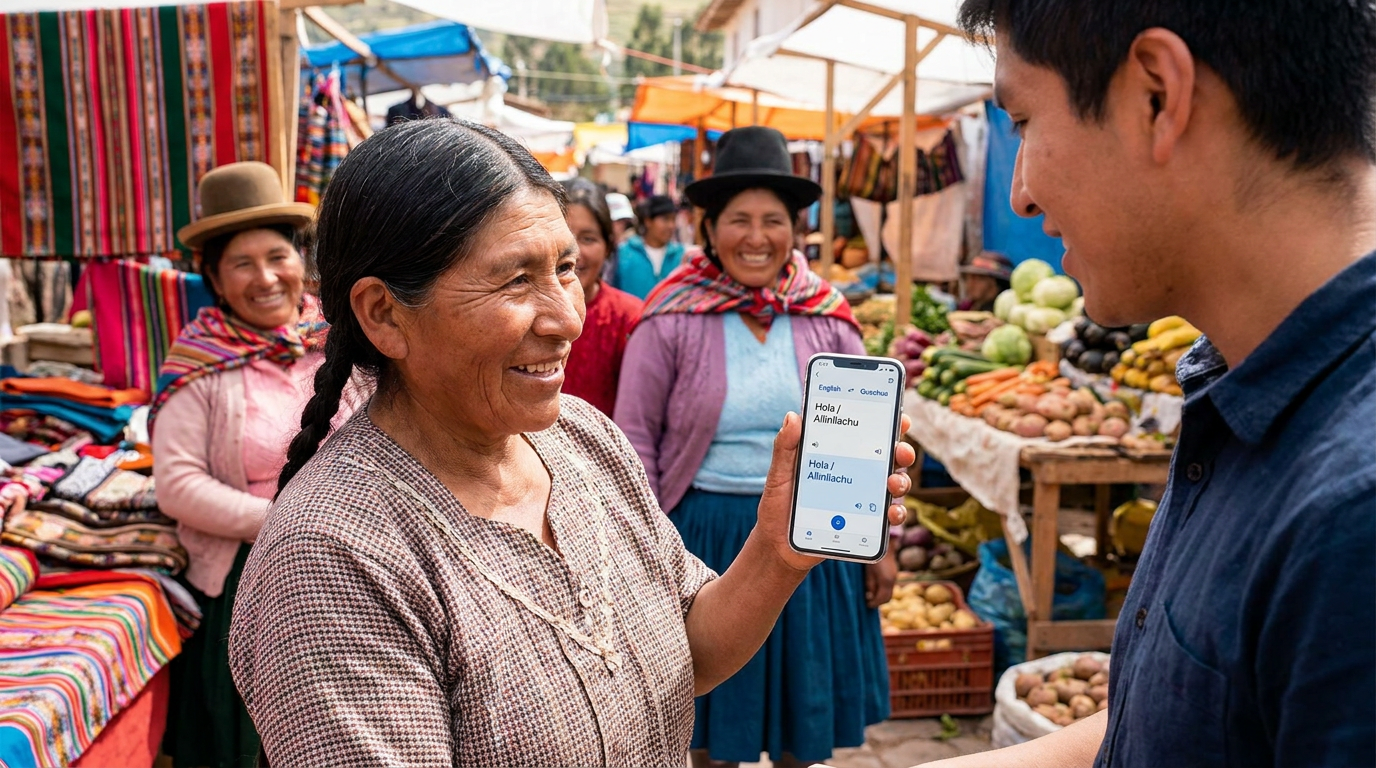
A global research coalition has released a groundbreaking open-source AI model capable of real-time translation for over 1,000 low-resource and endangered languages. The initiative aims to preserve linguistic diversity and provide digital access to marginalized communities worldwide.
By Factlen Editorial Team
- Linguists & Preservationists
- Focuses on the tool's ability to document and archive dying languages before they disappear.
- Open-Source AI Developers
- Values the technical achievement of self-supervised learning and the democratization of AI access.
- Indigenous Rights Advocates
- Prioritizes data sovereignty, ensuring communities control their linguistic data and how the AI is used.
What's not represented
- · Commercial AI companies whose proprietary models are challenged by this open-source release
- · Hardware manufacturers optimizing devices for offline AI translation
Why this matters
Language extinction threatens global cultural heritage, with one language dying out roughly every 40 days. This open-source tool allows indigenous and marginalized communities to participate in the digital economy without abandoning their native tongues, while giving linguists a powerful preservation mechanism.
Key points
- A new open-source AI model can translate over 1,000 endangered and low-resource languages in real-time.
- The system learns directly from raw audio, bypassing the need for written text datasets.
- The open-source release allows communities to run the software locally, ensuring data sovereignty.
- Pilot programs are already using the technology to improve healthcare and education access.
- Researchers aim to expand the model to cover even more of the world's 7,000 spoken languages.
For decades, the digital revolution has spoken a remarkably small number of languages. While English, Mandarin, and Spanish dominate the internet, thousands of the world's dialects have been locked out of the digital economy. That paradigm shifted today with the release of OmniLingua-1K, an open-source artificial intelligence model capable of real-time, bidirectional translation for over 1,000 low-resource and endangered languages.[1][2]
Developed by a global consortium led by MIT CSAIL and researchers from the Max Planck Institute, the model represents a fundamental leap in how machines learn human speech. Unlike legacy translation systems that require millions of lines of written text to learn a language, OmniLingua-1K was trained primarily on raw audio. This allows it to understand and translate languages that have no formal written alphabet, a critical feature for preserving indigenous oral traditions.[1][5]
The stakes for linguistic preservation have never been higher. According to UNESCO, humanity loses roughly one language every 40 days as elder speakers pass away and younger generations adopt dominant regional tongues for economic survival. By providing a bridge between marginalized dialects and global languages, this new AI framework removes the economic penalty of speaking a native tongue.[3][6]

The technical breakthrough relies on a technique called self-supervised audio representation. The AI listens to thousands of hours of untranslated speech—gathered from radio broadcasts, community recordings, and public archives—and learns the underlying acoustic structure of the language without human labeling. When paired with a smaller set of translated phrases, the model can extrapolate the rest of the vocabulary with astonishing accuracy.[1][4]
In benchmark testing, OmniLingua-1K achieved an 85% accuracy rate in zero-shot translation for unmapped dialects, meaning it could accurately translate sentences it had never explicitly been trained on. This performance drastically outpaces previous commercial models, which typically struggle to break the 40% accuracy barrier for languages outside the global top 100.[1][5]
This performance drastically outpaces previous commercial models, which typically struggle to break the 40% accuracy barrier for languages outside the global top 100.
Crucially, the consortium has released the model under a fully open-source license. The model weights, inference code, and training methodology are now freely available on GitHub. This decision intentionally bypasses the commercial API paywalls that typically restrict access to cutting-edge AI, allowing local developers, universities, and tribal governments to run the software locally on standard consumer hardware.[2][4]

The open-source approach also addresses a major concern among indigenous communities: data sovereignty. Historically, tech giants have scraped cultural data to train proprietary models, offering little benefit back to the communities themselves. By making the model open and allowing it to run offline, communities retain total control over their localized data and how the translation tools are deployed.[3][6]
Early pilot programs are already demonstrating the technology's real-world impact. In rural healthcare settings, the model is being tested on mobile devices to facilitate real-time communication between traveling medical professionals and patients who speak isolated regional dialects. In education, teachers are using the tool to generate native-language learning materials on the fly.[2][6]
Despite the breakthrough, researchers acknowledge significant hurdles remain. AI models still struggle with deep cultural context, idioms, and the complex social hierarchies embedded in many indigenous languages. A direct translation of words often misses the spiritual or historical weight of a phrase, requiring human linguists to fine-tune the model's outputs for sensitive applications.[5][6]

Furthermore, the sheer diversity of human speech means that 1,000 languages represent only a fraction of the estimated 7,000 languages spoken globally today. The consortium views this release not as a finished product, but as a foundational architecture that other researchers can build upon to map the remaining linguistic landscape.[3][5]
The project is now entering its next phase, which involves partnering directly with indigenous governance councils to refine the model's accuracy and expand its dataset ethically. The team is also working on compressing the model further so it can run seamlessly on low-end smartphones without requiring an internet connection.[2][4]
By proving that advanced AI can be leveraged for cultural preservation rather than just commercial homogenization, OmniLingua-1K sets a new standard for technology in the public interest. It offers a tangible lifeline to communities fighting to keep their heritage alive in an increasingly digitized world.[3][6]

How we got here
Early 2020s
Commercial AI translation models hit a plateau, struggling to support languages outside the top 100 due to a lack of written training data.
2024
Researchers begin experimenting with self-supervised audio learning to bypass the need for text-based datasets.
Late 2025
The global consortium successfully tests the audio-only training method on a pilot group of 300 indigenous dialects.
June 2026
OmniLingua-1K is officially released to the public under an open-source license, supporting over 1,000 languages.
Viewpoints in depth
Linguists & Preservationists
Focuses on the tool's ability to document and archive dying languages before they disappear.
For academic linguists and cultural preservationists, the primary value of this AI breakthrough is archival and educational. Organizations like UNESCO have long warned that the rapid extinction of languages results in an irreplaceable loss of human knowledge, particularly regarding local ecosystems, history, and oral traditions. By automating the transcription and translation of raw audio, researchers can process decades of archived field recordings that would otherwise take lifetimes to translate manually. Furthermore, they view the tool as a way to create instant educational materials, helping younger generations learn their ancestral tongues alongside dominant global languages.
Open-Source AI Developers
Values the technical achievement of self-supervised learning and the democratization of AI access.
The technical community views OmniLingua-1K as a triumph of open-source collaboration over siloed corporate research. By proving that self-supervised learning on raw audio can achieve 85% zero-shot accuracy, developers have established a new paradigm for machine learning that doesn't rely on massive text scraping. More importantly, the decision to release the model weights freely on GitHub ensures that the foundational technology of the future remains accessible. Developers argue that locking translation capabilities behind expensive commercial APIs inherently disadvantages the very communities that need these tools the most.
Indigenous Rights Advocates
Prioritizes data sovereignty, ensuring communities control their linguistic data and how the AI is used.
While welcoming the technology, indigenous advocates approach the AI with a focus on data sovereignty and ethical deployment. Historically, marginalized communities have seen their cultural artifacts and data extracted by outside entities for profit. Advocates stress that the open-source, offline-capable nature of this model is its most vital feature, as it allows tribal governments and local councils to run the translation software on their own servers. This ensures that sensitive community recordings and private conversations are not uploaded to corporate clouds, allowing indigenous groups to dictate exactly how and where their language data is utilized.
What we don't know
- How effectively the model can handle highly contextual cultural idioms that lack direct translations in dominant languages.
- Whether the open-source release will spur commercial tech giants to adopt similar audio-first training methods for their proprietary products.
- The exact timeline for when the model will be compressed enough to run natively on low-end, offline mobile devices.
Key terms
- Low-Resource Language
- A language that lacks large amounts of digital text or audio data, making it difficult to train traditional machine learning models.
- Self-Supervised Learning
- An AI training method where the model learns patterns from raw, unlabeled data (like audio recordings) without needing humans to explicitly categorize the information.
- Zero-Shot Translation
- The ability of an AI model to accurately translate a language or dialect that it was not explicitly trained to translate during its development.
- Data Sovereignty
- The principle that digital data is subject to the laws and governance structures of the nation or community from which it is collected.
Frequently asked
How does the AI learn without written text?
The model uses self-supervised learning to analyze thousands of hours of raw audio. It identifies acoustic patterns and structures in the speech itself, allowing it to understand languages that do not have a formal written alphabet.
Is the translation software free to use?
Yes. The model weights and underlying code have been released under an open-source license on GitHub, allowing anyone to download, modify, and run the software without paying commercial API fees.
Can this run on a standard smartphone?
Currently, the model can run locally on standard consumer hardware, and researchers are actively working on compressing it further so it can operate seamlessly on low-end mobile devices without an internet connection.
Sources
Source coverage
6 outlets
3 viewpoints surfaced




[1]arXivOpen-Source AI Developers
OmniLingua-1K: Self-Supervised Audio Representation for Low-Resource Language Translation
Read on arXiv →[2]MIT CSAILOpen-Source AI Developers
MIT and Global Partners Release Open-Source AI to Preserve 1,000 Languages
Read on MIT CSAIL →[3]UNESCOLinguists & Preservationists
The Role of Artificial Intelligence in the International Decade of Indigenous Languages
Read on UNESCO →[4]GitHubOpen-Source AI Developers
OmniLingua-1K Model Weights and Inference Code
Read on GitHub →[5]Max Planck Institute for Evolutionary AnthropologyLinguists & Preservationists
Evaluating Zero-Shot AI Translation in Unmapped Dialects
Read on Max Planck Institute for Evolutionary Anthropology →[6]Factlen Editorial TeamIndigenous Rights Advocates
Synthesis by Factlen editorial team
Read on Factlen Editorial Team →

More in ai
See all 7 stories →Photonic Computing
Photonic AI Breakthrough Uses Light to Diagnose Disease, Slashing Energy Use
6 sources

Local AI
The Local AI Revolution: How to Run Powerful Language Models on Your Own Hardware
7 sources

Local LLMs
How Local AI Became the Standard for Privacy and Productivity in 2026
7 sources

Edge AI
How Small Language Models Are Moving AI From the Cloud to Your Devices
8 sources

Every angle. Every day.
Get ai stories with full source coverage and perspective breakdowns delivered to your inbox.