
The Local AI Revolution: How to Run Powerful Language Models on Your Own Hardware
Open-source tools like Ollama and LM Studio have made it possible to run advanced AI models entirely offline, offering absolute privacy and zero subscription costs.
By Factlen Editorial Team
- Decentralization Advocates
- Focus on data sovereignty, open-source freedom, and eliminating reliance on massive tech conglomerates.
- Enterprise Security Leaders
- Prioritize regulatory compliance, intellectual property protection, and predictable infrastructure costs.
- Hardware Ecosystem Analysts
- Track the shifting economics of consumer computing and the rise of unified memory architectures.
What's not represented
- · Consumer hardware manufacturers
- · Cloud infrastructure providers losing market share
Why this matters
Running AI locally means your sensitive data—whether medical records, proprietary code, or personal journals—never leaves your device. It also eliminates recurring API costs, giving you unlimited access to state-of-the-art intelligence on hardware you already own.
Key points
- Local AI allows users to run powerful language models entirely offline, ensuring absolute data privacy.
- Enterprise adoption of on-premises AI inference has surged to 55 percent in 2026.
- Tools like Ollama and LM Studio have transformed local AI from a complex developer task into a simple, plug-and-play experience.
- Apple's unified memory architecture gives Macs a unique advantage, allowing consumer devices to run massive models.
- Local inference eliminates recurring cloud API costs, making AI usage effectively free after the initial hardware investment.
For years, artificial intelligence felt like a remote utility, locked behind cloud APIs and monthly subscription fees. Users sent prompts into the ether, waited for a remote server to process the request, and hoped their sensitive data remained secure. But in 2026, the paradigm has fundamentally flipped. The open-source community has democratized the infrastructure required to run large language models, allowing anyone to host powerful AI directly on their own hardware. This shift from cloud-dependent computing to local-first architecture is rapidly changing how developers, enterprises, and everyday users interact with machine intelligence.[1][2]
The migration away from cloud AI is not just a hobbyist trend; it has become a serious productivity practice. According to recent industry data, 55 percent of enterprise AI inference now happens on-premises, a massive leap from just 12 percent in 2023. Organizations are realizing that while cloud platforms are undeniably powerful, they quietly introduce friction, latency, and unpredictable costs. More importantly, uploading internal company data to external servers introduces uncontrolled exposure risks that many regulated industries simply cannot accept.[1]

Privacy is the primary catalyst driving this local revolution. When an AI model runs locally, the user's prompts, documents, and outputs never touch a third-party server. There are no network calls to intercept and no terms of service granting a provider the right to train future models on user data. For healthcare organizations bound by HIPAA, financial firms handling confidential client data, or individuals processing personal journals, local AI offers absolute data sovereignty. The system operates entirely offline, eliminating the risk of cloud data breaches.[3]
Beyond privacy, the economics of local AI are highly compelling. Cloud inference costs can scale aggressively, with commercial providers charging anywhere from seven to fifteen dollars per million tokens. For a production application processing millions of tokens daily, these API bills compound rapidly. In contrast, local inference costs exactly zero dollars per token. Once the initial hardware investment is made, users can generate unlimited text, analyze endless documents, and run autonomous agents 24 hours a day without ever watching a usage meter.[1][4]

This offline revolution would not be possible without massive leaps in consumer hardware. Previously, running a capable language model required server racks filled with expensive, specialized graphics processing units. Today, everyday laptops and desktop workstations can handle models that rival the capabilities of GPT-4. The minimum requirement for running a standard seven-billion parameter model is roughly eight gigabytes of unified memory or video RAM, a specification now common in mid-range consumer devices.[1][4]
Apple Silicon has emerged as a particularly disruptive force in the local AI landscape. Unlike traditional personal computers where the central processor and the graphics card maintain separate memory pools, Apple's M-series chips utilize a unified memory architecture. This means the CPU and GPU share the exact same RAM. When a massive language model is loaded into memory, the GPU can access it instantly without any data copying overhead, resulting in blistering inference speeds.[5][6]
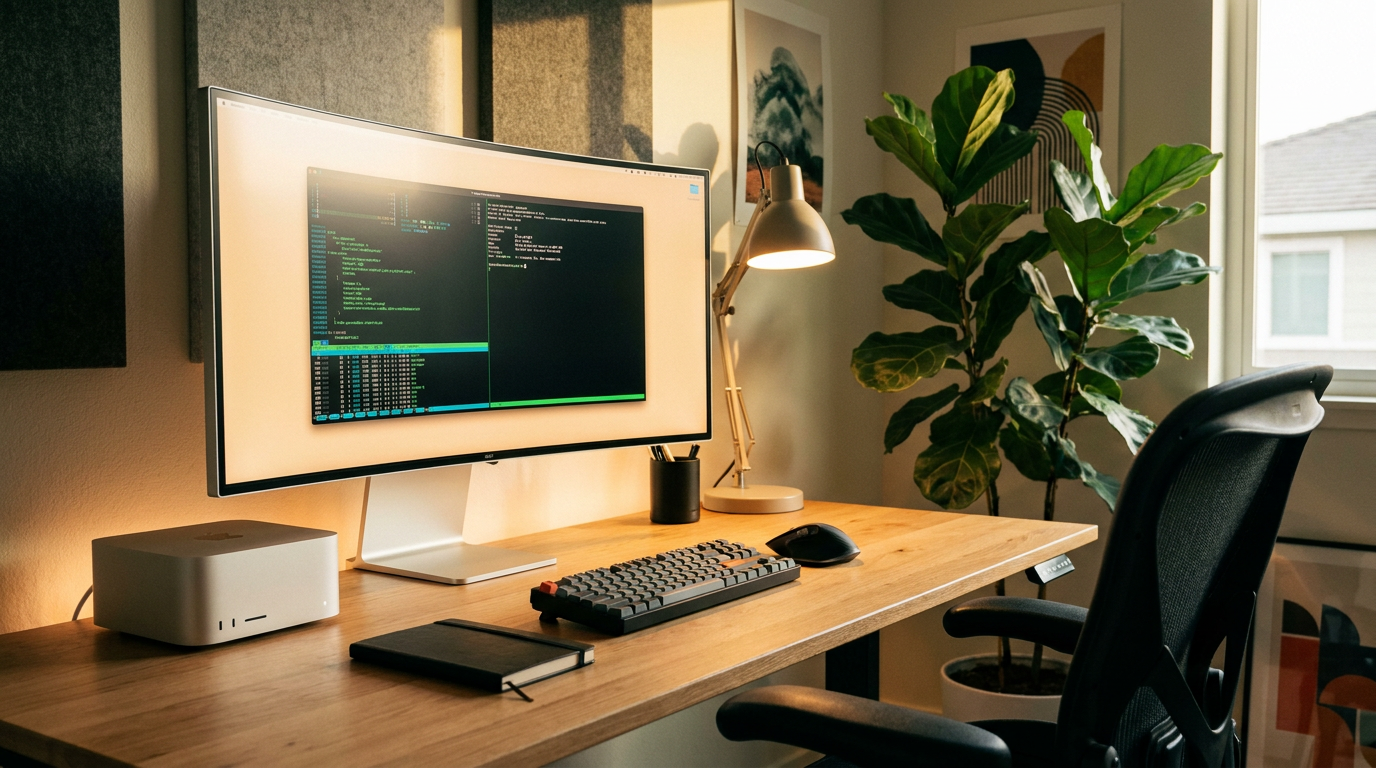
Because of this unified architecture, a high-end Mac Studio or MacBook Pro with 64 to 128 gigabytes of memory can comfortably run massive 70-billion parameter models. Achieving the same feat on a traditional PC would require stringing together multiple high-end NVIDIA graphics cards, costing thousands of dollars more. This hardware reality has turned consumer Apple devices into highly coveted AI workstations for developers and researchers.[5][6]
Because of this unified architecture, a high-end Mac Studio or MacBook Pro with 64 to 128 gigabytes of memory can comfortably run massive 70-billion parameter models.
However, hardware alone did not spark the local AI boom; the missing piece was accessible software tooling. In the past, running a local model required compiling complex C++ repositories, managing Python dependencies, and troubleshooting driver errors. Today, the ecosystem has matured into a frictionless, plug-and-play experience. Two dominant platforms have emerged to make local AI accessible to everyone: Ollama and LM Studio.[4][5]

Ollama has become the de facto standard for developers and engineers. It is a lightweight, command-line tool that bundles model management, hardware acceleration, and an HTTP server into a single binary. With a single terminal command, users can download a model, and with another, they can start chatting. Crucially, Ollama exposes an OpenAI-compatible application programming interface, meaning any existing software designed to talk to ChatGPT can be instantly redirected to talk to the local offline model instead.[1][4][5]
For users who prefer a visual interface over the command line, LM Studio offers a highly polished desktop application. Available on Windows, macOS, and Linux, LM Studio provides a familiar chat interface alongside a built-in model browser. Users can search for models, filter by hardware compatibility, and download them with a single click. It handles all the complex quantization and graphics card settings automatically, making it the easiest entry point for non-technical users.[4][5]
Other tools like LocalAI take a more comprehensive approach, offering a composable stack that serves as a complete drop-in replacement for cloud APIs. These platforms can run not just text models, but also image generation, voice synthesis, and autonomous agents, all from a single local server. This modularity allows enterprise teams to build entirely self-hosted AI ecosystems without writing custom integration code.[4]

The models themselves have also closed the quality gap with their proprietary cloud counterparts. Open-weight models like Meta's Llama 3.3, Alibaba's Qwen 3.6, Google's Gemma 4, and DeepSeek V4 are freely available to download. These models routinely match or beat older cloud models on reasoning, coding, and writing benchmarks. Because the weights are open, the community can fine-tune them for highly specific tasks, creating specialized experts that run efficiently on consumer hardware.[1][5]
The magic that allows these massive models to fit onto laptops is a technique called quantization. Raw AI models require enormous amounts of memory, but quantization compresses the model's neural weights from 16-bit precision down to 4-bit precision. Using formats like GGUF, this compression dramatically reduces the memory footprint and increases generation speed, with only a negligible impact on the model's actual intelligence and output quality.[4][5]
Software frameworks are also evolving to squeeze every drop of performance out of local hardware. For example, Ollama recently integrated Apple's MLX framework, an open-source machine learning library designed specifically for Apple Silicon. By tapping directly into MLX, local models can achieve significantly faster time-to-first-token and higher generation speeds, making local AI feel just as responsive as querying a massive cloud server.[6]
Ultimately, the rise of local AI represents a fundamental shift in computing trust and architecture. The industry is moving toward a local-first model, where tasks like summarizing documents, writing code, and organizing private notes happen instantly on-device. The cloud is no longer the default first move; it is becoming an escalation path for only the most complex, compute-heavy tasks. By bringing intelligence offline, users are reclaiming their privacy, eliminating recurring costs, and fundamentally changing how they interact with machine learning.[2][7]
How we got here
Early 2023
Cloud-based AI dominates the landscape, with local execution largely restricted to researchers with specialized hardware.
Mid 2023
The release of llama.cpp enables efficient AI inference on standard consumer processors, sparking the local AI movement.
2024 - 2025
User-friendly tools like Ollama and LM Studio launch, abstracting away the technical complexity of running models offline.
2026
Enterprise adoption of on-premises AI inference reaches 55 percent, driven by privacy concerns and the release of highly capable open-weight models.
Viewpoints in depth
Decentralization Advocates
Focus on data sovereignty, open-source freedom, and eliminating reliance on massive tech conglomerates.
This camp argues that the true power of AI should not be consolidated in the hands of a few cloud providers. By running models locally, developers and users reclaim ownership of their data and infrastructure. They emphasize that open-weight models allow for unrestricted innovation, free from the censorship, rate limits, and arbitrary API pricing changes imposed by centralized platforms.
Enterprise Security Leaders
Prioritize regulatory compliance, intellectual property protection, and predictable infrastructure costs.
For enterprise IT and security professionals, local AI is primarily a risk mitigation strategy. Uploading proprietary code, patient health records, or unreleased financial data to a cloud API presents an unacceptable attack surface. This camp champions local deployment because it automatically satisfies strict data residency laws like GDPR and HIPAA, while also converting unpredictable operational expenses into predictable capital hardware purchases.
Hardware Ecosystem Analysts
Track the shifting economics of consumer computing and the rise of unified memory architectures.
Analysts in this space highlight how the demands of local AI are fundamentally reshaping the hardware market. They point to Apple's unified memory architecture as a massive competitive moat, allowing consumer laptops to perform inference tasks that previously required enterprise-grade server racks. This camp predicts that future consumer hardware will be increasingly optimized for local AI workloads, driving a new supercycle of PC and Mac upgrades.
What we don't know
- How cloud AI providers will adjust their pricing and enterprise strategies to combat the rapid rise of local, zero-cost inference.
- Whether future regulatory frameworks will mandate local-only processing for certain classes of highly sensitive consumer data.
- The exact timeline for when open-weight models will definitively surpass the reasoning capabilities of the largest proprietary cloud models.
Key terms
- Quantization
- A compression technique that reduces the precision of an AI model's neural weights, allowing massive models to run efficiently on consumer hardware with minimal loss in quality.
- Unified Memory
- A hardware architecture, notably used in Apple Silicon, where the CPU and GPU share the exact same pool of RAM, drastically speeding up AI processing.
- Inference
- The process of a trained machine learning model generating an output or prediction based on a user's prompt.
- Open-Weight Model
- An AI model where the underlying neural network weights are made publicly available, allowing anyone to download, run, and modify the model locally.
Frequently asked
Do I need an internet connection to use local AI?
No. Once you have downloaded the software and the model weights, the entire system runs completely offline without any network connection.
Can my current laptop run these models?
Most modern laptops with at least 8 gigabytes of RAM can run smaller, quantized models. For larger models, Apple Silicon Macs or PCs with dedicated NVIDIA graphics cards are recommended.
Are local models as smart as ChatGPT?
Open-weight models like Llama 3.3 and Qwen 3.6 are highly capable and routinely match or exceed the performance of GPT-3.5, though the absolute largest cloud models still hold an edge in highly complex reasoning.
Is it difficult to set up local AI?
Not anymore. Tools like LM Studio offer a simple desktop application with a graphical interface, allowing users to download and run models with just a few clicks, requiring zero coding knowledge.
Sources
Source coverage
7 outlets
3 viewpoints surfaced







[1]TechsyDecentralization Advocates
Run LLMs Locally 2026: The 5-Minute Setup for Any GPU
Read on Techsy →[2]MediumDecentralization Advocates
Why Offline AI Feels Different
Read on Medium →[3]Local AI MasterEnterprise Security Leaders
Is Local AI Private? (Privacy Benefits)
Read on Local AI Master →[4]DevToolReviewsDecentralization Advocates
Ollama vs LM Studio vs LocalAI: Best Local LLM Hosting 2026
Read on DevToolReviews →[5]ContaboEnterprise Security Leaders
Ollama vs LM Studio: Local LLM Runtime Comparison
Read on Contabo →[6]The New StackHardware Ecosystem Analysts
Ollama taps Apple's MLX framework to make local AI models faster on Macs
Read on The New Stack →[7]Factlen Editorial TeamHardware Ecosystem Analysts
Synthesis by Factlen editorial team
Read on Factlen Editorial Team →



Every angle. Every day.
Get ai stories with full source coverage and perspective breakdowns delivered to your inbox.