
SpaceX's IPO Triggers a Passive Investing Tug-of-War Over Index Inclusion
As the initial retail frenzy over SpaceX's IPO cools, a massive wave of mandatory institutional buying is set to strike. But major index providers are split on whether the aerospace giant should be granted fast-tracked entry.
By Factlen Editorial Team
- Passive Index Providers
- Indexes must adapt quickly to reflect the actual market, favoring 'fast entry' rules.
- Traditional Market Gatekeepers
- Strict seasoning and profitability requirements protect retail investors from IPO volatility.
- Active Market Strategists
- Index inclusion is an 'engineered demand event' that distorts price discovery.
What's not represented
- · Retail investors who bought at the IPO peak and face dilution
- · Active fund managers forced to benchmark against distorted indexes
Why this matters
Trillions of dollars in retirement accounts are tied to passive index funds. The rules deciding when a megacap company like SpaceX enters these indexes directly dictate what your 401(k) is forced to buy, and at what price.
Key points
- SpaceX's recent IPO has triggered a massive wave of mandatory buying from passive index funds.
- Nasdaq and FTSE Russell have enacted 'fast entry' rules, allowing SpaceX to join their indexes within weeks.
- S&P Dow Jones Indices refused to waive its rules, meaning SpaceX cannot join the S&P 500 for at least a year.
- The divergence highlights a debate between reflecting real-time market caps and protecting investors from IPO volatility.
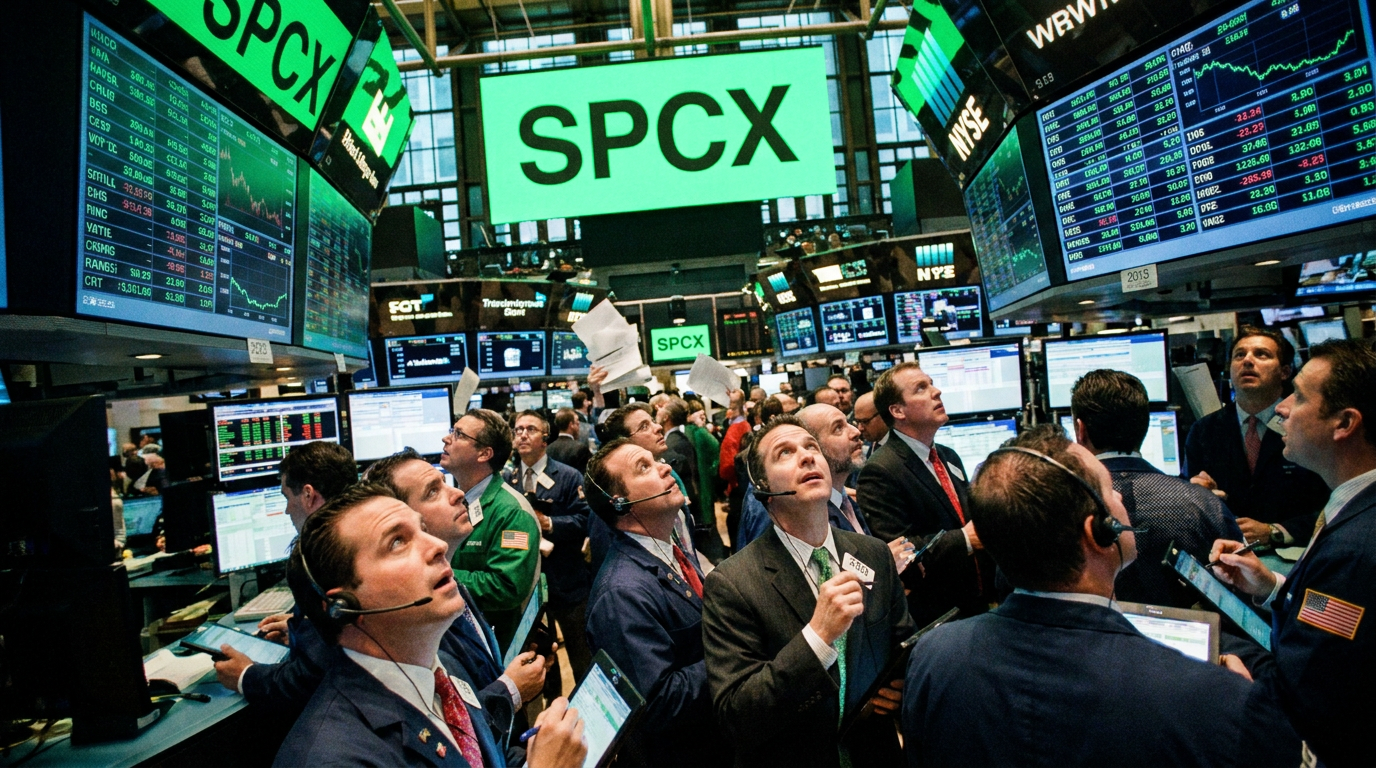
The June 12, 2026, initial public offering of SpaceX was a historic market event, characterized by intense retail fervor and massive trading volume across global exchanges. Shares surged an impressive 67% on their first day of trading before cooling to a more modest 33% premium over their $135 IPO price by the end of the week. But as the initial retail frenzy subsides and early speculators take their profits, the real story is shifting from individual day-traders to the looming, invisible wave of institutional cash. A massive, structural market event is about to unfold, driven not by human stock-pickers analyzing fundamentals, but by the rigid, automated rules of passive investing.[1]
In the coming days and weeks, SpaceX is expected to secure formal entry into several major stock indexes, a milestone that will unlock a new, mandatory source of investor demand. When a newly public company is added to a benchmark index, every passive mutual fund and exchange-traded fund (ETF) that tracks that specific index is legally obligated to buy the stock. These funds must purchase shares in exact proportion to the company's weight in the index to accurately reflect the new composition, regardless of whether the fund managers believe the stock is currently overvalued or undervalued.[1]
The sheer scale of this forced buying is staggering, reflecting the dominance of passive investing in modern financial markets. Combined, roughly $8.9 trillion worth of assets are held in passive funds benchmarked to major index providers like Nasdaq and MSCI. For a company of SpaceX's unprecedented size and market capitalization, index inclusion translates to tens of billions of dollars of automatic, price-insensitive buy orders hitting the market simultaneously, creating a tidal wave of liquidity that can dramatically alter the stock's short-term trajectory.[1][5]
Market strategists and financial analysts refer to this phenomenon as an 'engineered demand event.' Unlike active investing, where portfolio managers buy a stock because they believe its future cash flows are undervalued by the market, passive funds buy simply because the structural rules of their prospectus dictate they must. This dynamic can temporarily detach a stock's price from its underlying business fundamentals, as the sheer volume of mandated buying overwhelms normal price discovery and creates a self-fulfilling cycle of upward momentum.[1][5]

Historically, newly public companies had to wait months, or even years, before they were eligible to join the most prestigious market benchmarks. Index providers traditionally required a strict 'seasoning period' to ensure the stock's price had stabilized, early insider lock-up periods had expired, and the company had proven its viability in the unforgiving public markets. But the sheer scale of modern megacap IPOs—where companies debut with valuations rivaling established blue-chip corporations—has forced the financial industry to fundamentally rethink its gatekeeping mechanisms.[5]
Enter the controversial 'fast entry' rule. Recognizing that leaving a massive, highly influential company out of an index makes the benchmark less representative of the actual economy, several prominent index providers have rapidly amended their policies. FTSE Russell, for example, has adjusted its methodology to allow massive newly public companies to bypass traditional waiting periods and join its ranks in a matter of days, ensuring their indexes accurately reflect the real-time composition of the equity market without suffering from tracking errors against the broader economy.[2][4]
Under these accelerated rules, SpaceX is slated to be added to the widely followed Russell 1000 Index as part of its annual June reconstitution, which is set to take effect on June 26. This means that next Friday, every passive fund tracking the Russell 1000 will execute massive block buy orders for SpaceX stock, regardless of its trading price at that exact moment. This impending deadline has created a front-running dynamic, where active traders attempt to buy shares ahead of the guaranteed institutional inflows.[1][4]
This impending deadline has created a front-running dynamic, where active traders attempt to buy shares ahead of the guaranteed institutional inflows.
Nasdaq has led a similar rush to accommodate the aerospace giant and keep its benchmarks relevant. The exchange enacted a fast-entry rule that allows megacap firms to join the popular Nasdaq 100 index just 15 trading days after their initial public offering. This rapid inclusion ensures that flagship investment vehicles, such as the massive Invesco QQQ ETF, will soon be forced to allocate substantial capital to SpaceX, instantly exposing millions of everyday retirement accounts to the company's future performance.[1][2]
However, the biggest prize in the passive investing ecosystem—the S&P 500—has taken a starkly different path. The S&P 500 is the undisputed bedrock of American retirement portfolios, tracked by trillions of dollars in passive capital and serving as the primary barometer for the U.S. stock market. Its operator, S&P Dow Jones Indices, recently conducted a highly publicized review to determine whether it should exempt newly public megacap tech companies from its strict historical entry requirements in order to capture their early growth phases.[2][3]
In a surprising development that caught many Wall Street market watchers off guard, S&P Dow Jones Indices decided to firmly stand its ground. The index provider announced late Thursday that there would be no changes to its existing methodology for the index family, effectively denying SpaceX early entry into the benchmark. Despite intense pressure from institutional clients who want exposure to the aerospace sector, the committee opted to prioritize the long-term stability of the index over immediate market representation.[2][3]

The S&P 500's methodology is notoriously stringent by design. To be eligible for inclusion, a company must be publicly traded for at least one full year—a strict seasoning requirement designed to protect passive investors from the wild price swings that often characterize post-IPO trading. Furthermore, the company must report four consecutive quarters of positive GAAP profitability, a high financial hurdle that has historically kept high-growth, capital-intensive technology firms out of the index for years while they prioritize expansion over net income.[3][5]
This rigid stance creates a fascinating divergence in the passive investing landscape. While Russell and Nasdaq funds will be forced to buy SpaceX at its current lofty valuation in the coming days, S&P 500 funds will sit entirely on the sidelines until at least the summer of 2027. This split highlights a growing philosophical divide among index providers regarding their primary duty: whether they exist to perfectly mirror the current market capitalization of all equities, or to act as a curated filter for financial quality.[5]
The S&P's decision serves as a vital protective measure for its passive investors. SpaceX's valuation remains sky-high, and the company recently announced a massive $60 billion equity issue to acquire the artificial-intelligence coding firm Cursor. By enforcing its strict seasoning and profitability rules, the S&P 500 shields everyday retail investors and pension funds from the immediate risks associated with such aggressive corporate maneuvers, massive dilution events, and the inherent volatility of a newly public stock finding its true market clearing price.[1][2]

However, this institutional caution comes with a significant financial trade-off. If SpaceX's stock continues to soar over the next twelve months, S&P 500 investors will entirely miss out on those early, explosive gains. This scenario closely echoes the delayed inclusion of Tesla, where S&P 500 funds missed out on years of meteoric growth because the electric automaker did not meet the index's strict profitability requirements until very late in its initial growth cycle, forcing passive funds to eventually buy in at much higher prices.[2][5]
Ultimately, the battle over SpaceX's index inclusion highlights a deep structural tension in modern finance. Index providers are increasingly caught between the need to accurately reflect the real-time market and the responsibility to enforce quality controls for trillions of dollars in passive capital. As the 'new wave of cash' strikes the market next week via the Russell and Nasdaq rebalancing, investors will witness firsthand exactly how much power these automated, passive flows wield over the modern stock market, and whether the S&P's cautious approach will be vindicated or viewed as a missed opportunity.[1][5]
How we got here
June 12, 2026
SpaceX goes public on the Nasdaq at $135 per share.
June 17, 2026
Nasdaq and FTSE Russell confirm 'fast entry' eligibility for SpaceX.
June 18, 2026
S&P Dow Jones Indices announces it will not waive its 1-year seasoning rule for SpaceX.
June 26, 2026
SpaceX is scheduled to officially join the Russell 1000 index.
Viewpoints in depth
Passive Index Providers
Indexes must adapt quickly to reflect the actual market, favoring 'fast entry' rules.
Providers like Nasdaq and FTSE Russell argue that their indexes exist to accurately represent the current equity landscape. When a megacap company like SpaceX goes public, leaving it out of the index for months makes the benchmark less representative of the real economy. By implementing 'fast entry' rules, they ensure that passive investors gain immediate exposure to the market's newest heavyweights, preventing tracking errors against the broader market.
Traditional Market Gatekeepers
Strict seasoning and profitability requirements protect retail investors from IPO volatility.
S&P Dow Jones Indices maintains that its benchmarks are not just mirrors of market capitalization, but markers of financial stability. By enforcing a one-year seasoning period and requiring four consecutive quarters of GAAP profitability, the S&P 500 shields its trillions of dollars in passive capital from the wild price swings and unproven business models that often plague newly public companies. They view delayed entry as a necessary consumer protection.
Active Market Strategists
Index inclusion is an 'engineered demand event' that distorts price discovery.
Market strategists point out that forced buying by passive funds fundamentally breaks the mechanism of price discovery. When trillions of dollars are mandated to buy a stock simply because it was added to a list, the stock's price detaches from its underlying fundamentals. This dynamic can artificially inflate the valuations of megacap IPOs, creating a feedback loop where higher prices trigger even more passive allocation.
What we don't know
- How much of SpaceX's current stock premium is driven by front-running the expected index inclusion flows.
- Whether SpaceX will achieve the four consecutive quarters of GAAP profitability required for eventual S&P 500 inclusion.
- How the newly issued $60 billion in equity for the Cursor acquisition will impact the stock's float-adjusted weighting.
Key terms
- Passive Investing
- An investment strategy that tracks a market-weighted index or portfolio rather than relying on a fund manager to pick individual stocks.
- Seasoning Requirement
- A rule by index providers requiring a newly public company to trade for a minimum period (often 6 to 12 months) before it is eligible for index inclusion.
- Float-Adjusted Market Capitalization
- A measure of a company's size calculated by multiplying its stock price by the number of shares actually available for public trading, excluding locked-in shares.
- Engineered Demand Event
- A surge in buying pressure caused by structural market rules—such as index inclusion—rather than fundamental changes in a company's value.
Frequently asked
What is an index inclusion event?
It occurs when a stock is added to a major market index, forcing passive mutual funds and ETFs that track that index to automatically buy the stock.
Why isn't SpaceX joining the S&P 500 immediately?
S&P Dow Jones Indices requires companies to be publicly traded for at least one year and demonstrate four consecutive quarters of GAAP profitability before inclusion.
When will SpaceX join the Russell 1000?
SpaceX is scheduled to be added to the Russell 1000 index during its June reconstitution, taking effect on June 26, 2026.
Sources
Source coverage
5 outlets
3 viewpoints surfaced





[1]MarketWatchActive Market Strategists
The initial SpaceX frenzy is cooling off — but a new wave of cash is waiting to strike
Read on MarketWatch →[2]MorningstarTraditional Market Gatekeepers
In 'wild' twist, SpaceX won't be allowed early entry to the S&P 500 after all
Read on Morningstar →[3]S&P Dow Jones IndicesTraditional Market Gatekeepers
S&P U.S. Indices Methodology
Read on S&P Dow Jones Indices →[4]FTSE RussellPassive Index Providers
Russell U.S. Equity Indices Construction and Methodology
Read on FTSE Russell →[5]Factlen Editorial TeamActive Market Strategists
Synthesis by Factlen editorial team
Read on Factlen Editorial Team →



Every angle. Every day.
Get finance stories with full source coverage and perspective breakdowns delivered to your inbox.