
OLED vs. Mini-LED in 2026: The Complete TV Buying Guide
As Mini-LED panels hit 10,000 nits and Tandem OLEDs virtually eliminate burn-in, the traditional TV hierarchy has collapsed into a choice between two distinct flagship technologies.
By Factlen Editorial Team
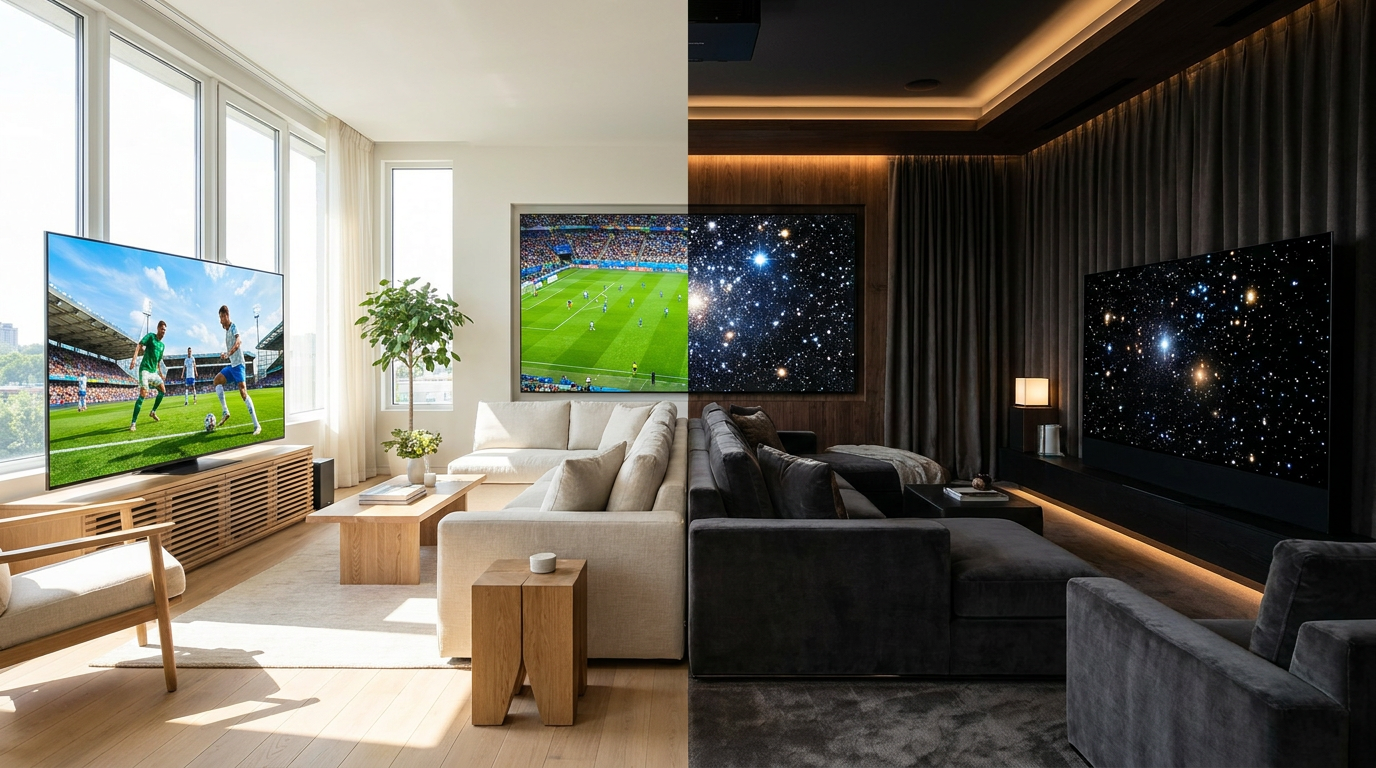
- Dark-Room Cinematic Purists
- Advocates for absolute picture precision, infinite contrast, and perfect black levels.
- Bright-Room & HDR Enthusiasts
- Advocates for massive sustained brightness, zero burn-in anxiety, and daylight usability.
- Hybrid Productivity Users
- Professionals who prioritize static-image safety and text clarity for mixed computer and entertainment use.
What's not represented
- · Budget-conscious consumers priced out of both flagship technologies.
- · Environmental advocates concerned about the massive power consumption of 10,000-nit displays.
Why this matters
Consumers dropping thousands of dollars on a flagship television in 2026 are no longer choosing between 'premium' and 'budget'—they are choosing between two radically different engineering paths that will either perfectly match or completely clash with their living room lighting.
Key points
- The 2026 TV market is no longer divided by budget, but by two flagship technologies: OLED and Mini-LED.
- Tandem OLED panels now reach 4,500 nits, significantly closing the brightness gap while minimizing burn-in risk.
- Flagship Mini-LEDs boast up to 20,000 local dimming zones and can hit 10,000 nits of peak brightness.
- OLED remains the definitive choice for dark rooms, wide seating angles, and competitive esports.
- Mini-LED is the undisputed king of sunlit rooms, marathon static-HUD gaming, and massive screen sizes.
For years, the television buying advice was simple: if you had the budget, you bought an OLED, and if you wanted to save money, you settled for an LCD. In 2026, that conventional wisdom is entirely obsolete. The television market has bifurcated into two distinct flagship engineering paths, each designed to conquer a specific physical environment. Consumers are no longer choosing between a premium tier and a budget tier; they are choosing between organic self-emissive pixels and inorganic gallium-nitride light cannons.[4][6]
To understand the trade-offs, one must first understand the atomic architectures at play. OLED, or Organic Light-Emitting Diode technology, relies on carbon-based molecules that generate their own light. When a scene calls for absolute black, the television's processor cuts the voltage to that specific pixel down to zero. The pixel turns off completely, emitting exactly zero nits of light. This capability yields a mathematically infinite contrast ratio, ensuring dark cinematic scenes maintain rich depth without any distracting background haze.[4]
However, OLED technology has historically faced a thermal wall. Because organic material degrades rapidly when subjected to sustained high voltage and heat, self-emissive panels utilize a hardcoded safety protocol called the Auto Brightness Limiter. If a bright scene—like a hockey game or a snow-covered landscape—stays on the screen too long, the television aggressively dims the entire panel to protect the pixels from burning out.[4][6]
In 2026, OLED manufacturers have pushed back against this limitation with Tandem OLED architecture. By stacking multiple layers of red, green, and blue organic materials, companies like LG Display and Samsung Display have dramatically increased efficiency. The latest 2026 Tandem OLED panels can now hit a staggering 4,500 nits of peak brightness in small highlight windows, closing the historical gap with traditional LED technology while significantly reducing the risk of permanent burn-in.[2][3]

On the other side of the showroom sits Mini-LED, the ultimate evolution of traditional liquid crystal displays. Instead of organic pixels making their own light, Mini-LED uses a massive backlight matrix of thousands of tiny, inorganic blue diodes. These diodes shoot light through a quantum-dot enhancement film to create pure colors, which then pass through an LCD matrix that shapes the fine details of the image.[4]
The engineering leap for Mini-LED in 2026 is the sheer volume of local dimming zones. Flagship models from brands like TCL and Hisense now feature upwards of 20,000 individually controlled zones. By dynamically turning off specific clusters of backlights behind dark sections of the screen, modern Mini-LEDs can mimic the deep blacks of OLED while utilizing the incredible power of traditional semiconductor illumination.[4][5]
This inorganic architecture allows Mini-LED to achieve terrifying levels of brightness. With new 2026 models pushing highlight details to 6,000 nits, and some flagship panels advertised to hit up to 10,000 nits, industry analysts have declared that the traditional 'brightness wars' are effectively over. These televisions can hold a full-field white screen at maximum output indefinitely, completely immune to the dimming algorithms that throttle OLEDs.[1][5]
This inorganic architecture allows Mini-LED to achieve terrifying levels of brightness.
When conducting a side-by-side trade-off analysis, the arguments for each technology become sharply defined. For OLED, the primary argument is absolute precision. The evidence for this rests in its 0.03-millisecond pixel response time and infinite contrast. Because each pixel operates independently, there is zero light bleed or 'blooming' around bright objects on dark backgrounds. For competitive esports players and home theater purists, this perfect motion clarity and shadow detail create an unmatched, reference-grade experience.[4][6]

Against OLED, the primary argument is environmental fragility. The evidence shows that despite the massive leaps in Tandem OLED brightness, these panels still struggle with sustained full-screen luminance in sun-drenched rooms. Furthermore, while burn-in risk is vastly reduced in 2026, it is not entirely eliminated. Marathon gamers who leave static heads-up displays or health bars on the screen for thousands of hours are still subjecting the organic carbon to differential aging.[4][6]
For Mini-LED, the argument centers on brute-force versatility and longevity. The evidence for this is found in its sustained high-nit HDR impact and zero burn-in risk. A Mini-LED television can sit directly opposite a massive bay window in a bright living room and effortlessly punch through the afternoon glare. Users can leave static news tickers, spreadsheets, or video game maps on the screen for days without a single worry about permanent image retention.[1][4]
Against Mini-LED, the primary drawback is optical compromise. The evidence points to the physical limitations of local dimming zones. Even with 20,000 zones, a single zone still illuminates thousands of pixels at once. When a bright white subtitle appears over a pitch-black movie scene, a faint halo of light—known as blooming—can still be visible, particularly if the viewer is sitting at an off-axis angle rather than dead center.[4][6]
Pricing realities have also shifted the calculation. In previous years, buyers willing to compromise on perfect blacks could save thousands by opting for an LCD. Today, the engineering required to synchronize 20,000 microscopic backlight zones and quantum-dot filters is immensely expensive. A flagship 2026 Mini-LED costs just as much as a flagship Tandem OLED, meaning the purchase decision must be based entirely on the physical environment rather than the budget.[6]

Ultimately, the decision comes down to matching the engineering to the room. OLED fits well when the primary viewing space is a light-controlled basement, a dedicated home theater, or a dark bedroom. It is the undisputed choice for viewers who prioritize cinematic shadow detail, wide seating arrangements where people sit at sharp angles, and competitive gaming where motion blur means the difference between winning and losing.[4][6]
Conversely, OLED does not fit well when the television is placed in a bright, open-plan family room with uncovered windows. It is also the wrong choice for users whose daily workflow includes hours of static web browsers, code editors, or marathon sessions of the exact same video game, as the Auto Brightness Limiter will constantly intervene to protect the panel.[4][6]
Mini-LED fits well when the living space features heavy ambient light and the user demands high-impact HDR highlights that actually feel like the sun is shining into the room. It is the ideal technology for massive 85-inch to 100-inch cinematic screens, sports fans who want vibrant turf colors without dimming, and households where the television is left on all day as background noise.[1][4]

However, Mini-LED does not fit well when the primary use case is pitch-black movie watching by a videophile who demands perfect pixel-level clarity. If the slight grayish haze around a starfield in a sci-fi movie will distract the viewer, the brute force of a Mini-LED backlight will never satisfy them the way an organic pixel can.[4][6]
How we got here
2013
LG releases the first commercially viable large-format OLED TVs, establishing self-emissive pixels as the premium standard.
2019
Mini-LED technology enters the consumer market, using thousands of tiny diodes to vastly improve LCD local dimming.
2024
OLED panels hit a thermal wall around 1,500 nits, while Mini-LEDs begin pushing past 3,000 nits.
January 2026
Panel manufacturers unveil Tandem OLEDs hitting 4,500 nits and Mini-LEDs reaching 10,000 nits, ending the traditional brightness wars.
Viewpoints in depth
Dark-Room Cinematic Purists
Advocates for absolute picture precision and perfect black levels.
This camp argues that raw brightness is a secondary metric compared to infinite contrast. They point out that in a properly light-controlled room, a 10,000-nit highlight is actually painful to look at, whereas the perfect black levels of an OLED create a sense of three-dimensional depth that LCDs cannot replicate. For these purists, the complete absence of blooming and the 0.03ms pixel response time make OLED the only acceptable choice for reference-grade film viewing and competitive gaming.
Bright-Room & HDR Enthusiasts
Advocates for massive sustained brightness and zero burn-in anxiety.
This perspective contends that most people do not watch television in pitch-black caves. They argue that Mini-LED is the superior real-world technology because it can overpower afternoon sunlight and deliver the massive, blinding HDR highlights that content creators increasingly use. Furthermore, they value the psychological freedom of zero burn-in risk, allowing them to leave sports scores, news tickers, or video game HUDs on the screen indefinitely without damaging a multi-thousand-dollar investment.
Hybrid Productivity Users
Professionals using large screens for both entertainment and daily computer work.
This growing segment uses 42-inch to 55-inch televisions as massive desktop monitors. They prioritize text clarity, static-image safety, and sustained full-screen brightness. While they appreciate OLED's motion handling, they often lean toward Mini-LED because OLED's Auto Brightness Limiter aggressively dims the screen when displaying large white windows, such as spreadsheets or word processors, creating friction in daily workflows.
What we don't know
- How the long-term degradation curve of 2026 Tandem OLED panels will compare to traditional single-layer OLEDs after 10,000 hours of use.
- Whether upcoming micro-LED technologies will eventually merge the benefits of both panels into a single, affordable consumer product.
- How aggressively content creators will master films for the new 10,000-nit ceiling now available on consumer displays.
Key terms
- Auto Brightness Limiter (ABL)
- A safety protocol in OLED TVs that automatically dims the screen during bright scenes to prevent the organic pixels from overheating.
- Blooming
- A visual artifact on Mini-LED TVs where a faint halo of light bleeds into the dark areas surrounding a bright object.
- Local Dimming Zones
- Specific clusters of backlights in a Mini-LED TV that can turn off independently to create deeper black levels in dark scenes.
- Tandem OLED
- A new panel architecture that stacks multiple layers of organic light-emitting materials to increase brightness and lifespan.
- Nits
- A standard unit of measurement for the brightness of a display, representing one candela per square meter.
Frequently asked
Does OLED still suffer from burn-in in 2026?
While the risk is vastly reduced thanks to Tandem architecture and improved heat dissipation, it is not entirely eliminated. Leaving static elements like news tickers or game HUDs on screen for thousands of hours can still cause uneven pixel wear.
Which TV is better for a bright living room?
Mini-LED is the clear winner for bright rooms. Its inorganic backlight can sustain massive full-screen brightness indefinitely, easily cutting through heavy daytime glare without triggering any dimming algorithms.
Why is OLED better for competitive gaming?
OLED pixels can change state in roughly 0.03 milliseconds, which is significantly faster than the liquid crystals in a Mini-LED. This near-instant response time eliminates motion blur and ghosting during fast-paced gameplay.
Are Mini-LED TVs cheaper than OLEDs?
Not anymore at the high end. While budget Mini-LEDs exist, flagship models with 20,000+ dimming zones and advanced processors cost just as much as premium OLEDs.
Sources
Source coverage
6 outlets
3 viewpoints surfaced






[1]RTINGSDark-Room Cinematic Purists
The LED Brightness Wars Are Over
Read on RTINGS →[2]FlatpanelsHDHybrid Productivity Users
2026 OLED TV panel hits 4500 nits with fewer reflections
Read on FlatpanelsHD →[3]TFTCentralHybrid Productivity Users
OLED TV Panels to Reach 4500 nits Peak Brightness in 2026
Read on TFTCentral →[4]TechStoryDark-Room Cinematic Purists
A deep structural analysis of OLED vs Mini LED display technology
Read on TechStory →[5]HomecruxBright-Room & HDR Enthusiasts
TCL's New C8L SQD-Mini LED TV Reaches 6,000 Nits Brightness
Read on Homecrux →[6]Data Wire SolutionsBright-Room & HDR Enthusiasts
Best TVs for 2026: 10 OLED and Mini-LED Picks
Read on Data Wire Solutions →
More in shopping
See all 7 stories →E-Bike Tech
The 2026 E-Bike Buying Guide: Motors, Classes, and the Safety Specs You Can't Ignore
7 sources

EV Tech
The 2026 Electric Motorcycle Buyer's Guide: Range, Charging, and the Solid-State Shift
7 sources
TV Tech
OLED vs. Mini-LED TVs in 2026: The Complete Technology Comparison
7 sources
Summer Sales
Amazon Shifts Prime Day to June, Triggering Massive Summer Retail Showdown
6 sources
Every angle. Every day.
Get shopping stories with full source coverage and perspective breakdowns delivered to your inbox.