
Apple Unveils iOS 27 with Rebuilt 'Siri AI' and Deep App Integrations at WWDC 2026
Apple's latest operating system update introduces a profoundly smarter Siri and embeds practical artificial intelligence across everyday apps like Safari, Photos, and Passwords.
By Factlen Editorial Team
- Everyday iPhone Users
- Value seamless, practical automation that works out-of-the-box without requiring prompt engineering.
- AI Industry Analysts
- View Apple's multi-model orchestration and Gemini integration as a pragmatic strategy to remain competitive.
- Privacy Advocates
- Emphasize the importance of Apple's on-device processing and Private Cloud Compute to protect deeply indexed personal data.
What's not represented
- · Android Competitors
- · Third-Party App Developers
Why this matters
For the 1.5 billion active iPhone users, iOS 27 represents the first time generative AI will be seamlessly integrated into their daily routines, automating tedious tasks like organizing tabs, fixing passwords, and finding specific photos without requiring a separate app.
Key points
- Apple unveiled iOS 27 and a completely rebuilt Siri AI at WWDC 2026.
- Siri can now execute multi-step tasks across different apps and understands on-screen context.
- A secure on-device index allows Siri to answer highly specific questions based on personal emails, messages, and photos.
- Apple is integrating Google Gemini to handle complex queries requiring broad world knowledge.
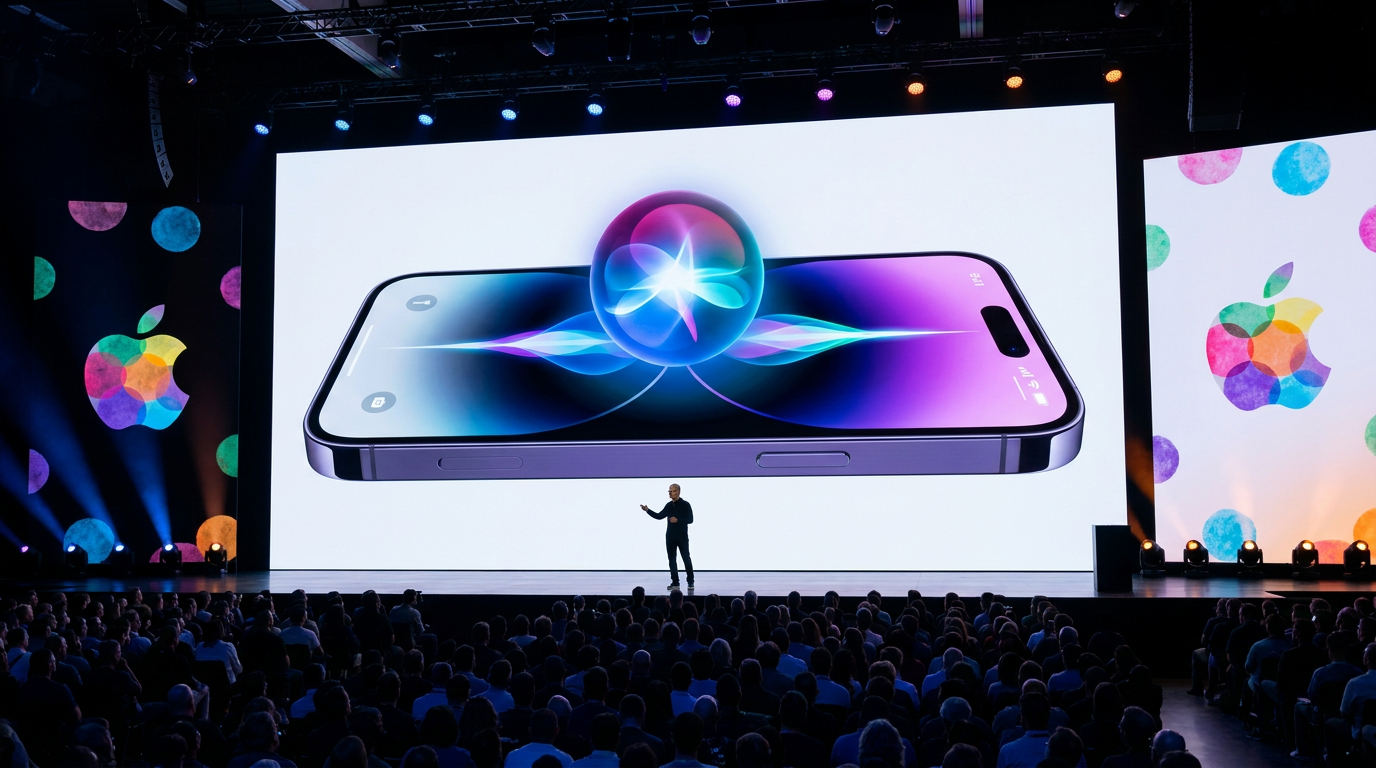
Apple has officially entered its next era of artificial intelligence, unveiling iOS 27 and a completely rebuilt 'Siri AI' at its 2026 Worldwide Developers Conference. Rather than simply launching a standalone chatbot to compete with the likes of ChatGPT, the company is embedding generative AI deeply into the iPhone's core applications. The focus of this massive software update is practical automation and personal context, aiming to eliminate the friction of everyday digital chores. By weaving intelligent capabilities directly into tools users already rely on—like Safari, Photos, and Mail—Apple is signaling that the future of mobile AI is not about chatting with a bot, but about a phone that seamlessly anticipates and executes its owner's needs.[1][2]
The centerpiece of the WWDC 2026 announcement is Siri AI, which Apple executives described on stage as a 'profoundly more intelligent, knowledgeable, and capable' digital assistant. Visually, the familiar glowing orb at the bottom of the screen has been retired. In its place, Siri now manifests as a translucent, edge-to-edge screen animation that pulses to indicate when the assistant is actively listening or processing information. This redesign is more than cosmetic; it represents a fundamental architectural shift. Siri has been rebuilt from the ground up to maintain conversational context over multiple turns, allowing users to speak naturally, correct themselves mid-sentence, and ask follow-up questions without having to repeat the initial premise of their request.[2][6]
For the first time since its inception, Siri features true on-screen awareness, bridging the gap between voice commands and visual context. Users can now ask the assistant to take action based on exactly what they are looking at. For instance, a user can say 'send this to my brother' while reading a recipe in Safari, and Siri will automatically identify the web page content, locate the correct contact in Messages, and draft the share sheet without requiring the user to manually copy links or switch apps. This spatial understanding extends across the operating system, allowing the AI to 'see' the user's current workflow and assist accordingly.[6][7]
The assistant's most significant functional leap is its new ability to handle multi-step task execution. Siri AI can now autonomously chain together up to eight distinct actions across different applications to complete a single, complex natural-language request. For example, a user can ask Siri to find a specific flight confirmation buried in their email, calculate the real-time travel distance to the airport using Maps, and automatically text their estimated time of arrival to a partner the moment they leave work. This level of cross-app orchestration transforms Siri from a simple voice-to-text transcription tool into a genuine digital agent capable of executing multi-stage workflows.[2][6]

To achieve this highly tailored level of assistance, iOS 27 introduces a secure, on-device indexing system that comprehensively scans a user's messages, emails, calendar events, and photo library. This 'personal context' engine allows Siri to answer highly specific, life-oriented questions that a general web chatbot could never address. A user can ask, 'What was the name of the restaurant Sarah recommended last month?' or 'Pull up the photos from my sister's graduation,' and Siri will instantly retrieve the exact information. Apple has engineered this index to reside permanently on the user's hardware, ensuring that deeply personal data is not harvested to train external AI models.[4][7]
This 'personal context' engine allows Siri to answer highly specific, life-oriented questions that a general web chatbot could never address.
When Siri encounters a query that requires broader world knowledge, complex coding assistance, or advanced reasoning outside its personal context domain, Apple is taking a pragmatic approach: multi-model orchestration. iOS 27 features direct, native integration with Google's Gemini models. If a user asks a question that Siri cannot confidently answer on-device, the system will prompt the user for permission to seamlessly route the request to Gemini. This partnership allows Apple to offer best-in-class general artificial intelligence without having to build a monolithic, all-knowing model from scratch, ensuring users get the right tool for the specific job at hand.[3][5]
Beyond voice commands, Apple Intelligence is quietly upgrading the iPhone's built-in utilities to be more agentic. The Passwords app, for example, can now automatically navigate websites on the user's behalf to update weak or compromised credentials with a single tap, entirely bypassing the tedious manual reset process. Meanwhile, Safari gains the ability to automatically group browser tabs by topic and generate custom browser extensions based purely on natural language descriptions. Even the Mail and Messages apps are receiving contextual upgrades, offering smart replies that mimic the user's personal writing style and proactively suggesting calendar events based on chat history.[1][4]
The Photos app is receiving a major overhaul powered by these new on-device models, headlined by a feature called 'Spatial Reframing.' This tool allows users to adjust the composition, depth, and perspective of an image long after it has been captured, using AI to intelligently fill in missing background details. Additionally, Apple is introducing a new Siri camera mode that provides real-time visual intelligence. By simply pointing the iPhone's camera at their surroundings, users can instantly identify foreign objects, translate physical text, pull up nutritional information for a plated meal, or learn the history of a landmark.[3][5]

To make the AI experience more cohesive across the broader Apple ecosystem, the company is introducing a dedicated Siri application. This provides a text-based interface similar to popular chatbots, allowing users to type queries silently in public spaces and maintain a continuous, scrollable conversation history. Crucially, this history syncs securely via iCloud across the user's iPhone, iPad, and Mac. A user can begin brainstorming a project with Siri on their phone during a commute, pick up the exact same thread on their iPad at a coffee shop, and finalize the work on their Mac at the office.[4][5]
Throughout the WWDC presentation, Apple executives repeatedly emphasized that privacy remains the foundational pillar of their AI strategy. The vast majority of Siri's new capabilities run entirely on-device, utilizing the upgraded Neural Engine found in modern Apple Silicon. For tasks that genuinely require more compute power than a smartphone can provide, Apple relies on its 'Private Cloud Compute' infrastructure. This system processes complex requests on secure Apple servers using cryptographic protocols that ensure user data is never stored, logged, or made accessible to Apple employees.[2][7]
The iOS 27 update also includes a host of quality-of-life improvements that extend beyond artificial intelligence. Users can expect up to 30 percent faster app launch speeds and significantly smoother system animations. A new 'Liquid Glass' visual slider in the settings menu allows for deep customization of interface transparency. Furthermore, Apple is expanding its child safety features, introducing intuitive tools that automatically enable age-appropriate system safeguards and content restrictions the moment a dedicated child account is created on the device.[5]
Developers can begin testing the new Siri AI and Apple Intelligence features immediately through the iOS 27 developer beta program. The full public release is scheduled for this fall, bringing these practical AI tools to hundreds of millions of compatible devices worldwide. While the most advanced features will require newer hardware like the iPhone 16 Pro to handle the intensive on-device processing, the update signals a definitive shift in how consumers will interact with their smartphones for the next decade.[2][6]
How we got here
June 2024
Apple introduces the first generation of Apple Intelligence with iOS 18.
September 2025
iOS 19 expands basic AI features but leaves users wanting deeper conversational capabilities.
June 8, 2026
Apple unveils iOS 27 and the completely rebuilt Siri AI at WWDC 2026.
Fall 2026
iOS 27 is scheduled for public release alongside the next generation of iPhones.
Viewpoints in depth
Everyday iPhone Users
Consumers value seamless, practical automation that works out-of-the-box without requiring prompt engineering.
For the average smartphone user, the appeal of iOS 27 lies in its invisibility. Rather than forcing users to learn how to write complex prompts for a standalone chatbot, Apple is bringing the AI directly to the tasks they already do. Features like automatic password fixing, smart photo reframing, and contextual message suggestions remove daily friction. This camp views the update as a massive success because it makes the device genuinely more helpful without altering the fundamental way they interact with their phone.
Privacy Advocates
Security experts emphasize the importance of Apple's on-device processing to protect deeply indexed personal data.
While impressed by Siri's new capabilities, privacy advocates are closely watching the implications of Apple's on-device semantic index. Because Siri now scans and understands the context of personal emails, text messages, and photos, the device holds a highly sensitive map of the user's life. However, this camp generally praises Apple's architectural choices—specifically keeping the index strictly on the local hardware and utilizing Private Cloud Compute for complex queries—as the most responsible approach to generative AI currently available in the consumer market.
AI Industry Analysts
Tech analysts view Apple's multi-model orchestration as a pragmatic strategy to remain competitive.
Industry watchers note that Apple's decision to integrate Google Gemini for broad world knowledge is a shrewd admission of its own limitations. Rather than spending billions to build a monolithic model that might still hallucinate or lag behind competitors, Apple is positioning itself as the ultimate orchestrator. By owning the user interface and the personal context, Apple can route queries to whichever third-party model is currently the best in class, maintaining its ecosystem dominance while letting others fight the expensive foundational model war.
What we don't know
- It remains unclear exactly which older iPhone models will support the full suite of Apple Intelligence features, beyond the confirmed iPhone 16 Pro requirement.
- Apple has not detailed the exact financial terms or data-sharing specifics of its Gemini integration partnership with Google.
Key terms
- Apple Intelligence
- Apple's overarching suite of artificial intelligence features integrated deeply across its operating systems.
- On-Device Processing
- Running AI models directly on the phone's hardware rather than sending data to external cloud servers, ensuring better privacy and lower latency.
- Private Cloud Compute
- Apple's secure server infrastructure designed to handle complex AI requests without storing or exposing user data.
- Spatial Reframing
- A new photo editing tool that uses AI to let users change the composition and perspective of an image after it was captured.
- Orchestration
- A software strategy where a system automatically routes different tasks to the most capable AI model, such as sending personal tasks to Siri and general questions to Gemini.
Frequently asked
Which iPhones will support the new Siri AI?
The most advanced Apple Intelligence features will require an iPhone 16 Pro or newer, as they rely on the advanced Neural Engine for intensive on-device processing.
Is Apple replacing Siri with ChatGPT or Gemini?
No. Apple has rebuilt Siri to handle personal tasks and device control, but Siri can seamlessly route complex world-knowledge questions to Google Gemini if the user grants permission.
When will iOS 27 be available to the public?
The software is currently in developer beta and will be released to the general public this fall, likely alongside the new iPhone hardware lineup.
Does Siri read my personal messages?
Siri indexes your messages, emails, and photos locally on your device to understand personal context, but Apple states this data is processed securely and is never used to train broader AI models.
Sources
Source coverage
7 outlets
3 viewpoints surfaced







[1]TechCrunchEveryday iPhone Users
Beyond Siri: Here are the practical AI features coming to your iPhone in iOS 27
Read on TechCrunch →[2]Apple NewsroomPrivacy Advocates
Apple introduces Siri AI, a profoundly more capable and personal assistant
Read on Apple Newsroom →[3]Tom's GuideAI Industry Analysts
WWDC 2026 was Apple's chance to show that it wasn't letting its AI dream die
Read on Tom's Guide →[4]BGREveryday iPhone Users
15 hidden features powered by Apple Intelligence in iOS 27
Read on BGR →[5]9to5MacAI Industry Analysts
Apple just unveiled iOS 27, iPadOS 27, macOS Golden Gate, and the biggest Siri upgrade ever
Read on 9to5Mac →[6]AI Empire MediaAI Industry Analysts
Apple just rebuilt Siri from the ground up
Read on AI Empire Media →[7]RekTech WorldPrivacy Advocates
WWDC 2026: 7 Powerful Apple Intelligence Features That Will Transform Siri and the iPhone Experience
Read on RekTech World →

Every angle. Every day.
Get technology stories with full source coverage and perspective breakdowns delivered to your inbox.