
The Rise of Astrotourism: How Dark Sky Reserves Are Redefining Travel in 2026
As light pollution obscures the stars for billions, a booming "astrotourism" industry is driving travelers to certified dark sky reserves. With 2026 offering a rare European solar eclipse and a solar maximum, communities worldwide are protecting their skies to offer unparalleled nocturnal experiences.
By Factlen Editorial Team
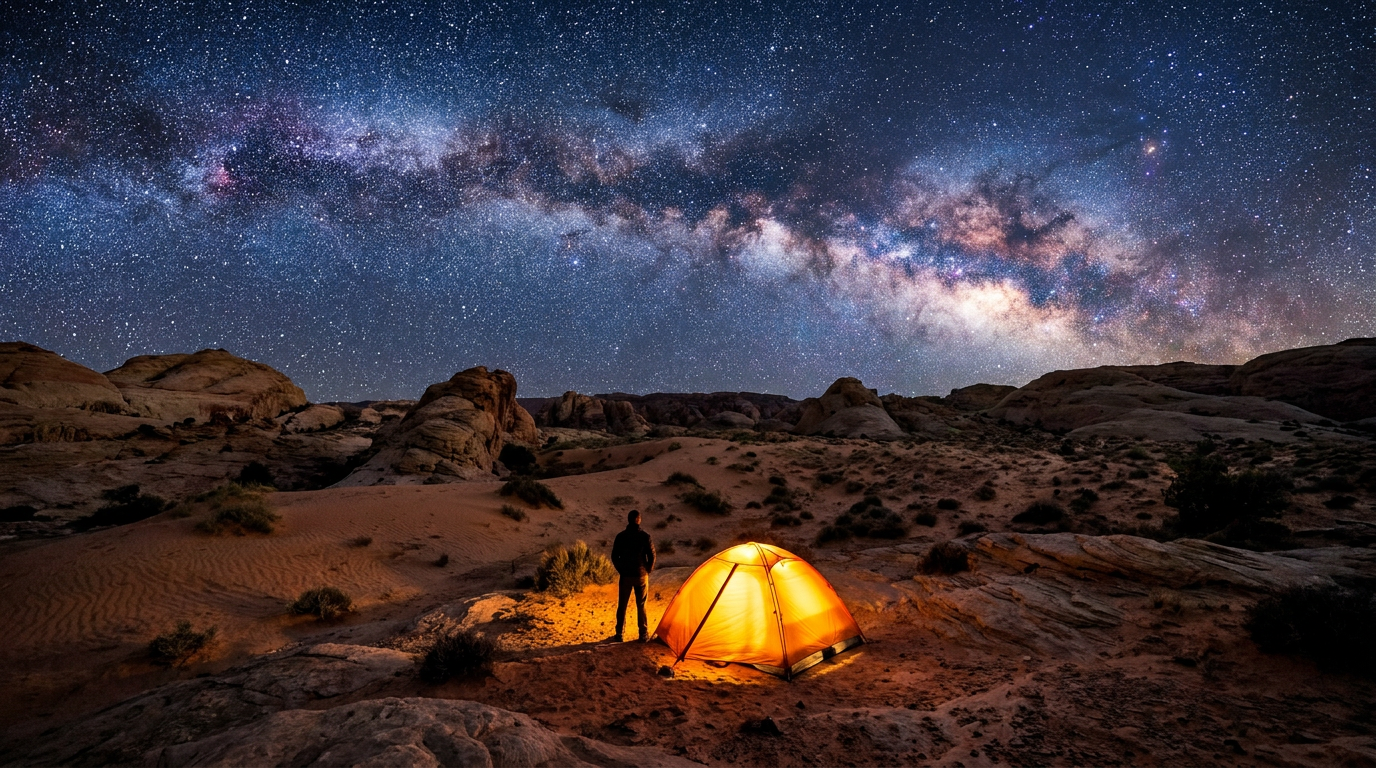
- Astrotourism Travelers
- Seek awe-inspiring celestial experiences, wellness, and a deeper connection to nature away from urban light pollution.
- Conservationists & Astronomers
- Focus on reducing light pollution to protect nocturnal ecosystems, save energy, and preserve the night sky for scientific observation.
- Rural Communities
- View dark skies as a sustainable, low-impact economic resource that can boost off-season tourism and support local businesses.
What's not represented
- · Lighting manufacturers adapting to dark-sky compliance
- · Urban planners balancing safety with light pollution reduction
Why this matters
With 80 percent of Americans unable to see the Milky Way from their homes, finding a truly dark sky has become a rare and sought-after experience. The astrotourism boom is not only creating unforgettable travel opportunities but also providing a powerful economic incentive for communities to reduce energy waste and protect nocturnal ecosystems.
Key points
- Astrotourism is one of the fastest-growing travel trends in 2026, driven by a desire to escape urban light pollution.
- DarkSky International has certified over 250 locations globally that enforce strict lighting policies to protect the night sky.
- The Bortle Scale is used to measure sky darkness, with astrotourists seeking out Class 1 and 2 environments.
- Major 2026 astronomical events, including a European solar eclipse and a solar maximum, are fueling record demand.
- Rural communities are leveraging their dark skies to boost sustainable, off-season economic growth.
For generations, travel itineraries have been dictated by the sun. Tourists wake early to beat the crowds, pack their days with sunlit sightseeing, and retreat indoors when darkness falls. But in 2026, a rapidly growing segment of the travel industry is flipping that schedule upside down. "Astrotourism"—the practice of traveling specifically to observe celestial phenomena in pristine, unpolluted skies—has emerged as one of the year's defining travel trends. Driven by a rare convergence of astronomical events, including a solar maximum that is supercharging the Northern Lights and a highly anticipated total solar eclipse crossing Europe in August, travelers are venturing to the most remote corners of the globe simply to look up.[1][2]
The surge in nocturnal exploration is largely a reaction to a modern environmental crisis: the disappearance of the night. According to conservation groups and government wildlife agencies, an estimated 80 percent of Americans and a vast majority of Europeans have never seen the Milky Way. The culprit is light pollution—the ambient skyglow caused by poorly designed, misdirected, or excessive artificial lighting. Beyond merely obscuring the stars, this excess light disrupts nocturnal ecosystems, wastes massive amounts of energy, and alters human circadian rhythms. For many urban dwellers, a truly dark sky has become a scarce natural resource, transforming the simple act of stargazing into a luxury experience worth traveling for.[3][5]
To quantify this scarcity, astronomers and astrotourists rely on the Bortle Scale, a nine-level numerical system introduced in 2001 by amateur astronomer John E. Bortle. The scale measures the brightness of the night sky and the observability of celestial objects. A Class 9 sky represents an inner-city environment where only the moon and a handful of the brightest planets are visible through a washed-out, grayish haze. Conversely, a Class 1 sky represents the darkest environments on Earth. In a Bortle Class 1 location, the Milky Way casts visible shadows on the ground, and the sheer density of visible stars can make familiar constellations difficult to identify. Most astrotourism destinations aim to protect Class 1 through Class 3 skies.[5][6]

The vanguard of this preservation effort is DarkSky International, a nonprofit organization founded in 1988 that has become the global authority on light pollution. In 2001, the organization launched the International Dark Sky Places program to encourage communities and protected areas to enact responsible lighting policies. What began with a single certification for Flagstaff, Arizona, has blossomed into a global network. As of 2026, DarkSky International has certified over 250 locations across six continents, encompassing more than 160,000 square kilometers of protected land. These designations range from Dark Sky Parks and Reserves to ultra-remote Dark Sky Sanctuaries, each requiring rigorous lighting retrofits and ongoing public education to maintain their status.[1][3]
Achieving Dark Sky certification is not merely a symbolic gesture; it requires significant infrastructural changes. Communities must audit their outdoor lighting, replacing glaring blue-white LEDs with warmer, low-intensity bulbs. Crucially, fixtures must be fully shielded, directing light strictly downward where it is needed for safety, rather than allowing it to spill horizontally or upward into the atmosphere. In regions like Quebec's Mont-Mégantic—the world's first International Dark Sky Reserve, certified in 2007—the conversion of thousands of luminaires across dozens of municipalities reduced light pollution by more than a third while saving nearly two gigawatt-hours of electricity annually.[6]
Achieving Dark Sky certification is not merely a symbolic gesture; it requires significant infrastructural changes.
For local economies, the financial incentives to darken their skies are proving substantial. Astrotourism provides a powerful economic engine for rural and remote communities that might otherwise struggle to attract visitors. Because stargazing is inherently a nighttime activity, astrotourists require overnight accommodations, dining, and local services, injecting revenue directly into local businesses. Furthermore, the best stargazing often occurs during the colder, drier winter months when the atmosphere is most stable, helping destinations extend their tourism seasons beyond the traditional summer peak. Recognizing this potential, the UN Tourism agency recently partnered with the Starlight Foundation to release a comprehensive guide for developing sustainable astrotourism products that empower local populations.[4][6]

The global map of astrotourism hotspots is expanding rapidly, with certain regions establishing themselves as premier nocturnal destinations. In the Southern Hemisphere, Chile's Atacama Desert remains the undisputed capital of stargazing, boasting more than 320 clear nights a year and hosting 70 percent of the world's astronomical observation capacity. Nearby, New Zealand's Aoraki Mackenzie International Dark Sky Reserve offers unparalleled views of the Magellanic Clouds. In Africa, Namibia's NamibRand Nature Reserve allows visitors to sleep in open-air "star-beds" amid the dunes, while South Africa's Lapalala Wilderness recently became the first "Big Five" wildlife reserve to earn Dark Sky certification, blending traditional safaris with cosmic exploration.[1][2]
North America is also experiencing a boom in dark sky infrastructure. Utah leads the United States with over two dozen certified places, integrating Indigenous sky knowledge into its visitor programs. Meanwhile, Arizona is cementing its legacy as the birthplace of the dark sky movement. Flagstaff is celebrating its 25th anniversary as a Dark Sky City, and the state is preparing to open the world's first visitor center entirely dedicated to dark skies, complete with a research observatory and planetarium. These facilities are designed not just for astronomers, but for everyday travelers seeking to reconnect with a universe that has been hidden behind a veil of artificial light.[1][6]
The 2026 astronomical calendar is acting as a massive catalyst for this travel sector. In late February, a rare six-planet alignment captivated skywatchers globally. However, the crown jewel of the year arrives on August 12, when a total solar eclipse will sweep across Iceland, northern Spain, and Portugal—the first total eclipse visible in Europe since 1999. Travel agencies have spent years curating specialized itineraries that place tourists in medieval Spanish castles and Portuguese vineyards directly in the path of totality, perfectly timed to coincide with the peak of the Perseid meteor shower that same evening.[2][6]

Simultaneously, the sun is reaching the peak of its 11-year solar cycle, known as the solar maximum. This heightened solar activity is triggering intense geomagnetic storms, resulting in some of the most vibrant and frequent auroral displays in decades. The Northern Lights, typically confined to the Arctic Circle, are expected to reach mid-latitudes with surprising regularity throughout 2026. Astro-lodges in Scandinavia, Canada, and Alaska are pairing aurora viewing with guided stargazing, offering travelers a front-row seat to the most dynamic light shows in the solar system.[1][2]

For travelers planning their own astrotourism adventure, experts emphasize that preparation and patience are key. The human eye requires 20 to 30 minutes of complete darkness to fully adapt and perceive the faintest stars. A single glance at a bright smartphone screen can instantly ruin this night vision. Guides recommend using flashlights equipped with red filters, as red light does not disrupt the eye's dark adaptation. While high-powered telescopes offer incredible views of deep-space objects, simply lying back with a pair of binoculars under a Bortle Class 1 or 2 sky is often enough to induce a profound sense of awe and perspective.[5][6]
Ultimately, the rise of astrotourism represents a hopeful shift in how humans interact with the natural world. It is a form of travel that leaves no physical trace, requiring only that we turn off the lights and look up. By assigning an economic value to darkness, the astrotourism movement is proving that conservation and commerce can align. As more communities realize that their most valuable natural asset might just be the sky above them, the push to reclaim the night is ensuring that future generations will still be able to find their place among the stars.[4][6]
How we got here
1988
DarkSky International (formerly the International Dark-Sky Association) is founded to combat light pollution.
2001
Flagstaff, Arizona, becomes the first certified International Dark Sky City, and the Bortle Scale is introduced.
2007
Quebec's Mont-Mégantic region is certified as the world's first International Dark Sky Reserve.
2026
A convergence of a solar maximum and a European total solar eclipse drives unprecedented global interest in astrotourism.
Viewpoints in depth
Astrotourism Travelers
Travelers seeking awe, wellness, and a deeper connection to nature away from urban light pollution.
For modern travelers, the appeal of astrotourism lies in its stark contrast to the hyper-connected, artificially lit environments of daily life. Enthusiasts view dark sky reserves not just as places for scientific observation, but as sanctuaries for mental wellness and perspective. The experience of seeing the Milky Way or a meteor shower in a pristine environment is increasingly treated as a bucket-list priority, driving demand for specialized accommodations like glass-roofed igloos, open-air star-beds, and remote eco-lodges that prioritize darkness over traditional luxury amenities.
Conservationists & Astronomers
Advocates focused on reducing light pollution to protect nocturnal ecosystems and preserve the night sky for scientific observation.
From a conservation standpoint, the astrotourism boom is a vital tool for environmental protection. Organizations like DarkSky International emphasize that light pollution is one of the easiest environmental crises to solve—it requires only the flip of a switch or the installation of a simple shield. By highlighting the negative impacts of artificial light on nocturnal wildlife, bird migration, and human circadian rhythms, conservationists use the popularity of stargazing to push municipalities toward smarter, more sustainable lighting infrastructure that saves energy while preserving the cosmos.
Rural Communities
Local populations viewing dark skies as a sustainable economic resource to boost off-season tourism.
For many rural and remote towns, a lack of development was once seen as an economic disadvantage. Today, that lack of development—and the resulting lack of light pollution—is their greatest asset. Local governments and tourism boards are actively pursuing Dark Sky certifications because astrotourism brings visitors during the colder, darker winter months when traditional tourism wanes. This influx supports local hotels, restaurants, and guides, proving that preserving the natural environment can be highly profitable for communities willing to protect their skies.
What we don't know
- Whether the rapid growth of astrotourism will eventually lead to overcrowding and infrastructure strain in fragile, remote dark sky sanctuaries.
- How quickly major urban centers will adopt dark-sky-compliant lighting to reduce the overall global growth of light pollution.
Key terms
- Astrotourism
- A niche segment of the travel industry focused on visiting destinations specifically for astronomical observation and experiencing unpolluted night skies.
- Bortle Scale
- A nine-level scale that measures the darkness of the night sky and the visibility of celestial objects, ranging from Class 1 (darkest) to Class 9 (brightest).
- Light Pollution
- The inappropriate or excessive use of artificial light at night, which obscures the stars, disrupts ecosystems, and wastes energy.
- Skyglow
- The brightening of the night sky over inhabited areas caused by artificial light scattering in the atmosphere.
- Solar Maximum
- The period of greatest solar activity during the sun's 11-year cycle, which results in more frequent and intense auroras (Northern and Southern Lights).
Frequently asked
What is astrotourism?
Astrotourism is a form of travel where the primary goal is to observe celestial phenomena, such as stargazing, meteor showers, or eclipses, in areas with minimal light pollution.
What is the Bortle Scale?
The Bortle Scale is a nine-level numerical system used to measure the brightness of the night sky. Class 1 represents the darkest, most pristine skies on Earth, while Class 9 represents heavily light-polluted inner-city skies.
How does a park become a certified Dark Sky Reserve?
Parks must apply through DarkSky International and prove they have enacted strict outdoor lighting policies, such as using shielded, low-intensity bulbs, and must offer public education programs about light pollution.
Do I need a telescope to enjoy a dark sky park?
No. While telescopes offer deep-space views, simply allowing your eyes to adjust to the dark for 20 to 30 minutes in a Bortle Class 1 or 2 sky will reveal thousands of stars and the Milky Way to the naked eye.
Sources
Source coverage
6 outlets
3 viewpoints surfaced






[1]Outside OnlineAstrotourism Travelers
The Best Destinations for Astrotourism in 2026
Read on Outside Online →[2]PixidiaAstrotourism Travelers
Astrotourism 2026: The 10 Most Stunning Starry Skies and Dark Sky Reserves in the World
Read on Pixidia →[3]DarkSky InternationalConservationists & Astronomers
International Dark Sky Places
Read on DarkSky International →[4]UN TourismRural Communities
Publication Launch: A Guide for the Development of Astrotourism
Read on UN Tourism →[5]Texas Parks & WildlifeConservationists & Astronomers
Dark Skies Program and the Bortle Scale
Read on Texas Parks & Wildlife →[6]Factlen Editorial TeamRural Communities
Synthesis by Factlen editorial team
Read on Factlen Editorial Team →
Every angle. Every day.
Get travel stories with full source coverage and perspective breakdowns delivered to your inbox.