
The Shift to Local AI: How to Run Powerful LLMs on Your Own Device
Running advanced AI models entirely offline has transitioned from a hobbyist experiment to a mainstream productivity practice, offering zero API costs and absolute data privacy.
By Factlen Editorial Team

- Privacy Advocates
- Value local LLMs for guaranteeing data sovereignty and ensuring sensitive information never touches third-party servers.
- Enterprise Developers
- Focus on the cost-efficiency and consistent latency of running unmetered inference on-premises.
- Hardware Manufacturers
- View the shift to local AI as a driver for upgrading consumer devices with higher unified memory and dedicated NPUs.
What's not represented
- · Cloud AI Providers
- · Open-Source Contributors
Why this matters
Running AI locally eliminates expensive cloud subscription fees and guarantees that your personal data, proprietary code, and private documents never leave your computer.
Key points
- Over half of enterprise AI inference now occurs on-premises to reduce costs and protect data.
- Local AI ensures that sensitive prompts and files never leave the user's device.
- Apple's unified memory architecture allows Macs to run massive models that normally require dedicated servers.
- Tools like Ollama and LM Studio have made downloading and running models accessible to everyday users.
- Local inference can deliver faster response times than cloud APIs by eliminating network delays.
For years, interacting with artificial intelligence meant sending your data to a remote server. You typed a prompt, waited for the cloud to process it, and hoped your internet connection remained stable. But in 2026, a quiet revolution has shifted the center of gravity in the tech industry: running powerful Large Language Models (LLMs) directly on your own hardware is no longer a niche hobbyist experiment. It has become a mainstream productivity practice.[1][6][8]
The shift is driven by a combination of shrinking model sizes, more capable consumer hardware, and a growing demand for data sovereignty. Today, an estimated 55 percent of enterprise AI inference happens on-premises, up from just 12 percent in 2023. Developers, researchers, and everyday users are realizing that they can achieve frontier-level AI performance without paying recurring API fees or sacrificing their privacy to third-party cloud providers.[1][8]
To understand how local AI works, it helps to look at the mechanism. An AI model is essentially a massive, static file containing billions of mathematical weights—the parameters the neural network uses to generate text or analyze data. To run the model, an inference engine loads these weights into the computer's memory. Once loaded, the software can process prompts and generate responses entirely offline, without ever making a network request.[1][7][8]
The primary bottleneck for this process is memory, specifically Video RAM (VRAM). A model must fit entirely into a system's high-speed memory to run efficiently. If a model is too large and spills over into standard, slower system RAM, the generation speed plummets. As a rule of thumb, running a compressed 7-billion parameter model requires about 8GB of VRAM, while a massive 70-billion parameter model demands significantly more specialized hardware.[1][6][8]

This memory constraint has given Apple a unique advantage in the local AI race. Apple Silicon—the M-series chips powering modern Macs and iPads—utilizes a "unified memory" architecture. Unlike traditional PCs that separate system RAM from the graphics card's VRAM, Apple devices share a single massive pool of high-speed memory. A Mac Studio with 128GB of unified memory can load colossal AI models that would otherwise require tens of thousands of dollars in dedicated Nvidia server GPUs.[1][2][8]
Apple is aggressively capitalizing on this hardware advantage. At the Worldwide Developers Conference (WWDC) in June 2026, the company unveiled the Core AI framework, designed to let developers run generative AI natively on Apple Silicon. The framework supports models with up to 70 billion parameters, ensuring zero server dependencies and zero per-token cloud costs. This technology underpins the next generation of Apple Intelligence, though Apple noted that its most advanced on-device models in iOS 27 will require devices with at least 12GB of unified memory, excluding older base-model iPhones.[2][3][8]
Apple is aggressively capitalizing on this hardware advantage.
Microsoft is making parallel moves to bring local AI to Windows PCs. The company recently introduced Aion 1.0 Instruct and Aion 1.0 Plan, a new generation of small language models purpose-built for local execution. Designed to run on capable dedicated GPUs and Neural Processing Units (NPUs), these models enable fully local "agentic" capabilities—allowing the AI to reason over user intent and manage files without a cloud round-trip.[4][8]
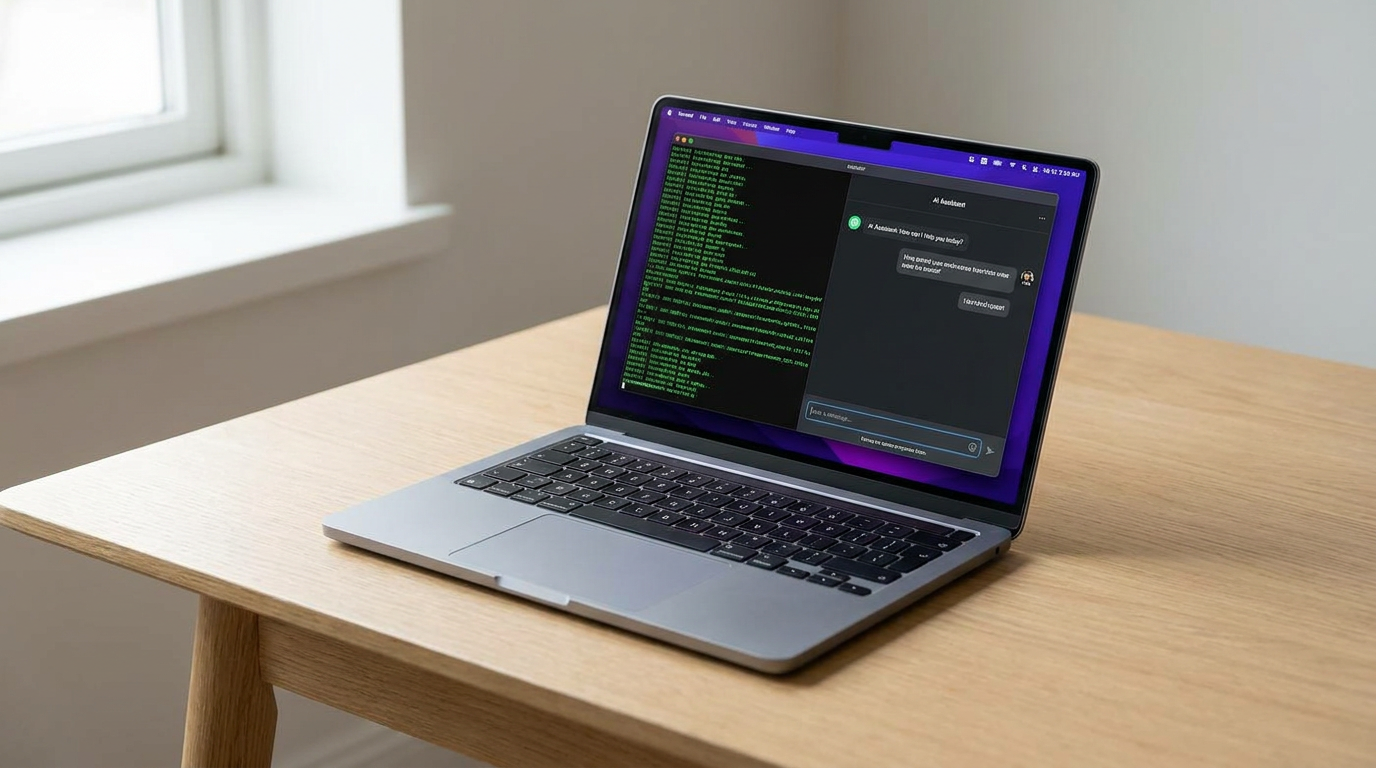
For users looking to run open-source models today, the software stack has become remarkably user-friendly. The de facto standard for developers is Ollama, a lightweight command-line tool that wraps complex inference code into a simple server. With a single terminal command, users can download a model, load it into memory, and start chatting or integrating it into their own applications via an OpenAI-compatible API.[1][6][8]
For those who prefer not to use the command line, LM Studio offers a polished desktop alternative. Available on Windows, Mac, and Linux, LM Studio provides a graphical interface where users can browse a visual catalog of models, download them with a click, and interact in a chat window that mirrors popular cloud-based AI interfaces. It democratizes access to local AI, making it as easy as installing a standard desktop application.[1][8]

The models available for these tools have also seen dramatic improvements. Open-weight models like Google's Gemma 3 and Alibaba's Qwen 3 pack immense reasoning and coding capabilities into highly compressed formats. A 12-billion or 27-billion parameter model can now fit comfortably on a single consumer GPU, offering multimodal features—like analyzing images and documents—that rival the massive, proprietary cloud models of just a year ago.[5][8]
The most compelling reason to adopt these tools is absolute data privacy. When an LLM runs locally, the prompts, medical records, legal documents, and proprietary code never leave the machine. There are no network calls to intercept, no data brokers, and no terms of service granting a provider the right to train future models on your inputs. For regulated industries like healthcare and finance, this architecture is not just a preference; it is a strict compliance requirement.[1][7][8]
However, cybersecurity experts caution that privacy does not automatically equal security. While a local model ensures data does not leak to the cloud, downloading unverified model weights from untrusted internet forums can expose a system to malicious code. Best practices dictate downloading models only from verified registries like Hugging Face or the official Ollama library, and ensuring that local API servers are not accidentally exposed to public networks.[7][8]

Beyond privacy, local execution offers a surprising performance benefit: speed. By eliminating the network round-trip required to send a prompt to a cloud server and wait for a response, a well-configured local setup can deliver first-token latency in under 40 milliseconds. Users never have to deal with rate limits, API outages, or waiting in queues during peak hours.[1][6][8]
As the industry moves toward "agentic" workflows—where AI systems autonomously orchestrate tasks, write code, and manage sub-agents over long periods—the cost of continuous cloud compute becomes prohibitive. Local execution solves this economic bottleneck by providing unmetered, always-on intelligence. By bringing the brain to the data rather than sending the data to the brain, local LLMs are transforming personal computers into truly intelligent companions.[4][6][8]
How we got here
Early 2023
The release of LLaMA weights sparks a massive open-source movement to optimize models for consumer hardware.
Late 2023
Tools like Ollama and LM Studio launch, dramatically simplifying the process of running local AI.
Mid 2024
Small Language Models (SLMs) begin matching the performance of earlier massive cloud models.
June 2026
Apple announces the Core AI framework, enabling 70B-parameter models to run natively on Apple Silicon.
Viewpoints in depth
Privacy Advocates
View local AI as the ultimate solution for data sovereignty and security.
For privacy advocates and compliance officers in regulated industries, local LLMs solve a fundamental architectural flaw of cloud AI: data exposure. By ensuring that prompts, proprietary code, and sensitive documents never leave the physical machine, local execution eliminates the risk of data breaches in transit or unauthorized use of user data for future model training. They argue that for medical, legal, and financial applications, local inference is the only viable path forward.
Enterprise Developers
Focus on the economic and operational benefits of unmetered local compute.
Software engineers and enterprise IT teams prioritize local models for their predictable costs and reliable latency. Cloud AI APIs charge per token, meaning that as an application scales or implements complex, multi-step agentic workflows, costs can spiral out of control. Running models on-premises provides unmetered intelligence, allowing developers to experiment freely, build autonomous agents, and avoid the rate limits and peak-hour outages associated with third-party cloud providers.
Hardware Manufacturers
See the local AI boom as a catalyst for a massive hardware upgrade cycle.
Companies like Apple, Microsoft, and Nvidia view the shift toward local AI as a primary driver for consumer and enterprise hardware sales. Because running models requires significant memory bandwidth and dedicated Neural Processing Units (NPUs), manufacturers are heavily marketing "AI PCs" and high-unified-memory devices. They argue that the future of computing requires a baseline of dedicated AI silicon in every laptop and smartphone.
What we don't know
- How quickly open-weight models will close the reasoning gap with the absolute largest proprietary cloud models.
- Whether future regulatory frameworks will mandate local execution for certain classes of sensitive personal data.
- How battery technology will evolve to handle the massive power draw of running continuous AI inference on mobile devices.
Key terms
- Local LLM
- A large language model that runs entirely on a user's own hardware rather than on a remote cloud server.
- VRAM (Video RAM)
- The specialized memory on a graphics card used to store and process the massive neural network weights of an AI model.
- Unified Memory
- An architecture used by Apple Silicon where the CPU and GPU share the same pool of memory, allowing massive AI models to load without dedicated graphics cards.
- Quantization
- A compression technique that reduces the precision of an AI model's weights, allowing it to run on hardware with significantly less memory.
- Inference
- The process of a trained AI model generating text, analyzing data, or solving problems in real-time.
- NPU (Neural Processing Unit)
- A specialized hardware chip designed specifically to accelerate machine learning tasks efficiently without draining the main battery.
Frequently asked
Can a local LLM access my files or the internet?
No, the model itself is a static file that generates text and has no network or file system access. However, the software running the model can be explicitly granted permission to read specific local files if you choose.
Do I need an internet connection to use a local LLM?
No. Once the model weights and the inference software are downloaded to your machine, the AI runs entirely offline.
What is the difference between Ollama and LM Studio?
Ollama is a command-line tool favored by developers for building applications, while LM Studio is a desktop app with a graphical interface designed for easy model browsing and chatting.
Why is Apple Silicon good for local AI?
Apple's M-series chips use unified memory, meaning a Mac can allocate almost all of its RAM to the GPU, allowing it to run massive models that would normally require multiple expensive PC graphics cards.
Sources
Source coverage
8 outlets
3 viewpoints surfaced








[1]TechsyPrivacy Advocates
Run LLMs Locally 2026: The 5-Minute Setup for Any GPU
Read on Techsy →[2]InfoQHardware Manufacturers
Apple Launches Core AI for Apple-Silicon Optimized On-Device Generative AI
Read on InfoQ →[3]MacRumorsHardware Manufacturers
Apple's most advanced on-device AI model in iOS 27 requires a minimum of 12GB of unified memory
Read on MacRumors →[4]MicrosoftHardware Manufacturers
A new generation of on-device models – Aion 1.0 Instruct and Aion 1.0 Plan in preview
Read on Microsoft →[5]Hugging FaceEnterprise Developers
The Best Open Source LLM Models to Run Locally in 2026
Read on Hugging Face →[6]Agent NativeEnterprise Developers
The state of local LLMs in 2026
Read on Agent Native →[7]Prompt QuorumPrivacy Advocates
Privacy vs Security for Local LLMs
Read on Prompt Quorum →[8]Factlen Editorial Team
Synthesis by Factlen editorial team
Read on Factlen Editorial Team →
Every angle. Every day.
Get ai stories with full source coverage and perspective breakdowns delivered to your inbox.