
US and Iran Open High-Stakes Peace Talks in Switzerland Amid Fresh Threats and Strait of Hormuz Tensions
Vice President JD Vance and Iranian officials have commenced 60-day negotiations to finalize a fragile ceasefire, even as President Trump threatens renewed military strikes and Tehran claims to have closed the Strait of Hormuz.
By Factlen Editorial Team
- U.S. Administration
- Seeks to use maximum military and economic pressure to force a permanent end to Iran's nuclear program and proxy network.
- Iranian Leadership
- Prioritizes sanctions relief and the unfreezing of assets while defending its sovereign right to enrich uranium.
- U.S. Domestic Critics
- Views the preliminary deal with deep skepticism, arguing it either rewards Iranian aggression or fails to secure lasting peace.
- Global Maritime Sector
- Focused entirely on the immediate stabilization of the Strait of Hormuz to prevent a catastrophic global economic shock.
What's not represented
- · Lebanese Civilians
- · Israeli Government Officials
- · European Energy Consumers
Why this matters
A successful agreement could end months of devastating regional conflict, stabilize global energy markets, and unfreeze billions in Iranian assets. However, a collapse in talks risks drawing the U.S. into a direct, full-scale war with Iran and triggering a global economic crisis through the closure of the world's most critical oil chokepoint.
Key points
- U.S. and Iranian delegations have opened 60-day peace negotiations in Switzerland, mediated by Qatar and Pakistan.
- Vice President JD Vance expressed hope for a 'new leaf' in relations, while President Trump threatened renewed military strikes.
- Iran claimed to have closed the Strait of Hormuz over Israeli strikes in Lebanon, a closure the U.S. military denies.
- Iranian President Masoud Pezeshkian announced the imminent release of $6 billion in frozen assets held in Qatar.
- Pezeshkian insisted Iran will never surrender its right to enrich uranium, setting up a major clash over nuclear capabilities.
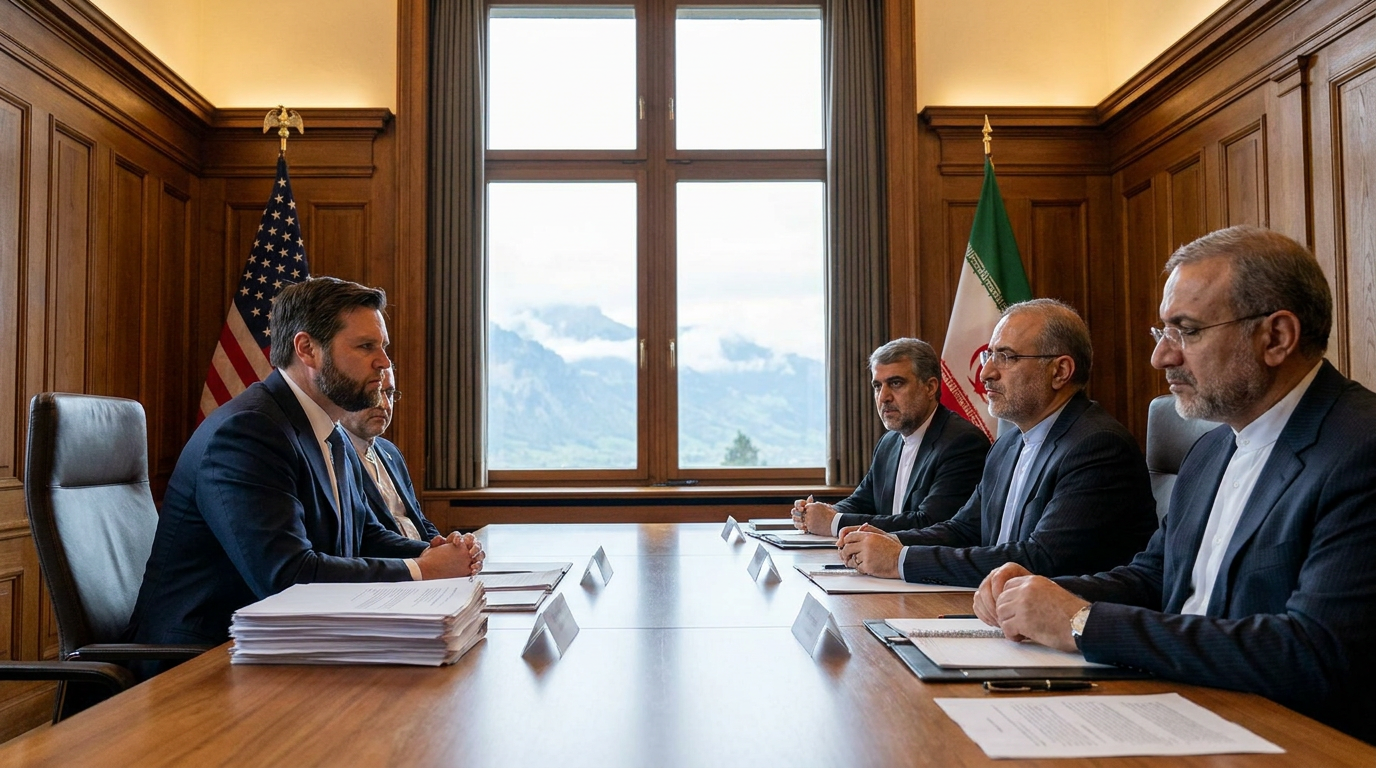
High-stakes diplomatic negotiations between the United States and Iran have officially commenced at the Bürgenstock resort in Switzerland, initiating a critical 60-day window to finalize a fragile ceasefire. Vice President JD Vance is leading the American delegation, sitting across from Iranian Parliament Speaker Mohammad Bagher Ghalibaf and Foreign Minister Abbas Araghchi. The "Lake Lucerne Summit," mediated by officials from Qatar and Pakistan, aims to formalize a 14-point memorandum of understanding signed last week by President Donald Trump and Iranian President Masoud Pezeshkian. The talks represent a pivotal effort to end months of devastating military conflict, address international concerns over Tehran's nuclear program, and stabilize a deeply volatile Middle East.[1][6][7]
At the negotiating table, Vice President Vance struck a notably conciliatory tone, expressing hope that the two historically adversarial nations could "turn over a new leaf" and permanently transform their relationship. Vance emphasized that the U.S. is extending an "outstretched hand" to the Iranian people, provided their leadership abandons its nuclear weapons ambitions and ceases its support for proxy militias across the region. The initial 80-minute session featured separate private discussions with the Qatari and Pakistani mediators, underscoring the delicate and highly choreographed nature of the diplomatic engagement.[1][6][7]
However, Vance's diplomatic overtures in Switzerland stood in stark contrast to aggressive rhetoric emanating from Washington. President Trump took to his Truth Social platform to issue severe warnings, threatening to hit Iran "very hard again... only harder" if Tehran fails to immediately rein in Hezbollah forces operating in Lebanon. In a subsequent interview, Trump escalated his threats, warning Iranian officials that they "won't have a country" if they attempt to disrupt global shipping, and suggesting the U.S. military could forcibly take over the Strait of Hormuz to act as the waterway's "Guardian Angel."[3][4]

The status of the Strait of Hormuz—a critical maritime chokepoint through which roughly one-fifth of the world's oil supply passes—immediately emerged as a central flashpoint. Iran's joint military command declared the strait closed to commercial traffic over the weekend, citing continued Israeli military strikes in southern Lebanon as a direct violation of the ceasefire agreement. Iranian officials warned that the closure was merely the "first step of response" to what they view as a breach of the memorandum of understanding.[5][8]
Iranian officials warned that the closure was merely the "first step of response" to what they view as a breach of the memorandum of understanding.
The United States swiftly disputed Iran's claims regarding the waterway. U.S. Central Command and Vice President Vance both denied that the strait had been shut down, stating that the U.S. military is actively monitoring the situation and that traffic continues to flow. U.S. Energy Secretary Chris Wright confirmed that 67 commercial vessels successfully transited the strait on Saturday, a volume roughly equal to pre-conflict levels. Furthermore, President Trump threatened to impose a 20 percent toll on all oil passing through the strait if a final peace deal is not reached within the 60-day negotiation period.[2][4][5]

On the economic front, the negotiations carry massive financial implications for Tehran. Iranian President Masoud Pezeshkian announced that $6 billion in frozen Iranian assets currently held in Qatar will be released as part of the preliminary agreement to begin talks. The unfreezing of these funds is a critical priority for the Iranian delegation, which includes senior banking and oil officials seeking immediate relief from crippling international sanctions.[7][8]
Despite the economic concessions, Iran's leadership is drawing a hard line on its nuclear capabilities. President Pezeshkian explicitly stated that while Iran has no intention of developing nuclear weapons, the nation will "never back down from the right to enrich uranium," insisting that the United States will be forced to accept this condition. This stance sets up a major clash with the Trump administration, which has repeatedly cited the complete termination of Iran's nuclear program as a primary justification for its recent military campaigns and the current diplomatic push.[4][8]
The unfolding negotiations are also facing fierce political headwinds within the United States. Republican hardliners have sharply criticized the memorandum of understanding, comparing it unfavorably to the 2015 Obama-era nuclear deal that the GOP previously dismantled. Conversely, Democratic lawmakers have accused the Trump administration of manufacturing a crisis through reckless military escalation, only to demand credit for negotiating a tenuous truce. As envoys Jared Kushner and Steve Witkoff prepare to dive into the technical details of sanctions relief and nuclear inspections, the success of the talks remains highly uncertain, tethered to the fragile ceasefire holding on the ground in Lebanon.[1][3][4]
How we got here
April 2026
The U.S. and Israel launch an air war against Iran, leading to Iranian retaliatory strikes and a severe disruption of global shipping.
June 17, 2026
President Trump and Iranian President Pezeshkian sign a 14-point memorandum of understanding to end the conflict.
June 20, 2026
Iran claims to close the Strait of Hormuz in response to Israeli strikes in Lebanon; the U.S. denies the closure.
June 21, 2026
Vice President JD Vance and Iranian officials open formal negotiations at the Bürgenstock resort in Switzerland.
Viewpoints in depth
The U.S. Administration's View
The White House seeks to leverage military pressure to secure a permanent, restrictive deal.
The Trump administration is employing a "good cop, bad cop" strategy, with Vice President Vance offering a "new leaf" in Switzerland while President Trump threatens devastating strikes and tolls from Washington. The core U.S. objective is to permanently dismantle Iran's nuclear weapons capability and secure the free flow of oil through the Strait of Hormuz, using the threat of overwhelming force as the primary leverage.
Iran's View
Tehran demands immediate economic relief and refuses to compromise on its nuclear enrichment rights.
Iranian leadership views the talks as a necessary step to lift crippling sanctions and unfreeze billions in assets, starting with $6 billion held in Qatar. However, they remain deeply suspicious of U.S. commitments following past military strikes and insist that uranium enrichment is a non-negotiable sovereign right. They are using their proxy forces and the threat of closing the Strait of Hormuz to maintain leverage against U.S. and Israeli actions.
U.S. Domestic Critics
Bipartisan skeptics argue the administration is rewarding Iranian aggression or repeating past diplomatic mistakes.
The negotiations face fierce headwinds in Washington. Republican hawks argue that unfreezing assets and allowing any uranium enrichment repeats the perceived flaws of the 2015 Obama-era nuclear deal. Meanwhile, Democrats criticize the administration for destabilizing the region through military escalation only to negotiate a fragile truce, arguing the White House is claiming credit for solving a crisis of its own making.
What we don't know
- Whether the fragile ceasefire between Israel and Hezbollah in Lebanon will hold long enough to allow the U.S.-Iran talks to succeed.
- How the U.S. will enforce its demand for a halt to Iran's nuclear program if Tehran refuses to compromise on uranium enrichment.
- If Trump will actually attempt to impose a 20% toll on commercial shipping in the Strait of Hormuz if the 60-day deadline passes without a deal.
Key terms
- Strait of Hormuz
- A critical maritime chokepoint between the Persian Gulf and the Gulf of Oman, through which roughly 20% of the world's oil supply passes.
- Uranium Enrichment
- The process of increasing the concentration of the U-235 isotope in uranium, which can be used for civilian nuclear power or, at high levels, nuclear weapons.
- Memorandum of Understanding (MOU)
- A preliminary, non-binding agreement outlining the broad terms of a potential final peace deal.
- Proxy Forces
- Armed groups funded, trained, or directed by a larger power to act on its behalf, such as Hezbollah in Lebanon acting with Iranian support.
Frequently asked
Why are the U.S. and Iran negotiating in Switzerland?
Switzerland has long acted as a neutral diplomatic intermediary between Washington and Tehran, providing a secure location for the delegations to meet alongside mediators from Qatar and Pakistan.
Is the Strait of Hormuz currently closed?
There are conflicting reports. Iran's military declared it closed due to ceasefire violations, but U.S. Central Command stated that dozens of commercial ships successfully transited the waterway over the weekend.
What is happening with Iran's frozen assets?
As part of the preliminary agreement to begin talks, $6 billion in Iranian funds previously frozen in Qatar are slated to be released to Tehran.
Who is leading the U.S. delegation?
Vice President JD Vance is leading the initial talks, accompanied by White House envoys Jared Kushner and Steve Witkoff, who are expected to handle the technical details.
Sources
Source coverage
8 outlets
4 viewpoints surfaced








[1]The Washington PostU.S. Administration
JD Vance holds peace talks with Iran as Trump threatens strikes over Hormuz
Read on The Washington Post →[2]Fox NewsU.S. Administration
Vance, Iranian officials meet in Switzerland for first round of high-stakes talks
Read on Fox News →[3]The GuardianU.S. Domestic Critics
Trump threatens Iran after JD Vance hails 'great progress' made in Switzerland talks
Read on The Guardian →[4]PBS NewsHourU.S. Domestic Critics
As Vance meets top Iranian officials in Switzerland, Trump threatens Tehran from afar
Read on PBS NewsHour →[5]ForbesGlobal Maritime Sector
Iran Says Strait Of Hormuz Is Closed After Lebanon Attacks—U.S. Denies It's Shut
Read on Forbes →[6]Channel News AsiaGlobal Maritime Sector
Vance hopes US, Iran can turn the page at 'historic' talks
Read on Channel News Asia →[7]Al JazeeraIranian Leadership
US-Iran talks in Switzerland: Is Lebanon top of agenda; who is attending?
Read on Al Jazeera →[8]News.AzIranian Leadership
Pezeshkian confirms $6B asset release as US talks begin
Read on News.Az →


Every angle. Every day.
Get news politics stories with full source coverage and perspective breakdowns delivered to your inbox.