
Earth's Energy Imbalance Doubles as 1.5°C Carbon Budget Shrinks to Three Years
A major scientific assessment reveals human-caused warming reached 1.37°C in 2025, driven by record greenhouse gas emissions and the inadvertent warming effect of reduced air pollution.
By Factlen Editorial Team
- Climate Scientists
- Focuses on the physical data, emphasizing the doubling of the Earth's energy imbalance and the shrinking carbon budget.
- Policy Negotiators
- Focuses on the implications of the shrinking 1.5°C carbon budget for national emission targets and international treaties.
- Vulnerable Nations
- Highlights the immediate, locked-in consequences of the 23cm sea-level rise and the tripling of marine heatwaves.
- Energy Transition Advocates
- Emphasizes the dual challenge of rapidly reducing CO2 while managing the short-term warming spike caused by the aerosol unmasking effect.
What's not represented
- · Fossil Fuel Industry Representatives
- · Agricultural Sector Leaders
Why this matters
The Earth is accumulating heat faster than at any point in the modern record, shrinking the remaining carbon budget to just three years at current emission rates. This acceleration guarantees more severe weather shocks, coastal flooding, and agricultural disruptions that will directly impact global supply chains and local economies.
Key points
- Human activities pushed global warming to 1.37°C above pre-industrial levels in 2025.
- The Earth's energy imbalance has doubled in recent decades, accumulating heat at a record pace.
- The remaining carbon budget for a 1.5°C pathway has shrunk to 130 billion tonnes.
- At current emission rates, the 1.5°C carbon budget will be exhausted in approximately three years.
- Reductions in sulfur dioxide air pollution are inadvertently unmasking the true warming effect of greenhouse gases.
- Global mean sea levels have reached a record 23 centimeters above 1901 levels.
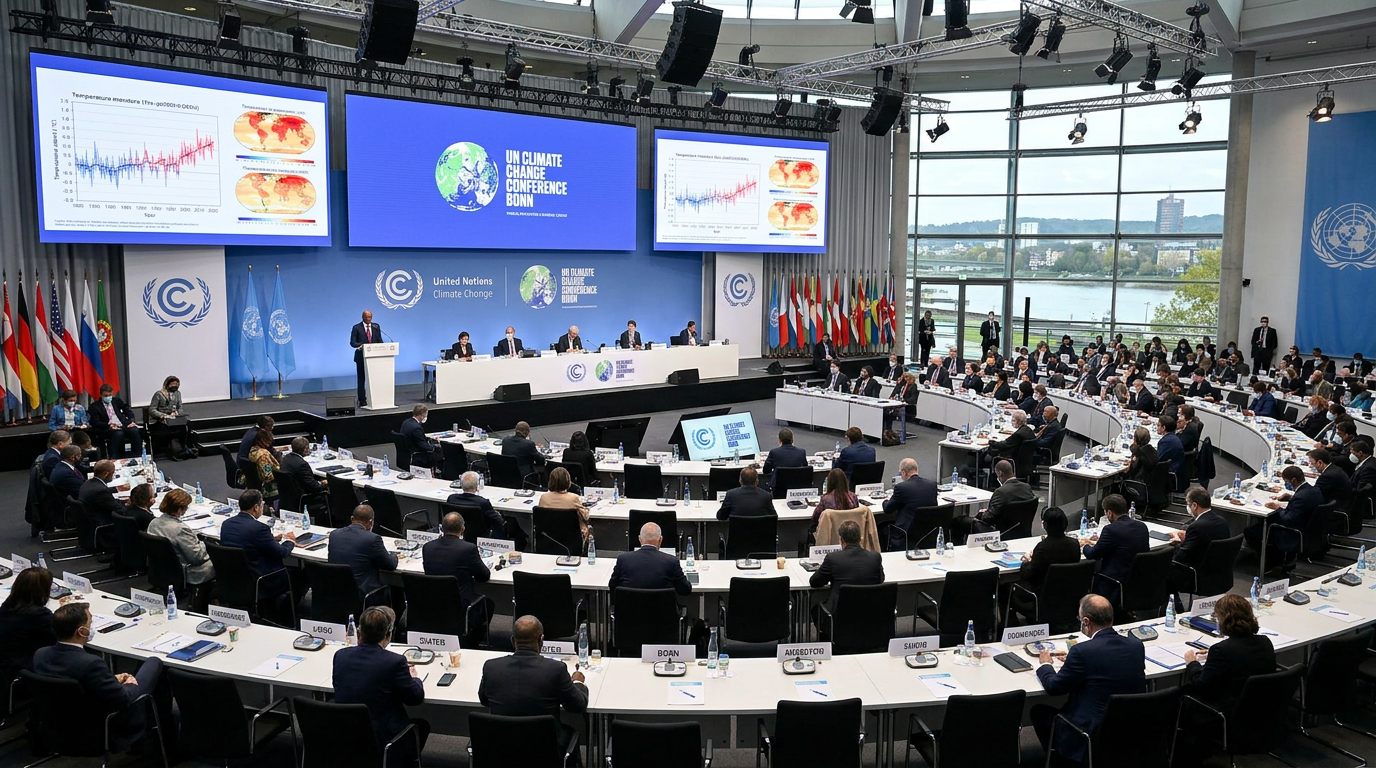
The scientific consensus on the pace of global warming has received its most rigorous update of the year. During the United Nations climate meetings in Bonn, Germany, an international coalition of more than 70 scientists released the latest Indicators of Global Climate Change (IGCC) report.[1][2]
Published in the peer-reviewed journal Earth System Science Data, the assessment serves as a comprehensive mid-cycle update to the Intergovernmental Panel on Climate Change (IPCC) reports. It aggregates thousands of data points to track the exact physical state of the planet.[1][6]
The primary finding is unambiguous: human activities pushed global temperatures to 1.37°C above pre-industrial levels in 2025. This represents a continuation of a relentless upward trend, driven primarily by the combustion of fossil fuels, deforestation, and industrial agriculture.[1][3]
Claim 1: The rate of warming is at an all-time high. The evidence strongly supports this assertion. The report calculates that human-induced warming is currently proceeding at a rate of 0.27°C per decade.[1][2]

This acceleration is not merely a statistical artifact; it is physically grounded in what scientists call the Earth's energy imbalance. This metric measures the difference between the amount of solar energy entering the atmosphere and the amount of heat escaping back into space.[2][3]
According to Professor Piers Forster, the study's lead author and director of the Priestley Centre for Climate Futures at the University of Leeds, this imbalance has doubled in recent decades and is now at a record high. The planet is accumulating heat faster than at any point in the modern instrumental record.[2][3]
Claim 2: The carbon budget for 1.5°C is nearly exhausted. The data here presents a stark timeline. The "carbon budget" refers to the total amount of carbon dioxide humanity can still emit while retaining a 50% chance of limiting long-term warming to the 1.5°C threshold established by the Paris Agreement.[1][3]
The IGCC assessment estimates that from the start of 2026, this remaining budget has shrunk to just 130 billion tonnes of CO2. To put this in perspective, global greenhouse gas emissions reached a record 56.8 billion tonnes of carbon dioxide equivalent in 2024.[1][3]

The IGCC assessment estimates that from the start of 2026, this remaining budget has shrunk to just 130 billion tonnes of CO2.
At current emission rates, the remaining budget will be entirely depleted in approximately three years. While crossing this threshold temporarily does not mean the Paris Agreement has failed—the treaty refers to long-term multi-decade averages—it guarantees that climate impacts will intensify significantly before any potential stabilization.[2][3][5][6]
Claim 3: Clean air regulations are inadvertently accelerating short-term warming. This is one of the most complex and robustly supported dynamics in contemporary climate science.[1][4]
For decades, the burning of coal and heavy fuel oil released massive amounts of sulfur dioxide (SO2) into the atmosphere. These aerosol particles act as a reflective shield, bouncing incoming solar radiation back into space and masking a portion of the greenhouse gas warming.[1][2]
As global efforts to combat air pollution have successfully reduced SO2 emissions—saving millions of lives from respiratory diseases—this reflective shield has thinned. The reduction in sulfur aerosols is now unmasking the true warming effect of accumulated greenhouse gases, contributing to the recent spike in global temperatures.[2][6]

Claim 4: Ocean systems are absorbing the brunt of the energy imbalance. The evidence for marine degradation is overwhelming and highly visible across multiple datasets.[1][3]
Because water has a massive heat capacity, the oceans have absorbed the vast majority of the excess heat trapped by greenhouse gases. This has led to a dramatic increase in marine heatwaves. The number of days experiencing marine heatwaves globally has more than tripled since 1991, with 65 such days recorded worldwide last year alone.[2][3]
These sustained thermal shocks devastate marine ecosystems, particularly coral reefs, and disrupt the ocean's ability to absorb further carbon dioxide. Furthermore, the thermal expansion of seawater, combined with the accelerating melt of land-based ice, has pushed global mean sea levels to a record 23 centimeters above 1901 levels.[3][6]
The rate of sea-level rise is also accelerating, currently standing at approximately 1.8 millimeters per year. While this increment may appear small, oceanographers warn that it exponentially increases the frequency and severity of coastal flooding during storm surges.[3][4]

Uncertainty and Data Gaps. While the overarching trends are unequivocal, the report highlights specific areas of scientific uncertainty. The precise sensitivity of the climate system to the removal of sulfur aerosols remains a subject of active modeling and debate.[1][6]
Additionally, the authors issued a stark warning regarding the infrastructure of climate science itself. Many of the critical observational datasets used to track these planetary changes—from satellite monitoring to deep-ocean buoys—are increasingly vulnerable to funding cuts and political interference.[3][6]
How we got here
1970s
The Earth's energy imbalance begins a sustained period of growth.
2015
The Paris Agreement establishes the goal of limiting long-term warming to 1.5°C.
2024
Global greenhouse gas emissions reach a record 56.8 billion tonnes of CO2 equivalent.
2025
Human-caused global warming reaches 1.37°C above pre-industrial levels.
June 2026
The IGCC report reveals the 1.5°C carbon budget has shrunk to 130 billion tonnes.
Viewpoints in depth
Climate Scientists & Modellers
Focuses on the physical data, emphasizing the Earth's energy imbalance and the aerosol unmasking effect.
For the scientific community, the headline is not just the surface temperature, but the underlying physics driving it. Researchers emphasize the doubling of the Earth's energy imbalance, which serves as the fundamental engine for future warming. Modellers are particularly focused on the 'aerosol masking effect'—the complex dynamic where successful efforts to clean up sulfur dioxide pollution are inadvertently removing a reflective shield that previously cooled the planet. They argue that understanding this sensitivity is crucial for accurate near-term forecasting.
Policy Negotiators
Focuses on the shrinking 1.5°C carbon budget and the implications for national emission targets.
Diplomats and policy experts view the IGCC report through the lens of international commitments. With the carbon budget for a 1.5°C pathway shrinking to just 130 billion tonnes—equivalent to roughly three years of current global emissions—negotiators face an unprecedented mathematical bind. This camp argues that the data renders gradual transition plans obsolete, necessitating immediate, aggressive interventions across all sectors of the global economy to prevent the temporary breach of 1.5°C from becoming a permanent baseline.
Vulnerable Nations
Highlights the immediate, locked-in consequences of the 23cm sea-level rise and marine heatwaves.
For low-lying island states and coastal communities, the abstract metrics of carbon budgets are secondary to the immediate physical impacts documented in the report. This perspective highlights the record 23-centimeter rise in global mean sea levels and the tripling of marine heatwave days. Representatives from these regions argue that the data proves the era of 'future risk' is over; they are currently absorbing the brunt of the Earth's energy imbalance, requiring immediate financial mechanisms for loss, damage, and urgent adaptation infrastructure.
What we don't know
- The exact degree to which the reduction in sulfur dioxide pollution will continue to unmask short-term greenhouse gas warming.
- Whether the recent spike in the Earth's energy imbalance represents a temporary anomaly or a permanent acceleration in the climate system.
- How vulnerable critical satellite and ocean-buoy monitoring systems are to impending international funding cuts.
Key terms
- Earth's energy imbalance
- The difference between the amount of solar energy entering the Earth's atmosphere and the amount of heat escaping back into space.
- Carbon budget
- The maximum amount of cumulative net global anthropogenic carbon dioxide emissions that would result in limiting global warming to a given level.
- Aerosol masking effect
- The phenomenon where particulate pollution, such as sulfur dioxide, reflects sunlight and temporarily cools the Earth, hiding the full extent of greenhouse gas warming.
- Marine heatwave
- A period of unusually high ocean temperatures, defined by lasting for at least five consecutive days, which can devastate marine ecosystems.
Frequently asked
Does crossing 1.5°C mean the Paris Agreement has failed?
Not immediately. The Paris Agreement targets refer to long-term, multi-decade averages, not a single year or a temporary spike. However, crossing it temporarily guarantees more severe climate impacts.
Why is cleaning up air pollution making the Earth hotter?
Sulfur dioxide pollution from coal and shipping acts like a reflective shield, bouncing sunlight away. As we reduce this pollution to save human lives, the 'shield' disappears, revealing the true warming effect of our greenhouse gases.
What happens when the carbon budget runs out?
It means humanity will have emitted enough carbon dioxide to make crossing the 1.5°C threshold highly likely. To cool the planet back down, we would need to remove more carbon from the atmosphere than we emit.
Sources
Source coverage
6 outlets
4 viewpoints surfaced






[1]Earth System Science DataClimate Scientists
Indicators of Global Climate Change 2025
Read on Earth System Science Data →[2]University of LeedsClimate Scientists
Major climate report shows Earth is getting hotter faster
Read on University of Leeds →[3]Mail & GuardianVulnerable Nations
Human-caused warming is rising faster than expected
Read on Mail & Guardian →[4]Inside Climate NewsEnergy Transition Advocates
Scientists Warn of Summer Heat Spikes as Global Warming Edges Toward 2C
Read on Inside Climate News →[5]World Meteorological OrganizationClimate Scientists
WMO Update: Prepare for El Niño and extreme weather
Read on World Meteorological Organization →[6]Factlen Editorial TeamPolicy Negotiators
Synthesis by Factlen editorial team
Read on Factlen Editorial Team →


Every angle. Every day.
Get science stories with full source coverage and perspective breakdowns delivered to your inbox.