
How Markerless Motion Capture and AI Are Extending Athlete Careers
By replacing sterile biomechanics labs with in-stadium camera arrays, artificial intelligence is allowing professional sports teams to track skeletal movement in real-time, preventing catastrophic injuries before they happen.
By Factlen Editorial Team
- Sports Scientists
- Prioritize ecological validity and the ability to capture natural movement at scale.
- Front Office Executives
- Focus on asset protection, roster availability, and performance optimization.
- Players & Union Advocates
- Value career extension but harbor deep concerns regarding data privacy and contract leverage.
What's not represented
- · Sports betting operators looking to utilize biomechanical data
- · Youth sports organizations adopting trickle-down analytics tech
Why this matters
The integration of AI and computer vision into live sports is fundamentally changing the limits of human performance. By predicting and preventing soft-tissue injuries and ligament tears, this technology is extending the careers of elite athletes and ensuring fans get to see their favorite players stay on the field.
Key points
- Markerless motion capture uses AI to track skeletal movements without wearable sensors.
- MLB teams use Hawk-Eye and KinaTrax to analyze pitcher biomechanics during live games.
- AI models detect fatigue-driven mechanical changes weeks before a ligament tears.
- NBA teams have reduced non-contact lower-body injuries by up to 37% using AI load management.
- Player unions are raising concerns about how predictive injury data affects contract negotiations.
For decades, understanding the precise biomechanics of an elite athlete required a sterile laboratory. Pitchers and point guards were forced to wear skin-tight suits covered in reflective ping-pong balls, performing highly unnatural movements while tethered to a web of sensors. It was highly accurate, but it lacked the adrenaline and authentic mechanics of a Game 7 scenario.[1][7]
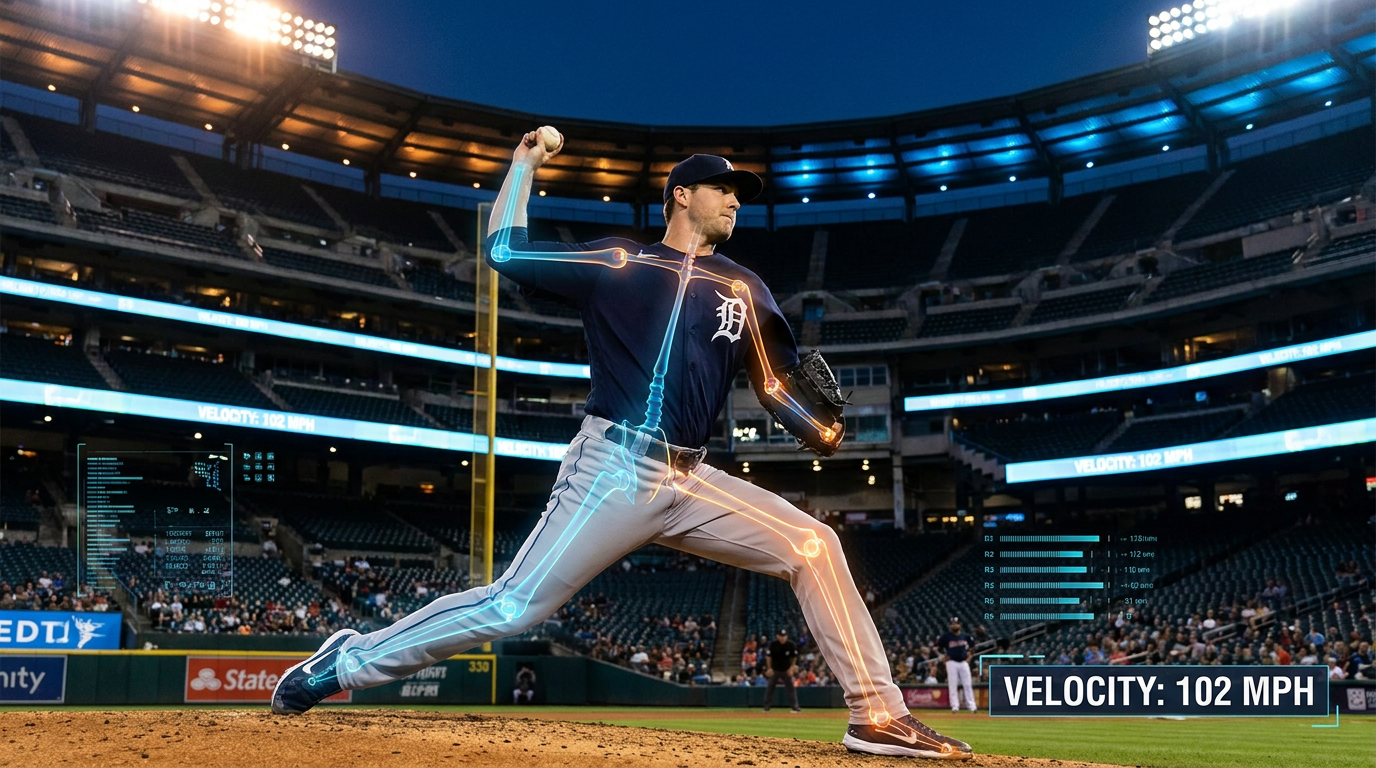
Today, that laboratory has been replaced by the stadium itself. The rapid maturation of markerless motion capture technology has allowed sports scientists to track the skeletal movements of athletes in real-time, during live competition, without attaching a single sensor to their bodies.[1][4]
This shift represents one of the most significant leaps in sports analytics since the invention of the radar gun. By combining high-speed optical tracking with advanced artificial intelligence, teams are no longer just measuring the outcome of a play—they are measuring the microscopic physical processes that created it.[7]
The mechanism relies on arrays of high-speed cameras mounted strategically around a stadium or practice facility. Modern systems, such as those provided by Hawk-Eye and KinaTrax, capture video at staggering rates of 300 to 600 frames per second, ensuring that even the fastest ballistic movements are recorded in crisp detail.[2][6]
As the athlete moves, deep learning algorithms perform a process known as "pose estimation." The AI scans the video feed frame-by-frame, identifying and tracking key anatomical landmarks—shoulders, elbows, hips, and knees—to reconstruct a continuous, three-dimensional digital skeleton of the player in space.[1][4]

The accuracy of these invisible systems is now rivaling traditional methods. A 2025 review from Auburn University published in the journal Sensors confirmed that markerless systems are quickly closing the accuracy gap with optical lab systems, achieving a mean per-joint position error of just 52 millimeters in live stadium environments.[4]
In Major League Baseball, this technology has fundamentally rewired how front offices evaluate talent and protect million-dollar arms. The league has centralized its technology infrastructure, ensuring that high-fidelity biomechanical data is available across both major and minor league ballparks.[2][6]
Historically, baseball analytics focused almost entirely on the ball. Systems like Statcast revolutionized the game by providing precise measurements of pitch velocity, spin rate, and exit velocity. But while ball tracking tells you what happened, it cannot explain how it happened.[2][7]
Now, by integrating Hawk-Eye and KinaTrax data, teams can track the body that produced that ball flight. They can measure the exact degree of trunk tilt, the rotational velocity of the pelvis, and the precise angle of elbow flexion at the moment a pitcher releases a 100-mph fastball.[2][6]
Now, by integrating Hawk-Eye and KinaTrax data, teams can track the body that produced that ball flight.
The stakes for this data are highest in the realm of injury prevention. Modern baseball is plagued by an epidemic of ulnar collateral ligament (UCL) tears, which require grueling Tommy John surgeries and cost pitchers over a year of their careers.[3][7]

By continuously measuring metrics like varus torque—the twisting force applied to the elbow—AI models can detect microscopic changes in a pitcher's mechanics caused by fatigue. If a pitcher's arm slot drops by two degrees over the course of a month, the system flags the anomaly weeks before a ligament actually snaps.[3][5]
Facilities like Driveline Baseball use these exact biomechanical pipelines to help athletes safely push the boundaries of human capability. By identifying movement inefficiencies, coaches can design targeted training programs that add velocity to a fastball or power to a swing without placing additional stress on vulnerable joints.[3]
The basketball world is leveraging similar AI-driven insights to solve its own crisis: the proliferation of lower-body soft tissue injuries. The grueling 82-game NBA schedule places immense cumulative stress on hamstrings, knees, and ankles.[5]
To combat this, NBA franchises are integrating in-game player tracking data with predictive AI platforms. These systems build a "digital twin" of each athlete, analyzing their acceleration rates, deceleration forces, and movement asymmetries to manage their physical load dynamically.[5][7]
The results have been transformative. One case study of a leading NBA franchise revealed a staggering 37% reduction in non-contact lower-body injuries over two seasons after implementing an AI-powered biomechanical analysis system.[5]

The AI system identifies subtle movement inefficiencies—such as a player favoring one leg slightly upon landing—that are entirely invisible to the naked eye. This allows athletic trainers to intervene with targeted physical therapy and modified practice schedules before a minor imbalance becomes a torn Achilles.[5]
Despite the overwhelming medical benefits, the transition to ubiquitous in-game biometric tracking introduces complex friction regarding data ownership and labor rights.[7]
Players and their union representatives are increasingly focused on how predictive injury data might be weaponized during high-stakes contract negotiations. The fear is that algorithms could be used to devalue players based on future probabilities rather than past performance.[7]

If an AI model flags a healthy 22-year-old phenom as having a 60% chance of a catastrophic knee injury within three years due to their landing mechanics, front offices may hesitate to offer the long-term, guaranteed contracts that athletes seek.[7]
How we got here
2015
Statcast launches in MLB, focusing primarily on radar-based ball tracking.
2020
MLB replaces legacy systems with Hawk-Eye for a fully camera-based tracking solution.
2023
Stadium cameras are upgraded to 300+ frames per second to capture detailed pitching and hitting biomechanics.
2025
Peer-reviewed studies confirm markerless stadium systems rival the accuracy of traditional optical labs.
Viewpoints in depth
Sports Scientists & Biomechanists
Prioritize ecological validity and the ability to capture natural movement at scale.
For decades, biomechanists were forced to compromise. They could get highly accurate data in a lab, but athletes rarely move in a sterile lab exactly as they do in a Game 7 scenario. Markerless technology solves this by bringing the lab to the field. Researchers emphasize that capturing thousands of natural, in-game movements provides a vastly superior dataset for understanding the true mechanics of elite performance and injury mechanisms.
Front Office Executives & Coaches
Focus on asset protection, roster availability, and performance optimization.
To a general manager, a star player on the injured list represents millions of dollars in lost value and a direct threat to championship aspirations. Front offices view AI-driven biomechanics as an insurance policy. By integrating markerless motion capture with load management algorithms, teams can optimize practice schedules, identify mechanical flaws that limit velocity, and intervene before a minor fatigue issue becomes a season-ending surgery.
Players & Union Advocates
Value career extension but harbor deep concerns regarding data privacy and contract leverage.
Athletes generally welcome technology that helps them stay healthy and maximize their earning potential. However, player unions are increasingly wary of the surveillance aspect of ubiquitous biometric tracking. Advocates argue that predictive injury models could be weaponized by teams during contract negotiations, potentially costing a player guaranteed money if an AI algorithm flags them as a high risk for future injury, even if they are currently healthy.
What we don't know
- How collective bargaining agreements will regulate the use of predictive injury data in future contract negotiations.
- Whether the massive influx of biomechanical data will eventually lead to standardized, league-wide mechanical profiles.
- How quickly this enterprise-grade technology will become affordable enough for widespread high school and youth sports adoption.
Key terms
- Pose Estimation
- A computer vision technique that uses AI to detect and track the spatial locations of key body joints in video footage.
- Varus Torque
- The twisting force applied to the elbow joint during a throwing motion, heavily monitored to prevent ulnar collateral ligament (UCL) injuries.
- Ecological Validity
- The degree to which a testing environment reflects real-world conditions; in sports, it means capturing data during actual competition rather than in a lab.
- Digital Twin
- A virtual, data-driven replica of an athlete's biomechanics used to simulate training loads and predict injury risks.
Frequently asked
What is markerless motion capture?
It is a technology that uses high-speed cameras and artificial intelligence to track an athlete's skeletal movements without requiring them to wear physical sensors or reflective markers.
How does AI prevent sports injuries?
AI algorithms analyze biomechanical data and training loads to identify subtle movement inefficiencies or fatigue patterns that precede injuries, allowing teams to intervene before a tear occurs.
Are these systems used during actual games?
Yes. Unlike traditional lab-based motion capture, markerless systems like Hawk-Eye and KinaTrax are installed directly in stadiums to capture authentic, in-game biomechanics.
Sources
Source coverage
7 outlets
3 viewpoints surfaced







[1]Journal of Sports SciencesSports Scientists
Markerless motion capture technology for human movement analysis in sports
Read on Journal of Sports Sciences →[2]Sports Business JournalFront Office Executives
MLB plans expansion of Hawk-Eye tracking, fielding metrics
Read on Sports Business Journal →[3]Driveline BaseballFront Office Executives
Applied Biomechanics and Markerless Motion Capture
Read on Driveline Baseball →[4]Sensors JournalSports Scientists
A Decade of Sports Validation: Which Motion Capture Tech Performs Best?
Read on Sensors Journal →[5]Casper AIPlayers & Union Advocates
AI Injury Prevention in Professional Sports
Read on Casper AI →[6]San Juan Daily StarFront Office Executives
MLB Centralizes Minor League Tech, Sparking Vendor Debate
Read on San Juan Daily Star →[7]Factlen Editorial TeamSports Scientists
Synthesis by Factlen editorial team
Read on Factlen Editorial Team →

More in sports
See all 7 stories →F1 2026 Rules
How Formula 1's 2026 Regulations Will Radically Reshape the Sport
7 sources
Knicks Basketball
New York Knicks Win 2026 NBA Finals, Ending 53-Year Championship Drought
8 sources
Gymnastics Longevity
How the NCAA Crossover and Sports Science Are Rewriting Gymnastics Longevity
6 sources

Player Safety
NWSL Becomes First U.S. Pro League to Mandate CPR Training Following Savy King's On-Field Collapse
7 sources

Every angle. Every day.
Get sports stories with full source coverage and perspective breakdowns delivered to your inbox.