
The 'Dad Brain' Is Real: How Fatherhood Rapidly Rewires Men's Brains
Recent neuroimaging studies reveal that fathers undergo profound structural brain changes in the first weeks of parenthood, driven entirely by the act of caregiving.
By Factlen Editorial Team

- Neuroscientists & Researchers
- Argues that paternal brain changes are an evolutionary adaptation driven by the act of caregiving, not just biology.
- Public Health Advocates
- Argues that biological evidence of 'patrescence' necessitates structural support like paid paternity leave and mental health screening for fathers.
- Parenting Psychologists
- Focuses on the lived experience of fathers, validating that the neural rewiring brings both profound bonding and significant emotional distress.
What's not represented
- · Single fathers
- · Adoptive fathers
Why this matters
Understanding the biological reality of 'patrescence' challenges the outdated idea that fathers are merely secondary helpers. It provides scientific backing for paid paternity leave and highlights the critical need to support men's mental health during the transition to parenthood.
Key points
- Neuroimaging confirms that fathers experience rapid structural brain changes, similar to the 'matrescence' seen in mothers.
- The most intensive neural reorganization occurs in the first six to nine weeks postpartum.
- Brain changes are triggered by the hands-on experience of caregiving, not the biological act of gestation.
- Fathers experience a drop in testosterone and a rise in prolactin, hormones that promote nurturing and bonding.
- While these adaptations increase attachment, they also make fathers more susceptible to sleep disturbance and postpartum depression.
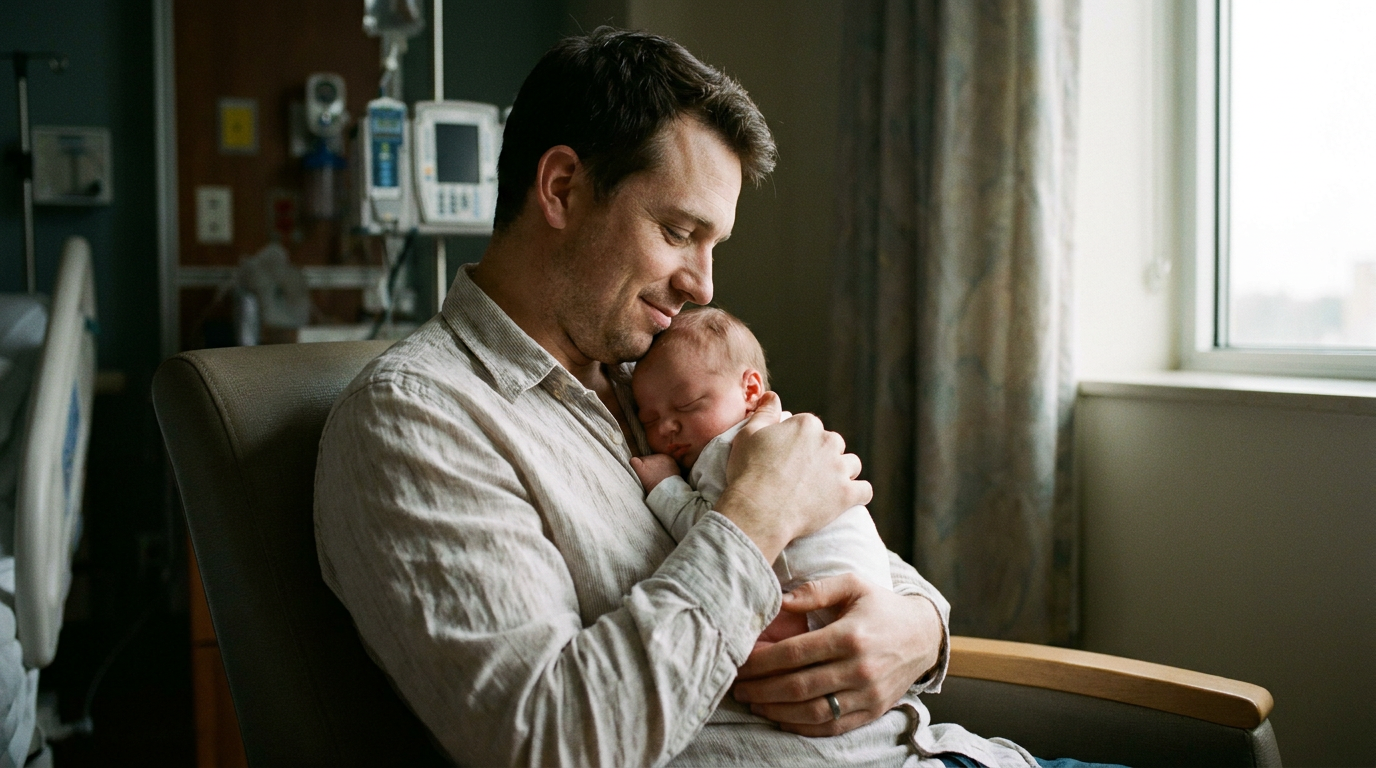
The cultural trope of the bumbling dad or the secondary "helper" is deeply ingrained in modern parenting narratives. For decades, society has treated the mother as the biological default for caregiving, while framing the father's role as supplementary. But a wave of new neuroimaging research is dismantling that assumption, proving that fatherhood is not just a social transition—it is a profound biological transformation.[1][2]
Scientists have long understood "matrescence," the intense physical and neural rewiring that women undergo during pregnancy and childbirth. Now, researchers are mapping a parallel phenomenon in men: "patrescence." Recent studies confirm that a father's brain undergoes rapid structural and functional changes after bringing home a new baby, adapting to the intense demands of caregiving in ways that mirror the maternal brain.[1][4][6]
The most striking evidence comes from a 2026 longitudinal study published in Translational Psychiatry, which tracked 25 first-time fathers through their first six months postpartum. Researchers conducted MRI scans at six different intervals, starting in the first week after birth. They discovered that the paternal brain does not change gradually; rather, it undergoes a massive, rapid reorganization.[3][5]
This critical window of neuroplasticity peaks between six and nine weeks postpartum. During this period, fathers experience significant reductions in gray matter volume across the frontal, temporal, and parietal lobes. While "losing brain volume" might sound alarming, neuroscientists explain that this is actually a highly efficient pruning process. The brain is shedding redundant connections to streamline the circuits necessary for a demanding new environment, much like the neural pruning that occurs during adolescence.[3][4][5][6]

As the brain refines its architecture, it also shifts its functional priorities. The 2026 study found that a father's neural networks pivot away from raw sensory processing and toward higher-order emotional and cognitive control. The salience network, which helps the brain flag important information and coordinate rapid responses, becomes hyper-active. For a new parent, this means an enhanced ability to instantly interpret a baby's cry or facial expression without needing verbal feedback.[3][5]
At the center of this emotional rewiring is the amygdala, the brain's hub for attachment, vigilance, and threat detection. Researchers observed that the amygdala forms stronger connections with the hippocampus and the anterior cingulate cortex in new fathers. Crucially, the men who exhibited the largest increases in amygdala connectivity also reported the strongest feelings of attachment to their infants. The brain is literally building the infrastructure for love and protective instinct.[3][5]
These structural changes are accompanied by a dramatic shift in paternal hormones. Washington Post science journalist Richard Sima notes that while fatherhood is conventionally associated with traditional masculinity, the biological reality is quite different. Fathers experience a significant drop in testosterone levels in the months following birth, a shift that reduces aggression and promotes nurturing behaviors.[1][2]
These structural changes are accompanied by a dramatic shift in paternal hormones.
Simultaneously, fathers experience an increase in prolactin—a hormone most famous for stimulating milk production in nursing mothers. In men, elevated prolactin is strongly linked to responsive caregiving and a lower threshold for reacting to infant cries. These hormonal tides work in tandem with the brain's structural changes to ensure the father is biologically primed to keep a vulnerable infant alive.[1][2]

Perhaps the most fascinating revelation from recent research is the trigger for these changes. The paternal brain is not rewired by the biological act of gestation; it is rewired by the physical act of caregiving. The brain, it turns out, responds to the environment it is forced to navigate.[4][6]
Studies comparing different cultural norms around parenting highlight this mechanism. In societies where fathers are expected to be highly hands-on—changing diapers, soothing, feeding, and holding the baby—men exhibit much more pronounced hormonal and neural shifts. Conversely, in cultures where childcare is strictly relegated to mothers, fathers show significantly less neuroplasticity. The more time a man spends in the primary caregiver role, the more his brain adapts to support that role.[1][6]

However, researchers caution against viewing these biological adaptations through a purely utopian lens. Psychologist Darby Saxbe, who leads the Center for the Changing Family at the University of Southern California, describes the neural changes of fatherhood as a "mixed bag." The brain is adapting to survive a grueling period, and those adaptations carry a cost.[4][6]
In her research, Saxbe found that fathers who lost the most cortical brain volume—indicating the highest degree of neural adaptation—were the most motivated to engage in parenthood and spent the most time with their infants. But these same highly-adapted fathers also reported the highest rates of sleep disturbance, feelings of isolation, and symptoms of postpartum depression.[4][6]
This duality perfectly mirrors the maternal experience. If fathers' brains are changing in ways that resemble mothers' brains, they are equally susceptible to the crushing exhaustion and loneliness that mothers have historically shouldered alone. The biological reality of patrescence means that men are not immune to postpartum mood disorders, a reality that the medical community is only just beginning to screen for.[6]

The confirmation of the "dad brain" has profound implications for public policy and workplace culture. If the most intensive neural reorganization happens in the first six to nine weeks of a child's life, and if that rewiring is dependent on hands-on caregiving, then denying fathers paid paternity leave actively suppresses their biological transition to parenthood. Expecting a man to return to a high-stress job days after his child is born interrupts a critical window of neuroplasticity.[2][5][6]
Ultimately, the science of the paternal brain validates what many modern fathers already know: they are wired to be equal partners, not just helpers. By acknowledging that fatherhood is a profound biological event, society can begin to build the support systems necessary to protect the mental health of both parents, ensuring that the parental brain can adapt, bond, and thrive.[4][5][6]
How we got here
2014
Early studies demonstrate that fathers involved in direct caregiving exhibit similar neural responses to infant stimuli as primary caregiving mothers.
2022
USC researchers publish evidence of cortical changes and the emergence of a 'dad brain' in first-time fathers.
2024
Studies link paternal brain changes to a 'mixed bag' of increased bonding but higher rates of postpartum distress.
May 2026
A landmark longitudinal study pinpoints the first 6 to 9 weeks postpartum as the critical window for rapid paternal neuroplasticity.
Viewpoints in depth
The Neurobiological View
Focuses on the evolutionary mechanics of the paternal brain.
Neuroscientists view the 'dad brain' as a marvel of evolutionary adaptation. They emphasize that the brain's plasticity is not strictly tied to the biological act of gestation, but rather to the environmental demands of keeping an infant alive. By pruning gray matter and hyper-connecting the amygdala, the brain is ruthlessly optimizing for empathy, threat detection, and emotional regulation. This camp stresses that caregiving itself is the trigger, proving that human males are biologically designed to be primary caregivers when the environment demands it.
The Public Health View
Focuses on the policy implications of paternal neuroplasticity.
For public health advocates and sociologists, the biological reality of patrescence is a mandate for policy reform. If the most critical window for a father's brain to adapt to his new role occurs in the first six to nine weeks, then denying men paid paternity leave is actively harmful to family development. This perspective argues that our current economic structures—which often force fathers back to work within days of a birth—interrupt a vital biological process, setting fathers up for failure and exacerbating maternal burnout.
The Psychological View
Focuses on the mental health toll of the transition to fatherhood.
Psychologists and family therapists focus on the 'mixed bag' of paternal brain changes. While society often romanticizes the bonding aspect of fatherhood, this camp highlights the costs of neuroplasticity. The same brain changes that make a father hyper-attuned to his baby also make him highly susceptible to sleep deprivation, anxiety, and postpartum depression. They argue that validating 'patrescence' is crucial for removing the stigma around paternal mental health struggles, ensuring fathers receive the same screening and support as mothers.
What we don't know
- Whether the structural brain changes observed in the first six months of fatherhood are permanent or if they revert over time.
- How neuroplasticity differs in adoptive fathers or non-biological caregivers compared to biological fathers.
- The exact causal direction between brain volume loss and postpartum depression in men.
Key terms
- Patrescence
- The developmental transition to fatherhood, encompassing physical, psychological, and emotional changes.
- Neuroplasticity
- The brain's ability to reorganize itself by forming new neural connections in response to learning or experience.
- Amygdala
- A small, almond-shaped region of the brain primarily responsible for processing emotions, attachment, and threat detection.
- Salience Network
- A collection of brain regions that work together to identify which stimuli in the environment are most important and worthy of attention.
- Prolactin
- A hormone traditionally associated with milk production in mothers, but which also rises in fathers to promote caregiving behaviors.
Frequently asked
Do fathers' brains change as much as mothers' brains?
While mothers experience unique changes driven by pregnancy, fathers who act as primary caregivers show strikingly similar patterns of cortical remodeling and emotional network activation.
What causes the brain to change if fathers don't give birth?
The changes are driven by the intense, hands-on experience of caregiving, which triggers hormonal shifts and forces the brain to adapt to the demands of a newborn.
Does losing gray matter mean fathers become forgetful?
Not necessarily. The loss of gray matter volume is actually a 'pruning' process that makes the brain more efficient at essential parenting tasks, like reading a baby's cues.
Sources
Source coverage
6 outlets
3 viewpoints surfaced






[1]NPRPublic Health Advocates
Recent studies show fathers' brains change after bringing home a new baby
Read on NPR →[2]The Washington PostPublic Health Advocates
‘Dad brain’ is real. Here’s how fatherhood changes a man’s brain.
Read on The Washington Post →[3]Translational PsychiatryNeuroscientists & Researchers
Longitudinal alterations in resting-state functional connectivity across large-scale networks in fathers during the early postpartum period
Read on Translational Psychiatry →[4]USC DornsifeNeuroscientists & Researchers
Dad brain is real: Study reveals men’s brains change after baby arrives
Read on USC Dornsife →[5]Science XNeuroscientists & Researchers
The first few weeks of fatherhood don't just change lives—they rapidly rewire men's brains
Read on Science X →[6]Early Childhood MattersParenting Psychologists
“Dad brain” is real: How fatherhood changes the brain
Read on Early Childhood Matters →
More in health
See all 8 stories →Gut-Brain Axis
The Gut-Brain Axis: How Psychobiotics and Nutrition Shape Mental Health
6 sources

Paternal Health
How Fatherhood Physically Rewires the Brain
7 sources

Cognitive Longevity
Why Science is Rebranding Creatine as a Brain Health Supplement
6 sources

Chrononutrition
Chrononutrition: How Aligning Meal Times With Your Circadian Rhythm Optimizes Metabolic Health
6 sources

Every angle. Every day.
Get health stories with full source coverage and perspective breakdowns delivered to your inbox.