
How Fatherhood Physically Rewires the Brain
New neurobiological research reveals that highly engaged fathers undergo profound brain restructuring, streamlining neural pathways to optimize for empathy and infant bonding.
By Factlen Editorial Team

- Neuroscientists
- Focus on the evolutionary adaptation of the brain, viewing gray matter reduction as an optimization for caregiving.
- Public Health Advocates
- Emphasize the mental health vulnerabilities exposed by neuroplasticity and the need for clinical screening for fathers.
- Family Policy Experts
- Argue that the biological reality of paternal brain changes necessitates robust paid paternity leave policies.
What's not represented
- · Adoptive and non-gestational parents whose brain changes rely entirely on caregiving engagement rather than biological triggers.
- · Employers navigating the economic impact of expanding paid paternity leave to support this developmental window.
Why this matters
Understanding that fatherhood physically rewires the brain validates the intense emotional and psychological shifts men experience postpartum. It also provides hard biological evidence that paid paternity leave is a medical and developmental necessity, not just a workplace perk.
Key points
- New research confirms that a father's brain physically restructures itself in response to the demands of parenthood.
- Fathers experience a reduction in gray matter volume, a process of synaptic pruning that optimizes the brain for empathy and infant bonding.
- The most rapid neurological rewiring occurs during the first six weeks postpartum.
- The extent of a father's brain changes is directly correlated with how much time he spends actively caregiving.
- This neuroplasticity heightens emotional attunement but also increases the risk of paternal postpartum depression, which affects 1 in 10 men.
The birth of a child is universally recognized as a profound life transition. For mothers, the biological and neurological changes are well documented, often described by researchers as a "second puberty" that fundamentally reshapes the brain and body.[2]
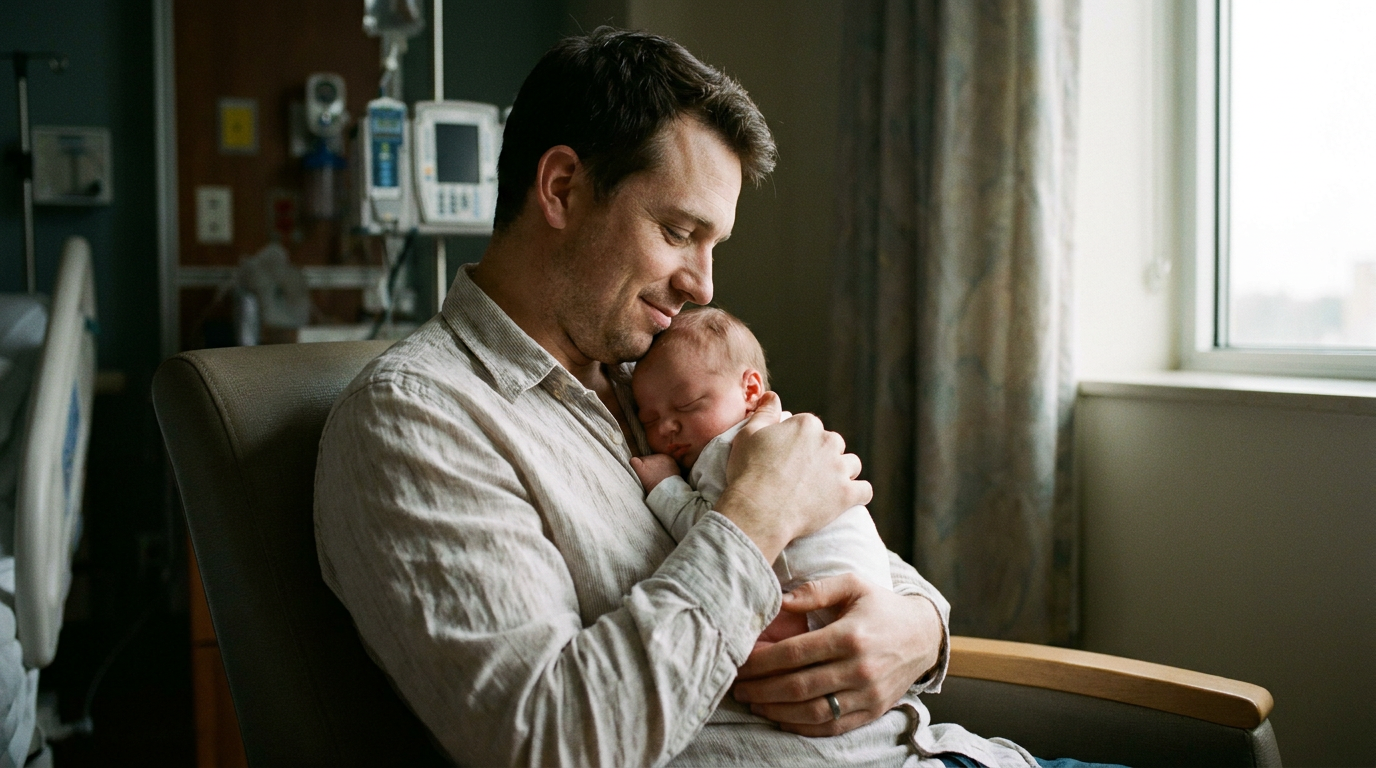
But a growing body of neurobiological research is revealing that fathers, too, undergo a dramatic biological transformation. Even without experiencing pregnancy or childbirth, a new father's brain physically restructures itself in response to the demands of parenthood.[1][2]
This phenomenon, increasingly referred to as "dad brain," challenges the long-held assumption that paternal bonding is purely psychological or socially learned. Instead, scientists are discovering that highly engaged caregiving triggers a cascade of neuroplasticity, permanently altering the male brain's architecture to optimize it for empathy, vigilance, and connection.[2][5]
The most striking evidence comes from recent longitudinal brain-imaging studies. When researchers scan the brains of first-time fathers before and after the birth of their child, they observe significant reductions in gray matter volume.[5][6]

To a layperson, the idea of a "shrinking" brain might sound alarming, often jokingly conflated with the forgetfulness and brain fog of severe sleep deprivation. However, neuroscientists emphasize that this loss of gray matter is actually a highly adaptive process of synaptic pruning.[2][4]
"Shrinking sounds bad, but it's not," explains Negin Daneshnia, a psychologist at RWTH Aachen University in Germany who studies paternal neuroplasticity. "It's usually a requirement for optimization of the brain." Much like editing a sprawling manuscript into a tight, focused narrative, the brain trims away extraneous neural connections to make essential pathways more efficient.[2][5]
These structural changes are heavily concentrated in the brain's "mentalizing network"—the regions responsible for social cognition, empathy, and interpreting the thoughts and intentions of others. By streamlining these areas, a father's brain becomes acutely tuned to the nonverbal cues of a vulnerable infant.[2][4][5]
A landmark 2026 study conducted by researchers at RWTH Aachen University tracked 25 fathers over the first six months postpartum, capturing this neurological remodeling in real time. The study revealed that the paternal brain does not change all at once, but rather follows a dynamic, moving sequence.[3][4]
The study revealed that the paternal brain does not change all at once, but rather follows a dynamic, moving sequence.
The most rapid and widespread rewiring occurs during the first six weeks after childbirth. During this critical window, fathers exhibited significant gray matter reductions across the frontal, temporal, parietal, and occipital lobes.[3][4]

However, the trajectory shifts as the infant grows. Between 12 and 24 weeks postpartum, the researchers observed that certain brain regions—particularly in the frontal cortex and cerebellum—actually began to swell and increase in volume.[3][4]
Alongside these structural shifts, the brain's internal communication networks also reorganize. The Aachen study found that fathers' brains shifted connectivity toward higher cognitive and emotional processing centers, strengthening the circuits involved in parental motivation and reward.[2][4]
Crucially, these neurological changes are not automatic; they are deeply tied to a father's level of engagement. Research led by Darby Saxbe, a professor of psychology at the University of Southern California, demonstrates a direct correlation between a father's hands-on caregiving and the extent of his brain's neuroplasticity.[2][5]
"The more dads wanted to engage in parenting and were invested in it, the more the brain changed," Saxbe noted. Fathers who spent more time interacting with their infants showed the most pronounced structural remodeling and reported stronger, more affectionate bonds with their children.[2][5]

This biological remodeling, while beneficial for infant care, also exposes new vulnerabilities. The same neuroplasticity that heightens a father's empathy and vigilance can also increase his susceptibility to mental health struggles.[2][5]
Paternal postpartum depression is a recognized clinical reality, affecting approximately 1 in 10 new fathers—compared to up to 1 in 5 new mothers. The intense neurological transition, combined with severe sleep deprivation and the psychological weight of new responsibilities, can overwhelm the newly sensitized brain.[2][5][6]
Saxbe's research indicates that fathers who experience the most significant brain changes often report higher levels of parenting stress and fatigue, underscoring that deep engagement brings both profound rewards and substantial strain.[5]

These findings have significant implications for public health and family policy. If a father's brain requires active caregiving to trigger this vital neurobiological remodeling, then policies that separate fathers from their newborns—such as a lack of paid paternity leave—may actively hinder this developmental window.[5][7]
Access to paid leave allows fathers the time necessary to engage in the intensive interactions that drive synaptic pruning and network reorganization. Studies consistently show that when fathers take leave, it not only lowers their own stress levels but also reduces the risk of postpartum depression in mothers.[5][7]
How we got here
2012–2014
Early fMRI studies begin showing overlapping brain activity in mothers and fathers when viewing their infants.
2023
Research links paternal brain volume changes to the strength of the father-infant bond and parenting stress.
2024
Studies confirm that gray matter reduction in fathers correlates directly with the amount of time spent actively caregiving.
May 2026
A landmark longitudinal study from RWTH Aachen University maps the exact week-by-week timeline of paternal neuroplasticity over the first six months.
Viewpoints in depth
Neuroscientists' view
Focuses on the evolutionary adaptation of the brain, viewing structural changes as an optimization for caregiving.
Researchers in this camp emphasize that the reduction of gray matter in a new father's brain is a feature, not a bug. By pruning away extraneous neural connections, the brain becomes leaner and more efficient at processing the specific social and emotional cues required to keep a vulnerable infant alive. They view this neuroplasticity as proof that humans are biologically wired for cooperative, highly engaged parenting.
Mental Health Advocates' view
Highlights the vulnerability of this period, noting that neuroplasticity increases the risk of mood disorders.
Mental health professionals point out that the same neurological rewiring that allows for deep bonding also opens the door to paternal postpartum depression. Because the brain is in a state of heightened sensitivity and flux, the compounding factors of sleep deprivation and new responsibilities can easily overwhelm the system. This camp argues for routine mental health screenings for new fathers, treating the postpartum period as a critical medical window for both parents.
Family Policy Experts' view
Argues that biological evidence of 'dad brain' makes paid paternity leave a medical and developmental necessity.
Policy advocates use this neurobiological data to argue that paid paternity leave is not merely a workplace perk, but a public health imperative. Because a father's brain requires active, hands-on caregiving to trigger this vital neuroplasticity, policies that force men back to work immediately after birth actively interrupt a critical biological process. They argue that supporting fathers with paid leave ultimately benefits the cognitive development of the child and the mental health of the entire family unit.
What we don't know
- Whether the paternal brain eventually reverts to its pre-parenthood structure, or if these neurological changes are permanent.
- Exactly how severe sleep deprivation interacts with and potentially alters the trajectory of this neuroplasticity.
- The precise hormonal triggers that initiate these brain changes in non-gestational and adoptive parents.
Key terms
- Neuroplasticity
- The brain's ability to reorganize itself by forming new neural connections in response to learning, experience, or major life changes.
- Mentalizing Network
- A specific group of brain regions involved in understanding and interpreting the thoughts, feelings, and intentions of other people.
- Gray Matter
- Brain tissue made up of neuronal cell bodies, which is heavily involved in sensory perception, memory, emotions, and decision-making.
- Synaptic Pruning
- A natural biological process where the brain eliminates extra or unused synapses to increase the efficiency of essential neural transmissions.
- Postpartum Depression
- A complex mix of physical, emotional, and behavioral changes that happen after childbirth, which can affect both mothers and fathers.
Frequently asked
Does a father's brain actually shrink?
Yes, fathers experience a reduction in gray matter volume. However, neuroscientists emphasize this is a positive 'pruning' process that makes the brain more efficient, not a sign of cognitive decline.
Do these changes happen to adoptive fathers?
Research suggests that active engagement and caregiving drive these neurological changes, meaning any highly involved parent can experience this neuroplasticity, regardless of biological relation.
Is 'dad brain' the reason for forgetfulness?
While new parents often feel foggy due to severe sleep deprivation, the structural brain changes of 'dad brain' are actually optimizing the brain for empathy and infant care, not causing memory loss.
Does the father's brain eventually go back to normal?
It remains unclear if the brain fully reverts. Some studies in mothers show changes lasting for years, and researchers are currently conducting long-term follow-ups on fathers to find out.
Sources
Source coverage
7 outlets
3 viewpoints surfaced







[1]NPRPublic Health Advocates
Recent studies show fathers' brains change after bringing home a new baby
Read on NPR →[2]The Washington PostPublic Health Advocates
The surprising science of how fatherhood changes the brain
Read on The Washington Post →[3]ScienceAlertNeuroscientists
Fathers' Brains Undergo Massive Rewiring After Birth of a Baby
Read on ScienceAlert →[4]ZME ScienceNeuroscientists
Fatherhood profoundly rewires the brain, just like motherhood
Read on ZME Science →[5]USC DornsifeNeuroscientists
'Dad brain' is real. It's reshaping our understanding of fatherhood.
Read on USC Dornsife →[6]National Institutes of HealthNeuroscientists
Longitudinal changes in gray matter volume during the first 4 months postpartum in human fathers
Read on National Institutes of Health →[7]Factlen Editorial TeamFamily Policy Experts
Synthesis by Factlen editorial team
Read on Factlen Editorial Team →


Every angle. Every day.
Get health stories with full source coverage and perspective breakdowns delivered to your inbox.