
How AI and Drones Are Revolutionizing Global Landmine Clearance
By combining sub-centimeter drone imagery with deep learning models, organizations are dramatically accelerating the detection and neutralization of unexploded ordnance. The technology is shrinking clearance timelines from decades to years while removing humans from the blast radius.
By Factlen Editorial Team
- Humanitarian Demining Organizations
- Focus on returning safe land to civilians, emphasizing that AI is a tool to assist, not replace, human judgment.
- Defense Technology Developers
- Focus on the speed, accuracy, and scalability of AI, pushing for fully autonomous detection and remote neutralization.
- Military Ordnance Teams
- Focus on force protection, rapid deployment, and the ability to retrain AI models on the fly for new battlefield threats.
- Academic Researchers
- Focus on the underlying algorithms, sensor fusion, and publishing open-source datasets to improve detection accuracy.
What's not represented
- · Local farmers in contaminated regions
- · Environmental scientists monitoring soil impact
Why this matters
For decades, clearing landmines has been a terrifyingly slow process done by hand, leaving millions of acres of farmland unusable and causing thousands of civilian casualties annually. The integration of AI and drones is fundamentally changing this math, promising to return safe land to communities exponentially faster while protecting the lives of demining teams.
Key points
- Globally, an estimated 60 million landmines remain buried, rendering massive tracts of land unusable.
- AI-powered drones using LiDAR and thermal imaging are replacing slow, dangerous manual detection methods.
- The HALO Trust used AI and satellite data to shrink Ukraine's suspected danger zone from the size of Florida to the size of Massachusetts.
- Machine learning models can now identify over 150 types of munitions in milliseconds.
- New heavy-lift drone systems are being developed to remotely drop detonating cords, neutralizing mines without human exposure.
- Experts caution that AI struggles with deeply buried mines and cannot entirely replace human deminers.
Across the globe, an estimated 60 million landmines remain buried in the soil of more than 60 countries, acting as a lethal, lingering echo of past conflicts. For decades, the protocol for neutralizing these threats has remained stubbornly rooted in the twentieth century: a trained technician walking inch by inch with a metal detector and a probe. It is a terrifyingly slow, physically exhausting, and inherently deadly process that has failed to keep pace with the rate at which new munitions are deployed.[3][6][7]
However, a convergence of commercial drone technology, cloud computing, and computer vision is fundamentally altering the math of mine clearance. Over the past two years, artificial intelligence has moved from theoretical academic research into active field deployment, transforming how both humanitarian organizations and military units approach unexploded ordnance (UXO).[2][7]
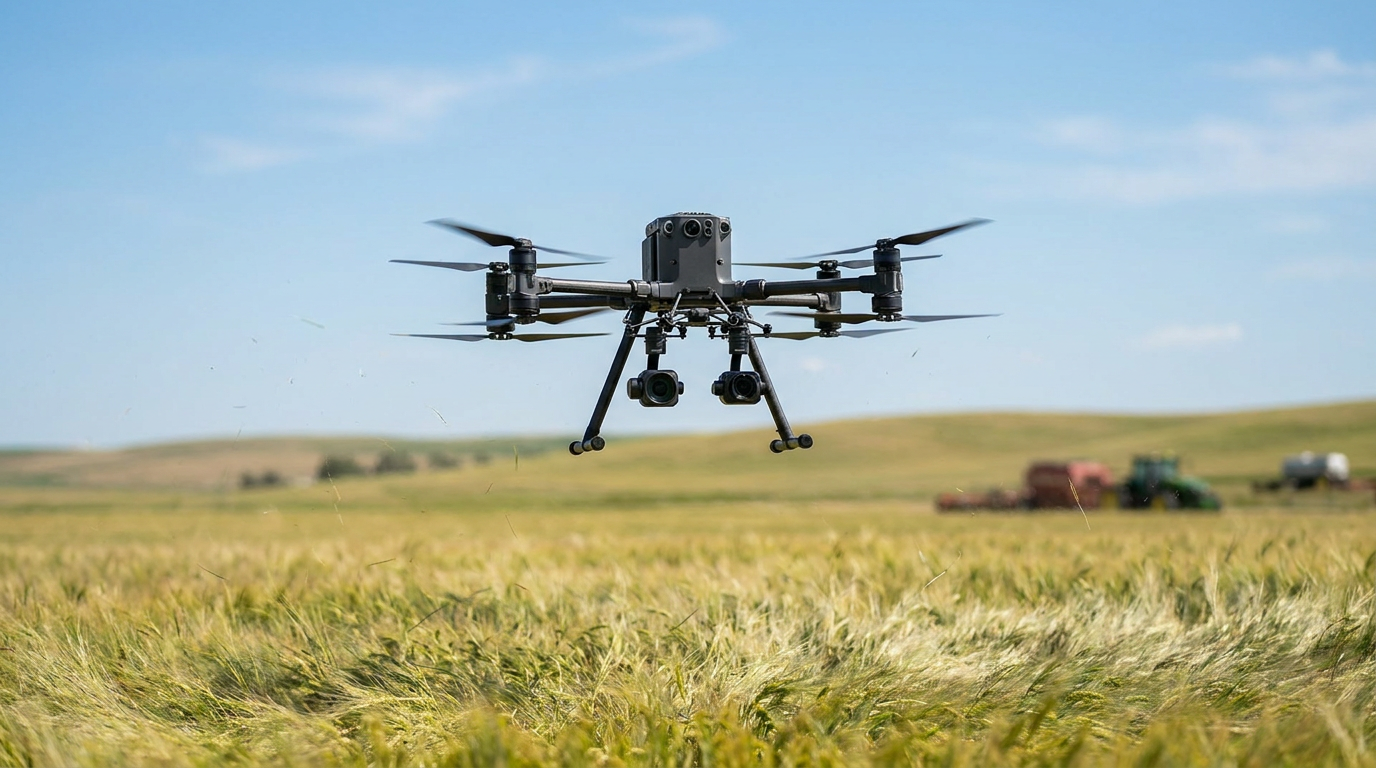
The core mechanism relies on multi-sensor data fusion. Commercial off-the-shelf drones are equipped with a suite of advanced sensors, including LiDAR, thermal imaging, and multispectral cameras. As these drones fly over suspected hazardous areas, they capture sub-centimeter-resolution imagery. This raw data is then fed into deep learning models—specifically Convolutional Neural Networks (CNNs)—that have been trained on vast datasets of known explosives.[7]

The most immediate and profound impact of this technology is not just finding mines, but proving where they are not. In the demining industry, this is known as "land release," and AI is accelerating it exponentially by allowing teams to safely cancel out massive swaths of suspected danger zones without ever stepping foot on the ground.[1]
The HALO Trust, the world's largest humanitarian mine clearance organization, has been utilizing this approach to tackle the massive contamination in Ukraine. By pairing satellite data from Planet Labs with their own drone imagery, and processing it through Amazon Web Services' analytical AI tools, HALO has been able to forensically map safe zones.[1]
Original estimates suggested that 174,000 square kilometers of Ukraine—an area roughly the size of Florida—were contaminated with explosives. By using geospatial AI to confidently cancel out areas that show no evidence of ordnance, that estimate has been shrunk to an area the size of Massachusetts, allowing thousands of civilians to return to their farms and homes.[1]

When the AI does detect anomalies, its speed and accuracy are unprecedented. Systems like the IRIS drone, developed by British firm Fenix Insight, can survey contaminated areas and identify UXO threats in milliseconds. These machine learning models can identify specific munitions with high precision, even when they are partially obscured by vegetation or terrain.[5][7]
When the AI does detect anomalies, its speed and accuracy are unprecedented.
Safe Pro Group, a developer of AI-powered threat detection, has analyzed over a million drone images in Ukraine using its SPOTD (Safe Pro Object Threat Detection) system. The platform has identified more than 23,000 explosive threats across 5,300 hectares of land. The model can instantly classify over 150 types of landmines, cluster munitions, and projectiles, processing each high-resolution image in less than a second.[2]
This capability is now crossing over from post-conflict humanitarian use to active military deployment. The US Army has shortlisted Safe Pro's AI object detection software for its Short Range Reconnaissance drone program, aiming to give frontline troops instantaneous threat detection capabilities.[2]
Similarly, the British Army and the Defence Science and Technology Laboratory (Dstl) recently concluded "Project GARA" trials in Essex. During the exercises, AI-enabled drones successfully located dozens of replica explosive devices scattered across varied terrain.[4]

Crucially, the British trials proved that AI models can be rapidly retrained at the tactical edge. In modern conflicts, where adversaries constantly iterate on the design of improvised explosive devices, the ability to update an AI model's threat library in real-time and push it to a drone fleet is a vital force-protection breakthrough.[4]
Beyond detection, the industry is now pushing toward remote neutralization. If drones can act as the eyes of a demining operation, heavy-lift UAVs are beginning to act as the hands.[8]
Canadian drone manufacturer Draganfly has partnered with Autonome Labs to deploy the MAGIC (Mine and Ground Inert Clearance) system. A heavy-lift drone, capable of carrying up to 27 kilograms, flies over an AI-identified mine and drops a reusable carbon-fiber rod attached to a coiled detonating cord.[8]

This mechanism allows for the precise, remote detonation of explosives without a human technician ever needing to step into the blast radius. Initial integration of the MAGIC system is currently underway, with pilot programs slated for post-conflict regions later this year.[8]
Despite these rapid advancements, experts caution that the technology has strict physical limitations. AI and thermal imaging struggle significantly with deeply buried mines, dense jungle canopies, and heavily silted underwater environments. Furthermore, modern high-tech mines are increasingly equipped with magnetic influence sensors that can detonate if a drone flies too low.[6][7]
The consensus among humanitarian organizations is that AI is a powerful force multiplier, but not a complete replacement for human expertise. As the UN Mine Action Service notes, drones and AI are incredibly effective at shrinking the haystack, but trained human deminers are still required to safely pull out the needles.[6]
How we got here
2014-2022
Traditional manual demining methods struggle to keep pace with rapid contamination in modern conflict zones.
2024
AI models begin processing large-scale drone imagery, moving from academic research to active field trials.
2025
Organizations like Safe Pro and the HALO Trust deploy cloud-based AI mapping in Ukraine, drastically reducing suspected hazard zones.
Early 2026
Military trials, such as the British Army's Project GARA, successfully test rapidly retrainable AI models at the tactical edge.
Viewpoints in depth
Humanitarian Demining Organizations
Focus on returning safe land to civilians and emphasize that AI is a tool to assist, not replace, human judgment.
Groups like the HALO Trust and the UN Mine Action Service view the primary value of AI not in finding every single mine, but in "canceling" safe land. By quickly proving a field is clear, they can return it to farmers months or years faster. However, they caution against over-reliance on technology, noting that no algorithm can fully replace the physical verification required to guarantee a schoolyard is safe.
Defense Technology Developers
Focus on the speed, accuracy, and scalability of AI, pushing for fully autonomous detection and neutralization.
Companies like Safe Pro and Draganfly approach the problem as a massive data challenge. By feeding millions of sub-centimeter drone images into deep learning models, they argue that AI can already spot anomalies faster and more accurately than the human eye. Their ultimate goal is to remove humans from the minefield entirely, using heavy-lift drones to both identify and detonate threats remotely.
Military Ordnance Teams
Focus on force protection, rapid deployment, and adapting to new battlefield threats in real-time.
For active military units, the priority is clearing paths for maneuverability under fire. Trials by the British Army demonstrate that the true breakthrough is the ability to retrain AI models at the tactical edge. When an adversary deploys a novel type of improvised explosive device (IED), the model can be updated in hours, instantly sharing the new threat profile across the entire drone fleet.
What we don't know
- It remains unclear how effectively AI models can adapt to heavily forested or jungle environments where aerial sensors cannot penetrate the canopy.
- The long-term cost-effectiveness of deploying proprietary AI cloud infrastructure in underfunded developing nations is still being evaluated.
- It is unknown how quickly adversaries will develop new countermeasures, such as drone-jamming tech or AI-evading camouflage for explosives.
Key terms
- UXO (Unexploded Ordnance)
- Explosive weapons such as bombs, shells, and grenades that did not explode when they were deployed and still pose a lethal risk.
- LiDAR
- A remote sensing method that uses light in the form of a pulsed laser to measure variable distances to the Earth, creating precise 3D maps.
- Land Release
- The process of surveying suspected hazardous areas and officially declaring them safe for civilian use, often without needing physical clearance.
- Convolutional Neural Network (CNN)
- A type of artificial intelligence algorithm specifically designed to process and analyze visual imagery.
Frequently asked
Can AI detect deeply buried landmines?
AI primarily relies on thermal imaging, LiDAR, and ground-penetrating radar. It excels at finding surface-laid or partially buried ordnance, but deeply buried mines remain challenging for current aerial sensors.
How does AI speed up demining?
The biggest time-saver is "land release"—using AI to quickly prove that large areas of suspected land are actually safe, allowing human teams to focus only on confirmed danger zones.
Are drones used to detonate the mines?
Yes, new heavy-lift drones like the MAGIC system can drop detonating cords onto identified mines, allowing for remote neutralization without risking human lives.
Sources
Source coverage
8 outlets
4 viewpoints surfaced








[1]National Defense MagazineHumanitarian Demining Organizations
AI, Drones Revolutionizing Landmine Clearance
Read on National Defense Magazine →[2]Army TechnologyDefense Technology Developers
Safe Pro integrates AI threat detection into US Army drones
Read on Army Technology →[3]DroneLifeDefense Technology Developers
Canadian Drone Company Selected as Preferred UAS Provider for Explosive Threat Mitigation in Ukraine and Beyond
Read on DroneLife →[4]Pathfinder InternationalMilitary Ordnance Teams
AI-powered drones trialled to detect landmines and explosive threats
Read on Pathfinder International →[5]DefSec Middle EastDefense Technology Developers
AI-assisted drone IRIS set to revolutionise demining operations
Read on DefSec Middle East →[6]United Nations Mine Action ServiceHumanitarian Demining Organizations
Drone use a tool, not a solution
Read on United Nations Mine Action Service →[7]MDPI SensorsAcademic Researchers
Automated Unexploded Ordnance Detection Using Thermal Imaging and Convolutional Neural Networks
Read on MDPI Sensors →[8]Uncrewed Systems TechnologyDefense Technology Developers
The MAGIC mine detection system
Read on Uncrewed Systems Technology →
Every angle. Every day.
Get defense security stories with full source coverage and perspective breakdowns delivered to your inbox.