
How 3D-Printed Homes Are Moving From Novelty to Neighborhoods in 2026
Once a futuristic experiment, 3D-printed residential construction is now delivering multi-story homes and entire subdivisions, promising faster build times and reduced waste.
By Factlen Editorial Team
- Environmental Technologists
- Highlight the drastic reduction in construction waste and the integration of low-carbon materials.
- Housing Advocates
- Focused on the technology's potential to rapidly deliver affordable housing and disaster relief.
- Traditional Builders
- Cautiously optimistic but emphasize the ongoing need for skilled human labor.
What's not represented
- · Neighborhood Zoning Boards
- · Mortgage Lenders
Why this matters
As global housing shortages and climate concerns mount, 3D printing offers a viable path to building durable, energy-efficient homes in a fraction of the time required by traditional construction.
Key points
- 3D-printed homes have moved from single-story prototypes to multi-story residences and 100-home subdivisions.
- Additive manufacturing can reduce the time needed to build a structural shell by up to 60 percent.
- The technology drastically cuts construction waste by extruding only the exact amount of material required.
- New material mixes are incorporating recycled plastics and low-carbon composites to improve sustainability.
- Human tradespeople remain essential for installing roofs, windows, plumbing, and electrical systems.
For years, 3D-printed housing was treated as a futuristic novelty—a single, slightly lumpy concrete hut printed as a proof of concept. But in 2026, the technology has crossed the threshold from experimental prototype to commercial reality. Entire subdivisions are now emerging from the nozzles of massive robotic printers, fundamentally altering the timeline and environmental footprint of residential construction.[6]
The most visible evidence of this shift is unfolding in Georgetown, Texas, where the Wolf Ranch community has completed a 100-home neighborhood using large-scale additive manufacturing. Instead of relying on traditional timber framing, developers deployed fleet-sized gantry printers to extrude the walls of three- and four-bedroom homes. This scale proves that the technology can move beyond one-off custom builds to satisfy the demands of modern, high-volume suburban development.[2][6]
The evolution is not just horizontal, but vertical. In the Netherlands, the city of Eindhoven has advanced its 'Project Milestone' initiative by printing multi-story residential homes. Unlike earlier single-story models, these new structures derive their entire structural integrity from printed concrete, a breakthrough achieved in collaboration with the Eindhoven University of Technology. With organic, boulder-like designs, these homes are now being sold to private buyers, signaling strong market confidence.[3][4]

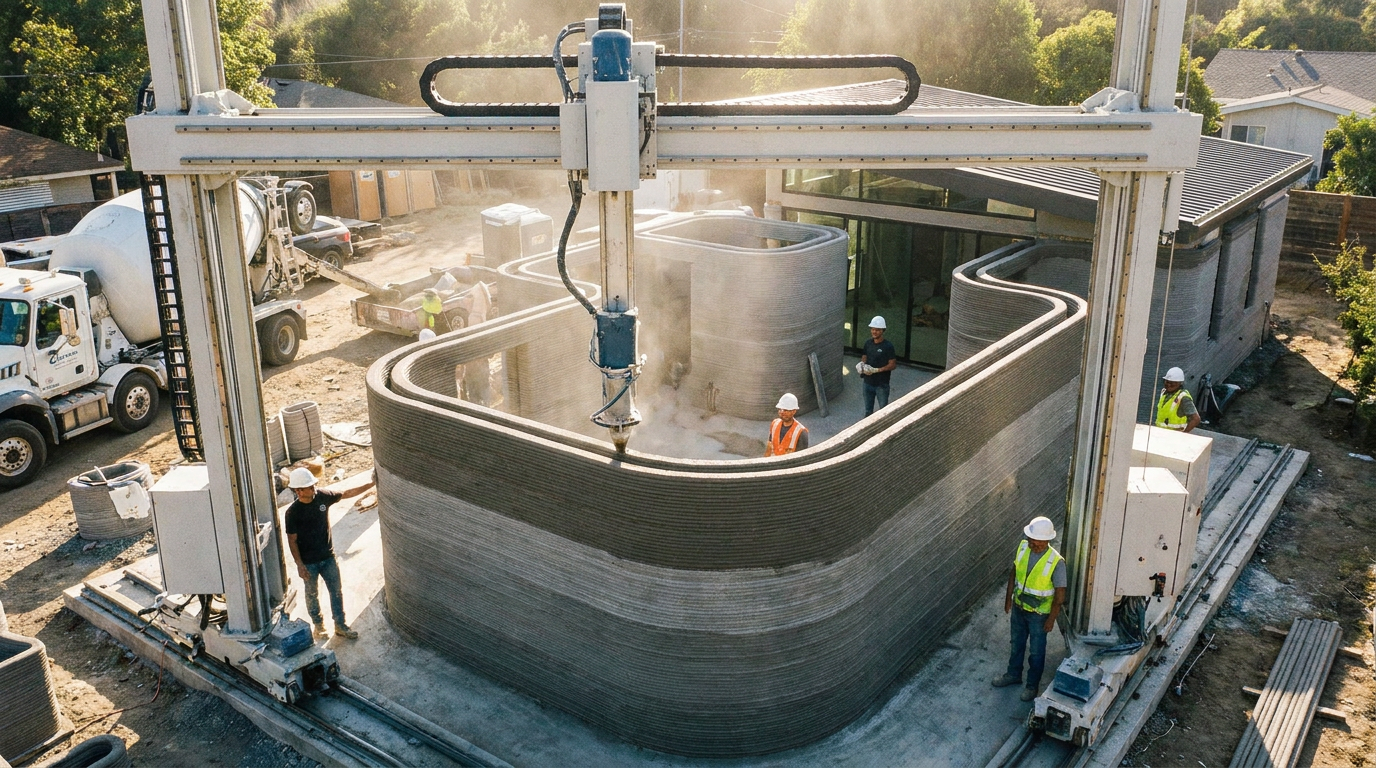
To understand the enthusiasm, one must look at the mechanism of construction 3D printing. The process relies on a gantry system—a massive frame that operates over the building site—or highly articulated robotic arms. Guided by precise digital blueprints, these machines extrude a proprietary mixture of high-performance concrete or composite materials layer by layer. This additive manufacturing approach eliminates the need for traditional formwork and drastically reduces the margin for human error in the structural envelope.[6]
The primary claim driving the adoption of 3D-printed homes is unprecedented speed. In recent social housing projects, developers have reported delivering duplexes in just 16 weeks, representing a 60 percent time savings compared to conventional building methods. The actual printing of the structural walls can take as little as 21 days. In an era plagued by chronic housing shortages and skilled labor deficits, shaving months off a construction schedule is a transformative economic advantage.[1]
The primary claim driving the adoption of 3D-printed homes is unprecedented speed.
This speed is directly translating into affordable housing initiatives. In Houston, a new development called Zuri Gardens is utilizing 3D printing to construct 80 energy-efficient homes priced to be accessible for households earning near the area median income. By combining printed materials with panelized roof construction, the city is leveraging the technology to deliver high-quality, durable housing without the premium price tag typically associated with custom architecture.[1][5]

Beyond economics, the environmental argument for printed homes is gaining significant traction. Traditional construction is notoriously wasteful, often filling dumpsters with offcuts and packaging. 3D printing, by contrast, generates near-zero structural waste, as the machine only extrudes the exact amount of material required. Furthermore, the thick, continuous concrete walls provide immense thermal mass, naturally regulating indoor temperatures and drastically reducing the energy required for heating and cooling.[1][2]
The materials themselves are also evolving to meet strict climate goals. While early printers relied on standard, carbon-intensive concrete, the class of 2026 is utilizing advanced eco-materials. Some companies have even pioneered processes that mix fiberglass with plastic pellets made from recycled bottles. This not only sequesters plastic waste within the walls of a home but also reduces the industry's reliance on mined aggregates.[1]
As climate volatility increases, the inherent durability of printed structures is becoming a major selling point. In coastal regions and wildfire-prone areas, homes are being engineered to withstand winds exceeding 200 miles per hour and resist fire damage far better than traditional timber frames. Canada has even invested in printed structures using fiber-reinforced concrete designed for rapid deployment in disaster relief scenarios, proving the technology's viability in extreme conditions.[2]
Despite the automation, human labor remains a critical component of the printed home ecosystem. The robots only build the shell; skilled tradespeople are still required to install the roofing, insert the windows, run the plumbing, and wire the electrical systems. Rather than replacing construction workers, the technology is shifting their roles, turning job sites into high-tech assembly environments where human crews work in tandem with automated systems.[1][6]

However, the industry still faces significant hurdles before a printer is a common sight in every neighborhood. The long-term durability of these novel material mixtures over a 50- or 100-year lifespan remains largely theoretical, as the oldest printed homes have only existed for a few years. Additionally, municipal zoning boards and building inspectors are often scrambling to update local codes to accommodate structures that do not fit neatly into traditional permitting categories.[6]
Yet, the momentum is undeniable. As local governments streamline permitting for automated construction and material science continues to lower the carbon footprint of the extrusion mixes, 3D printing is cementing its place in the residential landscape. For homebuyers in 2026, the prospect of living in a home built by a robot is no longer a science fiction fantasy, but a practical, sustainable, and increasingly accessible reality.[6]
How we got here
2021
Eindhoven completes the world's first legally habitable 3D-printed home.
2022–2024
The Wolf Ranch community in Texas constructs 100 printed homes, proving the technology's scale.
2025
Developers in the Netherlands successfully print multi-story residential structures.
2026
Cities like Houston begin integrating 3D-printed homes into official affordable housing programs.
Viewpoints in depth
Housing Advocates
Focused on the technology's potential to rapidly deliver affordable housing and disaster relief.
For housing advocates and municipal planners, the primary appeal of 3D printing is its ability to bypass traditional supply chain and labor bottlenecks. By reducing the time required to erect a structural shell to just a few weeks, cities can deploy affordable housing developments and disaster-relief shelters at an unprecedented pace. This camp argues that scaling additive manufacturing is a moral imperative to address the global shortage of accessible, high-quality homes.
Traditional Builders
Cautiously optimistic but emphasize the ongoing need for skilled human labor.
The traditional construction industry views 3D printing as a powerful new tool rather than a total replacement for human crews. Builders point out that while a robot can extrude walls, a home still requires carpenters for the roof, electricians for the wiring, and plumbers for the fixtures. This perspective advocates for a hybrid future where automated systems handle the heavy, repetitive structural work, freeing up skilled tradespeople to focus on the complex finishing tasks.
Environmental Technologists
Highlight the drastic reduction in construction waste and the integration of low-carbon materials.
Environmental technologists celebrate 3D printing for its near-zero waste profile and its potential to sequester carbon. Because the printers only use the exact amount of material required by the digital blueprint, the massive dumpsters of offcuts typical of traditional sites are eliminated. Furthermore, this camp is driving the shift away from standard concrete toward innovative extrusion mixes, such as recycled plastics and bio-based composites, turning homes into active carbon sinks.
What we don't know
- How these novel concrete and composite mixtures will hold up over a 50- or 100-year lifespan.
- Whether municipal zoning boards will adapt building codes quickly enough to allow for widespread adoption.
- How the secondary real estate market will value and appraise 3D-printed homes upon resale.
Key terms
- Additive Manufacturing
- The industrial term for 3D printing, where structures are built by adding material layer by layer rather than cutting it away.
- Thermal Mass
- The ability of a material, like thick printed concrete, to absorb, store, and release heat, improving a home's energy efficiency.
- Gantry Printer
- A large-scale 3D printer mounted on a frame that spans the width of the building site, moving on rails to extrude material.
- Extrusion
- The process of pushing a semi-liquid material, such as a specialized concrete mix, through a nozzle to form the structural layers of a wall.
Frequently asked
Can 3D-printed homes withstand extreme weather?
Yes. Many are engineered for high resilience, with some coastal projects designed to withstand winds over 200 mph and resist fire damage better than timber frames.
Are 3D-printed homes cheaper to buy?
While construction costs are dropping, current purchase prices often align with the broader market. However, buyers typically save significantly on long-term energy and maintenance costs.
Do these printers build the entire house?
No. The printers typically construct the interior and exterior walls, while human crews are still required to install the roof, windows, plumbing, and electrical systems.
Sources
Source coverage
6 outlets
3 viewpoints surfaced





[1]ForbesHousing Advocates
Future City Interest In 3D Printing Homes
Read on Forbes →[2]Clicks GorillaEnvironmental Technologists
12 Real Examples of 3D Printed Homes in 2026
Read on Clicks Gorilla →[3]3D.weberEnvironmental Technologists
Advancing 3D Printing Technology for Residential Construction
Read on 3D.weber →[4]Eindhoven University of TechnologyEnvironmental Technologists
Project Milestone: 3D Concrete Printing Innovation
Read on Eindhoven University of Technology →[5]City of HoustonHousing Advocates
Affordable Home Development Program: 3D Printed Housing
Read on City of Houston →[6]Factlen Editorial TeamTraditional Builders
Synthesis by Factlen editorial team
Read on Factlen Editorial Team →

Every angle. Every day.
Get home stories with full source coverage and perspective breakdowns delivered to your inbox.