
The Global Robotaxi Race Reaches Commercial Scale: How 2026 Became the Year of Driverless Transit
Autonomous vehicles have transitioned from experimental pilots to mass-market transit, with fleets in the US and China now delivering millions of driverless rides per week. A new global index highlights the fierce competition driving down costs and expanding service areas.
By Factlen Editorial Team
- Industry Analysts
- Evaluate the sector based on hard commercial metrics like unit economics, revenue generation, and regulatory compliance.
- US Autonomous Operators
- Prioritize deep urban mastery, rigorous simulation, and systematic safety-first scaling in complex environments.
- Chinese Autonomous Operators
- Focus on massive scale, rapid geographic expansion, and aggressive hardware cost reductions through domestic supply chains.
- Automaker Disruptors
- Leverage existing consumer fleets and manufacturing might to achieve economies of scale, often eschewing expensive LiDAR.
What's not represented
- · Traditional ride-hailing drivers facing displacement
- · City planners managing new traffic patterns
- · Public transit advocates
Why this matters
After years of missed deadlines, driverless technology is finally mature enough to reshape daily commuting. Plummeting hardware costs and rapid geographic expansion mean affordable, autonomous transit is arriving in major cities worldwide, fundamentally altering the economics of urban mobility.
Key points
- The Road to Autonomy Index ranks Baidu Apollo Go #1 and Waymo #2 globally.
- Waymo is delivering 500,000 paid rides per week across 10 US metropolitan areas.
- Hardware costs are plummeting, with Baidu's RT6 mass-produced for roughly $34,500.
- Chinese operators are prioritizing rapid geographic expansion, while US firms focus on deep urban mastery.
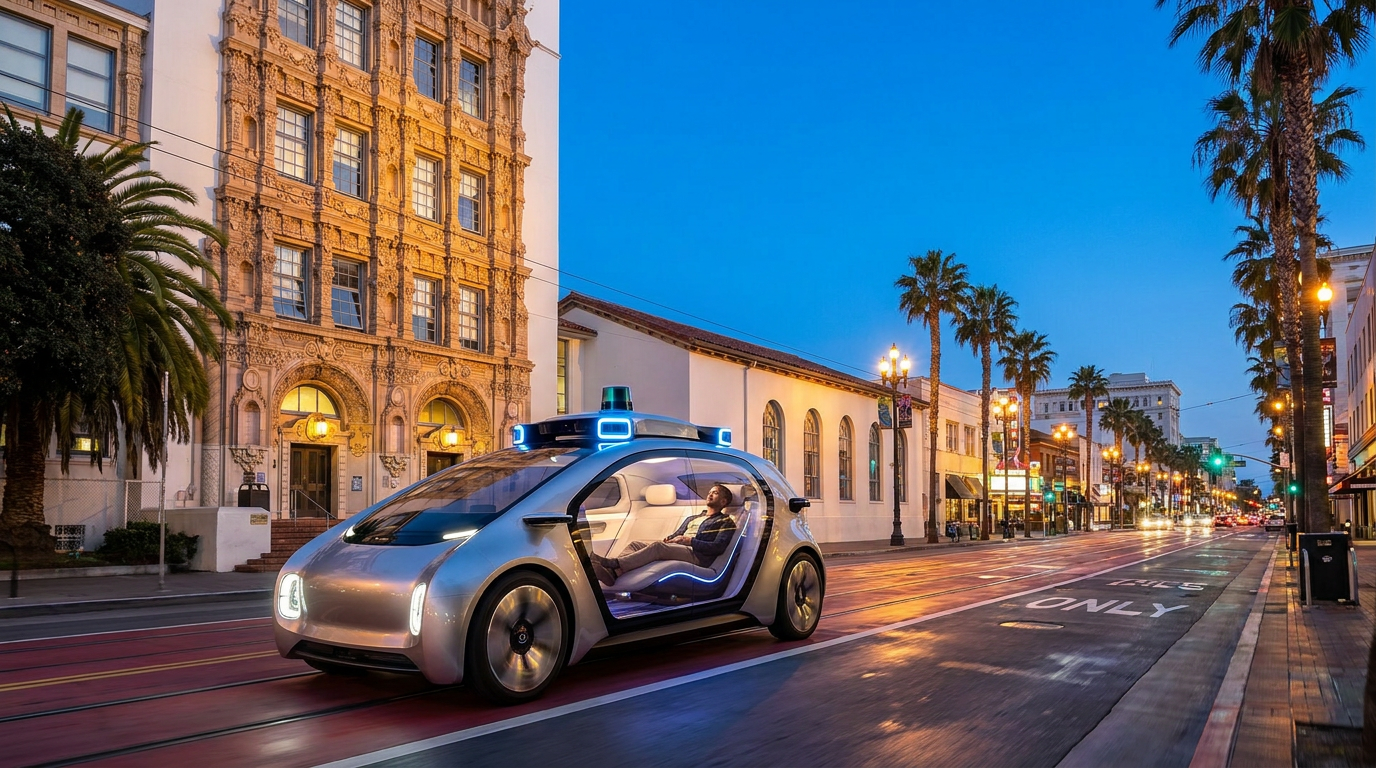
For the better part of a decade, the autonomous vehicle industry was defined by flashy demonstrations, massive capital raises, and a recurring chorus of missed deadlines. But by mid-2026, the narrative has definitively shifted from experimental pilots to mass-market commercial transit. Driverless cars are no longer a novelty confined to closed courses; they are a daily commuting reality for millions of passengers across the globe. This transition marks a pivotal moment in urban mobility, as the technology finally matures enough to support multi-billion-dollar operations.[1][5]
The clearest evidence of this shift comes from a new benchmarking effort that attempts to quantify the once-opaque robotaxi race. In June 2026, advisory and research startup Autnmy AI released its 'Road to Autonomy Index,' a real-time public scorecard built from global public databases, SEC filings, and federal reports. Unlike previous industry assessments that relied heavily on press releases and tightly controlled demonstrations, this index explicitly rewards commercialization over future promises. By updating its rankings every 12 hours based on hard operational data, the platform provides the first truly objective look at which companies are actually delivering rides to paying customers.[1][2]
The index evaluates companies across six rigorous factors: autonomous operations, scale, revenue, commercial partnerships, manufacturing, and safety transparency. The first three metrics account for 70 percent of a company's composite score, ensuring that only firms with actual paying customers and significant fleet deployments rise to the top of the leaderboard. The results have provided a stark look at the current global hierarchy, revealing a fiercely competitive landscape where Chinese and American firms are vying for absolute dominance in the transportation sector. The data confirms that the industry has moved past the research phase and into a battle for market share and operational efficiency.[1][2]

According to the latest index data, China's Baidu Apollo Go has narrowly edged out Alphabet's Waymo to claim the number one spot globally, boasting a composite score of 81.3 to Waymo's 78.5. The top five is rounded out by Chinese operators Pony.ai and WeRide, with Tesla securing the fifth position. The strong showing by Chinese firms—occupying three of the top five slots—highlights a broader industry trend where aggressive geographic expansion and domestic supply chain advantages are paying massive dividends. This ranking underscores how different regional strategies are yielding distinct competitive advantages.[2][6]
Despite slipping to second place in the index, Waymo remains the undisputed pioneer and standard-bearer in the United States. As of June 2026, the company operates public commercial robotaxi services in 10 US metropolitan areas, managing a fleet of nearly 4,000 vehicles. Waymo's systematic, safety-first approach has allowed it to scale impressively within complex urban environments like San Francisco, Phoenix, and Los Angeles, where it now provides upwards of 500,000 paid rides every single week. The company's leadership has publicly stated their goal of reaching one million weekly autonomous trips by the end of the year, cementing their status as a daily utility for hundreds of thousands of Americans.[5]
Waymo's technological edge is built on a foundation of staggering data collection and rigorous simulation. The company has logged over 200 million fully autonomous miles and in excess of 20 billion simulated miles, allowing its AI-driven perception system to anticipate the movement of objects and determine the safest paths in real time. Crucially, this methodical scaling has yielded highly encouraging safety data. Waymo's rider-only statistics show significantly lower rates of airbag deployments and injury crashes compared to human drivers operating in the exact same cities. This empirical safety record has been instrumental in winning over skeptical regulators and hesitant consumers.[5]
In stark contrast to Waymo's strategy of deep, technologically sophisticated deployment in select US cities, Chinese operators have prioritized rapid, extensive geographic coverage. Baidu's Apollo Go has emerged as an absolute juggernaut in the East, completing an astonishing 17 million rides across 22 different cities. In Wuhan alone, the Apollo Go service area covers 3,000 square kilometers, encompassing highways with 70-80 kph speed limits and serving a catchment population of nearly 8 million people. This massive operational footprint allows Baidu to gather diverse driving data across a wide variety of weather conditions, road types, and traffic behaviors.[2][4]
Baidu's Apollo Go has emerged as an absolute juggernaut in the East, completing an astonishing 17 million rides across 22 different cities.
The secret to Baidu's rapid scaling lies in its aggressive pursuit of hardware cost reductions through vertical integration and mass production. The company recently rolled out its sixth-generation autonomous vehicle, the Apollo RT6, which it claims is the world's only mass-produced Level-4 autonomous driving vehicle. By developing its battery-electric architecture in-house and leveraging local manufacturing partnerships, Baidu has managed to slash the unit cost of the RT6 to approximately $34,500 (250,000 yuan). This represents a dramatic drop from previous iterations that cost over $70,000, fundamentally changing the math of fleet expansion.[3][4]

This plummeting cost curve is not unique to Baidu; it is a structural advantage currently enjoyed by the entire Chinese autonomous vehicle ecosystem. The widespread adoption of smart driving functions in mass-produced consumer vehicles has significantly lowered the cost of core sensors and computing hardware across the board. For example, a single LiDAR unit that cost over 10,000 yuan just a few years ago has now fallen into the $200 to $250 range (roughly 1,800 yuan). These supply chain efficiencies have removed one of the largest financial barriers to building a profitable robotaxi network.[3]
As hardware costs fall, the elusive goal of profitability is finally coming into view for the industry's top players. In 2025, revenue from Pony.ai and WeRide's robotaxi businesses saw triple-digit year-over-year increases, signaling strong consumer demand. More tellingly, Pony.ai has achieved positive unit economics in major hubs like Guangzhou and Shenzhen, while Baidu Apollo Go has turned profitable in several core Chinese cities. While profitability in individual markets does not guarantee overall corporate profitability, it proves that the fundamental robotaxi business model is commercially viable when executed at sufficient scale.[3]
The competitive landscape is also expanding beyond traditional tech-first operators to include major automakers determined to control their own destiny. Tesla, ranking fifth on the Road to Autonomy Index, is pursuing a radically different strategy with its highly anticipated Cybercab. Rather than relying on expensive LiDAR arrays and high-definition maps, Tesla's approach utilizes a camera-only vision system trained on billions of miles of real-world driving data from its existing consumer fleet. With mass production slated to begin at Giga Texas in April 2026, Tesla is aiming to disrupt the market by offering autonomous rides at an ultra-low cost of 20 to 40 cents per mile.[2][6]

Chinese original equipment manufacturers (OEMs) are similarly refusing to cede the mobility market to software companies. XPENG recently unveiled a full-stack, in-house robotaxi prototype equipped with four self-developed AI chips delivering an immense 3,000 TOPS of computing power. Geely has also debuted a natively developed robotaxi prototype featuring a 'Quantum-level AI' architecture, signaling that traditional automakers are prepared to leverage their manufacturing might to capture a share of the autonomous mobility market. These deep-pocketed entrants ensure that the pace of innovation will only accelerate in the coming years.[3]
Despite the rapid technological and commercial progress, significant hurdles remain before driverless transit can achieve total global ubiquity. Regulatory frameworks regarding liability and insurance for robotaxi accidents remain fragmented and unclear in many jurisdictions, directly impacting the rhythm of expansion. Furthermore, the potential impact of large-scale robotaxi deployment on social employment structures—particularly the livelihoods of traditional taxi and ride-hailing drivers—has sparked widespread concern and localized protests. Policymakers are now scrambling to balance the safety and efficiency benefits of autonomous vehicles with the economic realities of displaced workers.[3][4]
The methodology of the new benchmarking indices also carries inherent caveats that industry observers must keep in mind. Because the Road to Autonomy Index relies heavily on SEC filings and US federal disclosures, it may not perfectly capture the nuances of companies whose primary operations and regulators are in China. Additionally, the 12-hour refresh cycle means the rankings are a momentary snapshot of a highly volatile industry, rather than a settled historical verdict. A single major partnership or regulatory approval could easily scramble the leaderboard overnight.[2]

Nevertheless, the data from 2026 paints an undeniable picture: the era of the robotaxi has definitively arrived. With industry leaders like Waymo targeting one million weekly autonomous trips by the end of the year, and Chinese operators expanding their fleets by the thousands, the focus has permanently shifted from proving that the technology works to proving that it can scale profitably. For urban commuters, the result is a safer, cheaper, and increasingly driverless future that is reshaping the very fabric of city life.[3][5]
How we got here
2009
Google begins its self-driving car project, which later becomes Waymo.
2017
Baidu launches its Apollo open-source autonomous driving program.
2020
Waymo opens its fully driverless service to the general public in Phoenix, Arizona.
2024
Baidu unveils the RT6, driving unit costs down to roughly $34,500.
June 2026
The Road to Autonomy Index is launched, ranking Baidu Apollo Go and Waymo as the top two global operators as fleets reach millions of weekly rides.
Viewpoints in depth
US Autonomous Operators
Prioritize systematic, safety-first scaling in complex environments.
US-based operators like Waymo argue that conquering complex, unpredictable environments like San Francisco and Los Angeles proves the robustness of their AI. They prioritize systematic, heavily regulated scaling over rapid geographic sprawl, ensuring that every new market meets strict safety thresholds before removing the safety driver. Their approach relies heavily on logging billions of simulated miles and proving empirical safety superiority over human drivers to win regulatory approval.
Chinese Autonomous Operators
Focus on massive scale and rapid geographic expansion.
Chinese operators argue that the fastest path to commercial viability is leveraging domestic supply chains to slash the cost of sensors and vehicles. By driving down unit costs, companies like Baidu and Pony.ai can deploy thousands of units across dozens of cities simultaneously. They believe that massive operational scale across diverse geographic regions provides the real-world data necessary to continuously refine their autonomous systems.
Automaker Disruptors
Leverage existing consumer fleets and manufacturing might to achieve scale.
Companies like Tesla argue that expensive LiDAR arrays and high-definition maps are a technological dead end. They advocate instead for camera-only vision systems trained on billions of miles of real-world data gathered from consumer vehicles. These automakers believe that true scale will come from selling autonomous capabilities directly to consumers alongside dedicated, ultra-low-cost robotaxi fleets manufactured in existing mega-factories.
Industry Analysts
Evaluate the sector based on hard commercial metrics rather than technological promises.
Financial and industry analysts argue that the true winners of the robotaxi race will be determined by unit economics, revenue generation, and regulatory compliance. They emphasize that the transition from R&D to commercialization requires transparent safety data and the ability to navigate complex local insurance and labor regulations. For analysts, a company's ability to turn a profit per ride is far more important than the theoretical capabilities of its AI.
What we don't know
- How quickly international regulatory frameworks will harmonize to allow cross-border robotaxi expansion.
- The long-term impact of autonomous fleets on the employment of traditional taxi and ride-hailing drivers.
- Whether camera-only vision systems can match the safety record of LiDAR-equipped vehicles in adverse weather conditions.
Key terms
- Robotaxi
- A fully autonomous, driverless vehicle operated as part of a ride-hailing service.
- Level-4 Autonomy (L4)
- A designation by SAE International indicating a vehicle can operate entirely without human intervention within a specific geographic area or under certain conditions.
- LiDAR
- Light Detection and Ranging, a remote sensing method that uses light in the form of a pulsed laser to measure variable distances and create 3D maps of a vehicle's surroundings.
- Unit Economics
- The direct revenues and costs associated with a single unit of a business—in this case, the cost and profit of operating a single robotaxi per mile or per ride.
- TOPS
- Tera Operations Per Second, a metric used to measure the computing power of the AI chips that process sensor data and drive autonomous vehicles.
Frequently asked
Which company is leading the global robotaxi race?
According to the June 2026 Road to Autonomy Index, China's Baidu Apollo Go currently holds the top spot, narrowly edging out Alphabet's Waymo based on scale, revenue, and autonomous operations.
How much does it cost to build a robotaxi?
Costs are dropping rapidly. Baidu's mass-produced RT6 costs approximately $34,500, driven by massive reductions in the price of sensors like LiDAR, which fell from 10,000 yuan to roughly 1,800 yuan.
Are robotaxis safer than human drivers?
Early data from operators like Waymo indicates that fully autonomous vehicles have significantly lower rates of injury crashes and airbag deployments compared to human drivers in the same cities.
When will Tesla release its robotaxi?
Tesla's Cybercab is slated to begin mass production at Giga Texas in April 2026, utilizing a camera-only vision system rather than expensive LiDAR arrays.
Sources
Source coverage
6 outlets
4 viewpoints surfaced






[1]TechCrunchIndustry Analysts
TechCrunch Mobility: A new robotaxi scorecard shows China's dominance
Read on TechCrunch →[2]AI WeeklyIndustry Analysts
Baidu Apollo Go Tops Waymo in New Global Robotaxi Index
Read on AI Weekly →[3]GasgooAutomaker Disruptors
Robotaxi supply chains and cost reductions in 2026
Read on Gasgoo →[4]South China Morning PostChinese Autonomous Operators
Baidu says self-driving vehicle costs drop to US$34,525 as mass production ramps up
Read on South China Morning Post →[5]Technology MagazineUS Autonomous Operators
Waymo Targets One Million Weekly Autonomous Trips by 2026
Read on Technology Magazine →[6]Road to AutonomyIndustry Analysts
The Road to Autonomy Robotaxi Index
Read on Road to Autonomy →


Every angle. Every day.
Get technology stories with full source coverage and perspective breakdowns delivered to your inbox.