
Meta Quest 3 vs. Apple Vision Pro: The 2026 Trade-Off Analysis
A comprehensive comparison of the market's two leading headsets reveals a stark divide between accessible gaming and premium spatial computing.
By Factlen Editorial Team
- VR Gaming Enthusiasts
- Users who prioritize immersive, interactive entertainment and tactile feedback.
- Spatial Computing Purists
- Advocates who view the Apple Vision Pro as the inevitable future of personal computing.
- Enterprise Evaluators
- Pragmatic buyers weighing cost, scalability, and specific use-case fit for businesses.
What's not represented
- · Budget-constrained consumers priced out of both ecosystems
- · Developers building cross-platform XR applications
Why this matters
Choosing the right mixed reality headset dictates whether you are buying a $499 gaming console or a $3,499 virtual workspace. Understanding these trade-offs ensures consumers and businesses don't waste money on hardware that doesn't fit their actual daily needs.
Key points
- The Meta Quest 3 is a $499 gaming-first headset with physical controllers and a massive software library.
- The Apple Vision Pro is a $3,499 productivity-first spatial computer with 23 million pixels and seamless Mac integration.
- Apple's controller-free eye and hand tracking excels in UI navigation but falls short for fast-paced gaming.
- The Quest 3's LCD lenses struggle with fine text, making it less viable as a multi-monitor replacement.
- Enterprise buyers favor Quest 3 for scalable team events and Vision Pro for high-end VIP demonstrations.
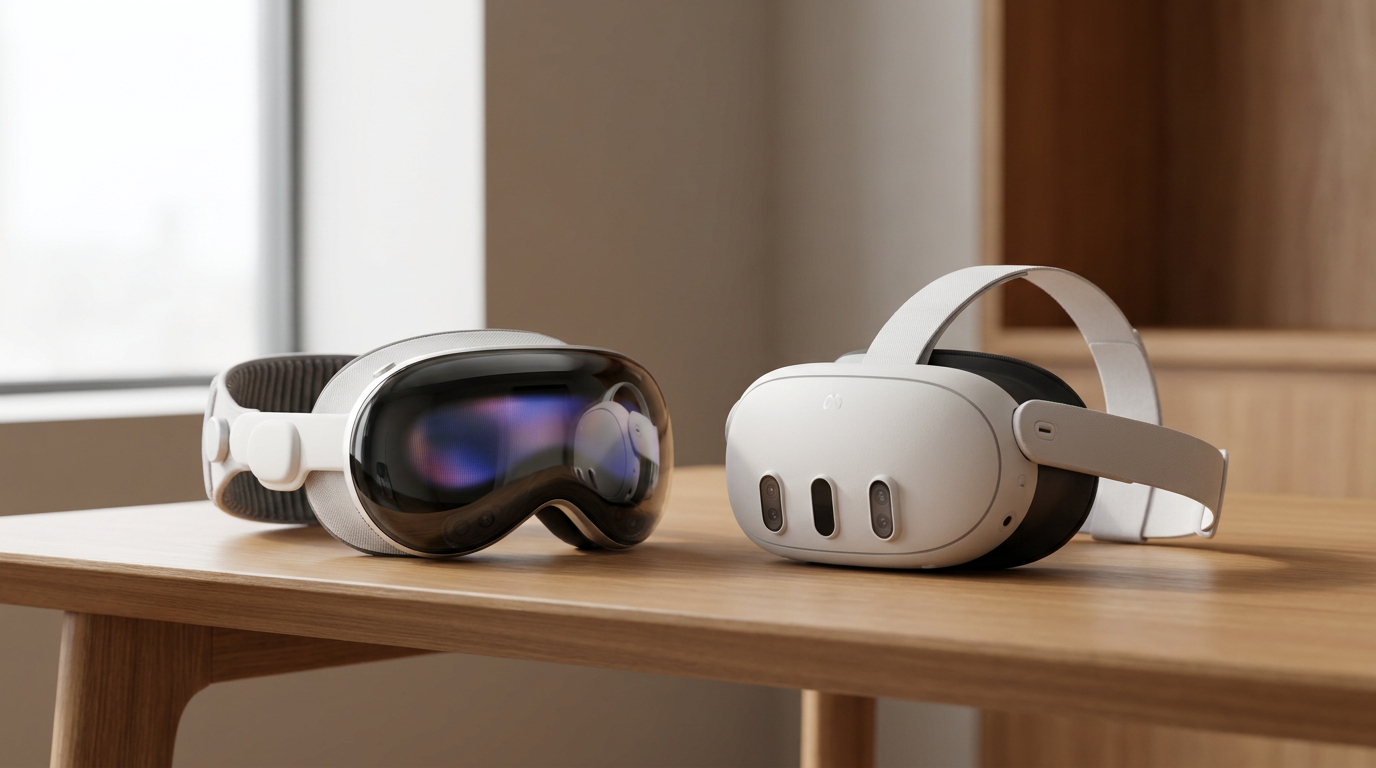
The virtual reality landscape in 2026 has matured past the initial hype cycle, leaving consumers and enterprise buyers with a fascinating choice between two fundamentally different philosophies. On one side sits the Meta Quest 3, a $499 device that has become the undisputed king of accessible, standalone virtual reality. On the other side is the Apple Vision Pro, a $3,499 premium spatial computer designed to seamlessly blend digital workspaces with the physical world.[1][2][6][8]
Comparing these two devices is no longer just an exercise in reading spec sheets; it is a trade-off analysis between a gaming-first console and a productivity-first wearable Mac. Both headsets offer full-color mixed reality passthrough, allowing users to see their physical surroundings while interacting with digital elements. However, their approaches to hardware, software, and user interaction could not be more distinct.[3][5][7]
The case for the Apple Vision Pro is built entirely around its unparalleled visual fidelity and seamless ecosystem integration. For users seeking a limitless virtual workspace, the Vision Pro delivers an experience that currently has no rival. Against the Vision Pro is its staggering $3,499 entry price, a heavy physical footprint, and a distinct lack of traditional gaming experiences.[1][3][4]
The evidence for Apple's visual dominance lies in its dual micro-OLED displays, which pack a combined 23 million pixels. This equates to roughly 4K resolution per eye, rendering text with such crispness that it can legitimately replace a physical multi-monitor setup. The passthrough cameras operate with a mere 6.5 milliseconds of latency, creating a nearly flawless reproduction of the real world that makes reading physical phone screens or fine print entirely possible while wearing the headset.[4][8]

The case for the Meta Quest 3 centers on its immense versatility, tactile control, and unbeatable value proposition. For gamers, fitness enthusiasts, and budget-conscious explorers, it is the default recommendation. Against the Quest 3 is its lower-resolution display, which struggles with fine text, and a mixed reality passthrough that exhibits noticeable warping and graininess in low-light conditions.[2][5][6]
The evidence for Meta's approach is found in its 4.5-million-pixel LCD pancake lenses and the inclusion of Touch Plus physical controllers. While the Quest 3's 2064 by 2208 pixels per eye cannot match Apple's sharpness for reading spreadsheets, its display is more than adequate for immersive gaming. Furthermore, the headset supports a 120Hz refresh rate, ensuring that fast-paced action and rapid head movements remain buttery smooth—a crucial metric where it outpaces Apple's standard 90Hz to 100Hz output.[1][8]
Interaction paradigms highlight another major divergence. Apple relies entirely on eye tracking and subtle hand gestures, eliminating physical controllers altogether. Looking at an app icon and tapping two fingers together feels like telepathy when navigating menus or browsing the web. However, this controller-free approach becomes a liability in gaming, where the lack of haptic feedback and precise spatial tracking leaves users grasping at empty air.[1][6][8]
Apple relies entirely on eye tracking and subtle hand gestures, eliminating physical controllers altogether.
Conversely, the Meta Quest 3 embraces physical inputs. The Touch Plus controllers provide the tactile resistance and precision required for competitive shooters, rhythm games, and complex simulations. While Meta has steadily improved its own hand-tracking capabilities, it remains a secondary input method. The trade-off is clear: Apple wins on frictionless UI navigation, while Meta wins on interactive precision.[6][8]

Comfort and wearability present a complex set of compromises for both devices. The Apple Vision Pro utilizes premium materials, including a curved glass front panel and a machined aluminum frame. This luxury aesthetic comes at a literal cost: the headset weighs roughly 650 grams and is noticeably front-heavy. To mitigate this, Apple offloads the battery into a tethered aluminum puck that must be kept in a pocket, which can feel cumbersome during active movement.[1][6][8]
The Meta Quest 3 opts for a utilitarian plastic construction, bringing its weight down to a more manageable 515 grams. Crucially, the battery is integrated directly into the headset, eliminating the need for external wires. While the default elastic strap is widely considered inadequate for long sessions, the thriving third-party accessory market allows users to easily upgrade to rigid halo straps with counter-weighted battery packs, transforming the Quest 3 into a highly comfortable device for extended wear.[1][5][8]
Software ecosystems dictate what users can actually do with these headsets. VisionOS is a masterclass in spatial computing, allowing users to pull native Mac screens into their physical environment, place spatial documents around their living room, and engage in lifelike spatial FaceTime calls. It is a productivity powerhouse for anyone already entrenched in the Apple ecosystem, but its native application library remains heavily skewed toward media consumption and 2D iPad ports.[3][4][5]
Meta's Horizon OS is built on an entirely different foundation. It boasts a massive, mature library of standalone virtual reality games, fitness applications, and social experiences. Furthermore, the Quest 3 can wirelessly connect to a gaming PC via Air Link or Steam Link, unlocking the highest tier of PC VR gaming. While Meta has introduced productivity apps and virtual desktop clients, they lack the frictionless, native integration that makes VisionOS so compelling for work.[2][3][5][6]

In the enterprise and event space, these trade-offs dictate deployment strategies. Event planners and corporate trainers overwhelmingly favor the Meta Quest 3. Its $499 price point allows companies to purchase fleets of headsets for multiplayer team-building exercises, while its robust controller tracking makes it ideal for interactive trade show booths where high throughput and quick onboarding are essential.[7]
The Apple Vision Pro, meanwhile, has carved out a niche in high-end enterprise environments. Real estate developers use its flawless passthrough and high-resolution displays to showcase luxury pre-construction apartments to VIP clients. Automotive designers rely on its color accuracy for spatial design reviews. In these scenarios, the premium brand signal and photographic visual quality justify the steep investment, even if the sessions are kept to 30 minutes to ensure comfort.[7][8]
Ultimately, choosing between these two devices requires an honest assessment of how the hardware will be used. There is no single winner without conditions; the right choice depends entirely on the user's priorities, budget, and existing technology ecosystem.[2][3]

The Meta Quest 3 fits well when you want a versatile, do-it-all headset that excels at gaming, fitness, and social virtual reality. It is the perfect choice for families, VR enthusiasts, and anyone looking for the best value in the industry. It does not fit well when your primary goal is replacing a multi-monitor work setup, reading dense text for hours, or experiencing the absolute bleeding edge of spatial computing fidelity.[2][3][6]
The Apple Vision Pro fits well when you are a creative professional, a spatial computing early adopter, or an enterprise user who requires the highest possible visual clarity for virtual workspaces. It is the ultimate device for watching 3D movies and integrating with a Mac workflow. It does not fit well when you are on a strict budget, want to play immersive VR games, or plan to engage in high-movement fitness routines.[1][3][4][7]
How we got here
June 2023
Apple officially announces the Vision Pro, introducing the concept of spatial computing to a mainstream audience.
October 2023
Meta releases the Quest 3, bringing high-quality color passthrough and pancake lenses to the consumer market.
February 2024
The Apple Vision Pro launches in the United States at a premium price of $3,499.
Late 2024
Meta phases out the 128GB Quest 3, making the 512GB model the standard at $499.
Early 2026
The secondary market stabilizes, solidifying the Quest 3 as the gaming standard and the Vision Pro as a niche productivity powerhouse.
Viewpoints in depth
Spatial Computing Purists
Advocates who view the Apple Vision Pro as the inevitable future of personal computing.
This camp argues that the Vision Pro is not a VR headset, but the next iteration of the Mac. They emphasize that the 23-million-pixel micro-OLED displays and seamless integration with the Apple ecosystem justify the $3,499 price tag. For these users, the ability to place infinite, perfectly legible virtual monitors around a physical room fundamentally changes how knowledge work is done, making traditional gaming capabilities irrelevant.
VR Gaming Enthusiasts
Users who prioritize immersive, interactive entertainment and tactile feedback.
Gaming enthusiasts argue that virtual reality is fundamentally an interactive medium, making the Meta Quest 3 the superior device. They point to the necessity of Touch Plus controllers for haptic feedback and precise spatial tracking in fast-paced games. This camp views Apple's controller-free approach as a fatal flaw for gaming and praises Meta's massive, mature library of standalone titles and PC VR compatibility as the true benchmark of headset value.
Enterprise Evaluators
Pragmatic buyers weighing cost, scalability, and specific use-case fit for businesses.
Enterprise planners look past the brand hype to evaluate return on investment. They favor the Meta Quest 3 for large-scale deployments, such as team-building exercises and trade show booths, where its $499 price and robust tracking allow for high throughput. However, they acknowledge the Vision Pro's dominance in luxury sales and design, where its photographic passthrough quality is necessary to impress VIP clients during guided, one-on-one demonstrations.
What we don't know
- Whether Apple will release a cheaper, non-Pro version of the Vision headset to compete directly with Meta's pricing.
- How quickly developers will build native, complex spatial applications for VisionOS beyond 2D iPad ports.
- If Meta can improve its Horizon OS productivity features enough to challenge Apple in the enterprise workspace.
Key terms
- Spatial Computing
- A technology paradigm where digital content is seamlessly blended into a user's physical environment, allowing them to interact with virtual objects as if they were real.
- Mixed Reality Passthrough
- The use of external cameras on a headset to display a real-time video feed of the physical world inside the digital display.
- Micro-OLED
- An advanced display technology that packs millions of pixels into a very small area, offering incredibly sharp images and deep contrast.
- Pancake Lenses
- A type of optical lens used in modern VR headsets that folds light multiple times, allowing the headset to be significantly thinner and lighter than older models.
- Foveated Rendering
- A rendering technique that uses eye tracking to display the highest resolution only where the user is looking, saving processing power elsewhere.
Frequently asked
Can I use the Meta Quest 3 for work and productivity?
Yes, but it is secondary to gaming. It supports virtual desktop apps, but the lower text clarity makes it less ideal for reading dense documents compared to Apple's headset.
Does the Apple Vision Pro have VR games?
It has a limited selection of spatial games and Apple Arcade titles, but it lacks the massive library of dedicated VR games and physical controllers found on the Quest 3.
Which headset is better for watching movies?
The Apple Vision Pro is significantly better for media consumption due to its micro-OLED displays, which provide true blacks, HDR support, and a cinematic viewing experience.
Do I need a PC to use either headset?
No, both are standalone devices that process everything internally. However, the Quest 3 can optionally connect to a PC to play high-end PC VR games.
Sources
Source coverage
8 outlets
3 viewpoints surfaced








[1]How-To GeekVR Gaming Enthusiasts
Meta Quest 3 vs Apple Vision Pro: Which Mixed Reality Headset Is Right for You?
Read on How-To Geek →[2]VR.orgVR Gaming Enthusiasts
Which VR headset should you buy in 2026?
Read on VR.org →[3]Reality AtlasEnterprise Evaluators
Meta Quest 3 and Apple Vision Pro compared — gaming vs spatial computing
Read on Reality Atlas →[4]MulticoreSpatial Computing Purists
Apple Vision Pro: the 2026 review
Read on Multicore →[5]FluidEnterprise Evaluators
Meta Quest 3 vs Apple Vision Pro trade-offs
Read on Fluid →[6]VR EddieVR Gaming Enthusiasts
Meta Quest 3 vs Apple Vision Pro comparison review 2026
Read on VR Eddie →[7]IGIVUEnterprise Evaluators
Meta Quest 3 vs Apple Vision Pro: Comparison for Events
Read on IGIVU →[8]R2USpatial Computing Purists
Hardware comparison: what matters for a sales gallery
Read on R2U →

More in meta
See all 6 stories →Hardware Comparison
E-Ink vs. OLED Tablets: The 2026 Guide to Choosing Your Deep Work Device
6 sources
Digital Trust
How Content Credentials and Invisible Watermarks Are Rebuilding Trust on the Internet
7 sources
Digital Provenance
How "Content Credentials" and Invisible Watermarks Are Solving the 2026 Deepfake Crisis
7 sources

Digital Provenance
How C2PA Content Credentials Are Becoming the HTTPS of Digital Media
6 sources

Every angle. Every day.
Get meta stories with full source coverage and perspective breakdowns delivered to your inbox.