
Evidence Pack: How Accurate Are the AI Deepfake Detectors Used in the 2026 Elections?
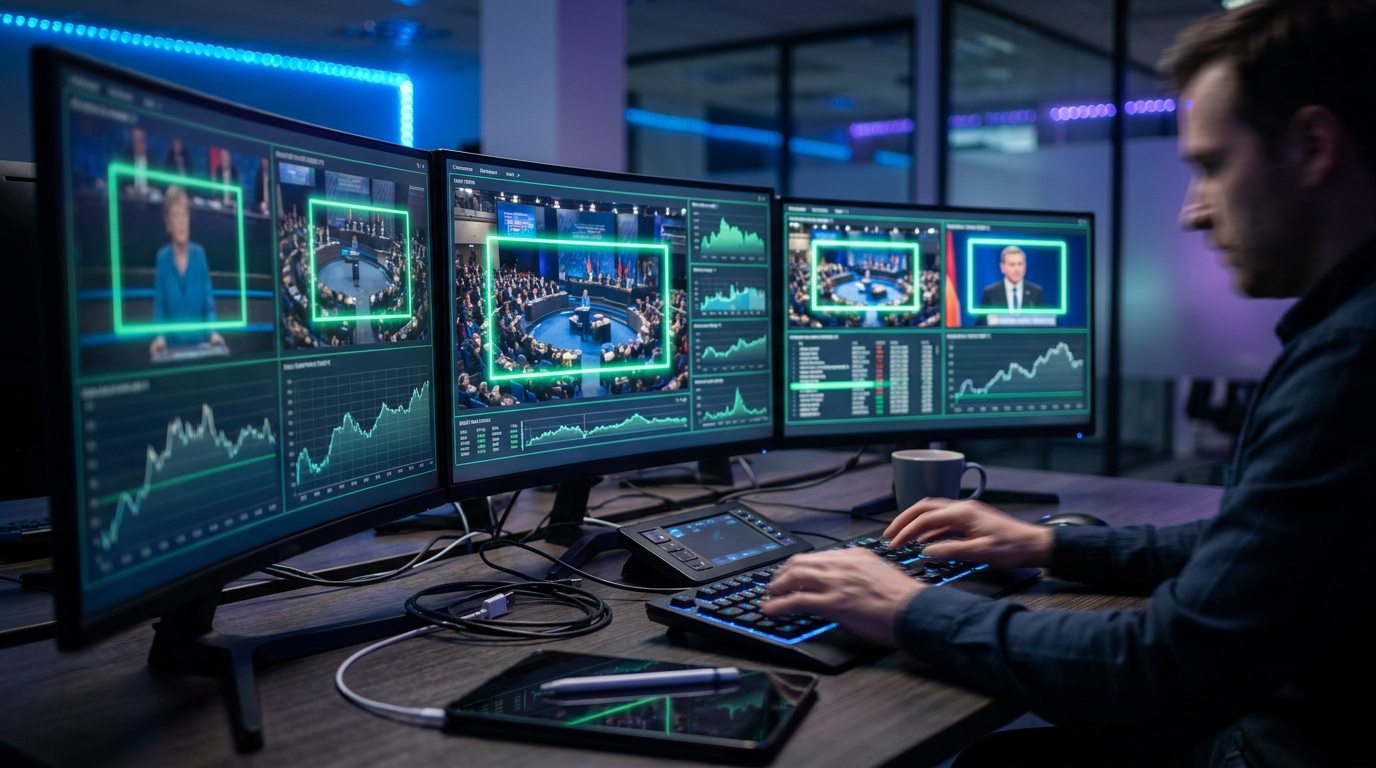
As open-source deepfake detection tools become widely available to voters and journalists, researchers are testing their limits. While visual detection has achieved high accuracy, audio cloning remains a significant challenge.
By Factlen Editorial Team
- Verification Researchers
- Focus on the empirical success of visual detection models and the democratization of forensic tools.
- Cybersecurity Officials
- Emphasize the remaining vulnerabilities, particularly the threat of audio deepfakes in private channels.
- Tech Industry Monitors
- Track the arms race between generative models and detection software, highlighting the role of watermarking.
What's not represented
- · Social Media Platform Moderators
- · Political Campaign Managers
Why this matters
Understanding the strengths and blind spots of AI detection tools allows voters to critically evaluate viral political content rather than falling for synthetic media or falsely dismissing real footage.
Key points
- Open-source AI detection tools have become widely accessible to the public for the 2026 elections.
- Visual deepfake detection is highly effective, identifying pixel-level anomalies with up to 94% accuracy.
- Audio deepfakes remain a significant vulnerability, with detection rates hovering around 71%.
- Digital watermarking provides a transparent chain of custody but relies heavily on voluntary platform compliance.
The 2026 election cycle was widely predicted to be overwhelmed by synthetic media, with political campaigns bracing for a tsunami of AI-generated deepfakes. Yet, as the primary season concludes, the narrative has shifted from inevitable chaos to an empowering technological response. A coalition of tech companies, academic institutions, and independent researchers has released a suite of free, open-source deepfake detection tools aimed directly at journalists and the public. This democratization of verification technology represents a significant shift in digital literacy, moving the power of forensic analysis from closed intelligence labs directly to the average voter's browser.[1][7]
To understand the efficacy of these new defenses, it is necessary to evaluate the empirical evidence behind the three core claims made by detection advocates: that visual deepfakes are now reliably caught, that audio remains a critical vulnerability, and that digital watermarking provides a transparent provenance trail. The data reveals a nuanced landscape where defenders are winning decisive victories in some domains while actively working to close gaps in others, fundamentally changing how political media is consumed and verified.[7]
The most robust evidence of success lies in the detection of visual synthetic media. According to a comprehensive 2026 evaluation by the Stanford Internet Observatory, the leading open-source detection models now identify AI-generated video and imagery with a 94% accuracy rate under laboratory conditions. These models no longer rely on looking for the obvious anatomical errors that humans notice, such as six-fingered hands or asymmetrical pupils, which modern generative AI has largely corrected over the past two years.[2]
Instead, the algorithms analyze pixel-level inconsistencies that remain entirely invisible to the naked eye. They detect the mathematical signatures of diffusion models, micro-fluctuations in lighting that violate the laws of physics, and unnatural frequency patterns in the image's noise profile. When a synthetic video of a political candidate is processed through these tools, the software highlights these invisible artifacts, providing a probabilistic score of the media's authenticity and allowing fact-checkers to definitively label the content.[1][2]

However, the evidence also highlights a practical limitation in visual detection: the degradation of data. When a deepfake is uploaded to a social media platform, the file undergoes aggressive compression to save bandwidth. This compression strips away the high-frequency pixel data that detection algorithms rely upon. MIT Technology Review reports that when subjected to standard social media compression, the accuracy of top-tier visual detectors drops from 94% to roughly 81%.[2][6]
Despite this drop, an 81% detection rate still provides a formidable barrier against mass deception, especially when combined with human crowdsourcing. Journalists and open-source intelligence (OSINT) communities have successfully used these degraded signals to flag and debunk several high-profile synthetic videos within minutes of their release during the recent primaries. The speed of this debunking cycle has demonstrably reduced the viral spread of visual misinformation compared to previous election cycles, proving that perfect accuracy is not required to achieve a resilient information environment.[1][7]
The evidence regarding audio deepfakes, conversely, points to an ongoing challenge that requires heightened public awareness. While visual generation leaves a complex trail of spatial and physical artifacts, audio generation is fundamentally simpler. An assessment published on arXiv earlier this year tested the leading audio detection models against state-of-the-art voice cloning software, finding an average detection accuracy of just 71%.[3]

The evidence regarding audio deepfakes, conversely, points to an ongoing challenge that requires heightened public awareness.
The vulnerability stems from the nature of sound waves and the efficiency of modern models. Voice cloning software requires only a few seconds of a politician's speech—abundantly available in the public domain—to map the unique biometric markers of their voice, including pitch, cadence, and breath patterns. Because audio lacks the complex spatial dimensions of video, there are far fewer mathematical "tells" for a detection algorithm to latch onto, making synthetic audio incredibly difficult to distinguish from authentic recordings.[3][4]
Furthermore, the environment in which audio is consumed exacerbates the detection challenge. A synthetic audio clip of a candidate purportedly making a controversial statement is often distributed via encrypted messaging apps or as a low-fidelity phone recording. In these formats, the natural background noise and low bitrate provide perfect cover for the synthetic nature of the voice, rendering algorithmic detection highly unreliable and forcing fact-checkers to rely on contextual clues rather than software.[3][4]
Cybersecurity experts at the US Cybersecurity and Infrastructure Security Agency (CISA) have flagged this audio gap as the primary vector for synthetic interference in the final months of the 2026 campaign. They note that while a fake video might be scrutinized by thousands of eyes on a public timeline, a fake audio clip shared in a private group chat bypasses both algorithmic detection and public OSINT verification, making public education about audio skepticism crucial.[5]
To bridge these detection gaps, the tech industry has heavily promoted the implementation of digital watermarking and provenance standards, most notably the C2PA (Coalition for Content Provenance and Authenticity) protocol. The claim is that by embedding cryptographic metadata into media at the point of creation, platforms can automatically label AI-generated content without relying on probabilistic detection models, creating a transparent chain of custody from creator to consumer.[1][6]

The evidence supporting the efficacy of watermarking shows immense promise, particularly on compliant platforms. When a user generates an image using a major commercial AI tool today, the resulting file carries a hidden, tamper-evident signature. If that image is uploaded to a participating social network, an "AI Generated" label is automatically applied, providing immediate transparency to the viewer and entirely bypassing the need for forensic detection.[1][6]
The weakness of this approach, however, is its reliance on voluntary compliance. The most sophisticated political deepfakes are not created using commercial tools with built-in safety guardrails; they are generated using open-source models running on private servers. These models do not embed C2PA metadata, rendering the provenance system blind to their output. Furthermore, researchers have demonstrated that even when watermarks are present, they can sometimes be stripped by adversarial attacks before the media is distributed.[3][6]
Therefore, while provenance standards provide an excellent baseline for identifying casual synthetic content and protecting the integrity of legitimate news photos, they offer an incomplete defense against deliberate disinformation campaigns. The ecosystem requires a combination of both embedded provenance and post-generation forensic detection to maintain a secure environment.[5][7]

Ultimately, the evidence suggests that the defense against AI-generated election interference is stronger than anticipated, provided voters understand the tools at their disposal. The most effective strategy observed in 2026 is a layered approach: utilizing visual detection algorithms to catch synthetic imagery, maintaining high skepticism toward unverified audio recordings, and relying on cryptographic provenance where available. By making these forensic tools publicly accessible, the electorate is no longer a passive target, but an active, capable participant in securing the democratic information ecosystem.[5][7]
How we got here
Early 2024
Generative AI models achieve photorealism, sparking widespread concern over election integrity.
Late 2025
Major tech platforms agree to adopt C2PA watermarking standards for AI-generated content.
Spring 2026
A coalition of researchers releases free, open-source deepfake detection tools to the public.
June 2026
Stanford and MIT publish comprehensive evaluations showing high visual detection rates but lingering audio vulnerabilities.
Viewpoints in depth
Verification Researchers
Focus on the empirical success of visual detection models and the democratization of forensic tools.
Academic institutions and independent researchers emphasize that the narrative of 'inevitable AI chaos' is outdated. By focusing on pixel-level anomalies and mathematical signatures rather than obvious visual errors, modern detection models have largely solved the problem of identifying synthetic imagery. These researchers argue that making these tools open-source empowers the electorate, shifting the balance of power away from bad actors and toward a crowdsourced, resilient information ecosystem.
Cybersecurity Officials
Emphasize the remaining vulnerabilities, particularly the threat of audio deepfakes in private channels.
Government agencies like CISA acknowledge the progress in visual detection but remain highly concerned about the 'audio gap.' Because voice cloning requires very little data and leaves fewer forensic traces, it remains the most viable vector for election interference. Officials stress that synthetic audio shared in private, encrypted messaging groups bypasses both algorithmic detection and public scrutiny, requiring a massive public education campaign to foster skepticism toward unverified recordings.
Tech Industry Monitors
Track the arms race between generative models and detection software, highlighting the role of watermarking.
Industry analysts point out that forensic detection is a perpetual cat-and-mouse game; as detectors improve, generative models are updated to evade them. Therefore, this camp strongly advocates for embedded provenance standards like C2PA. They argue that building cryptographic 'nutrition labels' directly into media files at the point of creation is the only sustainable long-term solution, even if it currently suffers from a lack of compliance among open-source, bad-actor models.
What we don't know
- Whether the accuracy of audio detection models will improve before the general election in November.
- How effectively adversarial attacks can strip C2PA watermarks from media generated by compliant platforms.
- The extent to which foreign state actors are utilizing private, untraceable models to bypass current detection tools.
Key terms
- C2PA
- The Coalition for Content Provenance and Authenticity, an open technical standard that embeds cryptographic metadata into media to prove its origin.
- Spatial Artifacts
- Invisible errors in lighting, geometry, or pixel distribution left behind by AI image generators, which detection algorithms use to flag synthetic media.
- Digital Watermarking
- The process of hiding identifying information within a digital file to track its origin and verify whether it was created by artificial intelligence.
- OSINT
- Open-Source Intelligence; the practice of collecting and analyzing publicly available data to verify claims or debunk misinformation.
Frequently asked
Can AI detection tools catch every deepfake?
No. While visual detection accuracy is very high (up to 94% in lab settings), social media compression and sophisticated audio cloning can still bypass current algorithms.
Why is audio harder to detect than video?
Audio lacks the complex spatial dimensions and physical lighting rules of video, providing fewer mathematical 'tells' for an algorithm to analyze.
What is digital watermarking?
It is a process where cryptographic metadata is embedded into a file at the moment of creation, allowing platforms to automatically label it as AI-generated.
Are these detection tools available to the public?
Yes. A coalition of tech companies and researchers has released multiple free, open-source detection tools ahead of the 2026 elections for public use.
Sources
Source coverage
7 outlets
3 viewpoints surfaced







[1]ReutersTech Industry Monitors
Tech consortium releases free deepfake detection tools ahead of 2026 midterms
Read on Reuters →[2]Stanford Internet ObservatoryVerification Researchers
Evaluating Visual Deepfake Detection Models in the 2026 Information Environment
Read on Stanford Internet Observatory →[3]arXivTech Industry Monitors
The Audio Deepfake Vulnerability: A 2026 Assessment of Detection Capabilities
Read on arXiv →[4]WiredTech Industry Monitors
Why AI Audio Is Still Fooling the Experts
Read on Wired →[5]CISACybersecurity Officials
Election Security and AI-Generated Content Mitigation Guidelines
Read on CISA →[6]MIT Technology ReviewVerification Researchers
The Limits of AI Watermarking on Social Media Platforms
Read on MIT Technology Review →[7]Factlen Editorial TeamVerification Researchers
Synthesis by Factlen editorial team
Read on Factlen Editorial Team →


Every angle. Every day.
Get news politics stories with full source coverage and perspective breakdowns delivered to your inbox.