
The Genetics Behind the Rare Pink Grasshopper
A recent sighting of a pink grasshopper has highlighted erythrism, a rare genetic mutation that replaces standard green camouflage with vibrant pink. While visually striking, the mutation creates a survival challenge by making the insects highly visible to predators.
By Factlen Editorial Team
- Geneticists & Entomologists
- Focuses on the biochemical mechanics of the mutation and debates whether the trait is inherited recessively or dominantly.
- Conservationists
- Emphasizes the extreme vulnerability of pink grasshoppers to predators and the broader implications for endangered insect populations.
- Citizen Scientists
- Values the aesthetic rarity of the mutation and the thrill of documenting a one-in-a-million natural anomaly in local environments.
What's not represented
- · Avian Predators (Ecological Impact)
Why this matters
Understanding erythrism offers a real-world glimpse into how genetic mutations interact with natural selection. It demonstrates in real-time why certain traits survive while others are quickly weeded out by environmental pressures.
Key points
- Pink grasshoppers are the result of a rare genetic mutation called erythrism, not a separate species.
- The mutation alters pigment production, reducing dark hues while overproducing red and pink pigments.
- The bright color destroys the insect's natural camouflage, creating a 'fatal visibility crisis.'
- Because they are easily spotted by birds and mammals, very few pink grasshoppers survive to adulthood.
- The trait is permanent; a pink grasshopper will retain its vibrant color through every molting stage.
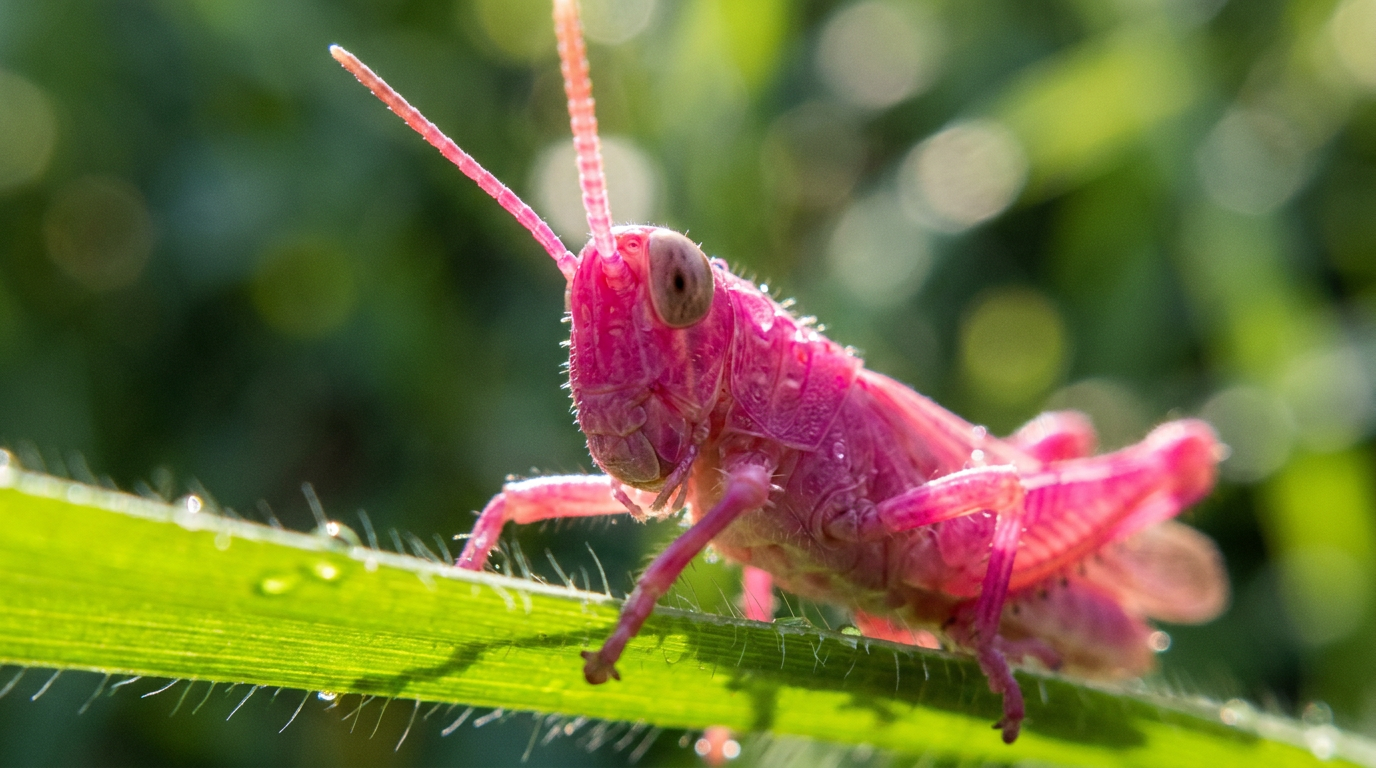
When a gardener in the UK recently stumbled upon a bright pink grasshopper resting on a green leaf, the striking images quickly captured public attention. Such discoveries often feel like finding a mythical creature in a suburban backyard, prompting a mix of awe and scientific curiosity. While these vibrant insects look like they belong to an entirely different, exotic species, they are actually common local grasshoppers displaying a remarkable biological anomaly.[1]
This phenomenon is not isolated to any single region or species. In recent years, citizen scientists and nature enthusiasts have documented similar neon-pink sightings everywhere from the scrublands of East Texas to the braided river basins of New Zealand. In each case, the insect stands out like a beacon against its natural environment, turning a routine nature walk into a viral moment.[2][3]
The scientific consensus attributes this striking coloration to a genetic mutation known as erythrism. Rather than being a separate breed, these individuals carry a genetic variation that fundamentally alters how their bodies produce pigment. The mutation shifts the insect's classic green and brown color palette into vivid shades of pink, rose, and magenta.[4][5]
At a biochemical level, erythrism works by disrupting the standard balance of melanin. Evidence suggests the mutation causes an underproduction of the dark pigments, known as eumelanin, that normally help create brown and green hues. Simultaneously, it triggers an overproduction of red pigments, known as phaeomelanin. The resulting combination leaves the insect coated in a bright pink exoskeleton.[5][6]

Geneticists often compare erythrism to other well-known pigment mutations, such as albinism or leucism. However, there is a distinct mechanical difference. While albinism is characterized by a complete or partial absence of pigment, erythrism does not erase pigment; it actively alters it. The insect's genetic blueprint is fully functional but operating with a different color output.[5][7]
Despite the aesthetic beauty of the mutation, it creates what biologists describe as a fatal visibility crisis. Grasshoppers rely heavily on their ability to blend into foliage, using green and brown camouflage to hide from a vast array of predators. When a grasshopper is born bright pink, that evolutionary advantage is entirely stripped away.[1][5]
The survival penalty for this mutation is severe. Against a backdrop of green grass or brown soil, a pink grasshopper acts as a neon sign for birds, small mammals, and predatory insects. Because they are so easily spotted from a distance, observational data indicates that pink grasshoppers are consumed at a much higher rate than their camouflaged siblings.[1][4]
Against a backdrop of green grass or brown soil, a pink grasshopper acts as a neon sign for birds, small mammals, and predatory insects.
This high predation rate is supported by field observations from wildlife photographers and entomologists. A peculiar piece of evidence is that pink grasshoppers are frequently found missing one of their hind legs. Grasshoppers possess the ability to intentionally drop a limb to escape a predator's grasp—a process called autotomy. The high frequency of five-legged pink grasshoppers suggests they are surviving near-miss attacks far more often than green grasshoppers.[6]

Furthermore, there is a stark age disparity in the sightings. The vast majority of documented pink grasshoppers are nymphs, meaning they are still in their juvenile stages. It is exceedingly rare to find a fully mature adult pink grasshopper, strongly implying that most individuals with the erythrism mutation are eaten before they ever reach reproductive age.[6][7]
The exact genetic inheritance model of erythrism remains a subject of scientific debate. The prevailing theory in entomological literature is that the trait is autosomal recessive. Under this model, a grasshopper must inherit the mutated gene from both parents to display the pink coloration. Because the gene is rare, and because pink adults rarely survive to breed, the alignment of two carrier parents is a statistical anomaly.[5][7]
However, some researchers have proposed an alternative hypothesis: the gene might actually be dominant. If the gene were dominant, only one parent would need to carry it. Proponents of this theory argue that the extreme rarity of the pink grasshopper is not due to recessive genetics, but rather to the brutal efficiency of natural selection. If every pink offspring is eaten before mating, the gene is constantly being eradicated from the local gene pool.[6][7]
It is also important to distinguish genetic erythrism from environmental color shifts. In some species, such as locusts, crowding, temperature changes, or specific diets can induce temporary pinkish hues in nymphs. However, true genetic erythrism is a permanent blueprint. As the grasshopper grows and molts its exoskeleton—typically about five times before adulthood—the new skin emerges just as vibrantly pink as the last.[6]

The vulnerability of these insects has even intersected with formal conservation efforts. During a recent survey in New Zealand, rangers discovered a pink variant of the robust grasshopper, a species that is already nationally endangered. Finding the highly visible pink female outside of a specialized predator-exclusion fence highlighted the immense challenges these unique insects face in the wild.[2]
Because formal laboratory studies on grasshopper genetics are relatively limited, much of the current evidence relies on citizen science. Everyday gardeners, hikers, and amateur photographers serve as the primary documenters of this phenomenon. Their geo-tagged photos and behavioral observations provide researchers with vital data points on where these mutations occur and how the insects interact with their environment.[3][4]
Ultimately, the pink grasshopper stands as a fascinating biological paradox. It is a beautiful error in nature's code, creating an insect that is visually spectacular but evolutionarily doomed. Each sighting offers a rare, fleeting opportunity to witness the strict rules of natural selection playing out in real-time.[7]
How we got here
1887
The erythrism mutation is first formally documented by scientists in a katydid species.
2018
New Zealand constructs the world's first insect predator exclusion fence, partly to protect rare and vulnerable grasshopper variants.
June 2026
A new sighting of a pink grasshopper in a UK garden captures public attention, highlighting the ongoing rarity of the mutation.
Viewpoints in depth
Geneticists' View
Focusing on the mechanics of the mutation and its inheritance.
For geneticists, the pink grasshopper is a living case study in pigment alteration. While albinism removes pigment entirely, erythrism demonstrates how a genetic misfire can actively change the ratio of produced pigments—specifically by suppressing eumelanin and boosting phaeomelanin. The primary debate within this camp is whether the gene is autosomal recessive, requiring two carrier parents, or if it is a dominant gene that simply appears incredibly rare because natural selection eradicates the carriers before they can reproduce.
Conservationists' View
Focusing on the survival challenges and environmental pressures.
Conservation biologists view the erythrism mutation through the lens of natural selection and habitat vulnerability. For endangered species, such as New Zealand's robust grasshopper, a pink mutation is a severe liability. Conservationists note that the lack of camouflage makes these insects an easy meal for invasive predators like hedgehogs and feral cats. Their focus is on how habitat protection—such as specialized predator-exclusion fences—might be the only way these unique genetic variants can survive to adulthood.
Wildlife Photographers' View
Focusing on the rarity, aesthetics, and documentation of the anomaly.
For nature photographers and citizen scientists, finding a pink grasshopper is often compared to winning the biological lottery. Because these insects rarely survive past the nymph stage, capturing high-quality images of them in the wild is a significant achievement. This community provides invaluable observational data to scientists, noting behavioral quirks—such as the high frequency of pink grasshoppers missing a leg due to near-miss predator attacks—that might otherwise go unrecorded in formal laboratory settings.
What we don't know
- Whether the erythrism gene in grasshoppers is strictly recessive, or if it acts as a dominant gene that is rapidly eradicated by predators before reproduction.
- The exact global population of pink grasshoppers, as their incredibly short lifespans make tracking and tagging nearly impossible.
Key terms
- Erythrism
- A genetic mutation that causes an unusual reddish or pinkish discoloration in an animal's skin, fur, or exoskeleton by altering pigment production.
- Autotomy
- The biological ability of certain animals, including grasshoppers, to intentionally drop a limb in order to escape a predator's grasp.
- Nymph
- An immature form of some invertebrates, such as grasshoppers, which undergoes gradual molting stages before reaching full adulthood.
- Phaeomelanin
- A type of pigment responsible for red, pink, and yellow hues, which is overproduced in individuals with erythrism.
Frequently asked
Can a pink grasshopper turn green over time?
No. The pink coloration is a permanent genetic blueprint. As the grasshopper grows and molts its exoskeleton, the new layer will emerge just as pink as the previous one.
Are pink grasshoppers a separate species?
No, they are individuals within standard grasshopper species that happen to carry a specific genetic mutation called erythrism.
Do pink grasshoppers survive long in the wild?
Rarely. Their bright color destroys their natural camouflage, making them highly visible to birds and other predators, which drastically reduces their lifespan.
Sources
Source coverage
7 outlets
3 viewpoints surfaced







[1]BBC NewsCitizen Scientists
Woman finds rare pink grasshoppers in garden
Read on BBC News →[2]The GuardianConservationists
‘Exceptionally rare’ pink grasshopper spotted in New Zealand
Read on The Guardian →[3]San Antonio Express-NewsCitizen Scientists
San Antonio teen spots 'unicorn' grasshopper with rare mutation
Read on San Antonio Express-News →[4]MySanAntonioCitizen Scientists
Ohio man finds rare pink grasshopper while exploring East Texas
Read on MySanAntonio →[5]A-Z AnimalsGeneticists & Entomologists
Pink Grasshoppers: Erythrism and Genetics
Read on A-Z Animals →[6]Roeselien Raimond NatureCitizen Scientists
The Mystery of the Five-Legged Pink Grasshopper
Read on Roeselien Raimond Nature →[7]Factlen Editorial TeamGeneticists & Entomologists
Synthesis by Factlen editorial team
Read on Factlen Editorial Team →



Every angle. Every day.
Get science stories with full source coverage and perspective breakdowns delivered to your inbox.