
2026 Rivian R2 vs. Tesla Model Y: The Ultimate Electric SUV Trade-Off Analysis
The highly anticipated Rivian R2 finally hits the road to challenge Tesla's refreshed Model Y. We break down the pricing, performance, and utility trade-offs between 2026's most important electric SUVs.
By Factlen Editorial Team
- Efficiency & On-Road Enthusiasts
- Values aerodynamic design, fast acceleration, and sporty handling on pavement.
- Adventure & Utility Seekers
- Prioritizes ground clearance, cargo volume, and off-road capability for outdoor lifestyles.
- Value & Practicality Shoppers
- Focuses on the entry-level price gap, standard features, and everyday usability.
What's not represented
- · Traditional dealership advocates
- · Long-term reliability analysts
Why this matters
For the first time, buyers in the mid-size electric SUV market have a genuine, no-compromises alternative to the Tesla Model Y. Understanding the distinct trade-offs between Tesla's on-road efficiency and Rivian's rugged utility is crucial for anyone spending $50,000 on their next family vehicle.
Key points
- The 2026 Tesla Model Y starts at $41,380, while the Rivian R2 launches with its $57,990 Performance trim.
- Both top-tier Performance models cost roughly $58,000, making them direct competitors at the high end.
- The Rivian R2 offers 9.6 inches of ground clearance and 90.1 cubic feet of cargo space, dwarfing the Model Y's utility.
- Tesla's Juniper update brings a quieter cabin, ventilated seats, and a rear entertainment screen.
- Surprisingly, the boxy Rivian R2 Performance beats the Model Y Performance in EPA efficiency (109 vs 104 MPGe).
- Both vehicles feature native NACS ports, granting equal access to the Tesla Supercharger network.
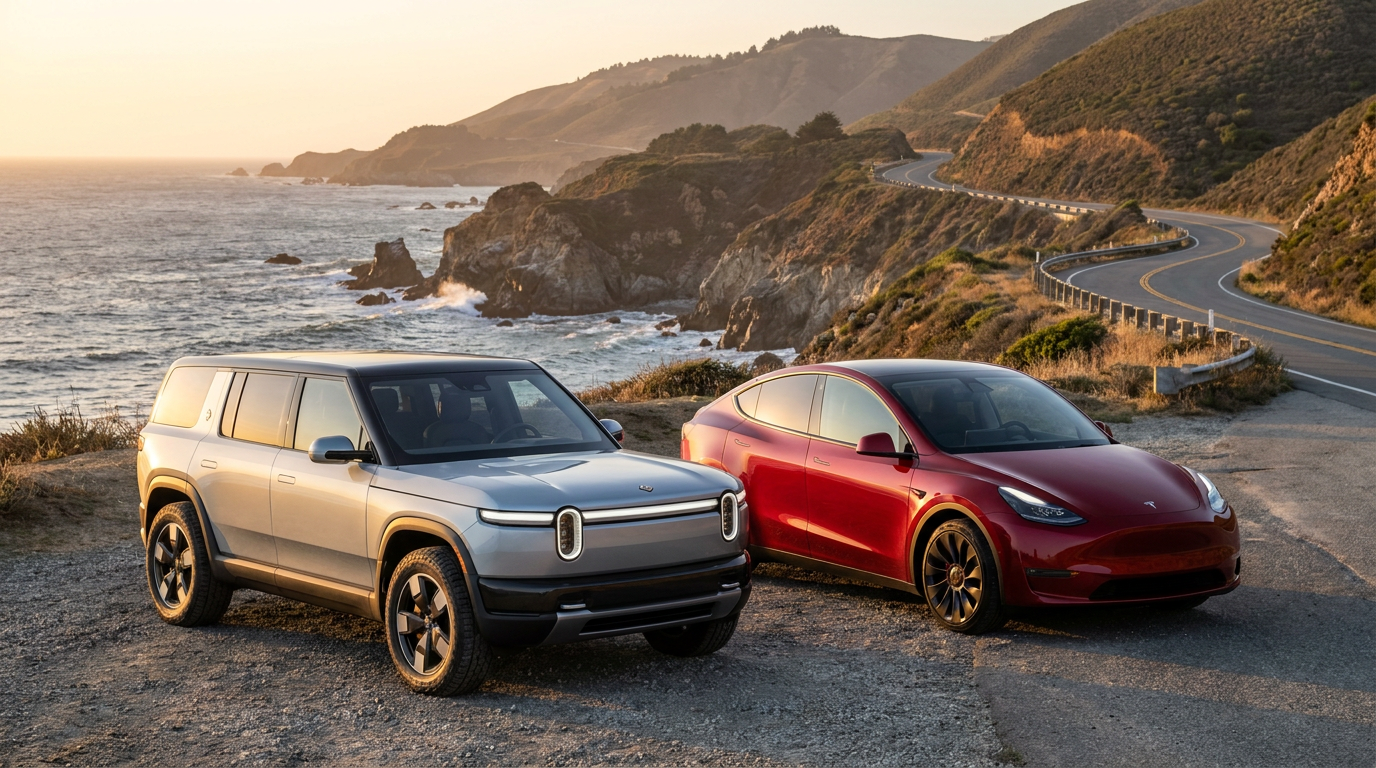
The mid-size electric SUV segment has reached a boiling point in 2026. For years, the Tesla Model Y has been the undisputed benchmark, blending range, software, and charging infrastructure into an unbeatable package. But the arrival of the Rivian R2 fundamentally alters the landscape. With Tesla rolling out its highly anticipated "Juniper" refresh and Rivian delivering its first R2 Performance models to customers, buyers finally have a genuine, no-compromises choice between two distinct philosophies. One prioritizes aerodynamic efficiency and on-road refinement, while the other leans heavily into rugged versatility and outdoor capability.[1][2]
When evaluating the pricing and availability landscape for 2026, the trade-offs become immediately apparent. The Tesla Model Y holds a massive advantage for budget-conscious buyers, starting at just $41,380 for the base rear-wheel-drive version. Rivian, conversely, is employing a top-down launch strategy. The only R2 models available in 2026 are the $57,990 Performance trim and the $53,990 Premium trim, with the sub-$50,000 standard variants delayed until 2027. However, when comparing the top-tier trims head-to-head, the financial gap vanishes entirely. The R2 Performance and the Model Y Performance are priced within a few hundred dollars of each other, making the $58,000 price point the ultimate battleground for these two electric heavyweights.[1][6][7]

The case for the 2026 Tesla Model Y rests on its peerless on-road dynamics and sleek, aerodynamic efficiency. The Juniper update refined an already winning formula, lowering the nose and adding a slim light bar that echoes the Cybertruck. This teardrop shape allows the Model Y to slice through the air, resulting in a whisper-quiet cabin at highway speeds and a sporty, planted feel on twisty roads. It drives much more like a performance sedan than a traditional SUV, offering a lower center of gravity and firmer suspension that rewards enthusiastic driving.[2][3]
The evidence supporting the Model Y's on-road supremacy is quantified in its performance metrics. The Performance trim delivers roughly 510 horsepower and rockets from zero to 60 mph in a blistering 3.3 seconds, edging out the Rivian's 3.6-second sprint. Furthermore, the Juniper update addressed long-standing complaints by adding acoustic glass, superior sound deadening, and a more compliant ride. For buyers who prioritize a sporty commute and maximum aerodynamic efficiency, the Model Y remains the undisputed leader in the segment.[1][6]

The case against the Tesla Model Y centers on its limited utility and polarizing interior minimalism. With only 6.0 inches of ground clearance, the Model Y is strictly a pavement dweller; taking it on anything rougher than a well-graded dirt road risks damaging the undercarriage. Inside, the Juniper update retains Tesla's "bachelor pad" aesthetic, lacking a dedicated driver display in front of the steering wheel. Drivers must still look to the central 15.4-inch touchscreen for critical information like speed and range, a design choice that continues to frustrate traditionalists despite the addition of new ambient lighting and ventilated seats.[2][3][7]
The case against the Tesla Model Y centers on its limited utility and polarizing interior minimalism.
The case for the Rivian R2 is built entirely around maximum versatility, off-road capability, and a more welcoming, tactile cabin. Rivian opted for a traditional, boxy SUV silhouette that sacrifices some aerodynamic slipperiness in exchange for massive interior volume and a commanding driving position. The R2 is designed to be a "do-everything" vehicle, equally comfortable handling the daily school run or navigating a rocky, rutted trail on the weekend. Its interior, often compared to a modern designer loft, features multi-layered textures, physical scroll wheels, and a dedicated digital driver's display that directly addresses Tesla's ergonomic blind spots.[2][3][5]
The evidence for the Rivian R2's utility is overwhelming when looking at the raw dimensions. Despite being nearly three inches shorter than the Model Y, the R2's boxy greenhouse yields 90.1 cubic feet of total cargo space with the seats folded, a 19 percent advantage over the Tesla's 76 cubic feet. It also boasts a larger 5.2-cubic-foot frunk. Off-road, the R2 is in a different league, offering 9.6 inches of ground clearance—60 percent more than the Model Y—along with 25-degree approach and 26-degree departure angles. Shockingly, Rivian's powertrain engineering allows the R2 Performance to achieve 109 MPGe, making it 5 percent more efficient than the Model Y Performance despite its heavier, boxier frame.[3][4]

The case against the Rivian R2 involves its higher barrier to entry in 2026 and slight compromises in on-road agility. Because it sits higher and weighs roughly 370 pounds more than the Model Y, the R2 cannot match the Tesla's sports-car-like cornering. It also charges slightly slower; the Model Y can complete a fast-charging session in roughly 24 minutes, while the R2 takes closer to 29 minutes. Additionally, buyers who want an R2 this year must be willing to spend nearly $58,000, entirely locking out the mid-$40,000 market until the standard trims arrive next year.[1][3]
The charging infrastructure debate, once a massive advantage for Tesla, has effectively been neutralized in 2026. Both the Model Y and the Rivian R2 feature native North American Charging Standard (NACS) ports, meaning Rivian owners can plug directly into Tesla's vast Supercharger network without needing a cumbersome adapter. This parity removes the biggest historical hurdle to buying a non-Tesla EV, allowing buyers to choose between the two vehicles based purely on their design merits, performance, and utility rather than range anxiety.[1]

Ultimately, the 2026 Tesla Model Y fits well when a buyer prioritizes a low starting price, sports-sedan handling, and maximum highway efficiency. It is the ideal choice for commuters who rarely leave the pavement, value a minimalist tech-forward aesthetic, and want the absolute quickest acceleration in the segment. The Model Y does not fit well when a buyer needs to navigate rough terrain, requires maximum cargo volume for bulky gear, or strongly prefers having physical controls and a traditional instrument cluster in their line of sight.[1][2][6]
Conversely, the 2026 Rivian R2 fits well when a buyer demands genuine off-road capability, massive interior storage, and a more rugged, distinctive design. It is the perfect match for outdoor enthusiasts who need the 9.6 inches of ground clearance for trailheads, or families who will utilize every inch of its 90.1 cubic feet of cargo space. The R2 does not fit well when a buyer is shopping on a strict $45,000 budget in 2026, prioritizes canyon-carving handling dynamics, or wants the absolute fastest charging curve available on the market.[1][3][4]
How we got here
2020
Tesla launches the original Model Y, which quickly becomes the best-selling electric vehicle in the world.
March 2024
Rivian officially unveils the R2 mid-size SUV, promising a smaller, more affordable alternative to its R1 lineup.
Late 2025
Tesla introduces the 'Juniper' refresh for the Model Y, adding updated styling, a rear screen, and improved cabin insulation.
Spring 2026
Rivian begins customer deliveries of the top-tier R2 Performance models, initiating the direct head-to-head competition.
2027
Rivian plans to release the entry-level standard R2 trims, bringing the starting price down to roughly $45,000.
Viewpoints in depth
Efficiency & On-Road Enthusiasts
This camp argues that the Tesla Model Y's aerodynamic teardrop shape and lower center of gravity make it the superior daily driver.
For these drivers, the SUV format shouldn't mean sacrificing driving dynamics. They point to the Model Y's 3.3-second 0-60 mph time and its sports-sedan-like cornering abilities as proof that Tesla has mastered the on-road experience. The Juniper update's focus on acoustic glass and a quieter cabin only strengthens their view that the Model Y is the ultimate pavement cruiser. They view the Rivian's boxy shape as an unnecessary aerodynamic penalty for buyers who rarely leave the asphalt.
Adventure & Utility Seekers
This camp believes an SUV must offer genuine off-road capability and maximum cargo space, making the Rivian R2 the clear winner.
Utility purists argue that the Model Y is merely a lifted hatchback, pointing to its restrictive 6.0 inches of ground clearance as a fatal flaw for outdoor recreation. They champion the Rivian R2's 9.6 inches of clearance, 25-degree approach angle, and massive 90.1 cubic feet of storage as the true definition of a sport utility vehicle. For this group, the fact that Rivian managed to make the R2 Performance 5 percent more efficient than the Model Y Performance (109 MPGe vs 104 MPGe) completely invalidates the argument that boxy SUVs must be inefficient.
Value & Practicality Shoppers
This camp focuses on the bottom line, weighing the Tesla's immediate affordability against the Rivian's delayed entry-level models.
Practicality-focused buyers and budget shoppers emphasize that the EV transition relies on affordability. They highlight the Tesla Model Y's $41,380 starting price as a massive advantage in 2026, noting that buyers looking for a sub-$50,000 Rivian R2 must wait until 2027. However, they also acknowledge that at the $58,000 Performance tier, the value proposition shifts; the Rivian offers significantly more horsepower, cargo space, and a dedicated driver's display for the exact same price, making it the better high-end investment.
What we don't know
- How Rivian's long-term build quality on the new R2 platform will compare to Tesla's mature Model Y production lines.
- Whether Tesla will introduce further price cuts to undercut the Rivian R2's standard trims when they launch in 2027.
- Real-world winter range degradation for the R2 compared to the Model Y's established cold-weather performance.
Key terms
- NACS
- North American Charging Standard, the charging plug design originally developed by Tesla and now adopted by most major automakers, including Rivian.
- MPGe
- Miles Per Gallon Equivalent, a metric used by the EPA to compare the energy efficiency of electric vehicles to traditional gas-powered cars.
- Approach Angle
- The maximum angle of a ramp or obstacle a vehicle can climb from a flat surface without the front bumper hitting the ground.
- Frunk
- A front trunk, an enclosed storage compartment located under the hood of an electric vehicle where an engine would traditionally be.
Frequently asked
Can the Rivian R2 use Tesla Superchargers?
Yes. The 2026 Rivian R2 comes standard with a native NACS port, allowing it to plug directly into Tesla Superchargers without an adapter.
Which SUV is faster from zero to 60 mph?
The Tesla Model Y Performance is slightly faster, hitting 60 mph in 3.3 seconds compared to the Rivian R2 Performance's 3.6 seconds.
When will the cheaper Rivian R2 models be available?
Rivian is launching the higher-priced Performance and Premium trims in 2026. The standard trims, priced around $45,000 to $48,000, will not arrive until 2027.
Which vehicle has more cargo space?
The Rivian R2 offers significantly more storage, with 90.1 cubic feet of total space (including the frunk) compared to the Model Y's 76 cubic feet.
Sources
Source coverage
7 outlets
3 viewpoints surfaced







[1]Road EthosValue & Practicality Shoppers
Rivian R2 Vs. Tesla Model Y: An Honest Comparison For 2026 Buyers
Read on Road Ethos →[2]CarwowValue & Practicality Shoppers
Rivian R2 vs Tesla Model Y: which electric SUV does Mat Watson prefer?
Read on Carwow →[3]ElectrekAdventure & Utility Seekers
Rivian R2 vs Tesla Model Y spotted side-by-side: Detailed size comparison
Read on Electrek →[4]CarBuzzAdventure & Utility Seekers
All The Ways The Rivian R2 Performance Beats Tesla's Top Model Y
Read on CarBuzz →[5]Top GearAdventure & Utility Seekers
Rivian R2 (US) Review 2026
Read on Top Gear →[6]Car and DriverEfficiency & On-Road Enthusiasts
2026 Tesla Model Y Review, Pricing, and Specs
Read on Car and Driver →[7]EdmundsEfficiency & On-Road Enthusiasts
2026 Tesla Model Y Prices, Reviews, and Pictures
Read on Edmunds →
Every angle. Every day.
Get automotive stories with full source coverage and perspective breakdowns delivered to your inbox.