
How Vehicle-to-Home (V2H) Charging Turns Your EV Into a Massive Home Battery
Bidirectional EV charging is transforming electric vehicles into mobile energy reservoirs. Here is how V2H technology works, how it compares to dedicated home storage, and whether it makes sense for your property.
By Factlen Editorial Team
- Energy Resilience Advocates
- Focuses on the ability of V2H to provide days of off-grid backup power during extreme weather and grid failures.
- Grid Integration Specialists
- Views bidirectional charging primarily as a tool for utility-scale load balancing and renewable energy integration.
- Homeowners & Consumers
- Prioritizes the upfront hardware costs, daily utility bill savings, and practical limitations of using a commuter vehicle as a home battery.
What's not represented
- · Traditional Utility Companies
- · Automotive Warranty Providers
Why this matters
An electric vehicle battery holds up to ten times more energy than a standard home battery. Tapping into that reservoir can provide days of backup power during grid outages and save thousands of dollars by avoiding peak electricity rates.
Key points
- Vehicle-to-Home (V2H) technology allows an electric vehicle to act as a massive backup battery for a house.
- An EV battery holds up to ten times more energy than a standard wall-mounted residential battery.
- V2H can power a typical home for three to ten days during a grid outage.
- Homeowners can save money daily by charging the EV at night and using it to power the home during peak-rate evening hours.
- Unlike Vehicle-to-Grid (V2G) setups, V2H does not require complex utility agreements because power is not exported to the public network.
- V2H hardware costs significantly less than purchasing a dedicated home battery system.
For most of automotive history, a car sitting in a driveway was simply a depreciating asset waiting to be driven. Even as electric vehicles (EVs) began replacing combustion engines, the primary question remained focused on mobility: how far can it go on a single charge? But in 2026, the conversation has fundamentally shifted from what an EV can drive to what else it can power.[2][6]
The average vehicle is parked and idle for roughly 95 percent of its life. For an EV, that means a massive reservoir of advanced lithium-ion energy storage is just sitting unused in the garage. Bidirectional charging technology is unlocking that dormant potential, allowing the electricity stored in a car to flow in reverse.[2][5]
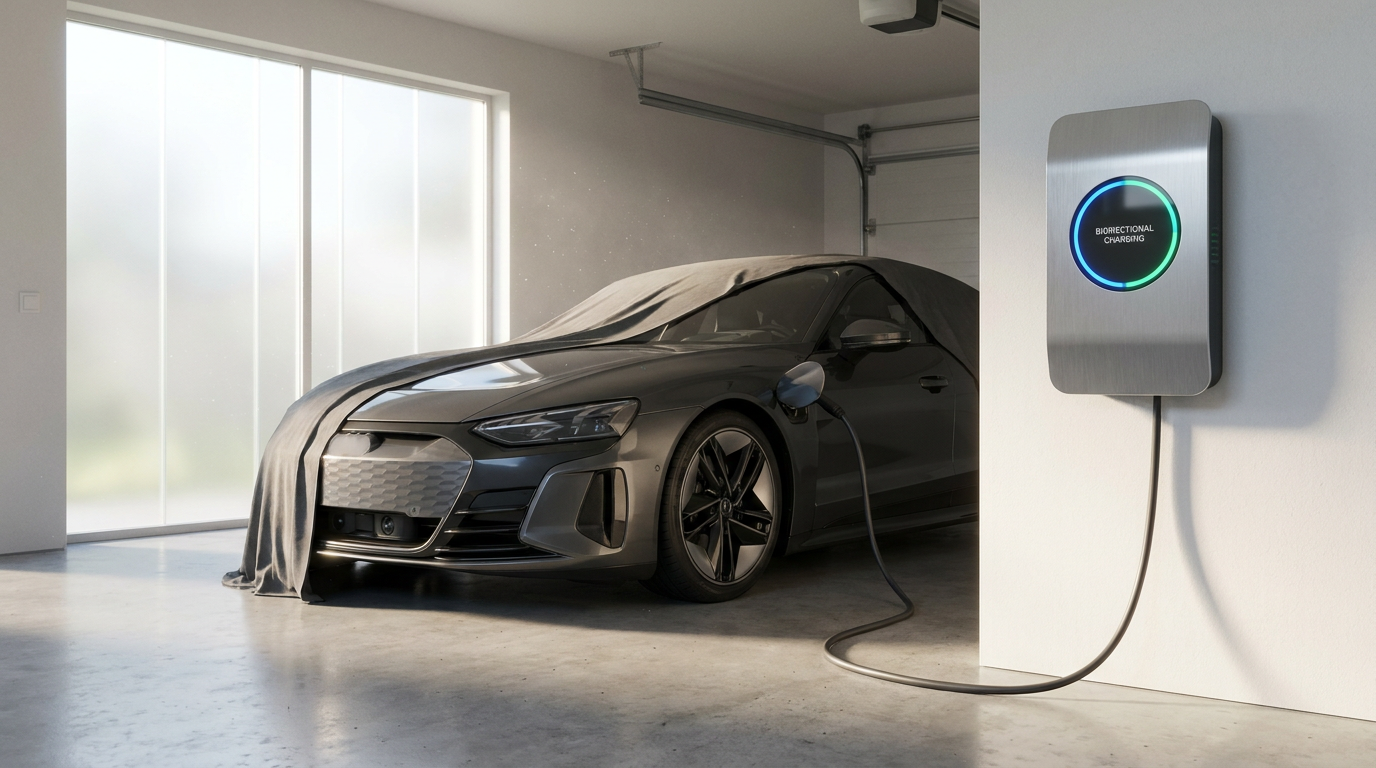
Traditional EV charging is strictly a one-way street. Alternating current (AC) electricity flows from the grid or a home solar system, passes through an inverter, and is stored as direct current (DC) in the vehicle's battery. Bidirectional charging, often referred to under the umbrella term V2X (Vehicle-to-Everything), introduces specialized hardware that allows that DC power to be converted back into AC and pushed out of the vehicle.[3][5]
While there are several types of bidirectional charging, Vehicle-to-Home (V2H) has emerged as the most practical and immediate application for consumers. V2H systems isolate the energy exchange to the property itself, allowing the vehicle to act as a dedicated, whole-home battery backup system without interacting with the broader public utility grid.[4][6]

To understand why V2H is so disruptive to the home energy market, one must look at the sheer scale of EV batteries. A standard, highly popular residential battery system like the Tesla Powerwall holds 13.5 kilowatt-hours (kWh) of energy. By contrast, modern electric vehicles carry battery packs ranging from 60 kWh to a staggering 131 kWh in trucks like the Ford F-150 Lightning.[1][6]
That mathematical difference translates directly into resilience. During a grid outage, a single dedicated home battery can typically power essential household loads for 8 to 12 hours—enough to get through the night until solar panels wake up the next morning. An EV plugged into a V2H system, however, can power an entire home for three to ten days, depending on usage.[1][3]

Beyond emergency backup, V2H offers significant daily financial benefits through a practice known as time-of-use (TOU) arbitrage. Many utility companies charge higher rates during peak evening hours (typically 4 PM to 9 PM) when grid demand spikes. A V2H system can automatically draw power from the EV during these expensive hours, effectively shielding the homeowner from peak pricing.[1][2]
The system then recharges the vehicle overnight when grid demand is low and electricity is at its cheapest. Over the course of a year, this daily load-shifting can shave hundreds or even thousands of dollars off a household's utility bill, accelerating the return on investment for the charging hardware.[2][5]
The system then recharges the vehicle overnight when grid demand is low and electricity is at its cheapest.
The economics become even more compelling when V2H is paired with residential solar panels. In this setup, the home's solar array charges the EV for free during peak daylight hours. When the sun goes down, the V2H system discharges the EV to power the house overnight. This cycle can eliminate grid electricity purchases almost entirely, creating a near-autonomous home energy ecosystem.[1][5]
It is important to distinguish V2H from its more complex sibling, Vehicle-to-Grid (V2G). While V2H keeps the power strictly "behind the meter" to run the owner's house, V2G exports the vehicle's stored energy back onto the public utility network. V2G allows EV owners to get paid by the utility for providing grid stability during extreme demand events.[3][4]
However, V2G faces massive regulatory and technical hurdles. Exporting power to the grid requires complex interconnection agreements, specialized utility metering, and software that allows the utility to communicate with the vehicle. Because utility regulations vary wildly by region, V2G remains largely in the pilot-program phase in many markets.[4][6]
V2H bypasses this red tape entirely. Because the energy never crosses the boundary back onto the public network, homeowners do not need complex utility approvals to deploy it. A V2H setup simply requires a compatible bidirectional charger, an automatic transfer switch to safely disconnect the home from the grid during an outage (islanding), and a compatible vehicle.[1][4]
Cost is another major factor driving V2H adoption over dedicated home batteries. As of 2026, a dedicated home battery system typically costs between $12,500 and $14,500 fully installed. A V2H bidirectional charger and installation generally ranges from $1,500 to $8,000, allowing homeowners to tap into a much larger battery for a fraction of the upfront capital.[1][3]

Furthermore, financial incentives are currently tilting the scales. While the federal tax credit for standalone residential battery storage expired at the end of 2025, the Section 30C credit—which provides up to $1,000 for EV charger installations—still applies to bidirectional chargers through June 30, 2026, making the V2H route even more cost-advantaged.[1][6]
There is, however, one unavoidable catch to V2H: the car must actually be parked at home to power the house. For remote workers or households with two vehicles where one is usually in the garage, this is a non-issue. But for a single-car household where the EV is used for a daily 9-to-5 commute, the battery will be absent precisely when the home's solar panels are producing peak power, and absent during the start of the evening peak-pricing window.[1][6]
For commuters, energy experts increasingly recommend a hybrid approach. Installing one smaller, dedicated home battery handles the daily solar storage and evening arbitrage, because it is permanently bolted to the wall. The V2H system is then reserved for extended grid outages, allowing the EV's massive capacity to supplement the home battery when multi-day resilience is required.[1][2]
Some EV owners worry that using their car to power their home will accelerate battery degradation. However, early data suggests that the impact is highly manageable. Home energy draw is typically a slow, low-wattage trickle compared to the massive power surges required to accelerate a 5,000-pound vehicle on the highway. Smart energy management systems also allow owners to set strict discharge limits, ensuring the car never drops below a 20 percent state of charge.[3][5]
As the electric grid faces increasing strain from extreme weather and rising demand, the decentralized storage offered by millions of EVs will become a critical buffer. V2H technology is no longer a futuristic concept; it is a commercially available tool that empowers homeowners to take control of their energy security, lower their bills, and maximize the value of the vehicle sitting in their driveway.[2][6]
Viewpoints in depth
Energy Resilience Advocates
Focuses on the ability of V2H to provide days of off-grid backup power during extreme weather and grid failures.
For resilience advocates, the primary value of V2H is sheer capacity. As climate change drives more frequent and severe weather events, the vulnerability of the centralized power grid has become a major concern for homeowners. A standard 13.5 kWh home battery is designed to bridge the gap between sunset and sunrise, but it struggles to keep a home running through a multi-day winter storm or hurricane aftermath. By tapping into a 100+ kWh vehicle battery, homeowners gain a level of energy security previously only achievable with noisy, maintenance-heavy diesel generators. This camp views the EV not just as transportation, but as critical emergency infrastructure.
Grid Integration Specialists
Views bidirectional charging primarily as a tool for utility-scale load balancing and renewable energy integration.
Grid specialists look beyond the individual home and see millions of EVs as a distributed, virtual power plant. While they acknowledge V2H is the easiest first step due to lower regulatory barriers, their ultimate goal is widespread Vehicle-to-Grid (V2G) adoption. They argue that as the grid transitions to intermittent renewable sources like wind and solar, utilities desperately need massive amounts of battery storage to smooth out supply and demand. By incentivizing EV owners to export power during peak events, utilities can avoid firing up expensive, highly polluting natural gas "peaker" plants, ultimately lowering energy costs and emissions for everyone.
Homeowners & Consumers
Prioritizes the upfront hardware costs, daily utility bill savings, and practical limitations of using a commuter vehicle as a home battery.
From the consumer perspective, the V2H debate comes down to return on investment and lifestyle compatibility. The math is highly attractive: spending $4,000 on a bidirectional charger to unlock $15,000 worth of battery storage is a clear win. However, this camp is quick to point out the logistical friction. If a homeowner commutes to an office every day, their "home battery" is sitting in a corporate parking lot precisely when their rooftop solar panels are generating peak power. For these users, the consumer consensus is shifting toward a hybrid approach: buying one small, permanent home battery for daily solar capture, and using the EV strictly for long-term outage backup.
What we don't know
- How aggressively automakers will honor battery warranties for vehicles subjected to heavy daily V2H cycling.
- When utility companies will standardize the regulations required to make broader Vehicle-to-Grid (V2G) exporting accessible nationwide.
- Whether future federal tax incentives will be introduced specifically to subsidize residential V2H installations after current charger credits expire.
Key terms
- Bidirectional Charging
- Technology that allows electricity to flow both into an electric vehicle's battery and back out to power external loads.
- Vehicle-to-Home (V2H)
- A specific bidirectional setup where an EV battery is used to power a single residential building, operating independently from the public grid.
- Vehicle-to-Grid (V2G)
- A bidirectional setup where an EV exports stored energy back onto the public utility network, often in exchange for financial compensation.
- Time-of-Use (TOU) Arbitrage
- The practice of storing electricity when grid rates are cheap and using that stored power when grid rates are expensive.
- Islanding
- The ability of a home energy system to safely disconnect from the public grid during an outage and operate autonomously.
Frequently asked
Can I use V2H if I don't have solar panels?
Yes. While solar makes V2H more efficient, you can still use the system to charge your EV from the grid at night when rates are cheap, and discharge it to power your home during expensive peak evening hours.
Will powering my house ruin my EV battery?
Studies show the impact is minimal. Powering a home requires a slow, low-wattage draw compared to the massive energy spikes required for driving, and software prevents the battery from draining completely.
Do I need utility permission to install V2H?
Unlike Vehicle-to-Grid (V2G) systems that export power to the public network, V2H operates entirely behind your meter. You generally only need standard electrical permits, not complex utility interconnection agreements.
Does V2H work during a blackout?
Yes, provided your system includes an automatic transfer switch (islanding capability) that safely disconnects your home from the dead grid so your EV can power your house independently.
Sources
Source coverage
6 outlets
3 viewpoints surfaced






[1]NuWatt EnergyEnergy Resilience Advocates
V2H vs Powerwall: The Complete Guide to Bidirectional Charging
Read on NuWatt Energy →[2]Schneider ElectricGrid Integration Specialists
The Future of Bidirectional Charging and V2X
Read on Schneider Electric →[3]Efficiency VermontEnergy Resilience Advocates
Viability and Economics of Residential V2X Applications
Read on Efficiency Vermont →[4]EmablerGrid Integration Specialists
Vehicle-to-grid comparison with V2H
Read on Emabler →[5]GridXGrid Integration Specialists
Smart Charging vs Bidirectional Charging
Read on GridX →[6]Factlen Editorial TeamHomeowners & Consumers
Synthesis by Factlen editorial team
Read on Factlen Editorial Team →
Every angle. Every day.
Get home stories with full source coverage and perspective breakdowns delivered to your inbox.