
US and Iran Establish 60-Day Roadmap and De-confliction Mechanisms in Swiss Peace Talks
High-level delegations from the US and Iran concluded their first round of negotiations in Switzerland, agreeing to technical mechanisms to manage the Lebanon conflict and secure the Strait of Hormuz despite a tense, near-collapsed opening.
By Factlen Editorial Team
- US Administration
- Focuses on securing the Strait of Hormuz, enforcing the Lebanon ceasefire through strength, and curbing Iran's nuclear ambitions.
- Iranian Leadership
- Emphasizes the need for sanctions relief, protests US and Israeli violations of the ceasefire, and views the talks as a necessary step while maintaining readiness to retaliate.
- Mediating Nations
- Focuses on keeping diplomatic channels open, facilitating technical de-confliction mechanisms, and preventing a regional economic collapse.
What's not represented
- · Lebanese civilians affected by the ongoing proxy conflict
- · Global shipping companies navigating the Strait of Hormuz
- · Israeli government officials excluded from the direct US-Iran talks
Why this matters
These negotiations represent the most viable off-ramp to a sprawling Middle East war that has choked global shipping and spiked energy prices. If the 60-day roadmap holds, it could stabilize the global economy; if it fails, the region risks an immediate return to all-out conflict.
Key points
- The US and Iran concluded their first round of high-level peace talks in Switzerland, mediated by Qatar and Pakistan.
- Both sides agreed to a 60-day roadmap to negotiate a final deal ending the Middle East conflict.
- A 'de-confliction cell' was established to manage the fragile ceasefire between Israel and Hezbollah in Lebanon.
- A dedicated communication line was created to ensure the safe passage of commercial vessels through the Strait of Hormuz.
- The talks survived a near-collapse after Iran temporarily walked out over public military threats from the US President.
- Technical committees will remain in Switzerland to monitor compliance and draft the final agreement.
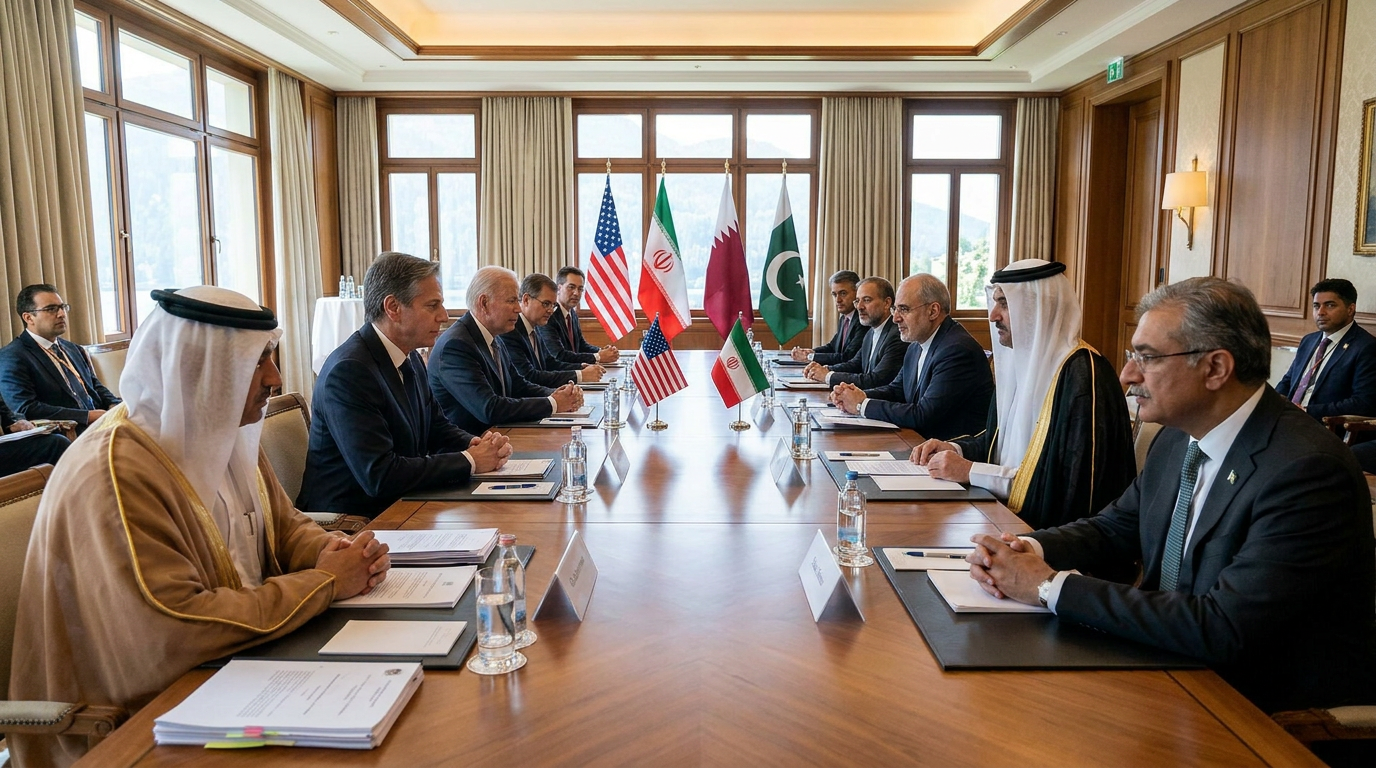
High-level delegations from the United States and Iran have concluded their first face-to-face negotiations in Bürgenstock, Switzerland, establishing a fragile 60-day roadmap aimed at ending the sprawling Middle East conflict.[1][6]
Mediated by Qatar and Pakistan, the talks represent the most significant diplomatic engagement between Washington and Tehran in years. The US delegation, led by Vice President JD Vance, and the Iranian team, headed by Parliamentary Speaker Mohammad Bagher Ghalibaf and Foreign Minister Abbas Araghchi, met under the framework of a Memorandum of Understanding signed last week.[3][4][8]
The primary objective of this two-month window is to translate a tenuous ceasefire into a permanent resolution, addressing both the proxy warfare in Lebanon and the crippling blockade of the Strait of Hormuz.[2][7]
To achieve this, negotiators have focused on concrete, technical mechanisms rather than immediate political grand bargains. The most critical output of the first day was the establishment of a "de-confliction cell" designed to manage the volatile border between Israel and Lebanon.[4][5]

This cell aims to coordinate directly with Lebanese authorities to ensure the termination of military operations and prevent accidental escalations from spiraling back into all-out war.[1][5]
Simultaneously, the parties agreed to open a direct "communication line" dedicated exclusively to maritime security. This channel is intended to avoid miscommunication and guarantee the safe passage of commercial vessels through the heavily contested waters of the Persian Gulf.[1][3][6]
Despite these structural agreements, the diplomatic process nearly collapsed before it began. The talks opened in a highly charged atmosphere, exacerbated by public threats from US President Donald Trump to resume military strikes if Iran failed to restrain Hezbollah.[1][6]
In response to what Iranian state media termed an "insulting message," the Iranian delegation temporarily refused to enter the negotiating room alongside the media. For several tense hours, messages had to be shuttled between the delegations by Qatari and Pakistani intermediaries.[1][4]
In response to what Iranian state media termed an "insulting message," the Iranian delegation temporarily refused to enter the negotiating room alongside the media.
The friction at the negotiating table mirrored the reality on the ground. Over the weekend, Iran effectively reinstated its blockade of the Strait of Hormuz, protesting continued Israeli airstrikes in southern Lebanon.[1][5]
Tehran argued that the US was failing to enforce the ceasefire, allowing Israel to breach the terms of the initial memorandum. The closure of the strait immediately sent shockwaves through global energy markets, underscoring the immense economic stakes of the Bürgenstock summit.[1][6]
Approximately 20 percent of the world's oil and natural gas travels through the Strait of Hormuz. Its effective closure in recent months has driven up global fuel prices, disrupted supply chains, and placed immense pressure on the international economy.[1][2]

A central pillar of the proposed final deal involves Iran permanently reopening the waterway in exchange for the United States lifting its military blockade on ships traveling to and from Iranian ports.[1][2]
However, the maritime standoff is inextricably linked to the conflict in the Levant. The newly established de-confliction cell faces an immediate test in southern Lebanon, where a fragile ceasefire between Israel and the Iranian-backed militant group Hezbollah has repeatedly fractured.[1][3]
Recent Israeli airstrikes, which local health ministries report have caused significant civilian casualties, prompted the US to declare a renewed ceasefire just days before the Swiss summit.[1]

Iranian Foreign Minister Araghchi explicitly stated that the success of the Lebanon de-confliction mechanism would be the first real test of the understandings reached in Switzerland.[1]
While the political leaders have departed Bürgenstock, specialized technical groups remain on-site. These lower-level officials are tasked with the arduous work of drafting the final agreement and monitoring compliance over the next eight weeks.[4][7]
How we got here
April 2026
The US and Iran agree to a tenuous initial ceasefire to halt the escalating regional conflict.
Mid-June 2026
The two nations sign a Memorandum of Understanding (MoU) committing to a 60-day negotiation period for a final peace deal.
June 20, 2026
Iran effectively closes the Strait of Hormuz again in protest of continued Israeli airstrikes in southern Lebanon.
June 21, 2026
High-level talks begin in Bürgenstock, Switzerland, marked by a shaky start and temporary Iranian walkout over US threats.
June 22, 2026
The first round of talks concludes with the establishment of technical de-confliction mechanisms and a commitment to continue negotiations.
Viewpoints in depth
US Administration's view
The US seeks to secure global energy markets and enforce regional stability through a combination of diplomacy and the threat of overwhelming force.
American negotiators are primarily focused on immediately reopening the Strait of Hormuz to relieve pressure on the global economy and securing a definitive end to Hezbollah's military operations in Lebanon. The administration maintains that "peace through strength" is necessary to keep Tehran at the table, utilizing public threats of military retaliation as leverage to ensure Iranian compliance with the ceasefire terms.
Iranian Leadership's view
Tehran views the talks as a pathway to crucial sanctions relief but remains highly suspicious of US commitments and Israeli actions.
Iranian officials argue that they are negotiating from a position of regional strength, using their control over the Strait of Hormuz as a vital bargaining chip. They contend that the US is failing to restrain its ally, Israel, pointing to continued airstrikes in Lebanon as evidence that Washington cannot be trusted to uphold its end of the Memorandum of Understanding. Consequently, Iran insists on maintaining its military readiness and proxy networks until a final, verifiable deal is implemented.
Mediators' view
Qatar, Pakistan, and Switzerland prioritize the maintenance of open diplomatic channels over immediate political victories, focusing on technical conflict management.
The mediating nations recognize the deep-seated mistrust between Washington and Tehran and are therefore steering the negotiations toward pragmatic, technical solutions like the de-confliction cell and maritime communication lines. Their primary goal is to prevent a catastrophic regional war and the subsequent collapse of the global energy market, acting as essential buffers when political rhetoric threatens to derail the fragile peace process.
What we don't know
- Whether the newly established de-confliction cell can successfully halt the entrenched fighting between Israel and Hezbollah in southern Lebanon.
- How the technical committees will address the complex, long-standing issues of Iran's nuclear program and comprehensive US sanctions relief.
- If the fragile 60-day diplomatic window can withstand further inflammatory rhetoric or unexpected military escalations on the ground.
Key terms
- Strait of Hormuz
- A highly strategic waterway between the Persian Gulf and the Gulf of Oman, through which a significant portion of the world's petroleum passes.
- Memorandum of Understanding (MoU)
- A formal, non-binding agreement between two or more parties outlining the terms and details of a mutual understanding, often serving as the foundation for a final treaty.
- De-confliction cell
- A dedicated communication and coordination center established to prevent accidental military engagements or misunderstandings between opposing forces in a shared operational area.
- Proxy war
- An armed conflict between two states or non-state actors which act on the instigation or on behalf of other parties that are not directly involved in the hostilities.
Frequently asked
What is the 60-day roadmap?
It is a framework agreed upon by the US and Iran to negotiate a final, comprehensive deal to end the Middle East conflict and reopen the Strait of Hormuz within two months.
Why did the Iranian delegation temporarily walk out?
The Iranian team protested a social media post by US President Donald Trump threatening to resume military strikes, leading to a temporary pause where mediators had to shuttle messages between rooms.
What is the Lebanon de-confliction cell?
It is a newly established technical mechanism designed to coordinate with Lebanese authorities to enforce the ceasefire between Israel and Hezbollah and prevent accidental escalations.
Why is the Strait of Hormuz so important?
Approximately 20 percent of the world's oil and natural gas travels through the strait, making it a critical chokepoint for the global economy and energy markets.
Sources
Source coverage
8 outlets
3 viewpoints surfaced








[1]The GuardianIranian Leadership
Iran hails ‘progress’ as first day of talks with US conclude after shaky start
Read on The Guardian →[2]AxiosUS Administration
U.S. and Iran reach deal to extend ceasefire and open strait
Read on Axios →[3]The HinduMediating Nations
'Progress', say mediators, after Iran-U.S. talks towards ending war
Read on The Hindu →[4]Al JazeeraMediating Nations
US and Iranian officials conclude day of high-level negotiations in Switzerland
Read on Al Jazeera →[5]EuractivMediating Nations
Mediators hail 'progress' in Iran-US talks on ending war
Read on Euractiv →[6]Channel News AsiaUS Administration
US and Iran conclude high-level talks in Switzerland, mediators say
Read on Channel News Asia →[7]Iran InternationalIranian Leadership
US-Iran high-level talks begin in Switzerland, Qatar says
Read on Iran International →[8]Swiss Federal Department of Foreign AffairsMediating Nations
Switzerland provides a discreet and reliable setting to facilitate talks at Bürgenstock
Read on Swiss Federal Department of Foreign Affairs →

Every angle. Every day.
Get news politics stories with full source coverage and perspective breakdowns delivered to your inbox.