
How "Content Credentials" and Invisible Watermarks Are Solving the 2026 Deepfake Crisis
As synthetic media threatens to overwhelm the internet, a coalition of tech giants and publishers has deployed a cryptographic "nutrition label" for digital content. Combined with invisible watermarking, the C2PA standard is shifting the fight against deepfakes from reactive detection to proactive verification.
By Factlen Editorial Team
- Standards & Provenance Advocates
- Argue that cryptographic chain-of-custody is the only durable defense against synthetic media.
- AI Platform Developers
- Emphasize that metadata is too fragile on its own and must be paired with invisible, pixel-level watermarks.
- Security & Policy Analysts
- View standardized labeling as a mandatory compliance baseline for public safety and market transparency.
What's not represented
- · Independent Creators
- · Social Media Platform Operators
- · Legacy Media Archivists
Why this matters
With AI-generated content projected to dominate the web by the end of 2026, the ability to instantly verify whether an image, video, or audio clip is real or synthetic is becoming a fundamental requirement for digital trust, democratic integrity, and brand safety.
Key points
- Deepfake incidents surged by 900% between 2023 and 2025, rendering traditional AI detection tools increasingly obsolete.
- The C2PA standard embeds a cryptographically signed 'nutrition label' into media, proving its origin and edit history.
- OpenAI and Google have adopted a dual-layer approach, pairing C2PA metadata with SynthID invisible watermarking.
- Google is integrating C2PA and SynthID verification natively into Search and Chrome, bringing provenance to billions of users.
- The EU AI Act, effective August 2026, mandates transparency labeling for synthetic content, accelerating enterprise adoption.
The digital ecosystem is facing a foundational crisis of trust. Europol has projected that up to 90% of all online content could be synthetically generated or manipulated by the end of 2026. This is not a distant theoretical threat; cybersecurity researchers tracked a staggering 900% surge in deepfake incidents between 2023 and 2025, reaching approximately 8 million cases globally. As the sheer volume of synthetic media scales, the infrastructure for proving authenticity is becoming just as critical as the infrastructure for delivering content.[1]
For years, the technology industry relied on "detection"—building machine learning models to spot the visual artifacts, audio inconsistencies, or unnatural movements inherent in synthetic media. But as generative AI has rapidly improved, those telltale artifacts have vanished. The perceptual gap between real and fake has closed so tightly that human judgment and automated detection tools are struggling to keep pace, turning detection into a permanent, losing arms race.[1]
Solving this crisis requires a paradigm shift: instead of trying to detect fakes after the fact, the industry must prove authenticity at the point of creation. This is the premise behind the Coalition for Content Provenance and Authenticity (C2PA), a massive alliance of technology giants, camera manufacturers, and news publishers that has spent the last five years building the open technical standard for digital trust.[1][4]
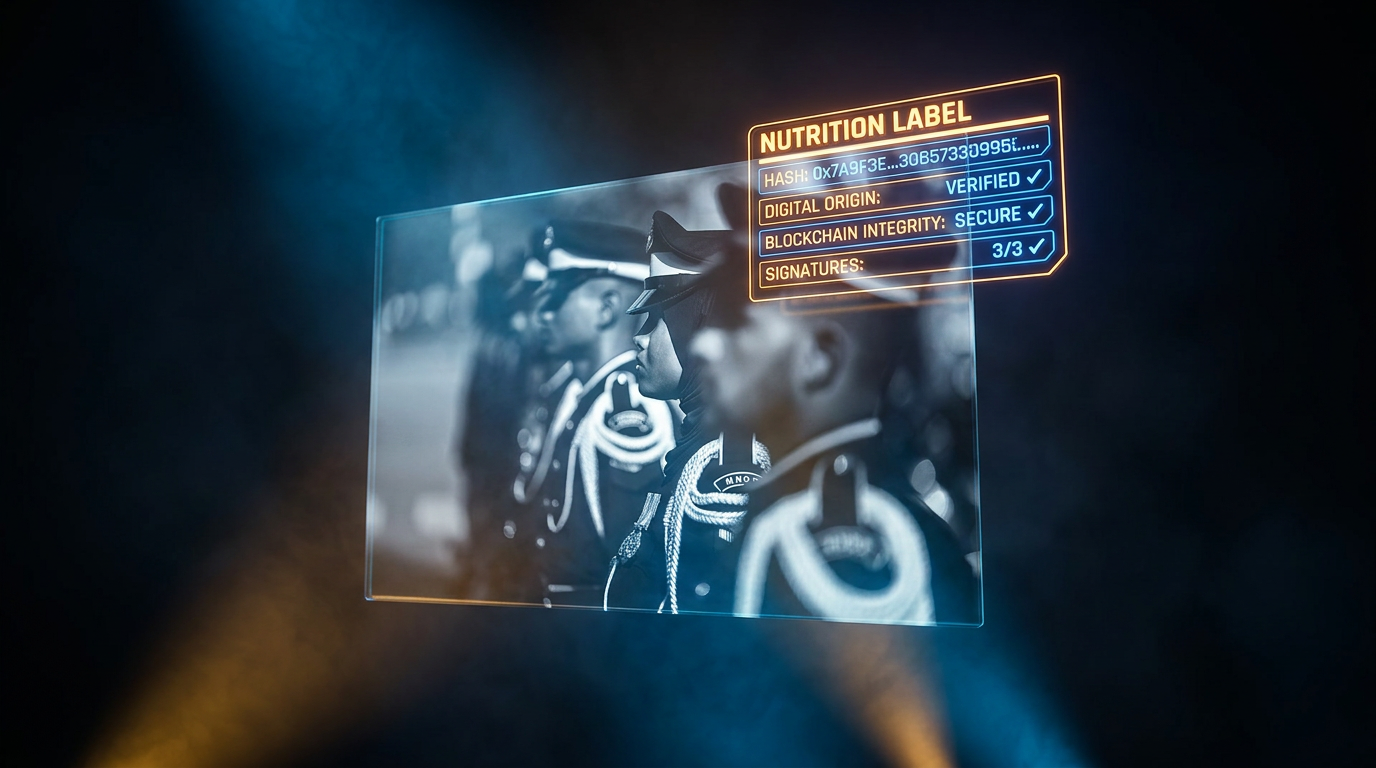
The C2PA standard operates like a cryptographic "nutrition label" for digital media, officially known to consumers as Content Credentials. When a photograph is taken or an image is generated by AI, a secure manifest is embedded directly into the file. This manifest records essential metadata: who created the file, when it was created, what specific tools were used, and whether artificial intelligence played a role in its generation.[1][6]

Because this manifest is digitally signed using public key cryptography tied to a trusted certificate authority, any subsequent tampering invalidates the signature. If a human editor crops the photo, or an AI tool alters the background, those changes are appended to the chain of custody. This creates a transparent, tamper-evident history that allows anyone to trace a piece of media back to its exact origin.[1][6]
Adoption of this standard has accelerated rapidly in 2026. Hardware manufacturers have begun integrating C2PA signing directly into camera firmware and smartphone security chips. Devices like the Google Pixel 10, alongside professional models from Nikon, Sony, and Leica, now allow photojournalists and everyday users to anchor their images to a specific physical device and moment in time before the file ever touches the internet.[5]
On the software side, enterprise platforms have made provenance a default setting. Adobe, a founding member of the initiative, has embedded Content Credentials across its Creative Cloud applications and Firefly AI models. This ensures that AI-generated assets carry an auditable chain of trust from creation to publication, a critical requirement for brand safety and enterprise compliance in an era of rampant digital impersonation.[3]
On the software side, enterprise platforms have made provenance a default setting.
However, C2PA metadata faces a structural vulnerability: fragility. Because the manifest lives within the file container, it can be stripped away. Many social media platforms routinely remove metadata during image compression to save space, and simply taking a screenshot of a C2PA-signed image severs its cryptographic chain entirely, leaving the resulting file without any verifiable history.[5]

To solve this "provenance gap," the industry has embraced a dual-layer approach, pairing C2PA metadata with invisible watermarking. On May 19, 2026, OpenAI and Google made simultaneous announcements cementing this strategy as the new industry standard, marking a rare moment of deep technical collaboration between the world's leading artificial intelligence laboratories.[5]
OpenAI formally joined the C2PA steering committee and announced it would embed Google DeepMind’s SynthID watermark into images generated by ChatGPT, the OpenAI API, and Codex, alongside the standard Content Credentials it already attaches. This layered defense ensures that if the metadata envelope is destroyed, the core identity of the file remains intact.[5]
SynthID embeds an imperceptible cryptographic signal directly into the pixel data of an image or the waveform of an audio file. Unlike metadata, this watermark survives screenshots, heavy compression, and color adjustments. It ensures that the AI-generated origin can still be verified even if the C2PA manifest is maliciously stripped or accidentally removed during upload.[2][5]

Google matched OpenAI's commitment with a massive distribution play at Google I/O 2026. The company announced that SynthID detection and C2PA verification are being integrated natively into Google Search and the Chrome browser, bringing digital provenance directly to billions of everyday internet users.[2]
This integration means users will no longer need specialized tools to check an image's provenance. By right-clicking an image in Chrome or using "Circle to Search," users will receive immediate context on whether the media was captured by a camera or generated by AI. Google reported that over 100 billion files have already been watermarked with SynthID, creating a massive foundation of verifiable content.[2][5]
The push for digital provenance is not purely voluntary; it is increasingly mandated by law. The European Union's AI Act, which takes full effect in August 2026, requires explicit transparency labeling for AI-generated content. Similarly, government agencies like the U.S. Cybersecurity and Infrastructure Security Agency (CISA) are adopting C2PA to secure official communications and evidentiary pipelines against state-sponsored disinformation.[5][6]

Despite this momentum, significant challenges remain. The internet is filled with billions of legacy images that predate Content Credentials, creating a vast pool of unverified media that will continue to circulate. Furthermore, user education is lagging; early studies indicate many consumers misinterpret the "CR" (Content Credentials) icon, assuming it marks an image as fake rather than providing a transparent history.[4]
Nevertheless, the infrastructure of digital truth is finally taking shape. By combining hardware-level capture, cryptographic metadata, and invisible watermarks, the technology industry is building a resilient ecosystem where authenticity can be verified. As these standards become ubiquitous, they promise to restore a baseline of trust to the digital world, ensuring that seeing can once again mean believing.[4][7]
How we got here
Feb 2021
The C2PA is founded by Adobe, Microsoft, Intel, and others to create an open standard for digital provenance.
2023 - 2025
Global deepfake incidents surge by 900%, overwhelming traditional AI detection tools.
Jan 2025
The U.S. Cybersecurity and Infrastructure Security Agency (CISA) formally recommends C2PA adoption for critical infrastructure.
May 2026
OpenAI and Google announce a unified approach, integrating both C2PA metadata and SynthID watermarking across their platforms.
Aug 2026
The EU AI Act takes full effect, legally mandating transparency labeling for AI-generated content.
Viewpoints in depth
Standards & Provenance Advocates
Argue that cryptographic chain-of-custody is the only durable defense against synthetic media.
This camp, led by camera manufacturers and software giants like Adobe, believes that the internet must shift from a "detect fakes" model to a "prove reality" model. They emphasize that AI detection will always be a losing game against rapidly improving generative models. Instead, they advocate for hardware-rooted security, where cameras and editing tools cryptographically sign media at the moment of creation, creating an auditable, tamper-evident history that empowers consumers to make their own trust decisions.
AI Platform Developers
Emphasize that metadata is too fragile on its own and must be paired with invisible, pixel-level watermarks.
AI labs and search providers acknowledge the value of C2PA but point out a critical flaw: metadata is easily stripped by social media platforms or destroyed by a simple screenshot. To counter this, developers advocate for robust invisible watermarking technologies like SynthID. By embedding cryptographic signals directly into the pixels or audio waveforms, they ensure that the synthetic origin of a file can be traced and verified even if the outer metadata envelope is maliciously or accidentally removed.
Security & Policy Analysts
View standardized labeling as a mandatory compliance baseline for public safety and market transparency.
Government agencies and cybersecurity experts view digital provenance through the lens of national security and fraud prevention. With deepfake incidents surging and the EU AI Act mandating transparency for synthetic content, this camp argues that voluntary adoption is no longer sufficient. They push for widespread integration of C2PA and watermarking into critical infrastructure, evidentiary pipelines, and enterprise workflows to protect democratic processes and prevent billion-dollar corporate impersonation scams.
What we don't know
- How quickly major social media platforms will stop stripping C2PA metadata during routine image compression.
- Whether consumers will actively check provenance data or succumb to verification fatigue.
- How effectively the industry can address the 'provenance gap' for billions of legacy images created before 2026.
Key terms
- C2PA
- The Coalition for Content Provenance and Authenticity, an alliance that develops the open technical standard for embedding verifiable history into digital media.
- Content Credentials
- The consumer-facing term for C2PA metadata, acting as a digital 'nutrition label' that shows who created a file and how it was edited.
- SynthID
- An invisible watermarking technology developed by Google DeepMind that embeds imperceptible cryptographic signals directly into the pixels or audio waves of AI-generated media.
- Cryptographic Manifest
- A secure, tamper-evident digital record attached to a file that logs its origin and edit history using mathematical signatures.
Frequently asked
Does a screenshot keep the Content Credentials?
No. Taking a screenshot creates a brand new image file, which severs the cryptographic chain and removes the C2PA metadata. This is why invisible watermarking is used as a backup.
Can Content Credentials be faked by bad actors?
It is cryptographically extremely difficult. The manifest is signed using public key cryptography tied to a trusted certificate authority, making tampering immediately evident to verification tools.
What happens to older photos taken before this technology?
Older photos lack Content Credentials, creating a 'provenance gap.' Verification systems will rely on traditional AI detection and forensic analysis for legacy media that doesn't carry a cryptographic signature.
Does the EU AI Act require these watermarks?
Yes. The EU AI Act, which takes effect in August 2026, mandates transparency labeling for AI-generated content, making standards like C2PA and SynthID essential for legal compliance.
Sources
Source coverage
7 outlets
3 viewpoints surfaced







[1]ForbesStandards & Provenance Advocates
The C2PA Standard And How It Works
Read on Forbes →[2]MashableAI Platform Developers
Google brings AI image detection to Search and Chrome
Read on Mashable →[3]Futurum GroupStandards & Provenance Advocates
Adobe Expands Creative Agent Across Firefly and Creative Cloud
Read on Futurum Group →[4]Content Authenticity InitiativeStandards & Provenance Advocates
Year Five Wrap-Up: The State of Digital Provenance
Read on Content Authenticity Initiative →[5]C2PA ViewerAI Platform Developers
May 19, 2026 Announcements: OpenAI and Google
Read on C2PA Viewer →[6]Cyber.gov.auSecurity & Policy Analysts
Content Credentials and Durable Content Credentials
Read on Cyber.gov.au →[7]Factlen Editorial TeamSecurity & Policy Analysts
Synthesis by Factlen editorial team
Read on Factlen Editorial Team →


Every angle. Every day.
Get meta stories with full source coverage and perspective breakdowns delivered to your inbox.