
The Resurgence of the 'Cozy Web': How Digital Third Places Are Replacing Mega-Platforms
Exhausted by algorithmic feeds and performative social media, millions of internet users are retreating into community-run digital gardens, private chat servers, and the decentralized Fediverse.
By Factlen Editorial Team
- Decentralization Advocates
- Value open protocols, data ownership, and the dismantling of corporate-controlled walled gardens.
- Digital Cultivators
- Prioritize mental health, slow publishing, and the curation of personal knowledge over algorithmic virality.
- Third-Place Sociologists
- Focus on the structural role of online gathering spots and how they replace fading physical community hubs.
What's not represented
- · Advertisers struggling to reach fragmented audiences
- · Creators who rely on algorithmic virality for income
Why this matters
As algorithmic mega-platforms become increasingly noisy and ad-driven, understanding how to navigate and build 'digital third places' empowers you to reclaim your attention, find genuine community, and take ownership of your online identity.
Key points
- Millions of users are migrating from algorithmic mega-platforms to smaller, community-run digital spaces.
- The 'Cozy Web' offers psychological safety through private group chats and Discord servers.
- Decentralized networks like Bluesky and Mastodon have seen explosive growth, reaching tens of millions of users.
- Digital gardening is replacing traditional blogging by focusing on interconnected, evolving ideas rather than chronological feeds.
- These new spaces prioritize chronological feeds, data ownership, and community-led moderation over corporate control.
The internet of the early 2020s was defined by scale, algorithmic feeds, and the relentless pursuit of viral engagement. But by mid-2026, a quiet migration has reshaped online culture. Exhausted by the performative demands of mega-platforms and the anxiety of algorithmic curation, millions of users are retreating into smaller, more intentional digital spaces. This movement—spanning private group chats, decentralized social networks, and personal 'digital gardens'—represents a fundamental rejection of the broadcast-era internet in favor of community and ownership.[9]
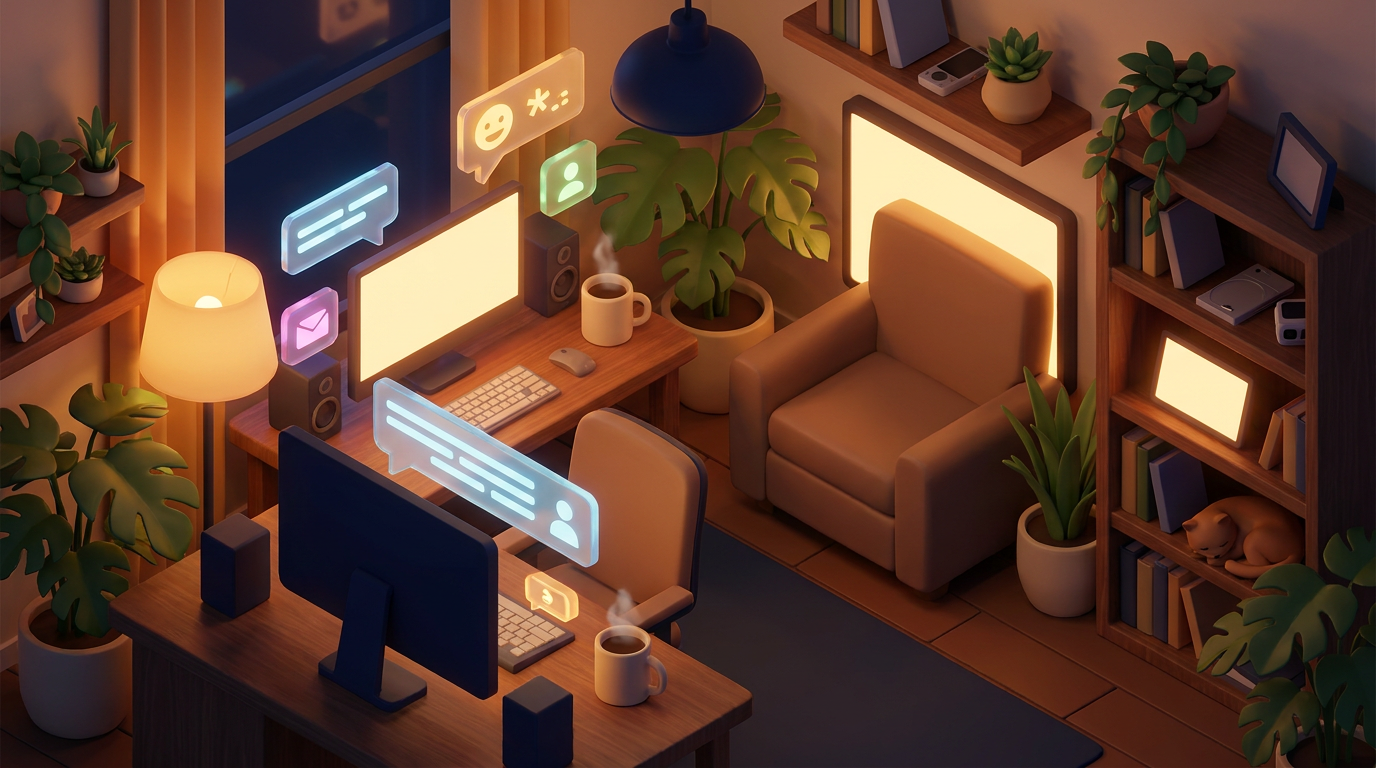
Cultural theorists have dubbed the public internet a 'Dark Forest,' a term coined by Yancey Strickler to describe an environment fraught with bots, trolls, and algorithmic surveillance. In response, users are migrating to the 'Cozy Web' or the 'Parlor'—private, gated spaces like Discord servers, Slack communities, and intimate group chats. Here, the pressure to perform for a permanent, public record is replaced by the freedom to converse with recognizable peers, restoring a sense of interiority and psychological safety that public platforms have largely eroded.[1]
This retreat aligns with the revival of the 'Third Place'—sociologist Ray Oldenburg’s concept of informal public gathering spaces distinct from home (the first place) and work (the second place). As physical third places like local cafes and neighborhood bars have faced economic pressures, digital environments have stepped in to fill the void. Academic research highlights how platforms like Discord successfully replicate the social utility of traditional neighborhood hubs, offering persistent, drop-in spaces where regulars can gather without formal membership requirements.[5]
These digital third places offer unique advantages over their physical counterparts. They provide 24/7 access, global reach, and geographic irrelevance, fitting seamlessly into the fluid schedules of remote workers. Furthermore, the line between gaming and socializing has effectively disappeared; immersive virtual environments and collaborative challenges now serve as primary venues for hanging out, transforming online gaming into a foundational pillar of modern social infrastructure.[4]
Beyond private chat servers, the desire for a healthier public square has fueled the explosive growth of the 'Fediverse.' Unlike centralized platforms controlled by a single corporation, the Fediverse is a network of independent, decentralized platforms that communicate with one another using shared protocols like ActivityPub. It operates much like email: a user on one server can seamlessly follow and interact with a user on a completely different server, breaking the walled-garden model of traditional social media.[6][7]
The numbers behind this decentralized migration are striking. By late 2025, Bluesky—a microblogging platform built on the AT Protocol that allows users to choose their own algorithms—surpassed 40 million users, driven by dissatisfaction with legacy platforms and major geopolitical events like Brazil's temporary ban on X. Mastodon, the original heavyweight of the ActivityPub ecosystem, maintains a robust base of 18 million registered users spread across thousands of independent, community-moderated servers.[6][8]

The appeal of the Fediverse lies in its structural guarantees. Feeds are predominantly chronological, external links are not algorithmically suppressed, and no single billionaire or corporation can unilaterally change the rules or monetize user outrage. Communities are empowered to define their own moderation policies and cultural norms, creating a diverse ecosystem of specialized instances rather than a monolithic, one-size-fits-all platform.[6][7]
The appeal of the Fediverse lies in its structural guarantees.
The momentum of decentralized social media reached a tipping point when Meta's Threads integrated Fediverse sharing capabilities. This allowed interactions between Threads and Mastodon users, bridging the gap between a corporate giant and the open web. However, data indicates that while Threads users were drawn by new platform features, Mastodon and Bluesky users were primarily motivated by a desire to escape the toxicity and corporate control of their previous platforms.[7][8]

Parallel to the rise of decentralized social networks is the resurgence of the personal website, reimagined through the practice of 'digital gardening.' If the Cozy Web is the digital living room, the digital garden is the personal backyard. Unlike traditional blogs, which present polished articles in reverse-chronological order, digital gardens are treated as living, evolving landscapes where ideas are cultivated over time.[2][3]
The digital gardening ethos rejects the performative nature of the modern web. Posts are not finalized broadcasts but rather 'seedlings' or 'works in progress' that grow through continuous revision. This approach harkens back to the early days of the Indie Web, prioritizing creative independence and a slower, more deliberate pace of publishing over the frantic churn of social media feeds.[2][3]
Technologically, digital gardens rely heavily on bi-directional linking—a feature popularized by tools like Roam Research, Notion, and Obsidian. Instead of a linear stream of posts, these sites function as explorable knowledge graphs. Readers can navigate freely through interconnected notes, mimicking the associative way the human brain processes information. This topology transforms the web from a timeline into a spatial environment.[3]

The shift toward these slower, more intentional digital practices is largely a psychological corrective. The broadcast internet fostered 'Continuous Partial Attention,' a state of fragmented consciousness that prevents deep focus and meaningful connection. By stepping away from algorithmic feeds designed to maximize time-on-site, users are attempting to reclaim their attention spans and escape 'Main Character Syndrome'—the solipsistic tendency to view life as a narrative arc performed for an audience of strangers.[1]
Yet, the transition to the Cozy Web and the Fediverse is not without significant challenges. The primary concern is fragmentation. As users retreat into private Discords and specialized Mastodon instances, the shared cultural reality of the internet fractures. While these silos provide psychological safety, they can also become fragile echo chambers, insulated from opposing views and broader societal discourse.[1][9]

Furthermore, the financial sustainability of community-run spaces remains an open question. Decentralized platforms and digital third places rely heavily on volunteer moderation and community funding, lacking the massive advertising revenue that sustains mega-platforms. As these networks scale, the burden on volunteer administrators increases, raising concerns about long-term viability and the potential for burnout among those maintaining the infrastructure.[6][9]
Despite these uncertainties, the trajectory of internet culture in 2026 is clear. The era of the monolithic, algorithmically driven public square is giving way to a more pluralistic, user-controlled web. Whether through tending a digital garden, hanging out in a Discord server, or federating across the open social web, users are proving that the internet can still be a place of genuine connection, creativity, and quiet refuge.[9]
How we got here
Early 2000s
The Indie Web movement champions personal homepages and creative independence before the rise of centralized social media.
2019–2020
The concept of 'Digital Gardening' gains mainstream traction among developers and writers seeking alternatives to traditional blogging.
Late 2022
The first major 'Twitter Migration' pushes Mastodon and the concept of the Fediverse into the public spotlight.
Early 2024
Bluesky opens to the public, accelerating the adoption of decentralized, user-controlled algorithms.
Mid 2024
Meta's Threads integrates ActivityPub, bridging the gap between a corporate mega-platform and the open web.
2026
Digital third places and the Cozy Web solidify as dominant cultural paradigms, fundamentally shifting how users socialize online.
Viewpoints in depth
Decentralization Advocates
This camp views the shift away from mega-platforms as a necessary evolution toward a free and open internet.
Advocates for the Fediverse and decentralized protocols argue that the fundamental flaw of the 2010s internet was corporate ownership of the public square. By moving to platforms powered by ActivityPub or the AT Protocol, they believe users can permanently solve issues of algorithmic manipulation, arbitrary censorship, and platform decay. For this group, the ability to pack up your social graph and move to a different server without losing your connections is the ultimate safeguard against billionaire overreach.
Digital Cultivators
This group focuses on the mental health benefits of slower, more intentional online creation.
Digital gardeners and Cozy Web proponents are less concerned with the underlying network protocols and more focused on the psychological experience of being online. They argue that the broadcast internet forces users into a state of constant performance, leading to anxiety and burnout. By building explorable personal wikis or retreating to private group chats, they aim to reclaim the internet as a tool for personal growth, quiet reflection, and genuine human connection, free from the metrics of likes and retweets.
Commercial Platform Defenders
Critics argue that decentralized and fragmented spaces sacrifice usability, discovery, and mass culture.
While acknowledging the toxicity of mega-platforms, defenders of centralized social media point out that algorithmic feeds excel at one crucial thing: discovery. They argue that the Cozy Web and the Fediverse are inherently exclusionary, requiring technical know-how to navigate and making it nearly impossible for new creators to find an audience. Furthermore, they warn that as users retreat into private, community-moderated silos, the internet loses its ability to foster a shared cultural reality, potentially worsening societal polarization.
What we don't know
- Whether decentralized platforms can financially sustain themselves long-term without traditional advertising models.
- How the fragmentation of the internet into private 'Cozy Web' spaces will impact broader societal discourse and shared cultural moments.
- If corporate integrations into the Fediverse (like Threads) will ultimately embrace open protocols or attempt to enclose them.
Key terms
- Cozy Web
- Private, gated, or intimate digital spaces—like group chats and Discord servers—where users can interact without the pressure of a public algorithmic feed.
- Digital Third Place
- An online environment that serves as an informal public gathering spot for community and conversation, distinct from home and work.
- Digital Gardening
- The practice of maintaining a personal website as a living, evolving collection of interconnected notes and ideas, rather than a chronological stream of finished posts.
- Fediverse
- A decentralized network of independent social media platforms that can communicate with each other, allowing users to interact across different services.
- ActivityPub
- The open, decentralized social networking protocol that powers the Fediverse, enabling different platforms to share posts and interactions.
- Bi-directional Linking
- A feature in note-taking and digital gardening tools where linking to a page automatically creates a visible return link on the destination page, forming a web of connections.
Frequently asked
What is the difference between a blog and a digital garden?
A blog publishes finished articles in a reverse-chronological feed. A digital garden is an interconnected web of notes and ideas that are continuously updated and linked together, allowing readers to explore by topic rather than by date.
How does the Fediverse work?
The Fediverse is a network of independent social media servers that communicate using a shared protocol (ActivityPub). Like email, it allows a user on one server to seamlessly follow and interact with users on completely different servers.
Why are people leaving traditional social media?
Users cite exhaustion from algorithmic feeds, the pressure to perform for a public audience, toxic environments, and a desire to escape platforms where a single corporation controls the rules and monetizes their attention.
Sources
Source coverage
9 outlets
3 viewpoints surfaced









[1]MediumDigital Cultivators
The Rise of the Dark Forest and the Cozy Web
Read on Medium →[2]Wilde About ArtDigital Cultivators
The Future of Digital Gardening with WordPress
Read on Wilde About Art →[3]Maggie AppletonDigital Cultivators
A Brief History and Ethos of the Digital Garden
Read on Maggie Appleton →[4]Easy Reader NewsThird-Place Sociologists
The Transition from Physical to Virtual Third Places
Read on Easy Reader News →[5]ResearchGateThird-Place Sociologists
The Emergence of Digital Third Place & the Waning Role of Physical Third Place
Read on ResearchGate →[6]MyPost.toDecentralization Advocates
What is the Fediverse? The Network You're Ignoring
Read on MyPost.to →[7]arXivDecentralization Advocates
Consequences of Information Feed Integration on User Engagement: Threads and the Fediverse
Read on arXiv →[8]Connected PlacesDecentralization Advocates
Growth Narratives on the New Social Networks
Read on Connected Places →[9]Factlen Editorial TeamThird-Place Sociologists
Synthesis by Factlen editorial team
Read on Factlen Editorial Team →

More in technology
See all 8 stories →Apple Leadership
Apple Restructures Hardware and Design Leadership Ahead of CEO Transition
9 sources
Python Ecosystem
Python 3.14 Officially Supports Free-Threading, Ending the 35-Year Reign of the GIL
7 sources
Right to Repair
What the EU's Landmark 'Right to Repair' Law Means for Your Next Smartphone
7 sources
Smart Home Tech
The End of the Walled Garden: How Matter 1.6 and Edge AI Are Rewiring the Smart Home
6 sources

Every angle. Every day.
Get technology stories with full source coverage and perspective breakdowns delivered to your inbox.