
Is the Password Finally Dead? Evaluating the Evidence for Passkeys
With 5 billion passkeys now in active use globally, the technology industry is rapidly abandoning traditional passwords. We evaluate the evidence behind the claims that passkeys eliminate phishing while speeding up logins.
By Factlen Editorial Team
- Identity Standards Bodies
- Argue that cryptographic passkeys are the definitive cure for credential phishing and must replace shared secrets.
- Enterprise IT & Identity Providers
- Value the reduction in helpdesk tickets and faster login times, but must balance deployment against legacy system constraints.
- Market Observers
- Track the massive consumer preference for passwordless flows over traditional multi-factor authentication.
- Cybersecurity Regulators
- Cautiously endorse the security benefits while emphasizing the risks of mixed-OS environments and private key management.
What's not represented
- · Legacy System Vendors
- · Consumer Privacy Advocates
Why this matters
The transition to passkeys means you will soon stop memorizing passwords and resetting forgotten credentials. This shift fundamentally protects your online bank accounts and personal data from the phishing attacks that drive modern identity theft.
Key points
- The FIDO Alliance reports that 5 billion passkeys are now in active use globally, marking a tipping point for passwordless authentication.
- Data from over 500 million logins shows zero successful phishing attacks against users employing passwordless methods.
- Passkeys reduce average login times to 1.2 seconds, significantly outperforming traditional passwords paired with multi-factor authentication.
- Enterprise adoption is accelerating, with 68% of organizations deploying passkeys to reduce helpdesk costs and improve security.
- Cross-ecosystem synchronization and account recovery remain the primary hurdles to completely eliminating legacy passwords.
For decades, the fundamental architecture of digital security relied on a flawed premise: the shared secret. Users memorized a string of characters, handed it to a server, and hoped the server kept it safe. In 2026, that paradigm is finally collapsing. The FIDO Alliance estimates that 5 billion passkeys are now in active use worldwide, marking a definitive tipping point in the transition away from passwords.[1][6]
This shift represents one of the most significant upgrades to consumer and enterprise security in the history of the internet. A passkey replaces the shared secret with public-key cryptography. When a user registers for a service, their device generates a unique cryptographic key pair. The private key remains securely locked in the device's hardware, while the public key is shared with the application.[8]
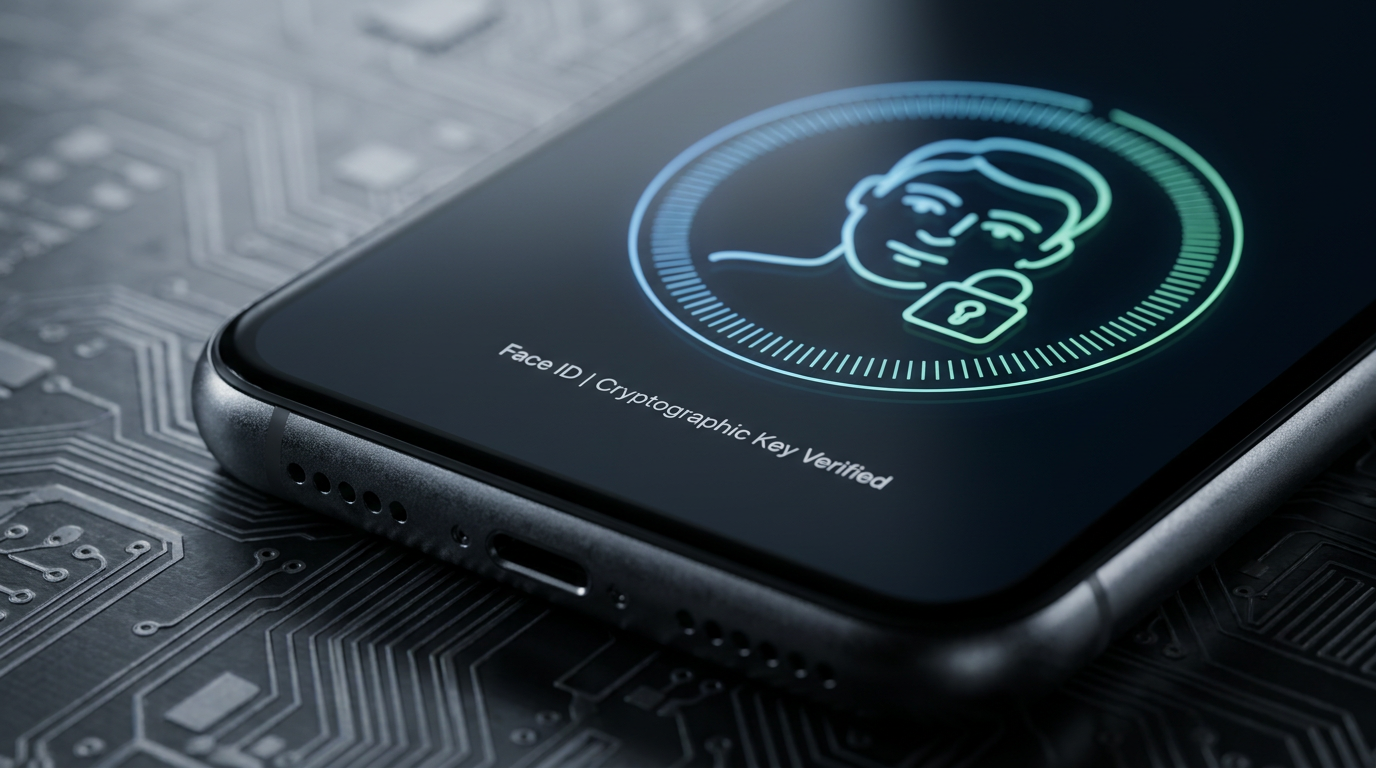
During login, the application issues a cryptographic challenge. The user unlocks their private key locally—typically via a biometric scan like Face ID or a fingerprint—and the device signs the challenge. Because the private key never travels across the network, there is nothing for an attacker to intercept.[5][8]

The primary claim driving the passkey revolution is absolute resistance to credential phishing and stuffing. The evidence supporting this claim is exceptionally strong. In a 2026 analysis of 523.7 million authentications, identity provider MojoAuth recorded zero successful phishing attacks against users employing passwordless methods.[2]
This perfect defense rate stems from the domain-bound nature of passkeys. A passkey generated for a legitimate banking website is cryptographically tied to that specific web address. If a user is tricked into visiting a visually identical phishing site, the device's operating system simply refuses to authenticate, as the domain mismatch breaks the cryptographic signature process.[8]
Furthermore, because there is no central database of passwords to breach, the threat of credential stuffing—where attackers use passwords stolen from one site to unlock accounts on another—is neutralized. The Canadian Centre for Cyber Security notes that while layered defenses remain necessary, the elimination of transmitted secrets fundamentally breaks the most common attack vectors used by cybercriminals.[4]
The second major claim is that passkeys dramatically improve usability and speed. Historically, security and convenience have existed in a zero-sum relationship; stronger security meant more friction. Passkeys appear to break this rule.[8]
Telemetry data from 2026 deployments provides robust evidence for this usability upgrade. The average passkey authentication takes just 1.2 seconds, compared to 8.7 seconds for a traditional password paired with multi-factor authentication (MFA).[2]

This reduction in friction translates directly to consumer behavior. FIDO Alliance survey data reveals that 90% of global consumers are now aware of passkeys, and 75% have enabled them on at least one account. Furthermore, e-commerce platforms report a 34.6% reduction in cart abandonment when users are offered passwordless checkout options, as forgotten passwords no longer interrupt the purchase flow.[1][2]
This reduction in friction translates directly to consumer behavior.
For enterprise environments, the evidence points to significant operational returns. The claim is that passkeys reduce IT overhead by eliminating the constant churn of password resets, a metric closely tracked by industry analysts.[3][7]
Industry data strongly supports this. A 2026 Descope report found that 68% of organizations are actively deploying or piloting passkeys for their workforce. Among those that have rolled them out, 35% report a measurable reduction in helpdesk tickets, while 45% cite faster employee login times.[3]
The financial impact is substantial. By eliminating password resets—which traditionally account for a massive percentage of IT support requests—and reducing the risk of account takeovers, organizations are saving an average of $3.2 million in prevented breach costs and operational overhead.[2]

However, the evidence is weaker when evaluating cross-ecosystem compatibility. The promise of passkeys is a seamless, universal login experience, but the reality of mixed-device environments remains messy.[4][8]
The Canadian Centre for Cyber Security warns that cross-device authentication across different operating systems can lead to an inconsistent user experience. While Apple, Google, and Microsoft have built robust passkey synchronization within their own walled gardens, moving a passkey from an iPhone to a Windows PC often requires scanning a QR code via Bluetooth, a process that introduces new friction.[4][8]
Additionally, older devices lack the secure enclaves required to safely store private keys. For organizations with legacy hardware or specialized industrial systems, a pure passwordless deployment is currently impossible, forcing them to maintain parallel authentication tracks.[4]
The most significant area of uncertainty involves account recovery. If a user loses their primary device and lacks a synchronized cloud backup, restoring access to passkey-secured accounts can be complex.[5]

Currently, 89% of organizations express confidence in their ability to restore access, but this often relies on falling back to less secure methods, such as email magic links or SMS codes. If an attacker targets these weaker recovery channels, the cryptographic strength of the passkey is effectively bypassed.[1][8]
Because of these recovery challenges, passwords are not entirely dead. Instead, they are being demoted. Identity architects increasingly view passwords not as a primary authentication method, but as a legacy fallback mechanism to be used only when modern cryptographic proofs fail.[5][8]
The trajectory, however, is irreversible. With 82% of enterprises stating that fully passwordless authentication is their ultimate goal, the infrastructure of the internet is being fundamentally rewired.[1]
The era of the shared secret is ending. While edge cases and recovery flows still require refinement, the evidence from 2026 is clear: passkeys have successfully delivered the elusive combination of cryptographic certainty and frictionless usability, securing their position as the new default for digital identity.[8]
How we got here
2013
The FIDO Alliance is formed to solve the internet's password problem.
2022
Apple, Google, and Microsoft announce expanded support for the FIDO standard, paving the way for passkeys.
2024
Major consumer platforms begin rolling out passkeys as the default sign-in option.
May 2026
The FIDO Alliance reports that 5 billion passkeys are now in active use globally.
Viewpoints in depth
Identity Standards Bodies
Advocating for the complete elimination of shared secrets.
Organizations like the FIDO Alliance argue that decades of security patches—such as complexity requirements and SMS-based MFA—have failed to address the root vulnerability of passwords. They view passkeys as the only mathematically sound solution to credential phishing, emphasizing that the transition is no longer a theoretical goal but a measurable reality with billions of active deployments.
Enterprise IT Leaders
Balancing security gains against deployment friction.
For corporate identity providers, the appeal of passkeys lies equally in security and cost reduction. Eliminating password resets directly impacts the bottom line by reducing helpdesk overhead. However, these leaders caution that enterprise environments are complex; legacy applications and non-standard hardware often force organizations to maintain parallel password infrastructure during a multi-year transition phase.
Cybersecurity Regulators
Highlighting the risks of implementation and recovery.
Government cyber agencies acknowledge the massive security upgrade passkeys represent but warn against treating them as a silver bullet. Regulators emphasize that the security of a passkey is only as strong as the device storing it and the recovery method used if the device is lost. They caution that poorly designed fallback mechanisms, like email links, can completely undermine the cryptographic strength of the primary passkey.
What we don't know
- How quickly legacy enterprise applications and industrial systems can be upgraded to support public-key cryptography.
- Whether cross-ecosystem synchronization between competing tech giants will become seamless enough for non-technical users.
- How attackers will pivot their strategies once credential phishing is rendered obsolete by domain-bound authentication.
Key terms
- Public-Key Cryptography
- A cryptographic system that uses pairs of keys: public keys which may be disseminated widely, and private keys which are known only to the owner.
- Credential Stuffing
- A cyberattack where stolen account credentials from one data breach are used to gain unauthorized access to user accounts on other websites.
- FIDO2
- An open authentication standard that enables users to leverage common devices to easily authenticate to online services in both mobile and desktop environments.
- Phishing-Resistant
- Authentication methods that cryptographically verify the domain, making it impossible for users to accidentally give their credentials to a fake website.
Frequently asked
What exactly is a passkey?
A passkey is a digital credential tied to your device that uses public-key cryptography instead of a password to verify your identity.
Can a passkey be stolen in a data breach?
No. The private key never leaves your device, and the server only stores a public key, which is useless to attackers.
What happens if I lose my phone?
Most passkeys are synced to cloud accounts (like iCloud or Google Password Manager), allowing you to recover them on a new device.
Do passkeys work across different operating systems?
Yes, but cross-ecosystem use (e.g., logging into a Windows PC using an iPhone) often requires scanning a QR code via Bluetooth.
Sources
Source coverage
8 outlets
4 viewpoints surfaced








[1]FIDO AllianceIdentity Standards Bodies
The State of Passkeys 2026: Global Consumer and Workforce Report
Read on FIDO Alliance →[2]MojoAuthEnterprise IT & Identity Providers
Passwordless Authentication Adoption & Performance Report 2026
Read on MojoAuth →[3]DescopeEnterprise IT & Identity Providers
The State of Passkeys 2026: Enterprise Outcomes
Read on Descope →[4]Canadian Centre for Cyber SecurityCybersecurity Regulators
Security considerations for passkeys (ITSAP.30.033)
Read on Canadian Centre for Cyber Security →[5]AuthgearEnterprise IT & Identity Providers
Password vs Passkey: A Phased Migration Strategy
Read on Authgear →[6]Business WireMarket Observers
Passkeys Hit Mainstream: FIDO Alliance Reports Widespread Adoption
Read on Business Wire →[7]KuppingerCole AnalystsIdentity Standards Bodies
Leadership Compass 2026: Passwordless Authentication for Enterprises
Read on KuppingerCole Analysts →[8]Factlen Editorial TeamMarket Observers
Synthesis by Factlen editorial team
Read on Factlen Editorial Team →

More in technology
See all 8 stories →Python Ecosystem
Python 3.14 Officially Supports Free-Threading, Ending the 35-Year Reign of the GIL
7 sources

Right to Repair
What the EU's Landmark 'Right to Repair' Law Means for Your Next Smartphone
7 sources

Smart Home Tech
The End of the Walled Garden: How Matter 1.6 and Edge AI Are Rewiring the Smart Home
6 sources

Lunar Base
How Autonomous 3D Printers Will Build Humanity's First Lunar Base
7 sources

Every angle. Every day.
Get technology stories with full source coverage and perspective breakdowns delivered to your inbox.