
How Autonomous 3D Printers Will Build Humanity's First Lunar Base
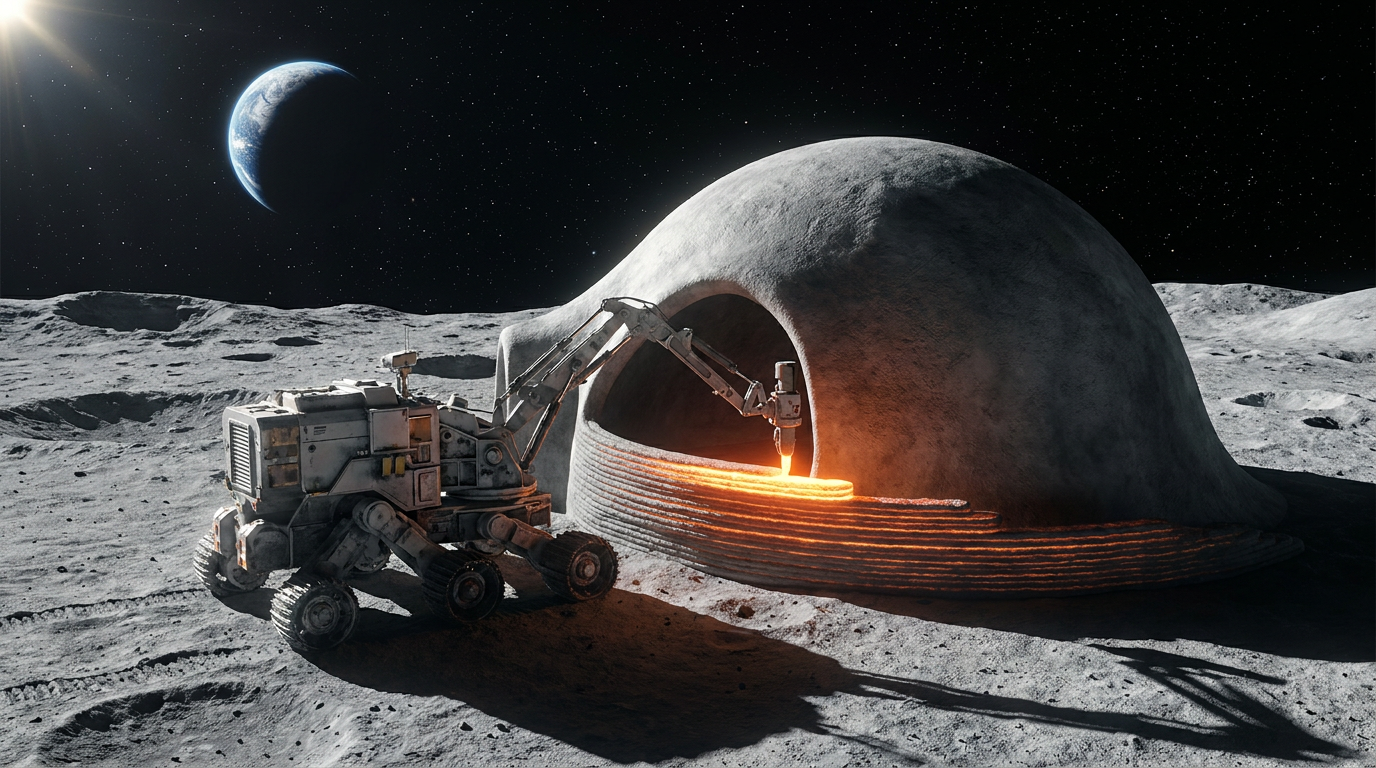
Space agencies and private companies are developing autonomous 3D printers that use high-powered lasers to melt lunar dust into radiation-shielded habitats. This 'in-situ' construction bypasses the impossible cost of launching building materials from Earth.
By Factlen Editorial Team
- Aerospace Engineers
- Focus on the mechanical viability, vacuum operation, and material strength of extraterrestrial construction.
- Space Architects
- Prioritize human factors, radiation shielding, and modular, expandable designs for long-term habitation.
- Space Agencies
- Focus on cost reduction, mission logistics, and establishing a permanent off-world presence to enable deep space exploration.
- Sustainability Advocates
- Emphasize how zero-waste, local-material construction in space can translate to greener building practices on Earth.
What's not represented
- · Lunar Geologists concerned about the contamination of pristine scientific sites
- · Space Law Experts debating the legality of resource extraction under the Outer Space Treaty
Why this matters
Establishing a permanent human presence on the Moon requires building infrastructure from local dirt, as launching heavy materials from Earth is financially impossible. The autonomous 3D-printing technologies being developed to survive the lunar vacuum could ultimately revolutionize sustainable, zero-waste construction here on Earth.
Key points
- NASA's Artemis program aims to establish a permanent lunar presence, requiring heavy infrastructure that cannot be launched from Earth.
- Engineers are developing autonomous 3D printers that melt local lunar dust (regolith) into solid, ceramic-like structures using high-powered lasers.
- Companies like ICON and AI SpaceFactory are testing robotic arms in thermal vacuum chambers to ensure they survive the Moon's harsh conditions.
- Thick layers of 3D-printed regolith will serve as vital shielding against cosmic radiation, micrometeorites, and extreme temperature swings.
The Apollo missions proved humanity could reach the Moon, but they were fundamentally camping trips. Astronauts brought everything they needed, stayed for a few days, and left their trash behind. As NASA’s Artemis program prepares to return humans to the lunar surface by the end of the decade, the objective has shifted from brief exploration to permanent habitation.[1]
Establishing a sustained presence on a barren rock 238,000 miles away requires heavy infrastructure: landing pads, roads, radiation shelters, and pressurized habitats. But the fundamental physics of spaceflight—often called the tyranny of the rocket equation—makes launching heavy construction materials like steel and concrete from Earth financially and logistically impossible.[5]
Every additional gram of cargo sent to the Moon requires exponentially more rocket propellant to escape Earth’s gravity. To solve this bottleneck, space agencies and private aerospace companies are turning to a concept that sounds like science fiction but is rapidly becoming engineering fact: building off-world settlements using autonomous 3D printers and the dirt already on the ground.[1][5]
This approach is known as In-Situ Resource Utilization (ISRU). Instead of fighting gravity to import supplies, ISRU advocates for harvesting local extraterrestrial resources. On the Moon, the most abundant resource is lunar regolith—a fine, abrasive, glass-like dust created by billions of years of micrometeorite impacts pulverizing the lunar crust.[5]

On Earth, 3D-printed construction typically relies on a wet cementitious mixture extruded through a nozzle. On the Moon, water is a precious commodity reserved for life support and rocket propellant, and the vacuum of space would cause any unprotected liquid to instantly boil away. Therefore, lunar 3D printing requires an entirely different mechanism.[5][6]
To bypass the need for water and traditional binders, engineers are developing thermal processes that melt the regolith directly. By applying intense, concentrated heat, the abrasive dust can be sintered or fully melted into a molten state, which then cools and crystallizes into a dense, ceramic-like solid.[6]
Leading this charge is ICON, a Texas-based construction technologies company that recently secured a $60 million NASA contract to develop its Project Olympus system. ICON is adapting the large-scale 3D printing technology it uses to build terrestrial homes for the unforgiving environment of the lunar south pole.[1][6]
ICON’s proprietary approach, called Laser Vitreous Multi-material Transformation (Laser VMX), uses a high-powered laser mounted on a robotic arm. The system sweeps across a bed of raw regolith, selectively melting the dust layer by layer. Laboratory tests in thermal vacuum chambers show the resulting material boasts a compressive strength of roughly 50,000 psi—significantly stronger than standard residential concrete.[6]
Working alongside architectural firms BIG (Bjarke Ingels Group) and SEArch+, ICON has developed habitat concepts like the Lunar Lantern. This design features a double-protective outer shield structure that can be autonomously printed by rovers before a human crew ever arrives, ensuring a safe haven is ready and waiting.[6]

Working alongside architectural firms BIG (Bjarke Ingels Group) and SEArch+, ICON has developed habitat concepts like the Lunar Lantern.
Across the Atlantic, the European Space Agency (ESA) is exploring a more modular approach to lunar construction. Recognizing that monolithic structures can be difficult to repair, ESA’s Spaceship EAC initiative has been experimenting with 3D printing interlocking blocks—essentially space-grade LEGO bricks.[2][3]
Because genuine Apollo-era lunar samples are too rare and scientifically valuable to use as test filament, ESA scientists had to find a terrestrial substitute. They sourced dust from a 4.5-billion-year-old meteorite discovered in Northwest Africa, grinding it down to perfectly mimic the jagged, abrasive properties of actual lunar regolith.[2][3]
Using this meteorite simulant, ESA successfully 3D-printed classic studded bricks. The interlocking design is highly practical for space construction: it requires no mortar, allows for flexible, expandable habitat designs, and enables astronauts to easily swap out damaged sections of a blast wall or radiation shield.[2][3]

Another major player in the lunar architecture space is AI SpaceFactory, which collaborated with NASA’s Kennedy Space Center to design the LINA (Lunar Infrastructure Asset) outpost. LINA is engineered to be constructed by autonomous robots near the Shackleton crater, an area where continuous sunlight can power the outpost's photovoltaic arrays.[4]
LINA’s design highlights the primary function of these 3D-printed structures: protection. The Moon lacks an atmosphere and a magnetic field, leaving the surface exposed to lethal cosmic radiation, dramatic temperature swings from -170ºC to 70ºC, and a constant rain of micrometeorites.[4][5]
To shield the crew, AI SpaceFactory’s design features 3D-printed Roman-style arches that will be covered by an additional 2.7 meters of loose lunar regolith. This thick blanket of dead dirt is one of the most effective radiation insulators available, effectively placing the astronauts in a reinforced artificial cave.[4]
Despite these rapid advancements in laboratory settings, deploying autonomous 3D printers on the Moon presents monumental engineering hurdles. The lunar environment is notoriously hostile to mechanical systems. The same regolith that makes a great building material is highly abrasive and carries a static charge, causing it to cling to and destroy moving gears, rails, and laser optics.[5]

Furthermore, the printers must operate flawlessly in a hard vacuum while enduring extreme thermal expansion and contraction. A robotic arm that works perfectly at room temperature on Earth might seize up or snap when exposed to the cryogenic cold of a lunar night.[5]
To mitigate these risks, companies are currently testing their print heads and robotic arms inside massive thermal vacuum chambers that simulate lunar conditions. ICON, for instance, is utilizing a massive testing chamber dubbed the MoonBox to validate its Laser VMX process under realistic atmospheric and gravitational constraints.[6]
The stakes for these technologies extend far beyond the Artemis program. If engineers can successfully demonstrate autonomous, zero-waste construction using local materials in the harshest environment imaginable, it will serve as the definitive blueprint for future crewed missions to Mars.[1][5]
Moreover, the architectural philosophy driving lunar ISRU—building strictly with what is available, minimizing logistical supply chains, and utilizing solar-powered robotics—could eventually filter back down to Earth. The quest to build sustainably on the Moon may ultimately provide the tools needed to reduce the massive carbon footprint of the terrestrial construction industry.[6][7]
How we got here
2018
NASA hosts the 3D Printed Habitat Challenge, spurring early innovation in autonomous off-world construction.
2020
NASA awards ICON initial funding under the Moon to Mars Planetary Autonomous Construction Technologies (MMPACT) initiative.
2022
AI SpaceFactory unveils the LINA lunar outpost design, engineered to be built by robots at the lunar south pole.
2024
The European Space Agency successfully 3D-prints interlocking LEGO-style bricks using 4.5-billion-year-old meteorite dust.
Late 2020s
NASA's Artemis program targets the deployment of early surface construction technologies to establish a permanent lunar base.
Viewpoints in depth
Aerospace Engineers
Focus on the mechanical viability, vacuum operation, and material strength of extraterrestrial construction.
For engineers, the primary hurdle is the sheer hostility of the lunar environment. The regolith is highly abrasive and carries a static charge, meaning it clings to moving parts and can quickly destroy the delicate optics and gears of a 3D printer. Furthermore, operating in a hard vacuum with temperature swings from -170ºC to 70ºC causes materials to expand, contract, and potentially snap. Their focus is on rigorous testing inside thermal vacuum chambers to ensure robotic arms and laser emitters can survive for years without human maintenance.
Space Architects
Prioritize human factors, radiation shielding, and modular, expandable designs for long-term habitation.
Architects view the Moon not just as an engineering challenge, but as a human habitat. Their designs—such as the Lunar Lantern and LINA—emphasize psychological well-being alongside physical survival. They advocate for structures that provide ample interior space, integrate natural light where possible, and utilize thick layers of regolith to shield against cosmic radiation and micrometeorites. They also favor modular designs, like ESA's interlocking bricks, which allow habitats to be easily expanded or repaired over time.
Sustainability Advocates
Emphasize how zero-waste, local-material construction in space can translate to greener building practices on Earth.
This camp sees lunar construction as the ultimate testbed for sustainable architecture. The constraints of spaceflight force engineers to develop zero-waste construction methods that rely entirely on local materials and solar power. Advocates argue that if we can perfect the technology to 3D-print durable homes out of raw dirt using only renewable energy, those same autonomous systems could be deployed on Earth to revolutionize the construction industry and drastically reduce its massive carbon footprint.
What we don't know
- How well the 3D printers will hold up against the abrasive, statically charged lunar dust over multi-year deployments.
- Whether the deep regolith shielding will be fully sufficient to protect crews from major solar flare events.
- The exact timeline for when the first fully autonomous 3D-printed structure will be completed on the lunar surface.
Key terms
- In-Situ Resource Utilization (ISRU)
- The practice of collecting, processing, and using materials found on other planets or moons to replace supplies that would otherwise need to be brought from Earth.
- Lunar Regolith
- The layer of fine, abrasive, and glass-like dust and broken rock that covers the surface of the Moon.
- Sintering
- A process that uses heat or pressure to compact and form a solid mass of material without melting it to the point of liquefaction.
- Simulant
- A terrestrial material, such as volcanic ash or crushed meteorite, engineered to replicate the chemical and mechanical properties of extraterrestrial soil for testing purposes.
- Thermal Vacuum Chamber
- A testing facility that simulates the extreme temperature fluctuations and lack of atmospheric pressure found in space.
Frequently asked
Why can't NASA just send building materials from Earth?
The physics of spaceflight makes launching heavy cargo like steel and concrete financially and logistically impossible. Every additional gram of payload requires exponentially more rocket fuel to escape Earth's gravity.
Does lunar 3D printing use water like normal concrete?
No. Water is too precious on the Moon, and it would instantly boil away in the vacuum of space. Instead, lunar printers use high-powered lasers or microwaves to melt the dust into a solid ceramic.
How do engineers test these printers on Earth?
Scientists use massive thermal vacuum chambers to simulate the Moon's lack of atmosphere and extreme cold. They also use 'simulants'—like volcanic ash or meteorite dust—that mimic the abrasive properties of lunar soil.
How will these structures protect astronauts from radiation?
The Moon lacks a magnetic field, exposing the surface to cosmic rays. 3D-printed habitats will be covered in thick layers of regolith—sometimes up to 2.7 meters deep—which acts as a highly effective radiation shield.
Sources
Source coverage
7 outlets
4 viewpoints surfaced







[1]NASASpace Agencies
NASA, ICON Advance Lunar Construction Technology
Read on NASA →[2]European Space AgencySpace Agencies
LEGO space bricks 3D-printed on Earth
Read on European Space Agency →[3]Space.comSpace Architects
ESA scientists 3D print LEGO-like bricks from meteorite dust to simulate moon building
Read on Space.com →[4]3D NativesSpace Architects
NASA Turns to 3D Printing for the Construction of a Lunar Bunker
Read on 3D Natives →[5]MDPIAerospace Engineers
A Review of In-Situ Resource Utilization for Lunar Base Construction
Read on MDPI →[6]ResearchGateAerospace Engineers
Project Olympus: Additive Construction for the Moon and Beyond
Read on ResearchGate →[7]Factlen Editorial TeamSustainability Advocates
Synthesis by Factlen editorial team
Read on Factlen Editorial Team →

More in technology
See all 7 stories →Apple Leadership
Apple Restructures Hardware and Design Leadership Ahead of CEO Transition
9 sources

Python Ecosystem
Python 3.14 Officially Supports Free-Threading, Ending the 35-Year Reign of the GIL
7 sources

Right to Repair
What the EU's Landmark 'Right to Repair' Law Means for Your Next Smartphone
7 sources

Smart Home Tech
The End of the Walled Garden: How Matter 1.6 and Edge AI Are Rewiring the Smart Home
6 sources

Every angle. Every day.
Get technology stories with full source coverage and perspective breakdowns delivered to your inbox.