
How Mass Timber is Engineering the Sustainable Skyscrapers of the Future
Engineered wood products like cross-laminated timber are replacing concrete and steel in high-rise construction, offering massive reductions in carbon emissions and surprising fire resilience.
By Factlen Editorial Team
- Sustainable Construction Advocates
- Argues that mass timber is essential for decarbonizing the built environment and turning cities into carbon sinks.
- Structural Engineers & Architects
- Values the material for its high strength-to-weight ratio, rapid prefabrication capabilities, and biophilic aesthetic appeal.
- Risk & Safety Regulators
- Focuses on ensuring the material meets strict fire-resistance standards, moisture control guidelines, and building code compliance.
What's not represented
- · Traditional Steel and Concrete Manufacturers
- · Local Forestry Communities
Why this matters
The built environment is responsible for nearly 40% of global carbon emissions. Transitioning from concrete and steel to engineered timber offers one of the most viable, scalable ways to turn future cities into massive carbon sinks while accelerating construction timelines.
Key points
- Mass timber utilizes engineered wood panels that match the load-bearing strength of concrete and steel.
- Cross-laminated timber (CLT) is created by gluing layers of wood at 90-degree angles under extreme pressure.
- The material acts as a carbon sink, significantly reducing the embodied carbon of new high-rise buildings.
- In a fire, mass timber chars predictably on the outside, insulating and protecting its structural core.
- Prefabrication of timber panels allows for faster construction timelines and smaller on-site crews.
The skyline of Milwaukee is currently incubating a revolution in how humanity builds cities. By 2026, a 31-story tower named Neutral Edison will reach 362 feet into the air, claiming the title of the world's tallest mass timber building.[3]
Unlike the steel and concrete monoliths that defined the 20th century, this new generation of skyscrapers is grown in forests. Mass timber construction is rapidly moving from a niche architectural experiment to a mainstream commercial reality, promising to drastically reduce the carbon footprint of the built environment.[6][8]
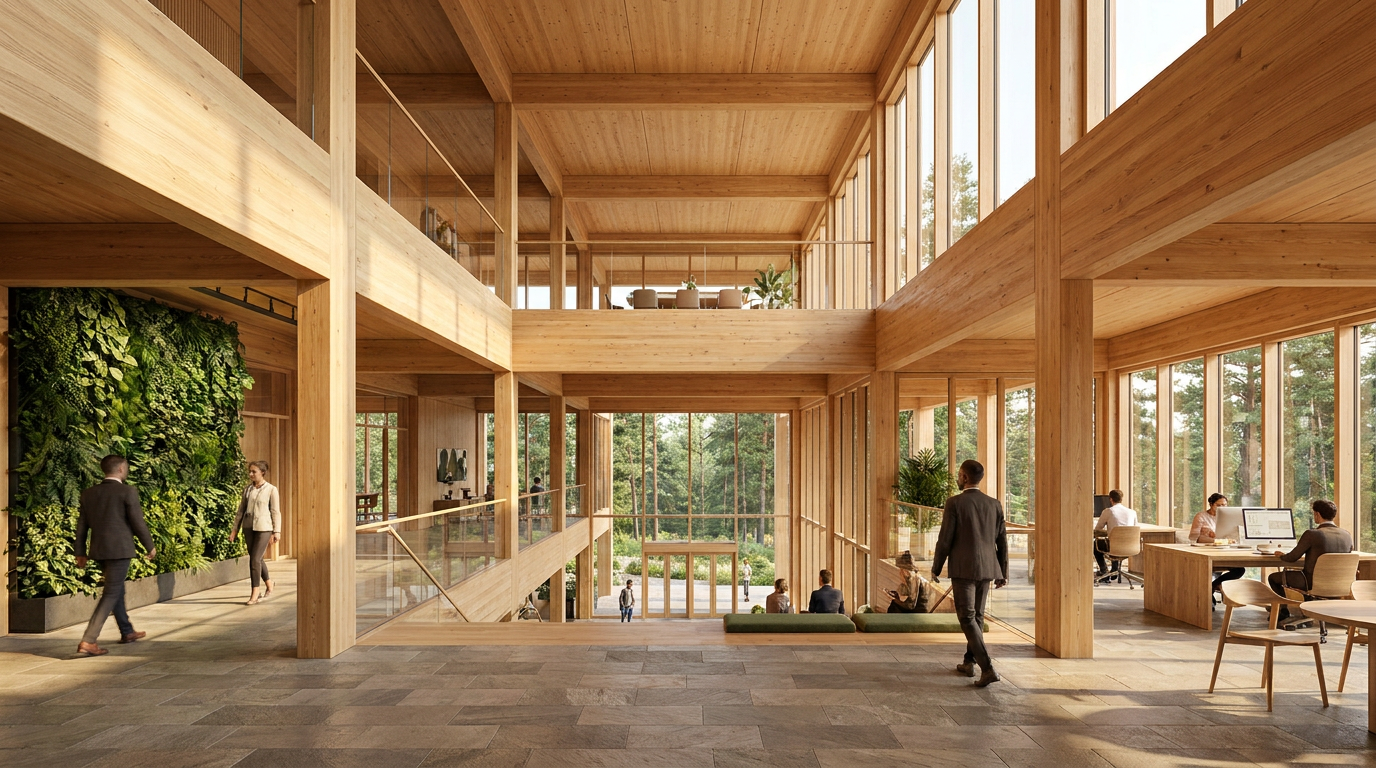
To understand the shift, one must discard the image of traditional light-wood framing—the 2x4s used in suburban homebuilding. Mass timber refers to a family of highly engineered, massive wood products designed to match or exceed the load-bearing capabilities of concrete and steel.[2][7]
The most prominent of these materials is Cross-Laminated Timber (CLT). CLT panels are manufactured by stacking layers of solid sawn lumber at 90-degree angles to one another and bonding them under immense pressure with structural adhesives. This cross-lamination process grants the panels exceptional dimensional stability and two-way spanning strength.[2]

Alongside CLT, Glue-Laminated Timber (Glulam) is used to create massive structural columns and beams by orienting wood grain in a single direction. Together, these engineered components are allowing architects to design structures that were previously unimaginable without carbon-intensive materials.[2][8]
The environmental stakes driving this transition are profound. Traditional concrete and steel production are responsible for a massive share of global greenhouse gas emissions. By contrast, mass timber acts as a carbon sink; the wood sequesters carbon dioxide absorbed by the trees during their lifetime, keeping it locked within the building's structure for decades or centuries.[6]
Studies indicate that substituting timber for concrete and steel can reduce a building's embodied carbon footprint by 30% to 50%. When paired with sustainable forestry practices that replant harvested trees, mass timber construction functions as a viable carbon removal technology.[6][8]

Studies indicate that substituting timber for concrete and steel can reduce a building's embodied carbon footprint by 30% to 50%.
However, the most persistent question surrounding wooden skyscrapers is intuitive: What happens in a fire? For decades, building codes heavily restricted timber heights due to the catastrophic urban fires of the 19th century.[8]
Modern mass timber, however, behaves entirely differently than light-wood framing. When exposed to intense heat, massive wood panels do not easily ignite; instead, their outer layer chars. This char layer acts as a highly predictable thermal insulator, protecting the unburned structural core inside and preventing the building from collapsing.[4][7]

Recent large-scale fire tests have repeatedly validated this mechanism. In tests conducted by Timberlab and the Forest Products Laboratory, exposed glulam columns successfully maintained their structural integrity for three hours in a furnace, matching the strict fire-resistance ratings required for non-combustible construction.[4]
Researchers at Oregon State University, in collaboration with the ATF Fire Research Laboratory, have conducted further large-scale compartment tests. Their data on char formation, heat flux, and structural behavior is helping to rewrite building codes and prove that mass timber can safely withstand severe fire events. Ironically, while steel can warp and buckle unpredictably under extreme heat, mass timber's charring process is mathematically predictable.[4][5][8]
Beyond sustainability and safety, mass timber is transforming the logistics of the construction site. Because the panels and beams are prefabricated off-site using precise computer numerical control (CNC) machinery, they arrive ready to be slotted together like a massive piece of flat-pack furniture.[2][6]

This prefabrication drastically accelerates construction timelines, requires smaller assembly crews, and significantly reduces neighborhood noise and disruption compared to pouring concrete. In urban infill projects, these logistical advantages often offset the currently higher upfront material costs of engineered wood.[6][8]
The regulatory environment is rapidly catching up to the technology. A major milestone occurred with the 2021 update to the International Building Code (IBC), which officially permitted mass timber structures up to 18 stories in the United States, provided specific fire encapsulation measures are met.[7]
The financial sector is also taking notice. The global cross-laminated timber market, valued at $1.7 billion in 2025, is projected to surge to $5.7 billion by 2033. Insurers like Zurich North America are actively developing frameworks to underwrite these structures, forecasting that annual mass timber building starts in the U.S. could jump from 750 in 2025 to 5,000 by 2035.[1][7]
Yet, the industry faces legitimate growing pains. The most critical constraint is the supply chain; scaling mass timber globally requires rigorous, certified sustainable forestry to ensure that increased demand does not inadvertently drive deforestation or harm indigenous lands. Furthermore, builders must carefully manage moisture during construction, as prolonged water exposure can damage the engineered panels before the building is sealed.[6][7]
Despite these hurdles, the momentum is undeniable. From the 31-story Neutral Edison in Milwaukee to the sprawling Stockholm Wood City project in Sweden, architecture is returning to its organic roots. By engineering nature's oldest building material to meet the demands of the modern metropolis, mass timber is proving that the cities of the future can be both towering and sustainable.[3][8]
How we got here
Late 1980s
Cross-laminated timber is first developed and utilized for commercial construction in Europe.
2021
The International Building Code (IBC) is updated to officially permit mass timber structures up to 18 stories in the U.S.
2022
Ascent MKE in Milwaukee is completed, becoming the world's tallest mass timber building at 25 stories.
2026
Neutral Edison, also in Milwaukee, is expected to top out at 31 stories, claiming the new height record.
Viewpoints in depth
Sustainable Construction Advocates
Focuses on carbon sequestration and replacing high-emission materials.
For climate advocates and environmental scientists, mass timber represents a rare opportunity to turn a major source of global emissions into a climate solution. The built environment is responsible for nearly 40% of global carbon emissions, largely driven by the energy-intensive processes required to manufacture cement and steel. By replacing these materials with engineered wood, buildings can actively sequester carbon that trees pulled from the atmosphere during their lifetimes. However, this camp emphasizes that the climate math only works if the timber is sourced responsibly. If mass timber demand drives deforestation or relies on clear-cutting old-growth forests, the carbon benefits are negated. Advocates stress the absolute necessity of certified sustainable forestry, where harvested trees are continually replanted, ensuring the forest remains a net carbon sink.
Structural Engineers & Architects
Focuses on the strength-to-weight ratio, prefabrication speed, and the aesthetic benefits of biophilic design.
From a design and engineering perspective, mass timber is celebrated for its exceptional strength-to-weight ratio. Because CLT and glulam are significantly lighter than concrete, they require smaller foundations and are highly resilient in seismic zones. Architects also champion the material for its biophilic properties—studies show that exposing natural wood grain in interior spaces can lower occupant stress and improve mental well-being. Engineers point to the logistical revolution mass timber brings to the job site. Because every panel is milled to millimeter precision in a factory, on-site construction becomes an exercise in rapid assembly rather than raw fabrication. This 'flat-pack' approach drastically reduces the number of workers needed on-site, cuts down on heavy machinery noise, and shaves months off traditional construction schedules.
Risk & Safety Regulators
Focuses on fire testing, moisture control, and the necessity of strict building codes to ensure safety.
Building code officials, fire marshals, and insurance underwriters approach mass timber with cautious optimism, prioritizing empirical testing over architectural enthusiasm. Their primary concern has historically been fire safety. However, extensive large-scale testing by organizations like the ATF Fire Research Laboratory has proven that mass timber's charring mechanism provides predictable, reliable structural protection during a blaze, often outperforming unprotected steel. Beyond fire, regulators are heavily focused on moisture management. Unlike concrete, engineered wood is highly susceptible to water damage if exposed to the elements for prolonged periods during construction. Insurers and code officials require strict moisture mitigation plans to ensure the structural integrity of the panels is not compromised before the building envelope is sealed.
What we don't know
- How the global timber supply chain will scale to meet surging demand without risking deforestation.
- The long-term performance of mass timber high-rises in extreme, prolonged moisture or flooding events.
- Whether the cost of engineered timber will drop enough to outcompete cheap concrete in developing nations.
Key terms
- Cross-Laminated Timber (CLT)
- An engineered wood panel made by gluing layers of solid lumber at alternating 90-degree angles for immense strength.
- Glulam (Glued Laminated Timber)
- Structural beams and columns made by gluing layers of wood with the grain all running in the same direction.
- Embodied Carbon
- The total greenhouse gas emissions generated by the manufacturing, transportation, and assembly of building materials.
- Char Rate
- The predictable speed at which the outer layer of a thick wood member burns and turns to protective charcoal during a fire.
- Prefabrication
- The practice of manufacturing and precisely cutting building components in a factory before shipping them to the construction site for rapid assembly.
Frequently asked
Is a wooden skyscraper a fire hazard?
No. Unlike light-wood framing, massive timber panels do not ignite easily. When exposed to fire, the outer layer chars, which insulates and protects the structural core from burning.
How tall can mass timber buildings get?
Current building codes in many regions allow up to 18 stories, but special engineering permits are pushing boundaries higher. A 31-story mass timber tower is currently under construction in Milwaukee.
Does building with mass timber cause deforestation?
It can if not managed properly. The environmental benefits rely entirely on sustainable forestry practices, where harvested trees are continually replanted to maintain the forest's carbon-absorbing capacity.
Is mass timber cheaper than concrete and steel?
The raw materials are often more expensive upfront, but developers save significant money on labor and construction time because the prefabricated panels assemble much faster.
Sources
Source coverage
8 outlets
3 viewpoints surfaced








[1]Grand View ResearchRisk & Safety Regulators
Cross Laminated Timber Market Size, Share & Trends Analysis Report
Read on Grand View Research →[2]WoodWorksStructural Engineers & Architects
Mass Timber Explained: Products, Performance, and Design
Read on WoodWorks →[3]Construction BriefingStructural Engineers & Architects
Construction starts on 'world's tallest' mass timber building
Read on Construction Briefing →[4]TimberlabRisk & Safety Regulators
Advancing Mass Timber Through Fire Testing
Read on Timberlab →[5]Oregon State UniversityRisk & Safety Regulators
Large-scale fire tests yield new insights for mass timber buildings
Read on Oregon State University →[6]American UniversitySustainable Construction Advocates
Fact Sheet: Mass Timber Construction
Read on American University →[7]Zurich North AmericaRisk & Safety Regulators
Why mass timber is changing the game in commercial construction
Read on Zurich North America →[8]Factlen Editorial TeamSustainable Construction Advocates
Synthesis by Factlen editorial team
Read on Factlen Editorial Team →
Every angle. Every day.
Get culture stories with full source coverage and perspective breakdowns delivered to your inbox.