
The Iron Path: How Via Ferrata is Democratizing the High Alpine
Once a military infrastructure used during World War I, via ferrata has exploded into a global adventure tourism phenomenon. By using fixed steel cables and specialized energy-absorbing gear, these 'iron paths' allow everyday hikers to safely scale sheer mountain cliffs.
By Factlen Editorial Team
- Adventure Tourism Advocates
- Focus on the accessibility and economic benefits of via ferrata.
- Traditional Alpinists & Conservationists
- Concerned about the commercialization and environmental impact of iron paths.
- Safety & Standards Organizations
- Focused on standardizing gear and grading to mitigate the sport's unique risks.
What's not represented
- · Search and Rescue Operators
- · Local Mountain Communities
Why this matters
Via ferrata opens up previously inaccessible vertical environments to non-climbers, offering profound outdoor experiences and boosting local economies. However, understanding the specialized gear and grading systems is a matter of life and death, as standard climbing equipment will catastrophically fail on these routes.
Key points
- Via ferrata routes use fixed steel cables and iron rungs to allow non-climbers to scale vertical alpine environments safely.
- The sport has seen a massive post-pandemic boom, expanding from its origins in the European Alps to North America and Asia.
- Climbers must use specialized Y-lanyards with energy absorbers, as standard climbing gear will fail under the high fall factors of a static cable.
- The original routes were built by Italian and Austro-Hungarian troops during World War I to move soldiers through the mountains.
- Traditional alpinists and conservation groups warn that the boom is causing overcrowding and disrupting fragile alpine wildlife.
The vertical world has long been guarded by a steep barrier to entry: technical rock climbing requires years of training, specialized gear, and a high tolerance for risk. But across the globe's most dramatic mountain ranges, a different kind of ascent is democratizing the alpine. It is called via ferrata—Italian for "iron path"—and it is transforming how everyday adventurers interact with extreme elevations. By bridging the gap between strenuous hiking and technical alpinism, these routes are opening up the sky to a much broader audience.[8]
Over the past decade, and accelerating sharply during the post-pandemic outdoor boom, via ferrata has exploded from a niche European pastime into a global adventure tourism juggernaut. Driven by a desire for accessible thrills and heavily promoted across social media, these protected climbing routes allow hikers to scale sheer cliffs and traverse yawning gorges with a fraction of the technical expertise required for free climbing. Destinations are seeing record numbers of visitors seeking out these iron paths for their perfect blend of safety and adrenaline.[4][6]
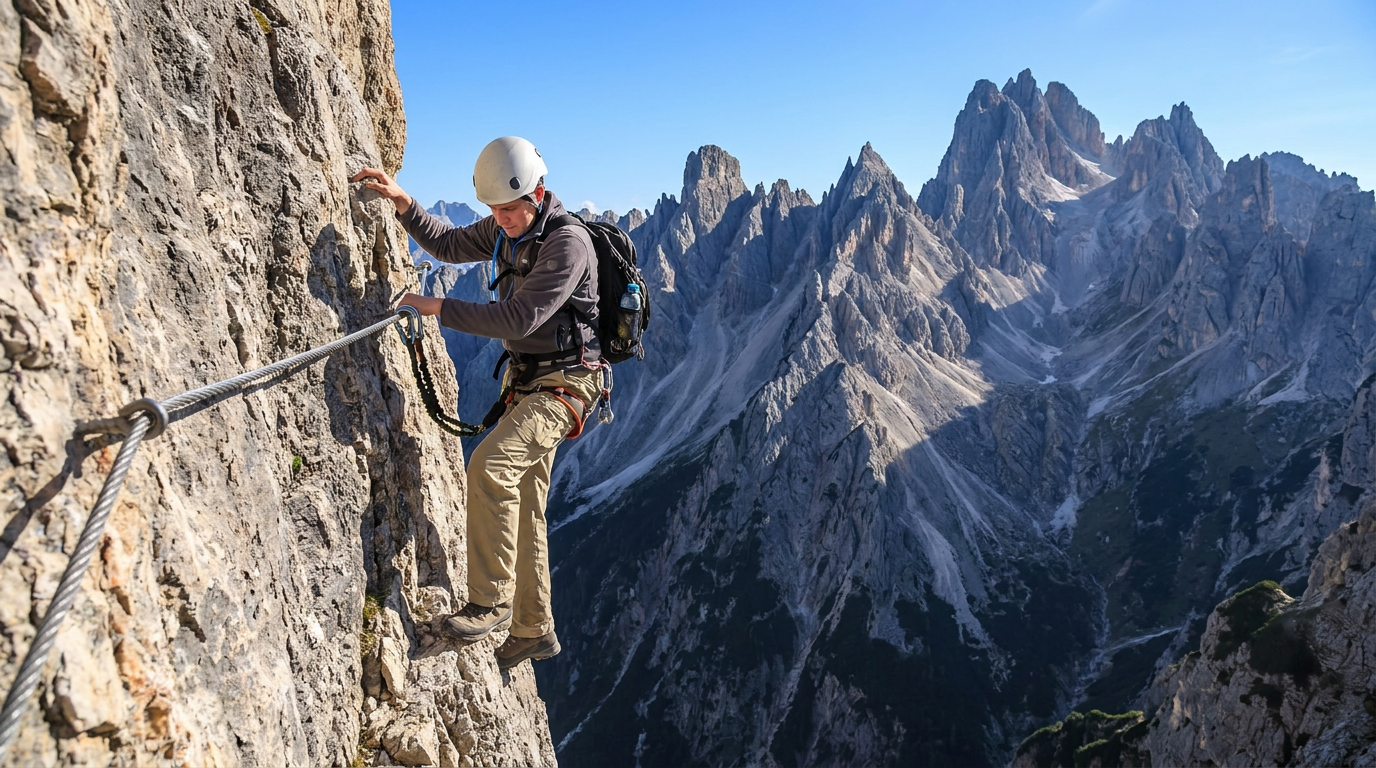
At its core, a via ferrata is a mountain route equipped with fixed steel cables, iron rungs, pegs, carved steps, and ladders bolted directly into the rock face. The continuous steel cable serves a dual purpose: it acts as a handrail for balance and, crucially, as a lifeline. Climbers wear a standard climbing harness attached to a specialized via ferrata lanyard, ensuring they are physically tethered to the mountain at all times. This infrastructure removes the need for complex rope management and belay partners.[1][4]
The mechanics of the ascent are elegantly simple, which accounts for the sport's broad appeal. As a climber moves up the rock, they slide two carabiners along the steel cable. When they reach an anchor point where the cable is bolted to the rock, they unclip one carabiner, move it past the anchor, and re-clip it. They then repeat the process with the second carabiner. This "Y-lanyard" system guarantees that the climber is always attached by at least one point of contact, eliminating the risk of an un-tethered fall.[1][5]

However, the simplicity of the movement masks a complex physical reality that every participant must understand. In traditional rock climbing, a dynamic rope stretches significantly to absorb the kinetic energy of a fall. On a via ferrata, the climber is attached to a static steel cable by a very short lanyard. If a climber slips, they will fall freely until their carabiners hit the nearest steel anchor point bolted into the rock below them, resulting in a sudden, violent stop.[1]
This scenario introduces a critical concept in climbing physics known as the 'fall factor.' The fall factor is calculated by dividing the distance of the fall by the length of the equipment catching it. Because a via ferrata fall distance can be significantly longer than the short lanyard catching it, a slip can generate a fall factor much higher than what is typically experienced in traditional rock climbing. Without specialized equipment, the abrupt stop against a steel anchor would generate enough force to snap standard climbing gear or cause severe bodily injury.[1]
To solve this physics problem, modern via ferrata lanyards are equipped with an 'energy absorber.' This device sits between the harness and the Y-shaped arms of the lanyard. Inside a small pouch, a length of webbing is stitched together with specialized breakaway threads. In the event of a high-impact fall, these threads systematically tear apart, deploying the extra webbing to decelerate the climber and absorb the shock. This tearing action is a one-time use mechanism that saves the climber's life by dissipating the catastrophic forces.[1][4]

The hardware at the end of the lanyard is equally specialized. Climbers use 'K-type' carabiners, with the 'K' standing for Klettersteig, the German word for via ferrata. These auto-locking carabiners feature an oversized gate opening designed to easily snap over thick steel cables, and a mechanism that can be operated swiftly with one hand. This ergonomic design is crucial for reducing grip fatigue during a long day of repeatedly clipping and unclipping past hundreds of anchor points on a towering alpine wall.[5]
The hardware at the end of the lanyard is equally specialized.
While the gear is thoroughly modern, the concept of the iron path is over a century old. The first rudimentary via ferratas were constructed in the Italian Dolomites in the 1880s to help alpine guides and their clients navigate tricky, exposed passages. However, the network truly expanded under the grim and desperate circumstances of World War I, transforming the high alpine into a vertical battlefield where survival depended on moving efficiently through the mountains.[1]
Between 1915 and 1917, Austro-Hungarian and Italian troops fought a bitter, high-altitude war across the jagged peaks of the Dolomites. To move soldiers, artillery, and supplies through hostile, vertical terrain, military engineers drilled iron rungs, thick cables, and wooden ladders into the sheer rock faces. After the war, these extensive military installations were abandoned to the elements, only to be rediscovered, restored, and expanded by alpine clubs decades later for recreational use, laying the foundation for today's booming adventure tourism industry.[1]

Today, the sport has migrated far beyond its alpine birthplace. While Italy, Austria, and Switzerland remain the traditional mothership of the sport, new routes are proliferating globally. In the United States, Colorado has become a hotspot for guided via ferrata tours, drawing thousands of summer tourists. In China, rural villages like Yangshan have installed routes that are driving significant economic revitalization, transforming quiet agricultural areas into bustling adventure hubs and providing lucrative new income streams for local residents through hospitality and guiding services.[4][6]
As the sport globalizes and attracts participants with varying levels of mountain experience, safety organizations have worked to standardize how routes are graded. This ensures climbers do not bite off more than they can chew. The difficulty of a via ferrata depends on several factors: the steepness of the rock, the amount of artificial footholds provided, the physical endurance required, and the sheer psychological exposure to the void below. A route that is technically easy but highly exposed can still paralyze a beginner with vertigo.[2][7]
The grading systems, however, remain an alphabet soup of regional standards that can confuse traveling climbers. The Italian scale, which has been adopted as an international standard by the International Climbing and Mountaineering Federation (UIAA), uses five main levels: F (easy), PD (slightly difficult), D (difficult), TD (very difficult), and ED (extremely difficult). This scale looks at the overall engagement of the route, factoring in both technical difficulty and environmental seriousness, helping climbers gauge whether they have the stamina for a full-day alpine commitment.[2]
Meanwhile, the Austrian system uses an alphabetical scale ranging from A, which denotes easy walking with protective cables, to F, which involves overhanging rock requiring immense upper body strength and perfect technique. In Switzerland, the Hüsler scale ranks routes from K1 to K6. Regardless of the specific letters or numbers used, the progression is universally the same: beginner routes feel like steep, protected hiking, while advanced routes demand the arm strength, technique, and mental fortitude of a seasoned rock climber.[2][7]

The rapid expansion of via ferrata is not without controversy. As the sport transitions from a mountaine mountaineering niche to a mainstream tourism product, friction is building in the high alpine. Traditional alpinists often view the proliferation of iron cables as a desecration of wild spaces. They argue that mountains should be climbed on their own terms, requiring skill and self-reliance, rather than being tamed by heavy engineering and continuous safety nets that alter the fundamental character of the peak.[3][8]
Environmental organizations, such as the Club Arc Alpin (CAA), have raised significant alarms about the ecological impact of the via ferrata boom. They point out that these routes bring unprecedented volumes of human traffic into previously inaccessible, fragile ecosystems. The continuous presence of climbers on steep rock faces can severely disrupt nesting birds, such as eagles and falcons, and trample rare alpine vegetation that relies on these isolated cliff sanctuaries to survive away from human interference.[3]
Furthermore, the CAA and other conservation groups are highly critical of the modern trend toward 'fun ferratas'—routes designed more like amusement park rides than traditional mountain ascents. These modern installations often feature unnecessary wire suspension bridges, tightropes, and cargo nets bolted into the rock. Critics argue these features prioritize adrenaline and social media aesthetics over the natural line of the mountain, degrading the dignity of the alpine landscape for the sake of commercial tourism and turning sacred summits into mere playgrounds.[3]

Despite these ongoing debates, the upward trajectory of via ferrata is clear. It offers an unparalleled intersection of accessibility and awe, allowing ordinary people to experience the profound exposure, physical challenge, and breathtaking beauty of the vertical world. As the industry matures, the ultimate challenge will be balancing the undeniable joy and empowerment of the iron path with the careful preservation of the wild landscapes that make the climb worthwhile in the first place. If managed responsibly, via ferrata can foster a deep appreciation for the mountains among a new generation of adventurers.[8]
How we got here
1880s
The first rudimentary via ferratas are constructed in the Italian Dolomites to assist alpine guides.
1914–1918
During World War I, Italian and Austro-Hungarian troops vastly expand the network of iron paths to move soldiers through the high alpine.
1960s–1980s
Alpine clubs begin restoring abandoned military routes and building new ones for recreational tourism across Europe.
2016
The UIAA officially adopts the Italian grading scale (F to ED) as the international standard for via ferrata difficulty.
2020s
A post-pandemic outdoor boom drives massive global expansion of via ferrata, reaching North America, South America, and Asia.
Viewpoints in depth
Adventure Tourism Advocates
Focus on the accessibility and economic benefits of via ferrata.
This camp, which includes local tourism boards and guide services, views via ferrata as a powerful tool for democratizing the outdoors. By installing safety cables, regions can safely open up breathtaking alpine environments to hikers who lack technical rock climbing skills. Furthermore, as seen in rural areas of China and the American West, these routes can transform struggling local economies by drawing a steady stream of eco-tourists, driving revenue for guides, gear rentals, and hospitality.
Traditional Alpinists & Conservationists
Concerned about the commercialization and environmental impact of iron paths.
Organizations like the Club Arc Alpin argue that the rapid proliferation of via ferratas is turning wild mountains into amusement parks. They are particularly critical of 'fun ferratas'—routes engineered with unnecessary suspension bridges and tightropes purely for adrenaline and social media appeal. Beyond aesthetics, conservationists warn that driving high volumes of human traffic into previously inaccessible cliff faces disrupts fragile alpine ecosystems, particularly nesting birds and rare vegetation.
Safety & Standards Organizations
Focused on standardizing gear and grading to mitigate the sport's unique risks.
Groups like the UIAA and national alpine clubs are primarily concerned with user safety in a sport that masks high objective risks behind apparent simplicity. Because a via ferrata fall can generate catastrophic forces, these organizations work to strictly regulate the manufacturing of energy absorbers and K-type carabiners. They also advocate for unified grading systems—like the Italian F to ED scale—so that tourists don't accidentally wander onto routes that exceed their physical capabilities.
What we don't know
- Whether the rapid global expansion of via ferrata will lead to stricter international environmental regulations on where new routes can be built.
- How local search and rescue teams will adapt to the increasing number of inexperienced tourists requiring extraction from complex vertical terrain.
Key terms
- Via Ferrata
- Italian for 'iron path,' a mountain route equipped with fixed cables, ladders, and rungs to assist climbers.
- Fall Factor
- A ratio used to determine the severity of a climbing fall, calculated by dividing the fall distance by the length of the equipment catching it.
- Energy Absorber
- A crucial component of a via ferrata lanyard that tears open during a fall to decelerate the climber and reduce impact force.
- K-Type Carabiner
- A specialized auto-locking carabiner with a wide gate opening designed specifically for clipping onto thick via ferrata cables.
- Stemple
- A metal rung or step drilled directly into the rock face to provide an artificial foothold or handhold.
Frequently asked
Do I need rock climbing experience to do a via ferrata?
No. While advanced routes require significant upper-body strength, beginner via ferratas are designed to be accessible to anyone with good fitness and a head for heights. The fixed cables and ladders remove the need for technical climbing skills.
Why can't I just use a regular climbing rope and carabiners?
Standard climbing gear is designed for dynamic ropes that stretch to absorb a fall. On a via ferrata, you are clipped to a static steel cable. Falling onto a static cable generates massive force that can snap standard gear, which is why a specialized energy absorber is mandatory.
Are via ferratas safe for children?
Many easy routes are suitable for older children, but they must use specialized children's via ferrata lanyards. Standard energy absorbers are calibrated for adult weights and may not deploy correctly for a lightweight child during a fall.
What happens if I fall on a via ferrata?
You will fall until your carabiners hit the nearest steel anchor point below you. The energy absorber in your lanyard will then tear open to cushion the impact and prevent severe injury or equipment failure.
Sources
Source coverage
8 outlets
3 viewpoints surfaced








[1]WikipediaSafety & Standards Organizations
Via ferrata
Read on Wikipedia →[2]The UIAASafety & Standards Organizations
Via Ferrata – Brief History and Scale of Difficulties
Read on The UIAA →[3]Club Arc AlpinTraditional Alpinists & Conservationists
The Via Ferrata Boom and Environmental Impact
Read on Club Arc Alpin →[4]Colorado Via FerrataAdventure Tourism Advocates
What is Via Ferrata and Why is it Growing in Popularity?
Read on Colorado Via Ferrata →[5]Peak MountaineeringSafety & Standards Organizations
Via Ferrata Skills and Equipment
Read on Peak Mountaineering →[6]Global TimesAdventure Tourism Advocates
Via Ferrata becomes a rising trend, boosting tourism
Read on Global Times →[7]Swiss Alpine ClubSafety & Standards Organizations
Via Ferrata Grading Systems (Hüsler Scale)
Read on Swiss Alpine Club →[8]Factlen Editorial Team
Synthesis by Factlen editorial team
Read on Factlen Editorial Team →

Every angle. Every day.
Get travel stories with full source coverage and perspective breakdowns delivered to your inbox.