
The Science Behind Pilates: How It Actually Changes Your Body
Advanced biomechanical research reveals how Pilates physically thickens deep core muscles and rewires the nervous system for better stability.
By Factlen Editorial Team
- Biomechanics Researchers
- Focus on measurable neuromuscular data, viewing Pilates as a system for rewiring anticipatory stabilizers rather than a traditional strength program.
- Athletic Performance Coaches
- Value Pilates for its ability to build core stability, allowing athletes to transfer force efficiently and maintain agility under dynamic loads.
- Clinical Rehabilitation Specialists
- Emphasize the therapeutic applications of controlled movements for managing back pain, improving posture, and regaining mobility.
- Traditional Strength Advocates
- Point to data showing Pilates does not trigger significant muscle hypertrophy, arguing it should supplement rather than replace weightlifting.
What's not represented
- · Casual gym-goers who prefer high-intensity interval training
- · Yoga practitioners comparing mind-body benefits
Why this matters
Understanding the actual biomechanics of Pilates helps you choose the right modality—mat or reformer—to effectively target back pain, improve athletic performance, or build functional strength without wasting time on the wrong exercises.
Key points
- Pilates specifically targets deep anticipatory stabilizers like the transverse abdominis, protecting the spine from injury.
- Ultrasound imaging confirms that consistent Pilates practice physically thickens deep core muscles over a 6-week period.
- Reformer Pilates provides external spring resistance, making it superior for building explosive athletic power and agility.
- While excellent for functional strength and dynamic flexibility, Pilates does not elicit robust muscle hypertrophy compared to weightlifting.
Pilates has evolved from a niche rehabilitation method for dancers into a global fitness phenomenon, but its precise effects on the human body have often been shrouded in marketing rather than science. Today, advanced biomechanical research, including electromyography (EMG) and rehabilitative ultrasound imaging, is finally mapping exactly how the century-old practice changes our physiology. The consensus among sports scientists is clear: Pilates is not merely a stretching routine, but a sophisticated system of neuromuscular re-education that fundamentally alters how the brain communicates with the muscular system.[1][7]
At the center of the scientific validation of Pilates is the concept of the 'powerhouse,' or the deep core. When researchers talk about core strength in this context, they are not referring to the superficial 'six-pack' muscles that are typically targeted by traditional crunches. Instead, Pilates specifically targets a complex system of deep stabilizers: the transverse abdominis, the multifidus, the diaphragm, and the pelvic floor. These muscles form an internal corset that supports the spine and internal organs during every physical movement.[1][4]
These deep muscles act as anticipatory stabilizers. Neurological studies demonstrate that in a healthy, well-conditioned body, these muscles activate milliseconds before the arms or legs move, bracing the spine against the upcoming load. In people with chronic back pain or sedentary lifestyles, this activation is often delayed, leaving the spine vulnerable to injury. Clinical trials show that consistent Pilates practice effectively rewires this mind-muscle connection, restoring the crucial anticipatory timing that protects the spine and allows for safe, pain-free movement in daily life.[4]
Recent studies utilizing rehabilitative ultrasound imaging have provided visual proof of these structural changes. In a comprehensive trial, researchers observed that participants who engaged in Pilates-based core stabilization training three times a week for six weeks showed significant increases in the actual thickness of the transverse abdominis and internal oblique muscles. The practice physically rebuilds the body's internal support structures, proving that the benefits of Pilates extend far beyond temporary improvements in posture or flexibility, creating lasting architectural changes in the core.[4]

The debate between mat Pilates and reformer Pilates has also been subjected to rigorous scientific scrutiny. Mat Pilates, which relies entirely on gravity and body weight, is highly effective for developing foundational movement control and balance. A study focusing on middle-aged women found that eight weeks of mat exercises led to a measurable reduction in waist-hip ratios and an increase in fat-free mass, highlighting its utility as an accessible, low-impact intervention for improving overall body composition without the need for specialized equipment.[1][2]
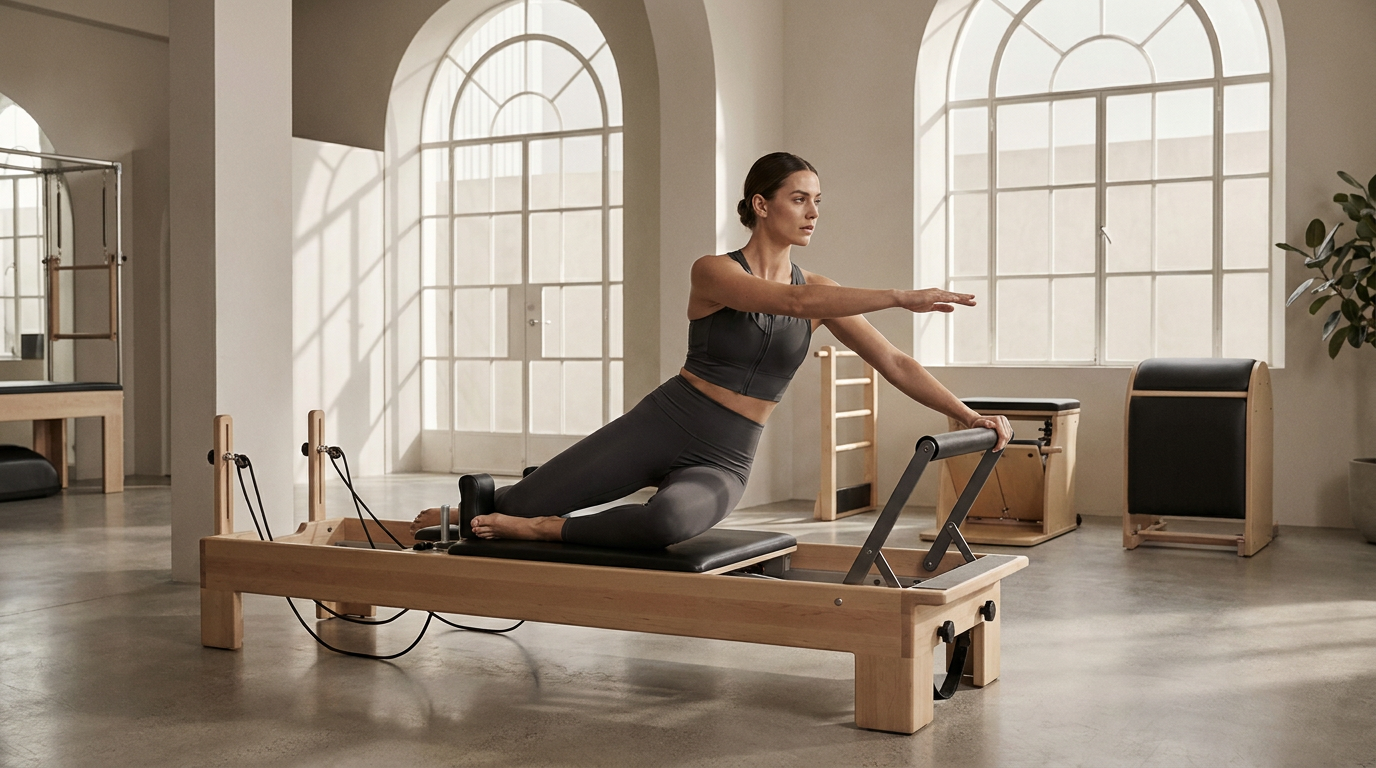
Reformer Pilates, however, introduces a different biomechanical stimulus through its system of adjustable springs and a sliding carriage. This external loading makes the reformer mechanistically better positioned to promote muscle hypertrophy and explosive power. The springs provide both concentric and eccentric resistance, challenging the muscles through their entire range of motion while simultaneously demanding intense proprioceptive focus to keep the carriage stable. This unique environment forces the nervous system to adapt to constantly shifting loads, building functional strength that translates directly to athletic performance.[2][3]
Reformer Pilates, however, introduces a different biomechanical stimulus through its system of adjustable springs and a sliding carriage.
A recent study comparing the two modalities in amateur soccer players highlighted these distinct benefits. While both methods improved overall performance, the reformer group saw superior gains in agility, standing broad jump distance, and short sprint times. The researchers attributed this to the reformer's capacity for progressive external resistance, which closely mimics the dynamic loads athletes experience on the field. The ability to incrementally increase spring tension allows practitioners to continually challenge their muscles, driving adaptations that body-weight exercises alone cannot achieve.[2][5]
Despite these benefits, sports scientists are careful to outline the limitations of Pilates when it comes to absolute muscle growth. A comprehensive review on muscle mass accretion concluded that while Pilates reliably improves functional strength and endurance, it does not consistently elicit robust muscle hypertrophy. For individuals whose primary goal is maximizing muscle size or achieving significant cardiovascular conditioning, traditional heavy weightlifting and dedicated aerobic training remain the superior modalities. Pilates is best viewed as a foundational practice that enhances, rather than replaces, other forms of exercise.[6][7]

Where Pilates excels uniquely is in the realm of dynamic flexibility. Traditional static stretching often fails to translate into functional movement because it does not build strength at the end ranges of motion. Pilates, conversely, requires practitioners to actively control their limbs as they stretch. Studies show that this combination of core stability and active lengthening significantly improves hamstring and shoulder flexibility, which is critical for injury prevention and maintaining a full, healthy range of motion as the body ages.[1][3]
The neurological component of Pilates—often referred to as the mind-muscle connection—is another area of active research. The method requires intense concentration on the specific muscle being worked, a principle Joseph Pilates originally called 'Contrology.' Modern electromyography studies confirm that this conscious mental focus actually increases the electrical activation of the targeted muscle fibers, making the exercise significantly more efficient than mindless repetition. This focused attention ensures that the correct muscles are firing in the correct sequence, preventing compensatory movement patterns.[1][4]
This mindful approach also yields measurable psychological benefits. Research led by the University of Salford found that regular Pilates practice improved self-confidence and the ability to manage chronic conditions among participants. The emphasis on diaphragmatic breathing not only oxygenates the blood but also triggers the parasympathetic nervous system, actively reducing physiological stress markers. By demanding total presence in the moment, Pilates acts as a form of moving meditation, providing a mental reset that is increasingly valuable in a high-stress modern world.[1]
For midlife and older adults, the biomechanical benefits of Pilates take on added clinical significance. Weight-bearing exercises are crucial for maintaining bone density and combating osteoporosis. While mat Pilates provides excellent body-weight resistance, the added load of the reformer can further stimulate bone remodeling. Furthermore, the unstable surface of the reformer carriage trains the proprioceptive system, significantly improving balance and spatial awareness. This targeted neuromuscular training is one of the most effective interventions available for reducing fall risk and preserving independence in older populations.[2][3]

The integration of Pilates into elite athletic training programs underscores its transition from a complementary therapy to a core performance enhancer. Biomechanists note that by strengthening the deep stabilizers through isometric contractions, athletes can transfer force more efficiently from their lower to upper bodies. This improved kinetic chain translates to a more powerful tennis serve, a higher volleyball jump, or a more efficient running stride, proving that core stability is the foundation upon which all athletic power is built.[1][5]
Ultimately, the science of Pilates validates its creator's original vision while refining its application for the modern era. It is not a magical cure-all, but rather a highly effective, evidence-based system that optimizes how the human machine operates. By enhancing neuromuscular control, increasing deep muscle thickness, and improving dynamic flexibility, Pilates builds a more resilient body. Whether the goal is rehabilitating a spinal injury, improving posture, or maximizing athletic potential, the scientific literature confirms that true strength begins deep within the core.[7]
How we got here
1920s
Joseph Pilates develops 'Contrology' to rehabilitate injured soldiers and train dancers in New York.
2012
Researchers establish a scientific consensus defining modern Pilates as a mind-body exercise with six specific biomechanical components.
2021
Systematic reviews confirm Pilates is a safe, effective intervention for improving mobility in older adults and patients with Parkinson's disease.
2025–2026
Advanced ultrasound and EMG studies map the exact neurological mechanisms of deep core activation during Pilates exercises.
Viewpoints in depth
Biomechanics Researchers
Focus on the measurable neuromuscular data and internal structural changes.
This camp relies on electromyography (EMG) and ultrasound imaging to understand Pilates. They view the practice not as a traditional strength or cardio workout, but as a system for neuromuscular re-education. Their research highlights how Pilates physically thickens the transverse abdominis and rewires the brain to activate anticipatory stabilizers milliseconds before movement, fundamentally changing how the body handles physical loads.
Athletic Performance Coaches
Value Pilates for its ability to build core stability and improve force transfer.
Sports scientists and coaches focus on how Pilates enhances athletic performance. They emphasize that by strengthening the deep stabilizers through isometric contractions, athletes can transfer force more efficiently from their lower to upper bodies. This improved kinetic chain translates to measurable gains in agility, sprint times, and explosive power, while simultaneously reducing the risk of joint injuries.
Clinical Rehabilitation Specialists
Emphasize the therapeutic applications of controlled movements for managing pain.
Physical therapists and rehabilitation experts utilize Pilates to treat chronic conditions. They focus on the method's ability to improve postural alignment, elongate shortened muscles, and provide safe, weight-bearing exercise for older adults. For this group, the mind-muscle connection and diaphragmatic breathing are essential tools for managing chronic lower back pain and improving overall mobility.
Traditional Strength Advocates
Point to data showing Pilates does not trigger significant muscle hypertrophy.
Exercise physiologists focused on absolute strength and hypertrophy point out the limitations of Pilates. They cite comprehensive reviews showing that while Pilates improves functional strength, it does not consistently elicit robust muscle mass gains compared to heavy resistance training. They advocate for using Pilates as a supplementary practice for mobility and core control, rather than a primary modality for building muscle size.
What we don't know
- The exact long-term differences in bone density preservation between mat and reformer Pilates over decades of practice.
- How specific genetic factors influence an individual's neuromuscular adaptation to Pilates training.
Key terms
- Transverse Abdominis
- The deepest layer of abdominal muscle that wraps around the torso like a corset, acting as a primary stabilizer for the spine.
- Anticipatory Stabilizers
- Deep core muscles that neurologically activate milliseconds before limb movement to protect the spine from sudden loads.
- Electromyography (EMG)
- A diagnostic technique used in sports science to measure the electrical activity and recruitment of muscles during exercise.
- Hypertrophy
- The enlargement of tissue from the increase in size of its cells, commonly referring to the process of building muscle mass.
- Proprioception
- The body's subconscious ability to sense its position, movement, and balance in three-dimensional space.
Frequently asked
Can Pilates replace weightlifting for building muscle?
No. While reformer Pilates offers resistance that can promote some muscle growth, studies show it does not consistently elicit the robust muscle mass gains achieved through traditional heavy weightlifting.
Is reformer Pilates better than mat Pilates?
It depends on your goals. Reformer Pilates provides external spring resistance ideal for building power and agility, while mat Pilates is highly effective for foundational core control and balance.
How often should I do Pilates to see physical changes?
Clinical studies typically observe significant improvements in core endurance, flexibility, and deep muscle thickness with two to three sessions per week over a 6- to 12-week period.
Sources
Source coverage
7 outlets
4 viewpoints surfaced






[1]IDEA Health & Fitness AssociationAthletic Performance Coaches
The Science of Pilates Research
Read on IDEA Health & Fitness Association →[2]Medical News TodayClinical Rehabilitation Specialists
Reformer vs mat pilates: Differences, risks, and more
Read on Medical News Today →[3]Frontiers in Sports and Active LivingBiomechanics Researchers
Effects of 12-week pilates reformer training on the biomechanics of Latin dance
Read on Frontiers in Sports and Active Living →[4]National Institutes of Health (PMC)Biomechanics Researchers
Effects of Core Stability Training on Deep Stabilizing Muscle Function and Neuromuscular Control
Read on National Institutes of Health (PMC) →[5]Journal of Bodywork and Movement TherapiesAthletic Performance Coaches
Pilates increases resistance performance in young volleyball players
Read on Journal of Bodywork and Movement Therapies →[6]Quality in SportTraditional Strength Advocates
Reformer Pilates vs Mat Pilates and Muscle Mass: Current State of Knowledge
Read on Quality in Sport →[7]Factlen Editorial TeamTraditional Strength Advocates
Synthesis by Factlen editorial team
Read on Factlen Editorial Team →
Every angle. Every day.
Get fitness stories with full source coverage and perspective breakdowns delivered to your inbox.