
Buying a Turnkey Home vs. a Fixer-Upper: The 2026 Cost Comparison
In a housing market defined by tight inventory and elevated rates, buyers face a critical choice between paying a premium for move-in-ready convenience or taking on the risks of a renovation. This deep dive breaks down the true costs, hidden risks, and long-term equity potential of both paths.
By Factlen Editorial Team
- Move-In Ready Proponents
- Argues that the upfront premium of a turnkey home is justified by the elimination of construction risk and carrying costs.
- Sweat Equity Investors
- Believes that buying distressed properties is the most reliable mechanism for generating outsized real estate wealth.
- Construction Risk Analysts
- Focuses on the hidden structural and macroeconomic risks that can derail renovation timelines and budgets.
What's not represented
- · Renters who are entirely priced out of both the turnkey and fixer-upper markets due to 2026 interest rates.
- · Local municipal planners who manage the permitting processes that dictate renovation timelines.
Why this matters
Choosing between a move-in-ready home and a renovation project is one of the largest financial decisions a family will make. Understanding the hidden costs and true premiums of the 2026 housing market empowers buyers to protect their capital, avoid construction nightmares, and strategically build long-term wealth.
Key points
- Turnkey homes command a 10% to 30% premium but offer predictable costs and immediate occupancy.
- Fixer-uppers sell at a steep discount, allowing buyers to force appreciation and customize their living space.
- Standard renovations in 2026 cost between $150 and $300 per square foot, with luxury markets reaching $1,000.
- Construction projects routinely exceed initial budget estimates by 20% to 50% due to hidden structural issues.
- Turnkey properties are ideal for buyers with strict timelines, while fixer-uppers suit those with flexible living arrangements and cash reserves.
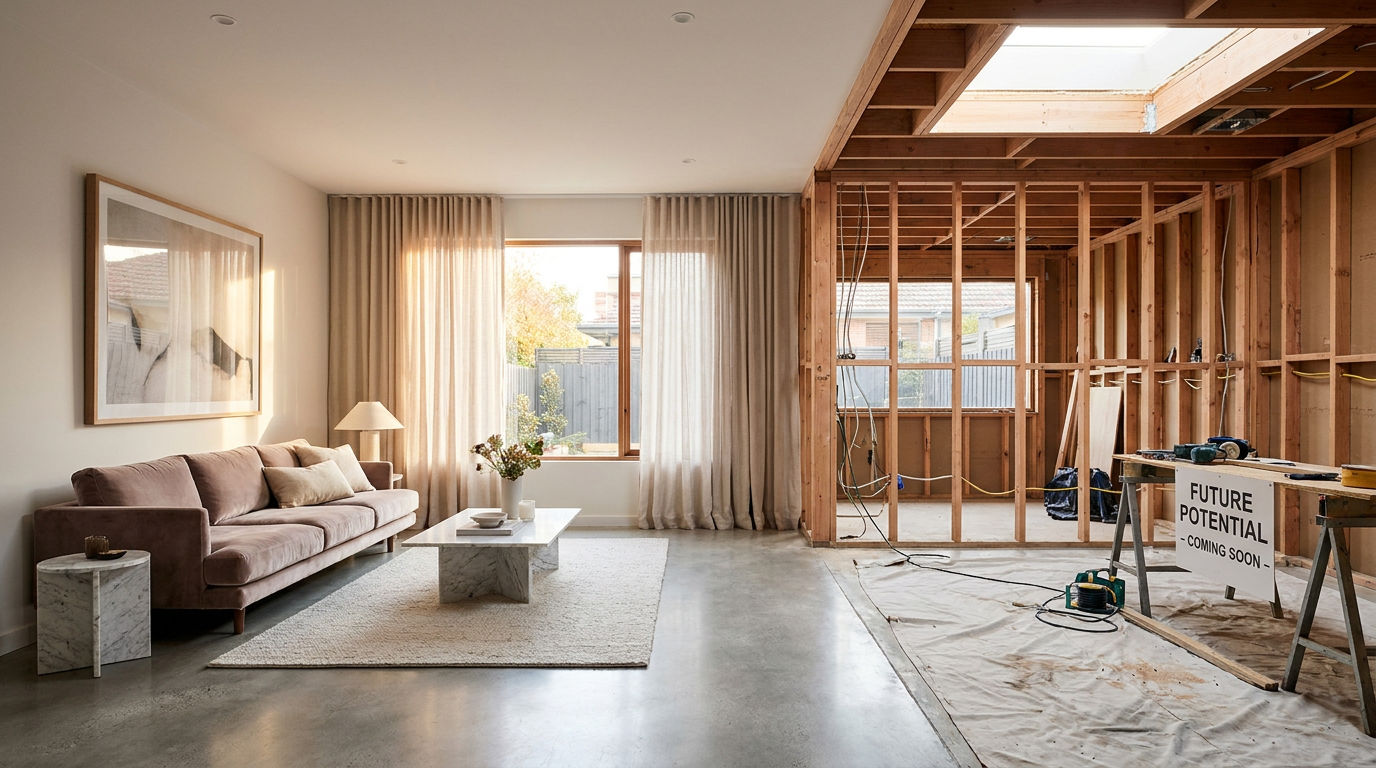
Every prospective homebuyer in 2026 eventually faces the same fundamental crossroads: purchase a pristine, move-in-ready property, or buy an aging house at a discount and renovate it to their exact tastes. With national mortgage rates hovering between 6.3 and 6.5 percent and housing inventory remaining stubbornly tight, the financial stakes of this decision have rarely been higher. The choice between a turnkey home and a fixer-upper is no longer just a matter of aesthetic preference; it is a complex calculation involving upfront capital, carrying costs, construction delays, and long-term equity generation. Navigating this landscape requires stripping away the romanticized visions of home renovation shows and examining the hard, quantitative trade-offs of each path.[1][8]
For the turnkey approach, the primary argument centers on absolute predictability and immediate utility. A turnkey property allows buyers to move in on closing day without touching a single tool or hiring a single contractor. The kitchen is modernized, the major systems like roofing and HVAC are functional, and the home inspection provides a clear, reliable picture of the asset's condition. This path eliminates the dual-housing dilemma where a buyer must pay rent on a temporary apartment while simultaneously paying the mortgage on an uninhabitable construction zone. Furthermore, financing a turnkey home is remarkably straightforward, as standard conventional mortgages easily cover the purchase without the need for specialized construction loans or complex appraisals based on future value.[3][4]
Against the turnkey strategy, buyers must accept a significant financial premium and a total loss of personalization. Real estate data indicates that move-in-ready homes command a premium of 10 to 30 percent over comparable properties that need work. When purchasing a turnkey home, the buyer is essentially reimbursing the previous owner or developer for the cost of their renovations, plus a healthy profit margin. Additionally, the buyer is locked into someone else's design choices. If the previous owner selected trendy but polarizing tile patterns or a kitchen layout that does not suit the new family's cooking habits, the buyer pays top dollar for finishes they may ultimately resent but cannot afford to replace.[2][5]

The evidence supporting the high cost of the turnkey premium is visible across both residential and investment real estate markets in 2026. Investment platforms note that turnkey properties consistently demand a higher initial investment, often pricing out buyers who are stretching to meet standard down payment requirements. Because these homes attract the widest pool of potential buyers—most of whom want to avoid the stress of construction—they frequently become the subject of intense bidding wars. This heightened competition further inflates the purchase price, meaning the buyer is paying maximum retail value and leaving very little room for immediate equity growth.[3][5]
For the fixer-upper strategy, the core advantage is the opportunity to purchase below market value and force rapid equity appreciation. Homes requiring significant cosmetic or structural work routinely sell for 30 to 50 percent less than their updated neighbors. This lower entry point allows buyers to break into highly desirable neighborhoods that would otherwise be financially out of reach. Beyond the initial discount, the fixer-upper offers total customization. The buyer dictates every finish, every layout adjustment, and every material choice, ensuring the final product perfectly aligns with their specific lifestyle. When executed correctly, the post-renovation value of the home often exceeds the combined cost of the purchase and the construction, generating immediate wealth.[2][5]
Against the renovation route, the primary risks are unpredictable costs and severe timeline uncertainty. The construction industry operates on a well-known rule of thumb: renovations almost always cost 20 to 50 percent more than the initial estimate. Once contractors open up the walls of an older home, they frequently discover hidden disasters such as outdated knob-and-tube wiring, hidden water damage, structural rot, or asbestos. These discoveries mandate immediate, expensive remediation that adds zero aesthetic value to the home. Furthermore, a project quoted to take three months routinely stretches to six or nine months due to permitting delays, backordered materials, and labor shortages, leaving the buyer stranded in a prolonged state of disruption.[2][7]
Against the renovation route, the primary risks are unpredictable costs and severe timeline uncertainty.
When evaluating the fixer-upper category, buyers must carefully distinguish between a cosmetic refresh and a full gut rehabilitation. A cosmetic fixer requires only surface-level updates: fresh paint, refinished hardwood floors, new baseboards, and updated light fixtures. These projects carry minimal structural risk, rarely require municipal permits, and can often be completed in a matter of weeks. Conversely, a gut rehab involves tearing spaces down to the studs, moving load-bearing walls, replacing plumbing stacks, and upgrading electrical panels. The gut rehab offers the highest potential return on investment but introduces exponential risk, requiring a sophisticated understanding of local zoning laws and a network of reliable, licensed subcontractors.[2][6]
The evidence from 2026 construction data highlights the steep financial reality of modern renovations. Average home renovation costs currently range from $150 to $300 per square foot for standard finishes, while luxury markets like Manhattan see gut renovations demanding $700 to $1,000 per square foot. Even a standard kitchen remodel now routinely costs between $14,000 and $40,000. When combined with the carrying costs of maintaining the property during a prolonged vacancy, the total capital required can quickly eclipse the turnkey premium. In one Manhattan case study, a fixer-upper required over a million dollars in renovations and carrying costs, though it ultimately still saved the buyer roughly $1.5 million compared to a comparable $6.5 million turnkey unit.[2][6]

Beyond the raw financial metrics, the psychological toll of a major renovation is a heavily underpriced variable in the fixer-upper equation. Living in a construction zone means waking up to the sound of air compressors, dealing with pervasive drywall dust that infiltrates every room, and losing access to essential spaces like kitchens and full bathrooms for months at a time. Even if the buyer lives off-site, the mental burden of decision fatigue is immense. Homeowners are routinely forced to make rapid-fire choices on grout colors, outlet placements, and trim profiles while balancing their normal professional and family obligations, leading to a phenomenon industry experts refer to as renovation burnout.[2][3]
The evidence regarding financing further complicates the fixer-upper path. While turnkey homes utilize standard 30-year fixed mortgages, funding a major renovation requires specialized financial instruments. Buyers must navigate FHA 203(k) loans, HomeStyle renovation loans, or high-interest hard money options if they do not have massive cash reserves. Alternatively, platforms like RenoFi allow buyers to borrow against the after-renovation value (ARV) of the home, but these loans still carry interest rates that are highly sensitive to the elevated 2026 macroeconomic environment. Securing this financing requires detailed contractor bids, architectural plans, and rigorous appraisals before the purchase can even close, adding immense friction to the transaction.[5][6]
The turnkey path fits well when the buyer is operating on a strict, inflexible timeline. If a family is relocating for a new job, expecting a child, or needing to settle before the school year begins, the immediate occupancy of a move-in-ready home is invaluable. It is also the optimal choice for buyers who lack the liquid cash reserves necessary to absorb a 20 percent construction budget overrun. For professionals with demanding careers who simply do not have the mental bandwidth to manage contractors, select fixtures, and make dozens of micro-decisions every week, the turnkey premium is a worthwhile investment in their own peace of mind and daily stability.[3][4]
The turnkey approach does not fit when the buyer has highly specific, uncompromising design tastes or requires unique architectural features that are rarely found in modern flips. If a buyer knows they will inevitably want to tear out the brand-new, builder-grade kitchen to install custom cabinetry and professional appliances, paying the turnkey premium is a massive destruction of capital. Furthermore, it is a poor fit for buyers whose primary goal is aggressive wealth generation. Because the developer or previous owner has already extracted the equity upside of the renovation, the new buyer must rely solely on passive market appreciation to build wealth, which can be painfully slow in a high-interest-rate environment.[2][5]

The fixer-upper route fits well when the buyer has highly flexible living arrangements, such as a month-to-month lease or the ability to live with family during the construction phase. It is ideal for individuals with deep cash reserves who can comfortably absorb unexpected plumbing or electrical emergencies without derailing the entire project. This path heavily rewards buyers who possess genuine project management skills, a high tolerance for disruption, and the vision to see past peeling paint and outdated floor plans. For those willing to trade their time and energy for financial gain, the fixer-upper remains one of the most reliable mechanisms for middle-class wealth creation in the modern real estate market.[2][5]
The renovation path does not fit when a buyer is stretching their absolute maximum financial capacity just to secure the initial down payment and closing costs. If there is no financial buffer, the first hidden structural issue will bring the entire project to a catastrophic halt. It is also a dangerous choice for couples or families who struggle with high-stress decision-making, as the relentless pressure of a major remodel is notorious for straining relationships. Finally, a fixer-upper is a poor strategy in neighborhoods where the post-renovation value is capped by surrounding property values; over-improving a home beyond what the local market can support guarantees a negative return on the construction investment.[2][7]
Viewpoints in depth
Move-In Ready Proponents
Argues that the upfront premium of a turnkey home is justified by the elimination of construction risk and carrying costs.
This camp emphasizes that time and mental bandwidth are valuable assets that are often ignored in real estate spreadsheets. By purchasing a move-in-ready property, buyers lock in their total housing cost on day one, avoiding the notorious 20% to 50% budget overruns that plague renovation projects. They point out that in a high-interest-rate environment, financing the entire purchase through a single, standard 30-year mortgage is far more efficient than juggling high-yield construction loans or draining liquid cash reserves to pay contractors.
Sweat Equity Investors
Believes that buying distressed properties is the most reliable mechanism for generating outsized real estate wealth.
For this group, the turnkey premium is viewed as a destruction of potential wealth. They argue that by purchasing a fixer-upper at a 30% to 50% discount, buyers can force appreciation through strategic upgrades, ultimately creating a post-renovation value that far exceeds their total capital outlay. This camp relies heavily on specialized financing like RenoFi or FHA 203(k) loans to leverage the future value of the home, allowing them to customize their living space entirely while simultaneously building a massive equity buffer against market downturns.
Construction Risk Analysts
Focuses on the hidden structural and macroeconomic risks that can derail renovation timelines and budgets.
Analysts in this camp warn that the romanticized vision of home renovation often clashes with the brutal realities of the 2026 construction market. They highlight that labor shortages, supply chain bottlenecks, and the discovery of hazardous materials like asbestos can easily double a project's timeline. From a macroeconomic perspective, they note that while mortgage rates have stabilized around 6.3%, the cost of raw materials and skilled labor remains near all-time highs, significantly compressing the profit margins that once made fixer-uppers a guaranteed win.
What we don't know
- Whether the cost of raw construction materials will stabilize or spike again in the latter half of 2026.
- How local zoning changes and permit backlogs will impact the average timeline for major gut rehabilitations.
- The exact degree to which elevated mortgage rates will suppress buyer competition for turnkey properties in specific regional markets.
Key terms
- Turnkey Property
- A home that is completely move-in ready, requiring no major repairs or cosmetic updates before the buyer takes occupancy.
- Carrying Costs
- The ongoing expenses of owning a property—such as property taxes, insurance, and mortgage payments—incurred while the home is vacant during a renovation.
- Forced Appreciation
- The act of increasing a property's market value through deliberate physical improvements and renovations, rather than waiting for natural market inflation.
- After-Renovation Value (ARV)
- The estimated market value of a property once all planned repairs and upgrades have been completed, often used by lenders to underwrite construction loans.
- Gut Rehabilitation
- A comprehensive renovation project that strips a home down to its structural framing, replacing all major systems, walls, and finishes.
Frequently asked
Is it cheaper to buy a turnkey home or a fixer-upper?
A fixer-upper is typically cheaper upfront, often selling for 30% to 50% less than a comparable turnkey home. However, once renovation costs, carrying costs, and inevitable budget overruns are factored in, the final price gap narrows significantly, though the fixer-upper usually still yields more total equity.
How much do home renovations cost in 2026?
Standard home renovations currently average between $150 and $300 per square foot. In luxury or high-cost urban markets, gut renovations can easily demand $700 to $1,000 per square foot.
Can I finance a fixer-upper with a standard mortgage?
Standard mortgages generally do not cover extensive renovation costs. Buyers typically need specialized products like FHA 203(k) loans, HomeStyle renovation loans, or ARV (After-Renovation Value) loans to finance both the purchase and the construction.
What is the turnkey premium?
The turnkey premium is the extra amount buyers pay for a move-in-ready home, typically ranging from 10% to 30% above the cost of a comparable unrenovated property. It covers the previous owner's renovation costs, their profit margin, and the convenience of immediate occupancy.
Sources
Source coverage
8 outlets
3 viewpoints surfaced








[1]Factlen Editorial TeamConstruction Risk Analysts
Synthesis by Factlen editorial team
Read on Factlen Editorial Team →[2]Gallery KBNYSweat Equity Investors
Buying A Turnkey Apartment Or Renovating A Fixer Upper: Which Is The Better Value?
Read on Gallery KBNY →[3]Vertex Realty GroupMove-In Ready Proponents
Turnkey vs Fixer-Upper: Should You Buy New or Renovate?
Read on Vertex Realty Group →[4]Desert Financial Credit UnionMove-In Ready Proponents
Turnkey vs. fixer upper homes: which is right for you?
Read on Desert Financial Credit Union →[5]InvstgSweat Equity Investors
Comparing Costs: Turnkey vs. Fixer-Upper Investments
Read on Invstg →[6]RealmSweat Equity Investors
Stay or go? In 2026, renovate with RenoFi
Read on Realm →[7]National Association of Home BuildersConstruction Risk Analysts
Remodeling Captures Growing Share of Residential Construction
Read on National Association of Home Builders →[8]Fannie MaeConstruction Risk Analysts
Housing Forecast: Mortgage Rates to Stabilize in 2026
Read on Fannie Mae →
Every angle. Every day.
Get real estate stories with full source coverage and perspective breakdowns delivered to your inbox.