
Turnkey vs. Fixer-Upper: The 2026 Guide to Weighing Homebuying Trade-Offs
As housing inventory rebounds and renovation costs remain elevated, homebuyers face a critical choice between paying a premium for move-in ready comfort or taking on the risks of a fixer-upper. This analysis breaks down the true costs, ROI, and lifestyle trade-offs of both paths.
By Factlen Editorial Team
- Turnkey Advocates
- Buyers and agents who prioritize predictability, immediate comfort, and lower risk of unexpected expenses.
- Value Investors & DIYers
- Homebuyers who focus on lower purchase prices, customization, and building sweat equity over time.
- Market & ROI Analysts
- Real estate economists and contractors who emphasize the strict math of renovation costs, insurance requirements, and resale value.
What's not represented
- · Renters priced out of both options
- · Local zoning boards restricting renovations
Why this matters
Choosing between a turnkey home and a fixer-upper is one of the largest financial decisions a buyer will make. Understanding the hidden costs of renovations and the strict ROI of home improvements prevents buyers from draining their savings on a distressed property or overpaying for someone else's design choices.
Key points
- Turnkey homes offer immediate comfort and predictable costs but come with higher purchase prices and property taxes.
- Fixer-uppers provide a lower entry price and customization options but carry high risks of unexpected renovation expenses.
- In 2026, 62% of buyers prefer move-in ready homes, reflecting a desire to avoid the stress and volatility of construction.
- High-visibility upgrades like garage doors and minor kitchen remodels offer the best ROI, while luxury customizations rarely recoup their costs.
- Stricter 2026 insurance requirements make older, unrenovated homes harder to finance, as outdated roofs can kill a mortgage deal.
The 2026 real estate market presents a distinct challenge for prospective homebuyers. While inventory has steadily rebounded from historic pandemic-era lows, elevated interest rates and persistently high property prices have squeezed purchasing power. This economic reality forces buyers into a critical decision: pay a premium for a move-in ready, turnkey home, or purchase a discounted fixer-upper that requires immediate work. Both paths offer distinct financial and lifestyle trade-offs, and the right choice depends heavily on a buyer's cash reserves, risk tolerance, and timeline.[1][7][8]
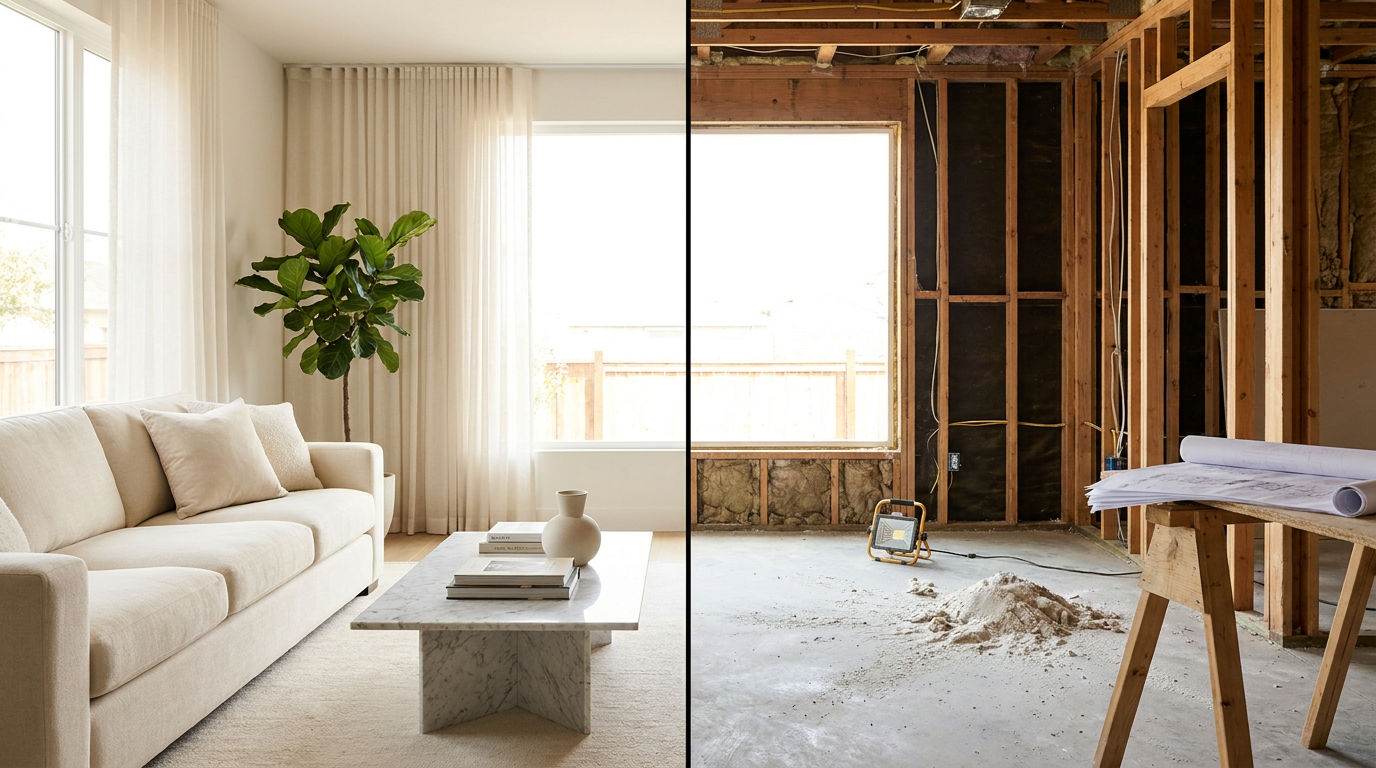
A turnkey property is defined as a home requiring zero immediate labor to be habitable or comfortable. The vital systems—such as plumbing, electrical, and roofing—are functional, and the aesthetic finishes are generally updated to modern standards. In contrast, a fixer-upper requires noticeable work, ranging from cosmetic overhauls like outdated kitchens to structural repairs involving moving walls or replacing major systems entirely.[1][6]
The primary argument for a turnkey home centers on predictability and immediate comfort. Buyers can move in on closing day without the disruption of construction, drywall dust, or contractor delays. Financing is also significantly more straightforward, as traditional mortgages easily cover the purchase price without the need for specialized, paperwork-heavy renovation loans. Furthermore, the total cost is locked in at closing, shielding the buyer from the volatile pricing of construction materials and labor.[6][8]
The argument against turnkey properties is largely financial. Buyers pay a significant premium for the convenience of a finished product, effectively reimbursing the previous owner or developer for the renovation costs plus a profit margin. Because the home is valued higher at the time of sale, property taxes are also elevated from day one. Additionally, buyers sacrifice personalization, inheriting design choices and finishes that they might not entirely love but cannot financially justify replacing.[1][6]

Evidence strongly suggests a growing market preference for this predictability. A recent survey of over 2,000 homeowners revealed that 62 percent opted for move-in ready homes. Buyers increasingly prioritize cost certainty, especially as inflation impacts the broader economy. Real estate data indicates that remodeled homes now sell for a 3.7 percent premium over expected values, reflecting a "nostalgia tax" where buyers are willing to pay extra to avoid the hassle of renovations.[2]
Conversely, the argument for a fixer-upper is rooted in accessibility and value creation. The most compelling advantage is a lower initial purchase price. Homes needing significant work are often priced well below comparable turnkey properties in the same neighborhood, allowing buyers to enter desirable school districts or locations that might otherwise be financially out of reach. Fixer-uppers also face less competition, as many buyers simply do not want to manage a renovation.[4][6]
Beyond the lower entry price, fixer-uppers offer the ultimate canvas for customization. Buyers have the freedom to select every finish, layout change, and architectural detail, ensuring the final product perfectly matches their lifestyle. When executed correctly, this path allows homeowners to build substantial "sweat equity," increasing the property's overall value by more than the cost of the renovations themselves.[4][7][8]
Beyond the lower entry price, fixer-uppers offer the ultimate canvas for customization.
The argument against fixer-uppers focuses on the high risk of unexpected expenses and timeline blowouts. Once walls are opened, contractors frequently discover hidden issues such as water damage, outdated wiring, or structural decay. These surprises can quickly consume a contingency budget. Furthermore, living in a construction zone is notoriously stressful, and buyers who cannot inhabit the home during renovations must carry the double financial burden of paying a mortgage while renting elsewhere.[4][7][8]
The evidence surrounding fixer-uppers highlights these financial risks. While median listing prices for fixer-uppers can be up to 54 percent lower than the broader market, the ongoing costs are substantial. Survey data shows that over 62 percent of fixer-upper owners spend more than $6,000 annually on renovations and repairs. Consequently, nearly a quarter of these buyers report regretting their decision, stating that the labor and unexpected costs ultimately outweighed the initial savings.[2]
Quantifying the renovation reality is crucial for buyers considering a distressed property. In 2026, a minor kitchen remodel typically costs between $15,000 and $30,000, while a full-scale home renovation can easily exceed $100,000. Buyers must accurately estimate these costs before closing, as undercapitalized projects often stall, leaving homeowners stranded in partially finished houses with depleted savings.[3][8]

Return on investment (ROI) is another critical factor, as not all renovations translate to increased resale value. High-visibility, functional upgrades consistently outperform luxury customizations. For example, replacing a garage door or steel entry door can yield an ROI of 190 to 260 percent, driven by immediate curb appeal. A mid-range kitchen refresh typically recovers 70 to 85 percent of its cost. In contrast, highly personalized luxury upgrades or custom pools often return less than 60 percent of their investment.[3][5]
The 2026 insurance landscape adds another layer of complexity to the fixer-upper route. Insurance carriers have implemented significantly stricter underwriting requirements, often refusing to write policies for homes with roofs older than 15 years or outdated electrical panels. Because buyers cannot secure a mortgage without homeowners insurance, an older roof or deferred maintenance can effectively kill a deal at the closing table, making turnkey homes a safer bet for financing.[5][8]
Ultimately, the turnkey path fits well when buyers have strict move-in timelines, such as relocating for a new job or timing a school enrollment. It is also the superior choice for those who lack the cash reserves to fund out-of-pocket renovations after paying their down payment and closing costs. Buyers with a low tolerance for project management, contractor negotiations, and construction dust will find the premium paid for a move-in ready home to be a worthwhile investment in their peace of mind.[1][6][8]

Turnkey properties do not fit well when buyers are strictly constrained by the maximum purchase price in a high-cost neighborhood. If a buyer's budget only affords the smallest, most outdated home in their desired zip code, holding out for a pristine turnkey property may result in being priced out of the market entirely. It is also a poor fit for buyers who possess specific architectural visions and will feel compelled to tear out perfectly good, brand-new finishes to achieve their desired aesthetic.[1][4]
The fixer-upper route fits well when buyers have strong, liquid cash reserves dedicated specifically to renovations, separate from their emergency funds. It is ideal for those with flexible living arrangements who can comfortably reside elsewhere during major construction phases. Buyers with genuine construction experience, reliable contractor networks, and a long-term timeline to slowly build equity will extract the most value from a distressed property.[4][7][8]

Conversely, a fixer-upper does not fit when buyers expect a rapid, inexpensive flip without professional guidance. It is highly risky for buyers stretching their absolute maximum budget just to secure the down payment, leaving no financial buffer for the inevitable hidden costs of remodeling. When a home requires extensive structural, foundation, or environmental remediation, the costs almost always outweigh the potential equity gains, making it a project best left to professional developers.[2][7][8]
How we got here
2020–2022
A pandemic-era housing boom drives inventory to historic lows, forcing buyers to waive inspections and purchase fixer-uppers at premium prices.
2023–2024
Interest rates rise sharply, cooling the market and making buyers more cost-conscious about taking on expensive renovation loans.
2025
Material and labor costs stabilize but remain elevated, shifting buyer preference heavily toward predictable, move-in ready homes.
2026
Insurance carriers tighten underwriting standards, making older, unrenovated homes harder to finance and further boosting the appeal of turnkey properties.
Viewpoints in depth
Turnkey Advocates
Buyers and agents who prioritize predictability, immediate comfort, and lower risk of unexpected expenses.
This camp argues that the premium paid for a move-in ready home is a worthwhile insurance policy against the stress and volatility of construction. They point out that turnkey homes offer fixed, predictable costs at closing, easier financing, and immediate livability. For busy professionals or families with strict timelines, avoiding the disruption of contractors and the risk of budget-busting surprises far outweighs the potential for building sweat equity.
Value Investors & DIYers
Homebuyers who focus on lower purchase prices, customization, and building sweat equity over time.
This perspective views fixer-uppers as the ultimate opportunity to bypass the "nostalgia tax" of flipped homes. By purchasing a distressed property at a discount, these buyers can enter desirable neighborhoods that would otherwise be unaffordable. They value the blank canvas a fixer-upper provides, allowing them to dictate every architectural detail and finish. For this group, the temporary stress of renovation is a necessary stepping stone to long-term wealth creation and a fully customized living space.
Market & ROI Analysts
Real estate economists and contractors who emphasize the strict math of renovation costs, insurance requirements, and resale value.
Analysts warn that the romanticized vision of renovating a home often clashes with the harsh realities of 2026 labor costs and material prices. They advocate for a strictly mathematical approach, noting that while cosmetic updates like paint and garage doors offer excellent ROI, major structural overhauls rarely recoup their costs. This camp also highlights the growing hurdle of insurance strictness, where older roofs or outdated systems can prevent a buyer from securing a mortgage entirely, shifting the math heavily in favor of updated properties.
What we don't know
- Whether the cost of construction materials will significantly drop in the coming years to make major renovations more affordable.
- How future zoning law changes might impact the ability of homeowners to easily renovate or expand fixer-upper properties.
Key terms
- Turnkey property
- A home that is completely move-in ready, requiring no immediate repairs or renovations for the buyer to live comfortably.
- Fixer-upper
- A property that requires significant maintenance, cosmetic updates, or structural repairs before or shortly after moving in.
- Return on Investment (ROI)
- The percentage of a renovation's cost that is recovered through the increased resale value of the home.
- Sweat equity
- The value added to a property through the homeowner's own unpaid labor and DIY renovations.
- Contingency budget
- Extra funds set aside (typically 10-20% of the total project cost) to cover unexpected expenses discovered during a renovation.
Frequently asked
Can I finance renovations into my mortgage for a fixer-upper?
Yes, specialized loans like the FHA 203(k) or Fannie Mae HomeStyle loan allow buyers to roll the purchase price and renovation costs into a single mortgage, though they require more paperwork and contractor approvals.
Do fixer-uppers always save money in the long run?
Not always. While the initial purchase price is lower, unexpected structural repairs, carrying costs during construction, and high material prices can make a fixer-upper more expensive than a comparable turnkey home.
Which renovations add the most value to a home?
High-visibility, functional upgrades offer the best return. In 2026, replacing garage and entry doors, updating minor kitchen features, and installing a new roof yield the highest ROI compared to luxury customizations.
Sources
Source coverage
8 outlets
3 viewpoints surfaced








[1]RedfinTurnkey Advocates
Fixer-Upper vs. Move-In Ready: Weighing the Costs
Read on Redfin →[2]HippoTurnkey Advocates
2026 Homeowner Survey: The True Cost of Fixer-Uppers
Read on Hippo →[3]HonestCasaMarket & ROI Analysts
Home Renovation Guide: Costs, ROI & Financing 2026
Read on HonestCasa →[4]TravelersValue Investors & DIYers
The Pros and Cons of Purchasing a Fixer-Upper
Read on Travelers →[5]Baltimore Roofing & RemodelingMarket & ROI Analysts
Top 10 Home Improvement Projects for ROI in 2026
Read on Baltimore Roofing & Remodeling →[6]Vertex RealtyTurnkey Advocates
Turnkey vs Fixer-Upper: Should You Buy New or Renovate?
Read on Vertex Realty →[7]State FarmValue Investors & DIYers
Pros and cons of buying a fixer-upper home
Read on State Farm →[8]Factlen Editorial TeamMarket & ROI Analysts
Synthesis by Factlen editorial team
Read on Factlen Editorial Team →
Every angle. Every day.
Get real estate stories with full source coverage and perspective breakdowns delivered to your inbox.