
The $3.8 Billion Science Experiment Growing the 2026 World Cup's Perfect Grass
Agronomists from the University of Tennessee and Michigan State have spent eight years engineering a uniform, high-performance natural grass system for the 16 stadiums hosting the 2026 World Cup.
By Factlen Editorial Team
- Agronomists & Turf Scientists
- Focused on the biological and biomechanical challenges of standardizing a living surface.
- FIFA & Tournament Organizers
- Focused on standardizing the global game and ensuring a flawless broadcast.
- Environmental & Legacy Advocates
- Focused on how elite sports research benefits local communities and public parks.
What's not represented
- · The stadium groundskeepers tasked with executing the daily maintenance of these highly complex systems.
- · The players themselves, whose careers depend on the safety and consistency of the newly engineered surfaces.
Why this matters
The unprecedented research required to keep natural grass alive indoors and uniform across drastically different climates is already trickling down to improve the safety and sustainability of local parks, high school fields, and public golf courses.
Key points
- The 2026 World Cup features 104 matches across 16 stadiums in the US, Canada, and Mexico.
- Five of the venues are indoor domes, requiring specialized grow lights and ventilation to keep grass alive.
- Researchers from the University of Tennessee and Michigan State spent eight years developing the turf.
- A custom 3D-printed robotic foot was used to simulate the exact biomechanical impact of a 168-pound player.
- The fields utilize a vacuum drainage system that can pull excess moisture out of the sand root zone in minutes.
- Innovations from the project are expected to improve local parks and public sports fields globally.
The 2026 FIFA World Cup is expected to draw an astonishing five billion viewers, easily making it the most-watched sporting event in human history. But beneath the dazzling footwork and strategic brilliance of the world's elite athletes lies an unprecedented, multi-billion-dollar scientific experiment. For the first time, the tournament spans three massive countries, four distinct time zones, and drastically different environmental climates. The venues range from the humid, sea-level air of Miami to the thin, 8,500-foot altitude of Mexico City, presenting a logistical nightmare for tournament organizers who demand absolute perfection from the playing surface.[4][1]
In previous iterations of the tournament, host nations like Qatar and Russia often built entirely new stadiums from scratch. This luxury allowed them to engineer the architecture and the environment specifically around the needs of the playing field. In 2026, however, the matches are being played in 16 pre-existing stadiums scattered across the United States, Canada, and Mexico. Adding to the complexity, five of these massive venues are domed or indoor arenas that were originally built for American football and were never designed to sustain living, breathing natural grass for an extended period.[4]
To solve this logistical and biological nightmare, FIFA turned away from traditional groundskeepers and sought out the academic world. In 2018, during a meeting over tea and biscuits in London, tournament organizers formally enlisted Dr. John Sorochan, a distinguished professor of turfgrass science at the University of Tennessee, alongside Dr. John "Trey" Rogers III from Michigan State University. Their mandate from the governing body was conceptually simple but scientifically staggering: they needed to ensure that every single blade of grass across all 16 stadiums looks, feels, and behaves exactly the same way, regardless of the city outside the stadium walls.[3][4]
"This is the world's biggest stage," Sorochan noted, reflecting on the immense pressure of the high-stakes project. The core issue is biomechanical consistency. If a star player transitions from a grueling match in the sweltering, humid heat of Atlanta to a subsequent game in the cool, temperate climate of Vancouver, they cannot be forced to consciously adjust their footing. The playing surface must offer the exact same traction, ball bounce, and physical give in every single location. If the turf behaves unpredictably, the risk of catastrophic, career-ending joint injuries skyrockets for the athletes.[2]

To achieve this elusive uniformity, the joint research team spent nearly eight years conducting over 150 distinct agronomic experiments. They essentially transformed the University of Tennessee's agricultural campus into a sprawling, high-tech laboratory. With funding from FIFA, the university constructed specialized, climate-controlled test fields designed to simulate the exact environmental conditions of the 16 host venues. These test plots allowed the scientists to subject various grass species to simulated droughts, torrential downpours, and extreme temperature fluctuations, meticulously recording how each variety responded to the stress.[3][1]
The biological foundation of the entire project relies on a carefully curated selection of specific grass species tailored to regional climates. In the warmer, southern host cities, the agronomy team opted to plant Bermuda grass, a highly robust, warm-season species renowned for its durability and ability to recover quickly from aggressive wear and tear. Conversely, in the northern venues where Bermuda grass would quickly go dormant and die, they utilized a specialized cool-season mixture consisting primarily of Kentucky bluegrass and perennial ryegrass, which thrive in milder temperatures.[2]
Naturally, utilizing entirely different species of grass introduces a massive variable into the equation: the texture of the leaves and the sheer strength of the root systems are fundamentally different. To ensure that the warm-season Bermuda grass in Texas feels absolutely identical to the cool-season ryegrass in Toronto, the scientists realized they could not rely on the plants alone. Instead, they had to heavily manipulate the soil architecture hidden beneath the surface, engineering a universal foundation that would standardize the physical feedback the players feel through their cleats.[2]
As a result, every single World Cup pitch in 2026 is constructed on a highly engineered, standardized sand root zone rather than traditional topsoil. This specialized granular foundation allows for incredibly rapid water drainage during torrential downpours, completely preventing the field from turning into a muddy, unplayable hazard. But the sand is only the first layer of defense. Hidden beneath the sand profile lies a sophisticated, interconnected drainage layer that is physically hooked up to a massive, industrial-scale vacuum ventilation system capable of manipulating the environment from the ground up.[2]

As a result, every single World Cup pitch in 2026 is constructed on a highly engineered, standardized sand root zone rather than traditional topsoil.
This vacuum ventilation system is nothing short of a marvel of modern agricultural engineering. If an outdoor stadium experiences a sudden, massive deluge of rain just minutes before kickoff, the groundskeepers can activate the system to literally pull the excess moisture down through the sand profile and pump it out of the stadium, effectively drying the pitch in a matter of minutes. Conversely, during extreme weather events, the exact same system can be reversed to push warm or cool air up through the root zone, artificially regulating the temperature of the grass to keep it in a state of active growth.[2]
But successfully growing the grass is only half the battle; the turf must also survive the brutal, unforgiving wear and tear of 104 high-intensity matches played over a highly condensed 40-day window. The fields will also host elaborate opening and closing ceremonies, adding massive amounts of foot traffic to the delicate living surface. To rigorously test the durability of their botanical creations before installing them in billion-dollar stadiums, Sorochan and his engineering team invented a highly specialized testing device known as the fLEX machine.[3][4]
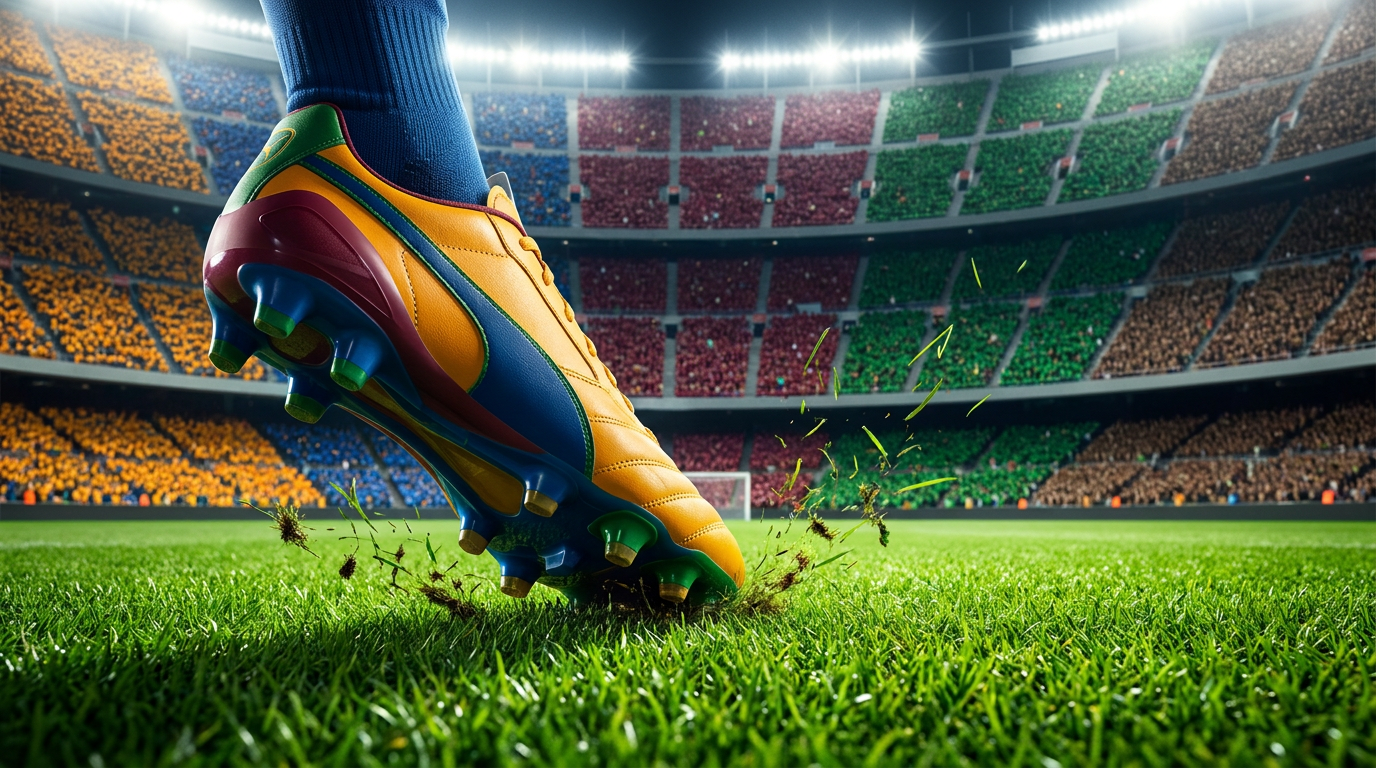
The fLEX machine is a remarkable piece of diagnostic equipment that features a 3D-printed foot, meticulously modeled after human anatomy and fitted with a standard professional soccer cleat. This robotic appendage is programmed to precisely simulate the exact biomechanical impact of a 168-pound athlete sprinting, stopping, and cutting across the field. The researchers specifically chose the 168-pound metric because it represents the exact average weight of a professional soccer player calculated across the rosters of the last two men's World Cup tournaments.[2][3]
By repeatedly striking the various test turfs with the fLEX machine, the researchers were able to accurately measure the shear strength of the grass, the depth of the resulting divots, and the rotational friction generated during a sharp turn. This wealth of quantitative data allowed them to meticulously tweak the sand-to-soil ratios and weave synthetic root reinforcement fibers into the ground until the turf provided the absolute perfect balance of grip and release. This balance is critical: the grass must hold firm enough to allow for explosive sprints, but give way just enough to protect players' ACLs from tearing when their cleats get caught in the turf.[2][3]

Despite the complexities of the outdoor venues, the most daunting challenge for the agronomy team has undoubtedly been the five indoor stadiums. Natural grass fundamentally requires abundant, direct sunlight to photosynthesize, generate energy, and recover from the severe cellular damage inflicted during a professional soccer match. Inside a massive, enclosed concrete dome, the grass is effectively starved of its most vital resource, creating an incredibly hostile environment for a living organism that is expected to perform flawlessly on global television.[4]
To keep the turf alive and actively growing, these indoor venues are being equipped with massive, industrial arrays of artificial LED grow lights that hover just feet over the field whenever the stadium is empty. The agronomy teams must carefully and continuously monitor the highly sensitive microclimates inside the domes. By perfectly balancing the ambient humidity, the artificial airflow generated by massive fans, and the specific spectrums of artificial light, the scientists are effectively tricking the grass into believing it is thriving outdoors in the middle of summer.[4]
The sheer logistical scale of the entire operation is staggering to comprehend. The sod for the 16 stadiums is meticulously grown at specialized, highly secure turf farms located across the continent. When it is time for installation, the grass is harvested and transported in massive, refrigerated rolls, requiring incredibly precise logistical timing to ensure the living plants do not suffocate or die in transit. Once the rolls are finally installed inside the stadiums, the root systems must be given enough time to seamlessly knit together, forming a flawless, unyielding carpet that will not shift under the weight of the players.[3]
While the immediate, high-pressure goal is delivering a flawless playing surface for the 2026 World Cup, the researchers are equally focused on the long-term, lasting legacy of their unprecedented work. The massive $3.8 billion investment into the tournament's infrastructure and turfgrass science is already yielding significant dividends that extend far beyond the realm of elite professional soccer. The scientific breakthroughs achieved in Knoxville and East Lansing are actively being compiled into open-source databases and certificate programs designed to educate the next generation of agronomists.[1][3]

The highly resilient, drought-resistant grass varieties, the advanced sand-based drainage techniques, and the non-toxic root reinforcement systems developed specifically for the tournament are already being adapted for widespread public use. According to leadership at the University of Tennessee Institute of Agriculture, these cutting-edge innovations will soon trickle down to benefit local communities. The exact same science used to protect international soccer stars will eventually be utilized to maintain municipal parks, high school football fields, and public golf courses across the country, making high-quality green spaces more accessible.[1][4]
By making high-performance natural grass significantly easier and cheaper to maintain in challenging climates, this research could help local communities transition away from their reliance on artificial turf. In recent years, synthetic fields have drawn intense scrutiny from public health officials and environmentalists alike, as they have been heavily linked to higher rates of lower-body injuries, severe heat retention during the summer months, and growing environmental concerns regarding the runoff of microplastics and toxic chemicals into local water supplies.[4]
As the historic tournament finally kicks off and the eyes of the world turn to North America, the ultimate measure of success for Sorochan, Rogers, and their dedicated army of agronomists will ironically be complete and total invisibility. If the billions of passionate fans watching around the globe spend the entire month marveling at the spectacular goals, the dramatic saves, and the heartbreak of penalty shootouts, without ever once noticing the meticulously engineered grass beneath the players' feet, the scientists will know they have successfully won their own quiet World Cup.[3][5]
How we got here
2018
FIFA enlists turfgrass experts from the University of Tennessee and Michigan State to begin research.
2021
A formal five-year project is initiated to produce optimum playing surfaces for all 16 stadiums.
2025
The turf systems are tested during the inaugural FIFA Club World Cup held in the United States.
June 2026
The 2026 FIFA World Cup kicks off, putting the eight years of agronomic research to the ultimate test.
Viewpoints in depth
Agronomists & Turf Scientists
Focused on the biological and biomechanical challenges of standardizing a living surface.
For the researchers at the University of Tennessee and Michigan State, the World Cup is the ultimate stress test for modern agronomy. Their primary concern is player safety and biomechanical consistency. By engineering the fLEX machine to simulate cleat strikes, they are prioritizing shear strength and rotational friction—ensuring that a player's foot releases from the turf before a ligament tears. To them, the tournament is a massive, high-stakes laboratory that proves natural grass can outperform synthetic alternatives even in hostile indoor environments.
FIFA & Tournament Organizers
Focused on standardizing the global game and ensuring a flawless broadcast.
FIFA's mandate is absolute uniformity. With 104 matches broadcast to an estimated 5 billion viewers, the governing body cannot afford for a pitch to tear up, flood, or look visually patchy on television. Organizers view the $3.8 billion investment in turf science as an insurance policy against the logistical nightmare of hosting a tournament across three massive countries. Their goal is for the grass to be completely invisible to the viewer, serving only as a perfect, unyielding canvas for the sport.
Environmental & Legacy Advocates
Focused on how elite sports research benefits local communities.
Advocates for public parks and youth sports see the World Cup's turf research as a catalyst for local infrastructure. Synthetic turf fields, while cheap to maintain, have drawn increasing scrutiny over heat retention, microplastic pollution, and injury rates. By developing drought-resistant natural grasses and highly efficient sand-based drainage systems, the World Cup research is creating a blueprint for municipalities to affordably maintain safe, natural grass fields for everyday citizens.
What we don't know
- How perfectly the indoor grass will hold up during the final weeks of the condensed 40-day tournament schedule.
- Whether the cost of maintaining these advanced vacuum-ventilated pitches will be sustainable for the stadiums after the World Cup concludes.
Key terms
- Agronomy
- The science of soil management and crop production, applied here to the specialized cultivation of sports turf.
- Sand Root Zone
- A highly engineered layer of sand beneath the grass that allows for rapid water drainage and deep root growth.
- Shear Strength
- The ability of the grass and soil to resist the lateral force of a player's cleat without tearing.
- Warm-Season Grass
- Grass species, like Bermuda grass, that thrive in hot climates and go dormant in cooler temperatures.
- Cool-Season Grass
- Grass species, like Kentucky bluegrass, that grow best in temperate climates and struggle in extreme heat.
Frequently asked
Why doesn't FIFA just use artificial turf?
FIFA mandates natural grass for the World Cup due to player safety concerns, as artificial turf is associated with higher rates of joint injuries and severe heat retention.
How do they grow grass in indoor stadiums?
Indoor venues use massive arrays of artificial LED grow lights and specialized climate control systems to simulate sunlight and optimal growing conditions.
Will the grass be the same in every city?
While the exact species of grass varies by climate—Bermuda in the south, bluegrass in the north—the underlying sand and drainage systems are engineered to make them feel and play identically.
Sources
Source coverage
5 outlets
3 viewpoints surfaced





[1]University of Tennessee Institute of AgricultureAgronomists & Turf Scientists
Ready. Set. FIFA WORLD CUP 26!
Read on University of Tennessee Institute of Agriculture →[2]NPREnvironmental & Legacy Advocates
John Sorochan explains the agronomic feat needed for a perfect FIFA World Cup grass pitch
Read on NPR →[3]USGAFIFA & Tournament Organizers
Creating the Perfect Pitch for the 2026 FIFA World Cup With Dr. John Sorochan
Read on USGA →[4]GCM OnlineAgronomists & Turf Scientists
Turfgrass researchers' work will take center field at the FIFA World Cup
Read on GCM Online →[5]Factlen Editorial TeamEnvironmental & Legacy Advocates
Synthesis by Factlen editorial team
Read on Factlen Editorial Team →
Every angle. Every day.
Get science stories with full source coverage and perspective breakdowns delivered to your inbox.