
Global Shutter vs. Rolling Shutter: How the New Sensor Tech is Changing Photography
A new generation of camera sensors is eliminating motion distortion and video 'jello' by capturing every pixel simultaneously. Here is how global shutter technology works and why it matters for the future of hybrid cameras.
By Factlen Editorial Team
- Action & Sports Photographers
- Value extreme speed, zero distortion, and blackout-free bursts above all other metrics.
- Cinematographers & Videographers
- Prioritize the eradication of the 'jello effect' during fast pans and the elimination of banding under artificial LED lights.
- High-Resolution & Studio Shooters
- Remain cautious about the slight dynamic range trade-offs, preferring maximum image quality over extreme speed.
- Tech Analysts & Forecasters
- View global shutter technology as the inevitable future baseline for all hybrid cameras once manufacturing costs decrease.
What's not represented
- · Smartphone Manufacturers
- · Casual Hobbyists
Why this matters
For decades, digital cameras have suffered from invisible motion distortion caused by scanning images line-by-line. The arrival of global shutters means consumers and pros alike can finally capture perfectly frozen, distortion-free action and video.
Key points
- Global shutter sensors capture every pixel simultaneously, eliminating the motion distortion caused by traditional rolling shutters.
- The technology eradicates the 'jello effect' in video, making fast pans and action shots perfectly stable.
- Photographers can now sync external flashes at any shutter speed, removing the need for power-draining High-Speed Sync.
- Early global shutter cameras prioritize extreme speed over maximum dynamic range, making them ideal for sports and wildlife.
- As manufacturing costs decrease, global shutter technology is expected to become the new baseline for enthusiast and professional cameras.
For decades, the digital camera industry has been locked in a race for megapixels, autofocus intelligence, and low-light performance. But beneath the surface, a fundamental compromise has quietly governed how every consumer camera captures the world. This compromise is known as the rolling shutter, a mechanism that reads light sequentially rather than instantaneously.[3][8]
Now, a profound shift is rewriting the rules of photography and videography. The global shutter—a technology previously confined to high-end cinema rigs and industrial machine vision—has officially arrived in the mainstream mirrorless market. By capturing every pixel at the exact same fraction of a second, global shutters eliminate motion distortion, eradicate video "jello," and unlock impossible flash synchronization speeds.[2][5][9]
To understand why this matters, one must first understand the invisible flaw in traditional cameras. Most modern sensors, including the one in your smartphone, operate like an office scanner. When you press the shutter, the sensor activates row by row, from top to bottom.[2][9]
This top-to-bottom scan happens incredibly fast—often in mere milliseconds—but it is not instantaneous. Because the bottom of the frame is captured slightly later than the top, fast-moving subjects can shift position during the readout.[9]

The result is the dreaded "rolling shutter effect." Helicopter blades look like bent rubber. A swinging golf club appears curved. A speeding train leans diagonally across the frame. In video, panning the camera quickly causes vertical lines, like buildings or trees, to wobble like gelatin—a phenomenon widely known as the "jello effect."[2][9]
Furthermore, rolling shutters struggle under modern artificial lighting. LED lights and stadium screens often flicker at frequencies invisible to the human eye. When a rolling shutter scans across a flickering light, it captures alternating bands of bright and dark exposure, ruining the image.[4][6]
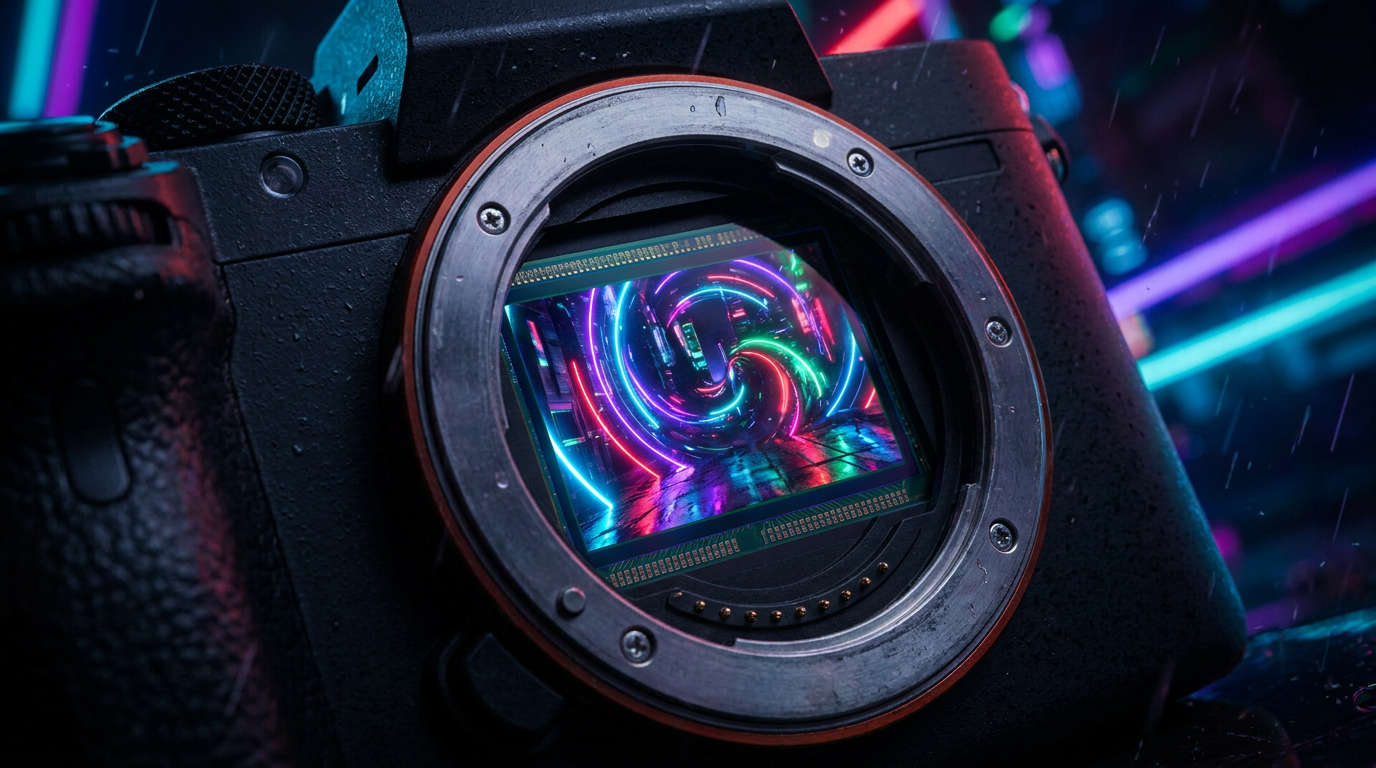
A global shutter solves all of these problems by fundamentally changing the architecture of the sensor. Instead of scanning line by line, a global shutter acts like a true flash of light. Every single pixel on the sensor begins gathering light at the exact same moment, and they all stop at the exact same moment.[1][2]
It is not an approximation of time; it is a perfect slice of it. To achieve this, manufacturers must build a tiny memory node directly into every pixel. When the exposure ends, the charge from all millions of pixels is instantly stored in these nodes, freezing the scene before the camera's processor reads the data.[8]

It is not an approximation of time; it is a perfect slice of it.
The implications for action and sports photography are staggering. The Sony a9 III, the first full-frame mirrorless camera to feature this technology, can shoot 120 frames per second in full 14-bit RAW without a single warped tennis racket or bent baseball bat.[4][7]
For videographers, the global shutter is equally transformative. Filmmakers can mount cameras to fast-moving vehicles, drones, or gimbals without worrying about motion skew. Panning across a scene feels mechanically precise, and shooting in arenas with complex LED lighting no longer requires frantic adjustments to avoid banding.[4][9]
Beyond freezing motion, the global shutter completely rewrites the rules of flash photography. Traditional cameras use mechanical shutter curtains, which limit the maximum flash synchronization speed—usually around 1/250th of a second.[1][3]
If a photographer wants to use a faster shutter speed to darken a bright sky, they must use High-Speed Sync (HSS), a workaround that pulses the flash rapidly but drains massive amounts of power. Because a global shutter exposes the entire sensor at once, it can sync with a flash at any speed—even up to a mind-bending 1/80,000th of a second.[1][4]

This allows portrait and commercial photographers to overpower the midday sun using smaller, lighter strobes, opening up entirely new creative possibilities for outdoor lighting.[1]
However, the transition to global shutters is not without its engineering hurdles. Adding memory circuitry to every pixel takes up physical space on the sensor, slightly reducing its light-gathering area.[8]
As a result, early global shutter implementations exhibit a slightly lower base dynamic range and higher base ISO compared to traditional rolling shutter sensors. For landscape photographers or fine-art studio shooters who demand maximum tonal depth, traditional sensors still hold a slight edge.[6][7]
Cost is another factor. Manufacturing these complex stacked CMOS sensors is expensive, keeping early models in the premium professional tier. Yet, the technology is advancing rapidly. Industrial sensor divisions are already producing next-generation global shutter chips capable of 500 frames per second at 12-bit readouts.[5]

Industry analysts predict that as manufacturing yields improve and computational noise reduction advances, global shutters will inevitably trickle down to enthusiast and prosumer camera bodies.[8]
How we got here
Pre-2023
Global shutters are restricted to high-end cinema cameras and industrial machine vision.
Nov 2023
Sony announces the a9 III, the world's first full-frame mirrorless camera with a global shutter.
Spring 2024
The Sony a9 III hits the consumer market, proving the technology works for sports and action.
Mid-2026
Next-generation global shutter sensors begin entering production, promising higher resolutions and 500+ fps capabilities.
Viewpoints in depth
Action & Sports Photographers
Professionals shooting fast motion view the global shutter as a necessary evolution.
For photographers covering the Olympics, motorsports, or erratic wildlife, the global shutter is a revelation. By eliminating the rolling shutter effect, these shooters no longer have to discard images because a golf club bent unnaturally or a baseball warped mid-flight. The ability to shoot at 120 frames per second without viewfinder blackout means they never miss the decisive moment, making the slight trade-off in dynamic range entirely worth it.
Cinematographers & Videographers
Filmmakers value the technology for its ability to stabilize motion and handle complex lighting.
In the video world, the 'jello effect' has been a persistent headache since the dawn of DSLR filmmaking. Global shutters allow videographers to pan aggressively or mount cameras to vibrating drones without the footage turning to gelatin. Furthermore, the technology completely ignores the flickering of cheap LED lights and stadium screens, saving hours of post-production work that would otherwise be spent trying to remove ugly horizontal banding from the footage.
High-Resolution & Studio Shooters
Landscape and fine-art photographers remain cautious about the technology's current limitations.
While sports photographers celebrate the speed, studio and landscape shooters are less eager to adopt early global shutter models. Because the sensor requires dedicated memory circuitry for every pixel, the light-gathering area is slightly reduced. This results in a higher base ISO and slightly less dynamic range than traditional sensors. For photographers who prioritize pulling maximum detail out of shadows in a static landscape, the traditional rolling shutter still reigns supreme.
What we don't know
- When global shutter technology will become affordable enough for entry-level consumer cameras and smartphones.
- How quickly engineers can close the slight dynamic range gap between global shutters and traditional rolling shutters.
- Whether upcoming flagship cameras from Nikon and Canon will fully adopt global shutters or stick to ultra-fast rolling shutters.
Key terms
- Global Shutter
- A sensor technology that exposes and reads every pixel simultaneously, capturing a perfect slice of time.
- Rolling Shutter
- The traditional sensor method that scans an image line-by-line from top to bottom, which can cause motion distortion.
- Jello Effect
- A visual artifact caused by rolling shutters where fast-moving objects appear warped, skewed, or bent.
- High-Speed Sync (HSS)
- A flash technique used with rolling shutters that pulses light to match fast shutter speeds, often losing significant power.
- Stacked CMOS
- A sensor design that layers memory and processing directly behind the pixels for ultra-fast data readout.
Frequently asked
Will a global shutter improve my everyday photography?
For static subjects like landscapes or portraits, you likely won't see a difference. The technology primarily benefits fast action, video panning, and advanced flash photography.
Why do global shutter cameras cost more?
The sensors are much more complex to manufacture, requiring dedicated memory and circuitry for every single pixel to allow simultaneous readout.
Does global shutter reduce image quality?
Early implementations have a slightly lower base dynamic range and higher base ISO compared to traditional sensors, though the gap is closing rapidly.
Can I get a global shutter in a smartphone?
Currently, smartphones use rolling shutters. Global shutters are still too large, power-hungry, and expensive for mobile devices, though industrial micro-sensors are evolving.
Sources
Source coverage
9 outlets
4 viewpoints surfaced









[1]DPReviewHigh-Resolution & Studio Shooters
What is global shutter: 3 ways it can change photography
Read on DPReview →[2]AdoramaTech Analysts & Forecasters
What is Global Shutter? And How It Works
Read on Adorama →[3]Digital Camera WorldHigh-Resolution & Studio Shooters
What is a global shutter – and why is it so important?
Read on Digital Camera World →[4]SLR LoungeAction & Sports Photographers
Sony A9 III Review | A Global Game-Changer Among Mirrorless Cameras
Read on SLR Lounge →[5]Y.M.Cinema MagazineCinematographers & Videographers
Sony's New Global Shutter Sensor Shoots 4K 12-Bit at 502 FPS
Read on Y.M.Cinema Magazine →[6]MPBAction & Sports Photographers
Review: Sony A9 III | The First Full-frame Camera with Global Shutter
Read on MPB →[7]SheClicksAction & Sports Photographers
Sony A9 III Review
Read on SheClicks →[8]Daisy Looks AheadTech Analysts & Forecasters
The Future of Camera Sensors Explained
Read on Daisy Looks Ahead →[9]CnomadicCinematographers & Videographers
Rolling vs. Global Shutter Explained – How It Affects Your Footage
Read on Cnomadic →


Every angle. Every day.
Get shopping stories with full source coverage and perspective breakdowns delivered to your inbox.