
How Tennis-Court-Sized 'Micro-Forests' Are Cooling Cities and Restoring Urban Nature
Communities worldwide are using a high-density Japanese planting method to grow self-sustaining, ultra-biodiverse forests in small urban spaces up to ten times faster than traditional woodlands.
By Factlen Editorial Team
- Urban Planners & Municipalities
- Focus on micro-forests as highly efficient, nature-based infrastructure for climate adaptation and stormwater management.
- Ecologists & Conservationists
- Focus on restoring authentic native biodiversity, soil microbiology, and accelerating natural ecological succession.
- Community Organizers & Educators
- Focus on tree equity, hands-on environmental education, and localized climate action in nature-deprived neighborhoods.
What's not represented
- · Commercial real estate developers
- · Traditional timber and forestry industries
Why this matters
As cities face record-breaking summer temperatures and biodiversity loss, micro-forests offer a scalable, localized solution. They empower everyday citizens to transform unused concrete spaces into self-sustaining ecosystems that actively cool neighborhoods and absorb floodwaters.
Key points
- Miyawaki micro-forests are densely planted, tennis-court-sized ecosystems designed for urban spaces.
- The method uses 100% native species planted at extreme density to force rapid upward growth.
- These forests grow up to 10 times faster and are significantly more biodiverse than traditional plantations.
- After two to three years of initial weeding and watering, the forests become entirely self-sustaining.
- They act as natural air conditioners and stormwater sponges, mitigating the urban heat island effect.
- Projects are typically community-led, providing hands-on environmental education and green space in concrete-heavy neighborhoods.
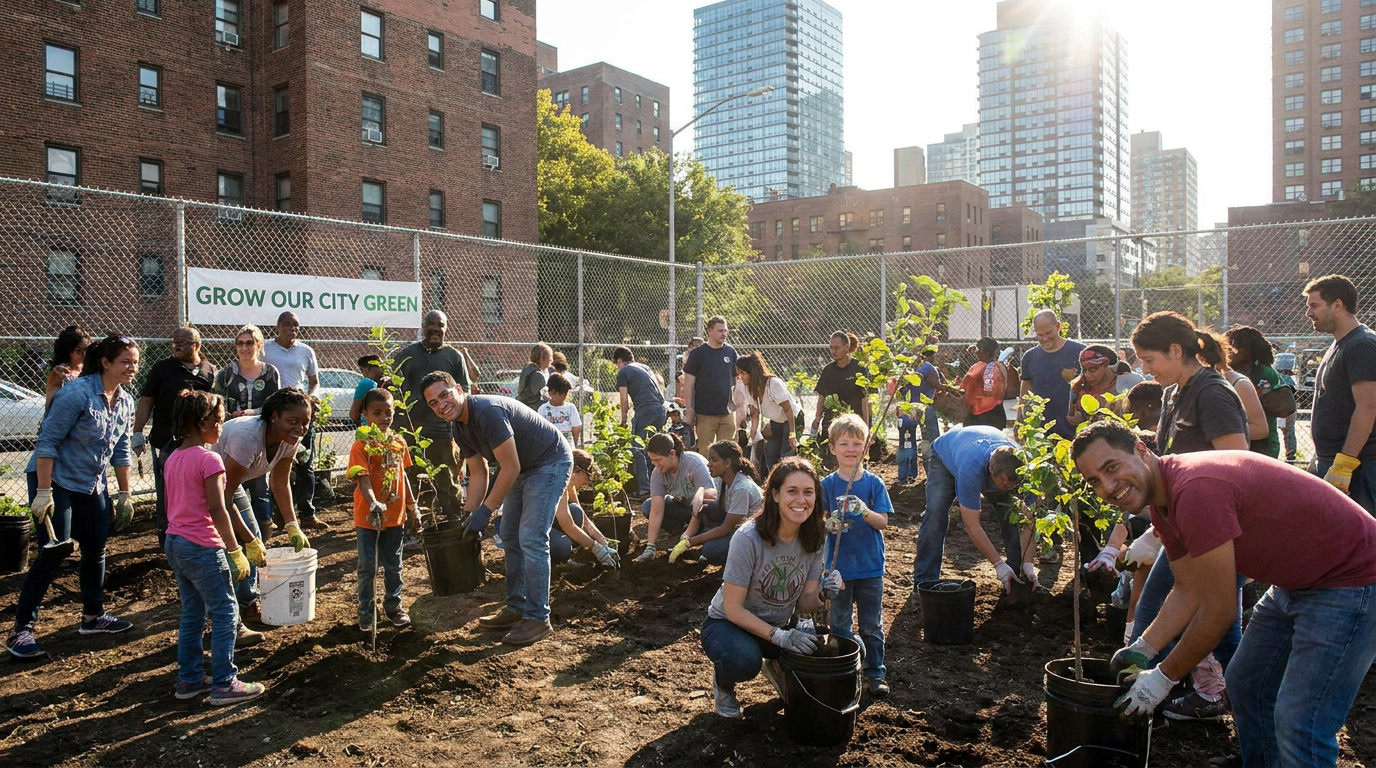
As urban centers grapple with intensifying summer heatwaves and the steady paving over of green spaces, local communities are increasingly turning to a radically efficient form of grassroots climate action. Rather than waiting for massive municipal park overhauls, neighborhood groups are taking matters into their own hands by planting "tiny forests" in the concrete jungle.[8]
Known formally as Miyawaki forests, these dense, pocket-sized woodlands are transforming vacant lots, schoolyards, and former landfills into thriving, self-sustaining ecosystems. Requiring an area no larger than a standard tennis court, they are uniquely suited for the fragmented landscapes of modern cities.[1]
The method was pioneered in the 1970s by the late Japanese botanist Dr. Akira Miyawaki. While studying the landscape, he observed that the protected areas around Japan's ancient temples and shrines contained a rich, resilient mix of native vegetation. This stood in stark contrast to the uniform, non-indigenous timber plantations that dominated the surrounding countryside and often failed to support local wildlife.[1][7]
To replicate this natural resilience, the Miyawaki method relies on a specific, highly structured mechanism. It begins not with the trees, but with the dirt. Urban soil is frequently compacted, degraded, or stripped of its natural nutrients by decades of industrial use or lawn monocultures.[2]

Forest makers first excavate the site and fold in massive amounts of organic biomass—such as compost, mulch, and natural fertilizers—to restore the soil's microbiology. This intensive preparation creates a fungi-dominant, spongy foundation that allows young roots to establish quickly and access vital nutrients.[2][4]
Next comes the rigorous selection of "Potential Natural Vegetation" (PNV). Practitioners consult historical records and local ecologists to identify the exact native species that would have grown in that specific area before human intervention, ensuring the plants are perfectly adapted to the local climate.[2][7]
These native species are then planted at an extreme density—typically three to four saplings per square meter. The selection includes a deliberate, randomized mix of four distinct canopy layers: low-lying shrubs, sub-trees, mature trees, and overarching canopy giants.[2][4]
This extreme density is the engine of the forest's rapid growth. Planted so closely together, the saplings are forced to compete for sunlight. Instead of spreading out laterally, they shoot upward, growing up to ten times faster than trees planted in a conventional, widely spaced plantation.[3][7]

This extreme density is the engine of the forest's rapid growth.
To protect the young ecosystem, the ground is heavily mulched with straw or wood chips. This layer retains moisture, suppresses invasive weeds, and feeds the soil food web as it breaks down. For the first two to three years, the site requires regular watering and weeding by local volunteers.[2][4]
After that three-year mark, a critical threshold is crossed: the forest becomes entirely self-sustaining. The canopy closes, shading out weeds and trapping moisture at the forest floor, while the falling leaves create a natural, ongoing cycle of fertilization that requires zero human intervention.[2][7]
The ecological results of this method are staggering. A mature ecosystem that would normally take 200 years to regenerate naturally can establish itself in just 20 to 30 years using the Miyawaki technique.[1][7]
Because they utilize entirely native, multi-layered species, these micro-forests become absolute magnets for local wildlife. Studies show they can host up to 100 times more biodiversity than monoculture forests, providing vital refuge for pollinators, birds, and amphibians in the heart of the city.[1][3]

Beyond biodiversity, tiny forests act as powerful urban infrastructure. Their dense canopies and transpiring leaves function as natural air conditioners, significantly mitigating the urban heat island effect and providing localized cooling during extreme summer temperatures.[3][4]
They also serve as massive carbon sinks and stormwater sponges. The deep, decompacted soil absorbs heavy rainfall, reducing toxic runoff and preventing neighborhood flooding, while the sheer volume of rapidly growing biomass sequesters carbon at accelerated rates.[3][6]
What makes the Miyawaki movement particularly unique is its reliance on community action. Because these forests can thrive in spaces as small as three square meters, they are uniquely suited for grassroots urban greening initiatives led by neighbors rather than heavy machinery.[1][6]

In Cambridge, Massachusetts, community groups recently planted the northeastern United States' first Miyawaki forest on a former landfill, turning a 4,000-square-foot plot into a living laboratory for climate resilience and tree equity.[4]
In Perth, Australia, schoolchildren are acting as citizen scientists. They use compost generated from their own lunch waste to prepare the soil, plant the native saplings, and track the localized cooling and biodiversity metrics as their schoolyard forest grows.[5]
While the initial cost of soil preparation and high-density sapling procurement can be higher than traditional tree planting, the long-term payoff of a zero-maintenance, high-impact ecosystem is driving global adoption. From European cities to Canadian suburbs, communities are proving that you don't need vast tracts of wilderness to restore the earth—you just need a small patch of dirt and a willingness to let nature take the lead.[1][6][8]
How we got here
1970s
Dr. Akira Miyawaki develops his high-density planting method after studying the resilient native forests surrounding Japanese temples.
2006
Dr. Miyawaki is awarded the Blue Planet Prize for his contributions to global environmental conservation and reforestation.
2015
The tiny forest movement begins gaining significant traction in Europe, with organizations in the Netherlands and Belgium adopting the method for urban spaces.
2021
The first Miyawaki micro-forest in the northeastern United States is planted at Danehy Park in Cambridge, Massachusetts.
2026
The method is now utilized globally, from Australian schoolyards to Canadian suburbs, as a frontline community defense against urban heat.
Viewpoints in depth
Urban Planners' view
Micro-forests are viewed as highly efficient, nature-based infrastructure for climate adaptation.
For city governments and urban planners, the appeal of the Miyawaki method lies in its density and utility. Traditional street trees often struggle in compacted soil and provide limited canopy cover. Micro-forests, however, act as concentrated "sponges" that absorb heavy stormwater runoff and serve as powerful localized air conditioners to combat the urban heat island effect. While the upfront cost per square meter is higher due to intense soil preparation, the lack of maintenance required after three years makes them a highly attractive long-term municipal investment.
Ecologists' view
The method is championed as a way to restore authentic, complex ecosystems rather than just planting trees.
Conservationists emphasize that planting trees is not the same as planting a forest. Traditional afforestation often relies on monocultures of fast-growing, non-native timber species that offer little value to local wildlife. By strictly utilizing "Potential Natural Vegetation" and mimicking the multi-layered structure of ancient woodlands, the Miyawaki method rebuilds the entire soil food web. Ecologists value these pocket forests as vital genetic reservoirs and stepping-stone habitats for pollinators and birds navigating fragmented urban landscapes.
Community Organizers' view
Tiny forests are seen as a tool for environmental justice and community empowerment.
For local organizers, micro-forests are a scalable way to bring nature back to redlined, industrial, or historically under-resourced neighborhoods that suffer from a lack of green space. Because they require only the space of a tennis court, they can be inserted into schoolyards, vacant lots, and community centers. The hands-on nature of the planting process—which relies on volunteer labor rather than heavy machinery—transforms residents from passive observers into active stewards of their local environment, providing profound mental health and educational benefits.
What we don't know
- How the highly dense root systems of Miyawaki forests will interact with aging underground urban utilities over multi-decade timespans.
- Whether the extreme density will make these specific micro-forests more or less susceptible to emerging, climate-driven invasive pests.
Key terms
- Miyawaki Method
- An afforestation technique that involves densely planting a wide variety of native species in enriched soil to rapidly create a self-sustaining forest.
- Potential Natural Vegetation (PNV)
- The specific community of native plants that would naturally exist in a given area if it were free from human intervention.
- Urban Heat Island Effect
- A phenomenon where cities experience much warmer temperatures than surrounding rural areas due to heat-absorbing infrastructure like concrete and asphalt.
- Canopy Layering
- The natural vertical structure of a forest, typically divided into shrubs, sub-trees, mature trees, and an overarching upper canopy.
- Mycorrhizal Fungi
- Beneficial fungi in the soil that form a symbiotic relationship with plant roots, helping them absorb water and nutrients.
Frequently asked
How much space is needed to plant a Miyawaki forest?
A micro-forest can be planted in an area as small as 3 square meters, though a typical community plot is about the size of a tennis court (200 square meters).
Why are the trees planted so close together?
Planting 3 to 4 saplings per square meter forces the plants to compete for sunlight. This competition drives rapid vertical growth, allowing the forest to mature up to 10 times faster than traditional plantings.
Do these forests require a lot of maintenance?
They require regular watering and weeding for the first two to three years. After that, the canopy closes, the ecosystem stabilizes, and the forest becomes entirely self-sustaining.
Can I use any type of tree?
No. The method strictly requires using native species that are naturally adapted to the specific local environment, a concept known as Potential Natural Vegetation.
Sources
Source coverage
8 outlets
3 viewpoints surfaced





[1]World Economic ForumEcologists & Conservationists
Why 'tiny forests' are springing up in cities around the world
Read on World Economic Forum →[2]SUGi ProjectEcologists & Conservationists
How to Grow a Miyawaki Forest
Read on SUGi Project →[3]Earthwatch AustraliaUrban Planners & Municipalities
Tiny Forests: Supercharged Urban Nature
Read on Earthwatch Australia →[4]Biodiversity for a Livable ClimateCommunity Organizers & Educators
Miyawaki Forests: Ecosystem Restoration
Read on Biodiversity for a Livable Climate →[5]UNESCOCommunity Organizers & Educators
Miyawaki Forest school project in Australia
Read on UNESCO →[6]Network of NatureUrban Planners & Municipalities
Mini Forests in Canada
Read on Network of Nature →[7]Creating Tomorrow's ForestsEcologists & Conservationists
The Miyawaki Method for Reforestation
Read on Creating Tomorrow's Forests →[8]Factlen Editorial TeamCommunity Organizers & Educators
Synthesis by Factlen editorial team
Read on Factlen Editorial Team →
Every angle. Every day.
Get community stories with full source coverage and perspective breakdowns delivered to your inbox.