
How Neural Networks Reshaped Human Chess Creativity
Rather than rendering human play obsolete, the rise of neural network chess engines has sparked a renaissance in grandmaster creativity and training.
By Factlen Editorial Team
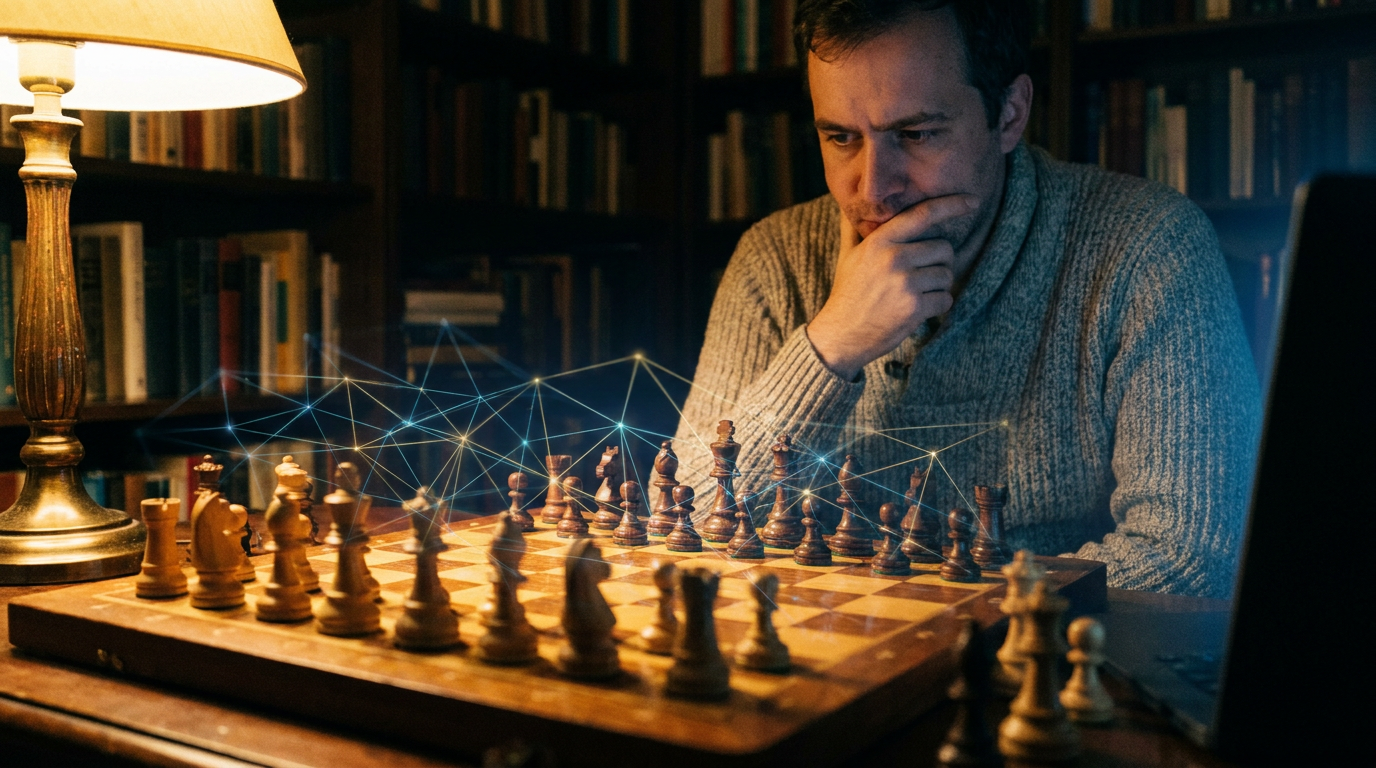
- Human-AI Collaborators
- Advocates for using AI as a tool to expand human intuition while retaining independent thought.
- Algorithmic Purists
- Focuses on the objective truth of the board, embracing 'alien' evaluations that discard traditional heuristics.
- Aesthetic Traditionalists
- Values the subjective beauty, counterintuitive sacrifices, and human drama of the game.
What's not represented
- · Amateur players without access to high-end hardware
- · Classical chess historians
Why this matters
As artificial intelligence permeates every industry, the evolution of chess serves as a hopeful blueprint: it proves that superhuman AI doesn't have to replace human ingenuity, but can instead serve as a collaborative tool that pushes human creativity to unprecedented heights.
Key points
- Neural network engines like AlphaZero and Leela Chess Zero learned chess through self-play, developing an organic, highly creative style.
- Modern engines like Stockfish use a hybrid approach, combining brute-force calculation with neural network evaluation.
- While early AI layers recognize human chess concepts, deeper layers rely on 'alien' mathematical representations to win.
- Top players use the 'sandwich method' to train with AI, ensuring they retain their own human intuition.
- New AI models are being trained specifically to recognize and generate subjectively 'brilliant' and beautiful chess moves.
When computers first surpassed human world champions at chess, purists feared the ancient game would devolve into a sterile exercise in rote memorization. The assumption was that machines, armed with cold calculation, would strip the board of its romance and reduce centuries of strategic theory to a solved mathematical equation. Instead, the exact opposite has occurred. The modern era of chess is defined by an unprecedented explosion of human creativity, driven not by human isolation from technology, but by a profound, evolving partnership with artificial intelligence.[1]
This renaissance began with a fundamental shift in how chess engines "think." For decades, programs like Deep Blue relied on brute-force calculation. They evaluated millions of positions per second using hard-coded heuristics programmed by human grandmasters—assigning fixed point values to pieces and prioritizing traditional concepts like controlling the center of the board. While incredibly powerful, these early engines played a highly mechanical style of chess that rarely surprised top human players with anything other than tactical precision.[6]
The landscape fractured and rebuilt itself with the neural network revolution, spearheaded by DeepMind's AlphaZero and its open-source successor, Leela Chess Zero. Unlike their predecessors, these systems were not taught human heuristics. They learned the game entirely through self-play, starting with only the basic rules and developing their own understanding of strategy through reinforcement learning. By playing billions of games against themselves, they built an intuition that felt shockingly organic.[6]
This unsupervised learning produced a style of play that mesmerized the chess world. The neural networks prioritized long-term piece activity and spatial control over immediate material gain. They routinely sacrificed pawns and even minor pieces for abstract positional advantages that traditional engines—and human grandmasters—initially evaluated as blunders. They demonstrated that the "truth" of chess was far more dynamic and fluid than classical theory had ever suggested.[1][6]

To compete with this new wave of artificial intuition, the world's strongest traditional engine, Stockfish, was forced to adapt. In 2020, its developers integrated an Efficiently Updatable Neural Network (NNUE) into its architecture. This hybrid approach combined the raw, exhaustive calculating power of traditional alpha-beta search with the nuanced, pattern-recognizing evaluation of a neural network. The result was a monumental leap in playing strength and a tool that would change human preparation forever.[6]
Armed with these hybrid engines, top players began discovering "alien" ideas—moves that blatantly violate classical opening principles but hold hidden, profound logic when analyzed twenty moves deep. Grandmasters now routinely employ these engine-approved novelties to drag their opponents into uncharted, highly complex positions where human creativity is forced to shine. The machine does not play the game for them; it acts as a sparring partner that expands the boundaries of what is considered playable.[1]
However, as these AI models become increasingly sophisticated, researchers are discovering that their internal representations of the game are diverging significantly from human thinking. A recent study by researchers at Stanford University and Columbia University analyzed a 270-million-parameter transformer model capable of grandmaster-level play. They sought to understand whether the AI actually comprehends human strategic concepts or merely mimics surface-level patterns to win games.[4]
A recent study by researchers at Stanford University and Columbia University analyzed a 270-million-parameter transformer model capable of grandmaster-level play.
The researchers uncovered a striking paradox in how the neural network processes the board. In its early processing layers, the AI accurately encodes traditional human concepts—such as king safety, center control, and knight outposts—with up to 85 percent accuracy. The machine clearly recognizes the vocabulary that humans have used to describe chess for centuries.[4]
But as the data moves deeper into the network's layers to generate the final, optimal move, this conceptual alignment drops precipitously to between 50 and 65 percent. The representations that actually drive the engine's superhuman performance are fundamentally "alien." As the AI optimizes purely for winning, it discards human heuristics in favor of complex, inscrutable mathematical optimizations that defy simple explanation.[4]

This divergence poses a fascinating challenge for the future of human-AI collaboration. If the machine's ultimate logic is incomprehensible, how can humans effectively learn from it? If an engine suggests a brilliant move but cannot explain the strategic narrative behind it in human terms, the player is left to reverse-engineer the machine's intent.[1][4]
Chess professionals have adapted to this reality by developing new, disciplined training methodologies. The goal is to harness the AI's power without becoming overly reliant on its evaluations. A prominent U.S. Women's Chess Champion recently described her approach as the "sandwich method." A player first analyzes a complex position using their own intuition and calculation, forming an independent hypothesis about the best continuation.[2]
Only after exhausting their own mental resources do they consult the AI's evaluation to see what tactical resources or long-term plans they missed. Finally, they return to their own thinking to synthesize the takeaways, ensuring that the machine's insights are translated into human-readable concepts they can actually remember and apply in a high-pressure tournament game. This prevents the "sycophancy" of simply nodding along to the engine's top choice.[2]

Beyond simply finding the strongest moves, the next frontier of chess AI involves teaching machines to understand the subjective beauty of the game. Researchers at the University of Toronto recently developed a neural network specifically designed to recognize moves that humans perceive as "brilliant" or highly creative. Rather than just maximizing win probability, this system analyzes game trees to identify paths that require a player to see far into the future, often involving dramatic, counterintuitive sacrifices.[5]
By training their model on how human players react to specific sequences, the Toronto researchers achieved a 79 percent accuracy rate in predicting whether a move would be celebrated for its aesthetic appeal. This breakthrough paves the way for AI training tools that don't just crush human opponents, but actively guide them toward more imaginative and dramatic styles of play.[5]

Similarly, Google DeepMind recently unveiled an AI system capable of generating original, highly creative chess puzzles. Trained on four million positions from the online platform Lichess, the system was rewarded for producing compositions that were both unique and counterintuitive. When presented to a panel of renowned human experts, the AI-generated puzzles were praised as elegant and pioneering, proving that machines can contribute to the artistic side of the game.[3]
These developments highlight a crucial shift in the technological landscape. Artificial intelligence is no longer viewed merely as an invincible oracle that dictates the absolute truth of the board. It is rapidly evolving into a nuanced, collaborative tool that can be tuned to enhance human aesthetics, improve training methodologies, and unlock new dimensions of creativity.[1][3]
The early fears that machines would "solve" chess and render human competition obsolete have been thoroughly debunked. Instead, neural networks have vastly expanded the game's frontier. They have proven that the 64 squares still hold infinite mysteries, and that the highest level of mastery is now achieved through the seamless partnership of human intuition and artificial intelligence.[1]
How we got here
1997
IBM's Deep Blue defeats Garry Kasparov using brute-force calculation.
2017
DeepMind's AlphaZero achieves superhuman performance through self-play neural networks.
2020
Stockfish integrates NNUE, combining traditional search with neural network evaluation.
2024
University of Toronto researchers develop an AI that recognizes human-perceived 'brilliant' moves.
2025
Google DeepMind unveils an AI system capable of generating highly creative, original chess puzzles.
Viewpoints in depth
Human-AI Collaborators
Advocates for using AI as a tool to expand human intuition while retaining independent thought.
This camp, which includes many top competitors and trainers, views AI not as an oracle but as a high-powered sparring partner. They emphasize methodologies like the 'sandwich method'—where a player analyzes a position manually, consults the engine, and then synthesizes the result—to ensure that human creativity remains the driving force. For them, the engine's value lies in uncovering hidden tactical resources that a human can then weave into a coherent, memorable strategy.
Algorithmic Purists
Focuses on the objective truth of the board, embracing 'alien' evaluations that discard traditional heuristics.
Computer scientists and engine developers in this camp are primarily concerned with maximizing playing strength and finding the absolute mathematical truth of chess. They are comfortable with the fact that deep neural network layers develop 'alien' representations of the game that humans cannot comprehend. To them, if discarding centuries of classical chess theory results in a higher win rate, the AI is functioning exactly as intended, pushing the boundaries of objective performance.
Aesthetic Traditionalists
Values the subjective beauty, counterintuitive sacrifices, and human drama of the game.
This perspective cherishes the artistic and psychological elements of chess. While acknowledging the power of modern engines, they actively seek out AI developments—like the generative puzzle models from DeepMind or the brilliance-recognizing networks from the University of Toronto—that prioritize aesthetic appeal over pure win-rate maximization. They argue that the true magic of chess lies in its ability to surprise and inspire human observers, a quality that brute-force calculation often ignores.
What we don't know
- Whether future AI models will be able to translate their 'alien' deep-layer evaluations into human-readable strategic concepts.
- How the continued evolution of AI will affect the popularity of randomized variants like Chess960.
Key terms
- NNUE
- Efficiently Updatable Neural Network; a hybrid architecture that adds neural network evaluation to a traditional calculating chess engine.
- Reinforcement Learning
- A machine learning training method where an AI learns by playing against itself and being rewarded for winning.
- Centipawn
- A unit of measure in chess engines equal to one-hundredth of a pawn, used to evaluate exactly how favorable a position is.
- Game Tree
- A mathematical representation of all possible future moves and counter-moves from a given position on the board.
- Chess960
- A chess variant where the starting positions of the pieces on the back rank are randomized, eliminating memorized opening theory.
Frequently asked
Did AI ruin competitive chess?
No. While it changed how players prepare, AI has actually led to more dynamic and creative games by uncovering unconventional strategies that humans previously thought were unplayable.
How do grandmasters use AI to train?
Top players use engines as high-level sparring partners to test novel opening ideas and analyze complex positions, often employing the 'sandwich method' to ensure they retain their own human intuition.
Can a computer understand a 'beautiful' chess move?
Historically no, but recent models developed by researchers at the University of Toronto and Google DeepMind have been specifically trained to recognize and generate moves that humans find aesthetically brilliant.
Sources
Source coverage
6 outlets
3 viewpoints surfaced






[1]Factlen Editorial TeamHuman-AI Collaborators
Synthesis by Factlen editorial team
Read on Factlen Editorial Team →[2]TIMEHuman-AI Collaborators
What Playing Chess With AI Taught Me About Humanity
Read on TIME →[3]Chess.comAesthetic Traditionalists
DeepMind's New AI Generates 'Beautiful, Counterintuitive' Chess Puzzles
Read on Chess.com →[4]arXivAlgorithmic Purists
Do AI systems truly understand human concepts or merely mimic surface patterns?
Read on arXiv →[5]University of TorontoAesthetic Traditionalists
U of T researchers design a chess AI that understands human creativity
Read on University of Toronto →[6]ChessProgramming.orgAlgorithmic Purists
Neural Networks in Chess Programming
Read on ChessProgramming.org →

More in sports
See all 7 stories →Sports Biomechanics
How Markerless Motion Capture and AI Are Extending Athlete Careers
7 sources

Snowboard Tech
The 1620 Era: How Women's Snowboarding Shattered the Spin Barrier
5 sources

US Cricket
How Major League Cricket's 2026 Season is Reshaping the American Sports Landscape
6 sources
UWCL Format
How the New 18-Team Format is Transforming the UEFA Women's Champions League
6 sources

Every angle. Every day.
Get sports stories with full source coverage and perspective breakdowns delivered to your inbox.