
The End of Isolation: How Open-Ear Audio is Rewriting the Headphone Rulebook
A new generation of 'open-ear' earbuds is prioritizing situational awareness and auditory health over noise cancellation, fundamentally changing how we listen.
By Factlen Editorial Team
- Hybrid Workers & Everyday Listeners
- Seek a middle ground of all-day comfort, ear health, and decent sound without being isolated.
- Outdoor Athletes & Cyclists
- Value maximum situational awareness and secure fit above all else, favoring bone conduction.
- Audiophiles & Commuters
- Prioritize high-fidelity sound and active noise cancellation to block out the world.
What's not represented
- · Hearing Aid Manufacturers
- · Acoustic Engineers
Why this matters
Prolonged use of sealed earbuds has been linked to ear fatigue, bacterial infections, and dangerous losses of situational awareness. The shift toward open-ear technology offers a healthier, safer way to consume audio without disconnecting from the physical world.
Key points
- Open-ear earbuds sit outside the ear canal, allowing ambient noise to mix with audio.
- The design significantly improves safety for pedestrians and cyclists by maintaining situational awareness.
- Unsealed designs promote better ear health by reducing pressure and preventing moisture buildup.
- Bone conduction bypasses the eardrum entirely, while newer air conduction uses directional speakers.
- Air conduction models offer richer bass and a wider soundstage than traditional bone conduction.
- Open-ear models lack passive isolation, making them less ideal for extremely noisy environments.
The headphone industry is undergoing a quiet but profound revolution. For the past decade, the gold standard of personal audio was total isolation. Manufacturers raced to develop the most powerful Active Noise Cancellation (ANC) algorithms, designing silicone-tipped earbuds that sealed the listener off from the chaotic outside world.[1]
But a growing contingent of consumers, outdoor athletes, and hybrid workers are pushing back against this "sealed-off" paradigm. Enter the "open-ear" earbud, a rapidly maturing form factor designed to invite the world back in, prioritizing situational awareness and physical comfort over absolute acoustic isolation.[1][7]
Unlike traditional earbuds that plug directly into the ear canal, open-ear devices sit entirely outside the ear. They allow ambient sounds—the rumble of approaching traffic, a colleague asking a question, or the rustle of wind in the trees—to mix freely with the user's music or podcast.[2][7]
The shift is driven in large part by safety concerns. The World Health Organization reports over 1.3 million road deaths annually, and urban safety advocates increasingly point to the dangers of pedestrians and cyclists navigating busy streets with impaired hearing. Open-ear technology directly addresses this hazard by keeping the listener anchored to their physical environment.[7]

Beyond physical safety, there is a mounting focus on auditory health. Prolonged use of in-ear monitors can cause significant ear fatigue and pressure buildup. Furthermore, sealing the ear canal traps moisture and earwax, which can increase the risk of bacterial infections and painful irritations over time.[7]
By leaving the ear canal completely unobstructed, open-ear designs promote natural airflow. They eliminate the physical strain of silicone tips pressing against sensitive cartilage, allowing for a healthier, more breathable listening experience that can comfortably last an entire workday.[7]
Historically, the open-ear market was dominated almost entirely by "bone conduction" technology. Pioneered for the mass consumer market by brands like Shokz, bone conduction takes a radical approach to audio delivery by bypassing the eardrum entirely.[3][8]
Instead of projecting sound waves through the air, bone conduction devices rest firmly on the user's cheekbones. They translate audio signals into micro-vibrations, sending them directly through the skull into the inner ear (the cochlea), where the brain interprets them as sound.[3]
This method is highly secure and leaves the ear 100 percent open, making it the undisputed go-to choice for intense outdoor sports. It is also a transformative technology for individuals with certain types of middle-ear hearing loss, as it circumvents the damaged portions of the ear entirely.[3]
This method is highly secure and leaves the ear 100 percent open, making it the undisputed go-to choice for intense outdoor sports.
However, bone conduction comes with a notable acoustic compromise. Because it relies on vibrating dense bone rather than moving air, it inherently struggles to reproduce deep bass frequencies and the subtle, sparkling nuances of high-fidelity music. For audiophiles, the sound can sometimes feel thin or hollow.[2][8]

To bridge the gap between situational awareness and premium sound quality, audio engineers have developed a newer category: "air conduction" open earbuds. This is the technology driving the current surge in the consumer market, offering a "best of both worlds" approach.[1][2]
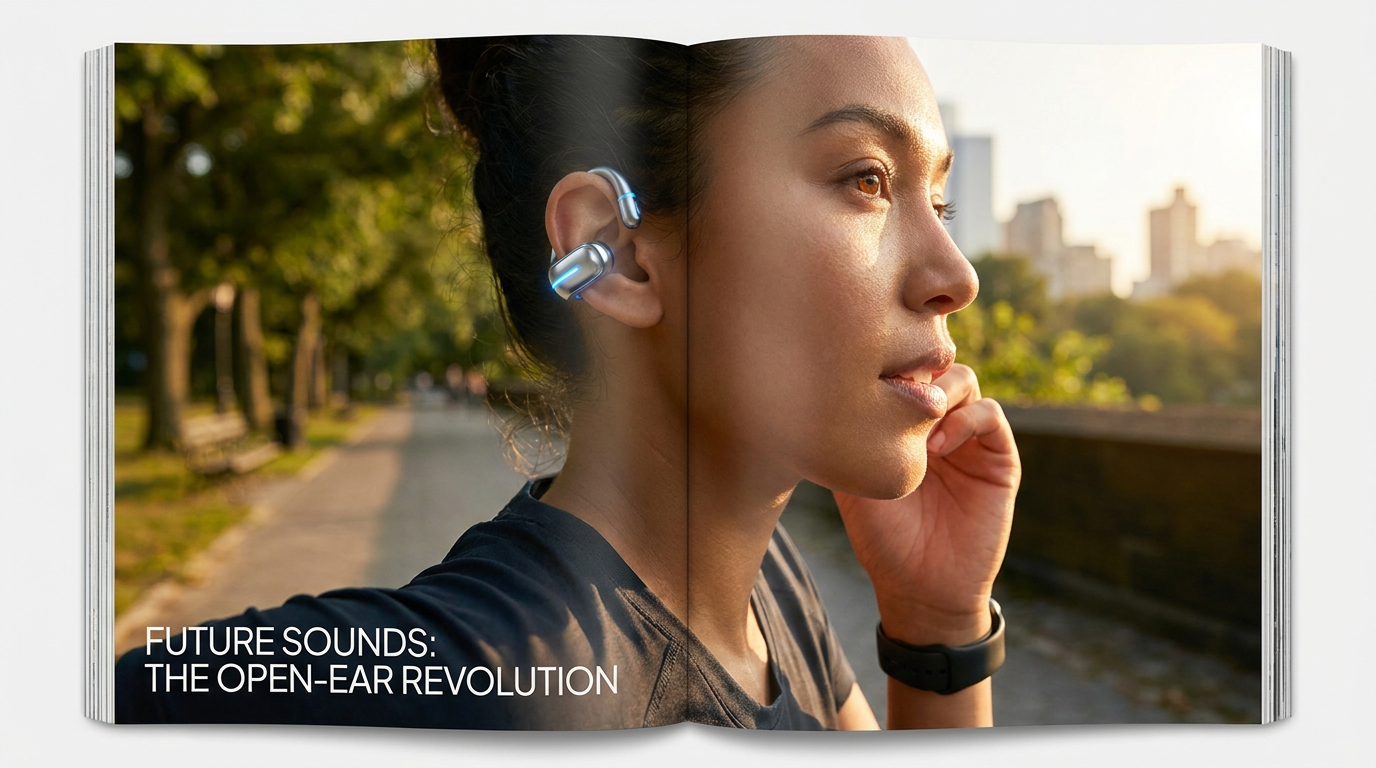
Devices like the Bose Ultra Open Earbuds and the newly announced Sennheiser Accentum Clip use tiny, highly directional speakers. Rather than vibrating the skull, these devices hover just above the ear canal or clip onto the earlobe like a piece of modern jewelry.[4][5][6]
These air conduction buds utilize advanced acoustic algorithms and reverse sound waves to beam audio precisely into the ear canal. This directional focus ensures the music reaches the listener clearly while minimizing "leakage" to the people sitting nearby.[2][6]
The acoustic result is a much wider soundstage and a significantly richer bass response than bone conduction can achieve. Reviewers frequently note that the music feels less like it is playing inside the listener's head and more like it is emanating from the room around them.[5][6]

Bose's implementation, dubbed "OpenAudio," even incorporates spatial audio head-tracking. This creates an immersive, three-dimensional layer of sound that blends seamlessly with the physical environment, elevating the experience beyond simple stereo playback.[5][6]
The physical form factor is also evolving rapidly. While early open-ear models relied on rigid, wrap-around neckbands, the latest air conduction devices look more like futuristic ear cuffs. Sennheiser's new Accentum Clip, for instance, weighs a mere 6.8 grams, making it virtually imperceptible during wear.[4][8]
Despite the massive advancements, open-ear air conduction is not without its trade-offs. In extremely loud environments—such as airplane cabins, subway trains, or active construction sites—the lack of passive isolation means the audio can easily be drowned out by ambient noise.[6]
Furthermore, while the bass response has improved significantly with 10 to 12mm dynamic drivers, it still cannot match the physical, thumping punch of a sealed earbud pushing air directly against a closed eardrum.[6][8]

Yet, for the daily commute, the collaborative hybrid office, or the evening jog, that acoustic trade-off is increasingly viewed as a feature rather than a bug. Listeners are actively choosing connection over isolation.[1][4]
As the technology continues to mature, the binary choice between high-fidelity sound and safe situational awareness is dissolving. Open-ear audio is proving that we don't have to shut the world out just to hear our music clearly.[1]
How we got here
Early 2010s
Bone conduction headphones gain traction among niche athletic communities for their safety benefits.
2023
Major audio brands begin releasing 'air conduction' models, shifting the focus from bone vibration to directional speakers.
Early 2024
Bose launches the Ultra Open Earbuds, popularizing the 'ear cuff' design and spatial audio in open-ear formats.
June 2026
Sennheiser announces the Accentum Clip, further cementing air conduction as a mainstream, high-fidelity category.
Viewpoints in depth
The Audiophile Perspective
Focuses on the acoustic limitations of unsealed audio delivery.
Audio purists argue that while open-ear technology has made impressive strides, it fundamentally cannot defy physics. Without a physical seal to trap air pressure, sub-bass frequencies are inherently compromised, and the intricate details of high-fidelity tracks can be lost to ambient noise. For critical listening, mastering, or commuting in highly noisy environments like airplanes, this camp maintains that Active Noise Cancellation (ANC) and a tight in-ear seal remain absolutely essential.
The Safety & Fitness Perspective
Emphasizes the life-saving benefits of total situational awareness.
For runners, cyclists, and urban commuters sharing roads with vehicles, blocking out ambient noise is viewed as a critical hazard. This camp champions open-ear designs—particularly bone conduction—for their unwavering environmental transparency. They argue that the ability to hear an approaching siren, a bicycle bell, or a shouted warning far outweighs the desire for a booming bassline during a workout.
The Auditory Health Perspective
Highlights the medical and ergonomic benefits of unsealing the ear canal.
Medical professionals and health-conscious consumers point to the long-term damage caused by traditional earbuds. By eliminating the pressure buildup, moisture trapping, and direct eardrum bombardment of sealed monitors, open-ear designs drastically reduce the risk of ear fatigue, tinnitus, and bacterial infections. This camp views the shift toward open audio as a necessary evolution in personal wellness, akin to ergonomic keyboards or blue-light filters.
What we don't know
- Whether air conduction technology can eventually replicate the deep sub-bass response of sealed earbuds.
- How the widespread adoption of open-ear audio will impact long-term rates of noise-induced hearing loss.
- If active noise cancellation (ANC) can ever be effectively integrated into an unsealed, open-ear form factor.
Key terms
- Air Conduction
- The traditional method of hearing where sound waves travel through the air, enter the ear canal, and vibrate the eardrum.
- Bone Conduction
- A technology that bypasses the eardrum by sending audio vibrations directly through the cheekbones or skull into the inner ear.
- Active Noise Cancellation (ANC)
- Technology that uses microphones to listen to external noise and generates inverse sound waves to cancel it out.
- Soundstage
- The perceived spatial location and width of the audio; a wide soundstage makes music feel like it is playing in the room around you.
- Directional Audio
- Acoustic engineering that focuses sound waves in a tight beam toward the ear canal, minimizing how much sound escapes to bystanders.
Frequently asked
Can other people hear my music with open-ear earbuds?
Air conduction earbuds use directional audio and reverse sound waves to minimize leakage. While someone sitting inches away in a quiet room might hear a faint whisper, they are generally discreet enough for office use.
Are open-ear headphones better for my hearing?
They can be. By not sealing the ear canal, they reduce air pressure against the eardrum, prevent moisture buildup that can cause infections, and naturally discourage listening at dangerously high volumes.
Do open-ear earbuds have Active Noise Cancellation?
No. The entire purpose of open-ear headphones is to let ambient sound in. If you need to block out airplane engine noise or loud construction, traditional ANC earbuds are still the better tool.
What is the difference between air and bone conduction?
Air conduction uses tiny speakers to beam sound waves through the air into your ear canal. Bone conduction rests on your cheekbones and sends physical vibrations directly into your inner ear, bypassing the eardrum entirely.
Sources
Source coverage
8 outlets
3 viewpoints surfaced








[1]Factlen Editorial TeamHybrid Workers & Everyday Listeners
Synthesis by Factlen editorial team
Read on Factlen Editorial Team →[2]BoseHybrid Workers & Everyday Listeners
Air Conduction vs. Bone Conduction: What's the Difference?
Read on Bose →[3]ShokzOutdoor Athletes & Cyclists
How Bone Conduction Works
Read on Shokz →[4]ForbesHybrid Workers & Everyday Listeners
Sennheiser Introduces Accentum Clip Open-Ear Earbuds
Read on Forbes →[5]TechRadarHybrid Workers & Everyday Listeners
Bose Ultra Open Earbuds review
Read on TechRadar →[6]PCMagAudiophiles & Commuters
Bose Ultra Open Earbuds Review
Read on PCMag →[7]QCYHybrid Workers & Everyday Listeners
Open-Ear Earbuds Explained
Read on QCY →[8]CNETOutdoor Athletes & Cyclists
Shokz OpenFit Earbuds Aren't Bone-Conduction Headphones -- and They're Better for It
Read on CNET →


Every angle. Every day.
Get shopping stories with full source coverage and perspective breakdowns delivered to your inbox.