
Induction vs. Gas Stoves: The 2026 Upgrade Guide
As induction technology reaches mainstream adoption, homeowners face a critical choice between electromagnetic efficiency and traditional gas combustion. Here is the definitive breakdown of speed, health impacts, and hidden installation costs.
By Factlen Editorial Team
- Efficiency & Health Advocates
- Prioritize indoor air quality, climate impact, and raw cooking speed.
- Budget-Conscious Upgraders
- Weigh the long-term energy savings against the high upfront costs of electrical retrofits.
- Culinary Traditionalists
- Value the tactile control, visual feedback, and versatility of an open flame.
What's not represented
- · Renters unable to modify their kitchens
- · Landlords weighing appliance costs
Why this matters
Choosing the right stove impacts your daily cooking speed, your home's indoor air quality, and your long-term energy bills. Understanding the hidden costs of electrical upgrades versus the respiratory risks of unvented gas ensures you make a financially and physically healthy investment.
Key points
- Induction cooktops transfer up to 90% of their energy directly to the food, boiling water significantly faster than gas.
- Gas stoves lose roughly 60% of their heat to the surrounding air, making kitchens hotter and wasting energy.
- Unvented gas stoves release nitrogen dioxide and carbon monoxide, increasing the risk of childhood asthma by 42%.
- While induction is cheaper to operate, transitioning from gas often requires a costly 240-volt electrical panel upgrade.
The American kitchen is in the midst of a generational transition, moving away from the century-old dominance of the blue flame. In 2026, the debate between gas and induction cooktops has evolved from a niche environmental talking point into a mainstream performance showdown. For homeowners planning a renovation or replacing a dying appliance, the choice is no longer just about aesthetics; it is a fundamental decision about indoor air quality, cooking speed, and long-term energy costs. This side-by-side trade-off analysis examines the hard data behind both technologies, cutting through the marketing to reveal where each stove genuinely excels. By weighing the upfront financial hurdles against the daily operational benefits, consumers can make an informed upgrade that aligns with their cooking habits and household needs.[7]
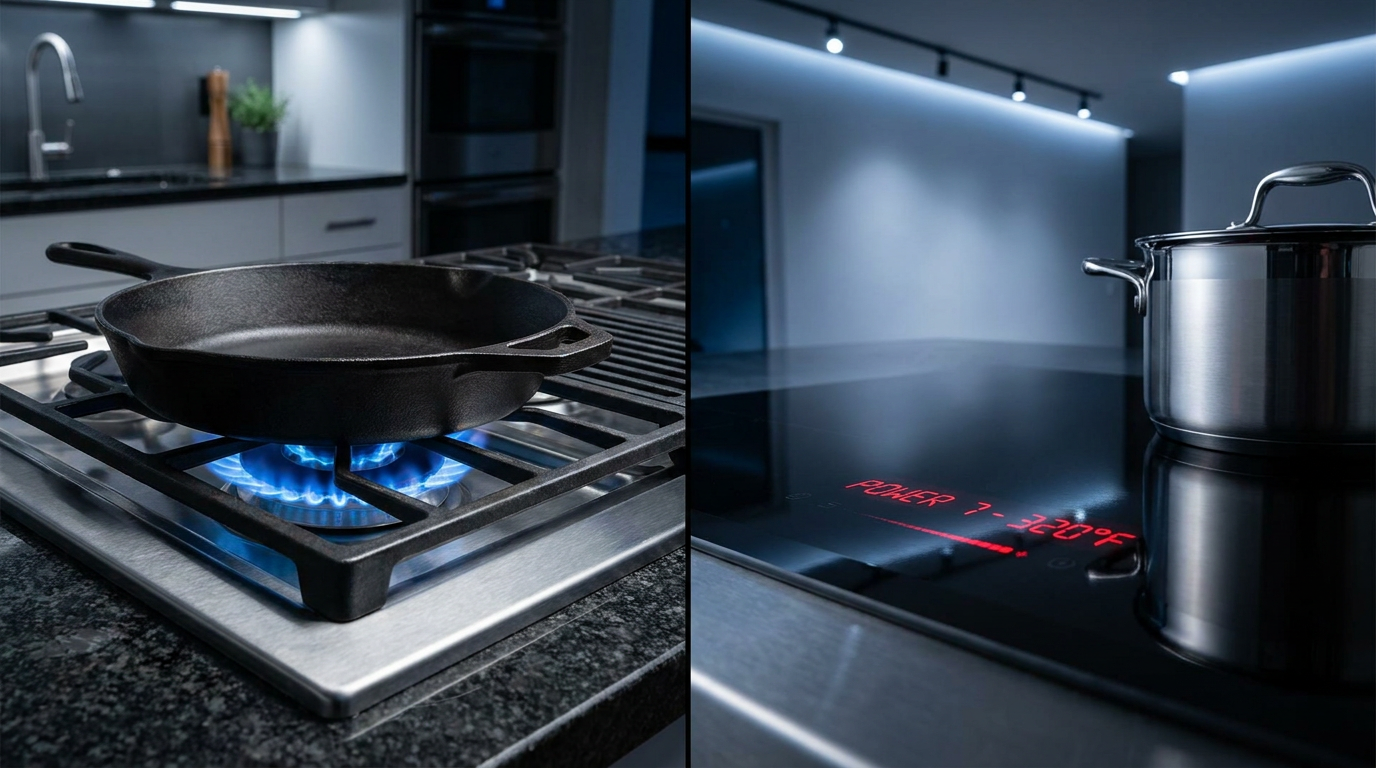
Understanding the divide begins with the underlying physics of how each stove generates heat. Gas ranges rely on traditional combustion, igniting natural gas to create an open flame that heats the air, the heavy iron grates, and eventually the cookware resting on top. Induction, by contrast, uses tightly wound copper coils beneath a smooth glass surface to generate an oscillating electromagnetic field. This field induces an electrical current directly inside ferromagnetic pots and pans, turning the cookware itself into the heat source while the glass surface remains relatively cool. Because it bypasses the need to heat the surrounding environment, induction represents a fundamental shift in thermal engineering.[2]
The argument for induction centers heavily on raw thermal efficiency and speed. The evidence shows that electromagnetic fields transfer up to ninety percent of their energy directly into the food being cooked. Gas stoves, meanwhile, operate at roughly thirty-two to forty percent efficiency, with the majority of the heat escaping around the sides of the pan and dissipating into the kitchen air. This massive efficiency gap translates directly into measurable cooking speed. In standardized testing, an induction range successfully boiled sixty ounces of water in just five minutes, significantly outpacing the eight minutes required by a high-end gas equivalent.[2][4][6]

The argument for gas relies on tactile control, culinary tradition, and versatility. The evidence from professional and home kitchens alike shows that gas provides instant visual feedback; a cook can glance at the height of the blue flame and immediately gauge the heat level without needing to read a digital display. Furthermore, gas excels at specific techniques that flat glass surfaces struggle to replicate. Charring peppers directly on the open grates, tossing food in a round-bottomed wok where the flames lick the sides of the pan, or tilting a skillet to baste a steak without losing the heat source are all maneuvers where gas remains the undisputed champion.[3][4]
However, the argument against gas regarding precision is gaining traction as digital technology improves. The evidence indicates that while gas offers intuitive visual cues, high-end induction units provide unparalleled mathematical precision. Modern induction cooktops can hold exact temperatures—such as a steady two hundred and nine degrees for a delicate custard or simmer—without the risk of a low flame flickering or blowing out in a draft. Additionally, because induction does not heat the surrounding air, professional kitchens are increasingly adopting the technology simply to keep their staff from sweltering during busy dinner services, proving that the culinary industry is slowly rethinking its reliance on fire.[3]
However, the argument against gas regarding precision is gaining traction as digital technology improves.
The most urgent argument against gas is increasingly rooted in health and environmental data. The evidence, highlighted by federal agencies and respiratory health organizations, links unvented gas stoves to severe indoor air quality degradation. Burning natural gas indoors releases a cocktail of combustion byproducts, including nitrogen dioxide, carbon monoxide, and trace amounts of benzene. Meta-analyses of these emissions have linked homes with gas stoves to a forty-two percent increased risk of childhood asthma, comparing the respiratory impact of an unvented kitchen to living in a home with a cigarette smoker.[1][5]

While a high-quality, externally vented range hood can mitigate many of these respiratory risks, the evidence shows that the vast majority of American homes lack adequate, code-compliant ventilation that actually exhausts air to the outside. Induction completely eliminates these point-of-use emissions, offering a zero-combustion cooking environment. This health benefit is increasingly becoming the deciding factor for families with young children or individuals with respiratory sensitivities. The total elimination of indoor methane and nitrogen dioxide has even prompted some municipalities to mandate electric or induction hookups in all new residential construction.[2][5]
The argument for induction also extends to physical safety features that gas inherently cannot match. Because the glass cooktop only warms residually from contact with the hot pan, the risk of severe burns is drastically reduced. If a burner is accidentally turned on without a compatible pot in place, the electromagnetic field generates absolutely no heat. Features like automatic pan detection, child safety locks, and automatic shutoffs make induction the safest choice for households with curious toddlers or aging residents who might accidentally leave a burner running.[1][7]
The primary argument against induction usually focuses on the financial barrier to entry and equipment compatibility. The evidence indicates that while the cooktops themselves are dropping in price, a mid-tier induction range still commands a premium, typically costing between one thousand and two thousand dollars, compared to reliable gas models that can be found for under a thousand. Furthermore, induction requires ferromagnetic cookware. While cast iron and most stainless steel work perfectly, homeowners with extensive, expensive collections of aluminum, glass, or pure copper pans face the hidden cost of replacing their kitchen arsenal just to use the new stove.[4]

The most substantial hidden cost, however, lies in the electrical infrastructure required to power the appliance. Transitioning from a gas line to an induction range often requires a dedicated forty-amp or fifty-amp, two-hundred-and-forty-volt circuit. For older homes, this can necessitate a complete electrical panel upgrade, adding anywhere from one thousand to three thousand dollars to the installation bill. While federal rebates under the Inflation Reduction Act can offset some of these costs, the upfront investment remains a significant hurdle for budget-conscious upgraders who already have a functioning gas line installed.[7]
When evaluating daily maintenance and cleanup, the evidence swings heavily back in favor of the electromagnetic option. Cleaning a gas stove is a notoriously tedious chore, requiring the removal of heavy cast-iron grates and the careful scrubbing of intricate burner caps to remove baked-on grease and food debris. An induction cooktop is a single, flat sheet of ceramic glass. Because the surface itself does not get hot enough to instantly carbonize and bake on accidental spills, cleaning usually requires nothing more than a quick wipe with a damp microfiber cloth after the meal is done.[4]

Ultimately, the 2026 landscape reveals a clear divergence in utility, requiring buyers to weigh upfront costs against long-term health and efficiency. Induction is rapidly winning the performance and safety metrics, offering a cleaner, faster, and more precise cooking experience. Gas remains a viable option for those who prioritize tactile culinary traditions or need to avoid the steep costs of electrical retrofitting. As the electrical grid becomes cleaner and manufacturing scales, the invisible magnetic field is steadily proving that the future of the American kitchen does not necessarily require a fire.[7]
How we got here
Early 1900s
Gas stoves become the standard in American homes, replacing wood and coal.
1970s
Induction technology is first introduced to the consumer market but fails to gain widespread traction due to high costs.
2022
Major health studies link unvented gas stoves to increased risks of childhood asthma, sparking national debate.
2026
Induction cooktops reach mainstream adoption as prices fall and federal rebates incentivize electric upgrades.
Viewpoints in depth
Induction Upgraders
Homeowners prioritizing speed, safety, and indoor air quality.
This technology fits perfectly when a household wants to eliminate indoor combustion emissions, drastically reduce boiling times, and simplify daily cleanup. It is the ideal choice for families with young children due to the cool-to-the-touch surface and auto-shutoff features. However, it does not fit well when a home requires a multi-thousand-dollar electrical panel upgrade just to plug the stove in, or when a cook refuses to part with a beloved collection of non-magnetic copper or aluminum cookware.
Gas Traditionalists
Cooks who value tactile control, visual feedback, and lower upfront costs.
Gas fits well when a kitchen is already plumbed for it, keeping installation costs low, and when the chef frequently uses techniques like wok tossing or flame-charring that require an open fire. It remains the standard for those who rely on visual cues to gauge heat. It does not fit well when a kitchen lacks high-quality, external ventilation, as the accumulation of nitrogen dioxide and carbon monoxide poses documented respiratory risks, particularly to children.
What we don't know
- Whether the price of mid-tier induction ranges will drop below gas equivalents by the end of the decade.
- How quickly older electrical grids can adapt to the increased load of fully electrified neighborhoods.
Key terms
- Electromagnetic Field
- A physical field produced by electrically charged objects; in induction stoves, it rapidly oscillates to create heat directly inside the metal of the cookware.
- Ferromagnetic
- Materials, such as iron or certain steel alloys, that are highly susceptible to magnetization and are required for an induction stove to function.
- Combustion Byproducts
- The gases and particles, such as nitrogen dioxide and carbon monoxide, released into the air when natural gas is burned.
- Nitrogen Dioxide (NO2)
- A gaseous air pollutant produced by gas stoves that can irritate airways and exacerbate respiratory diseases like asthma.
Frequently asked
Do I need to buy all new pots and pans for induction?
Not necessarily. Induction requires ferromagnetic cookware. If a magnet sticks strongly to the bottom of your current cast iron or stainless steel pans, they will work perfectly. Aluminum, copper, and glass will not work.
Is induction the same as a traditional electric glass-top stove?
No. Traditional electric stoves use radiant heating coils under the glass that get extremely hot and transfer heat slowly. Induction uses electromagnetic fields to heat the pan directly, making it much faster and keeping the glass cooler.
Can I use a wok on an induction cooktop?
Traditional round-bottom woks struggle on flat induction glass because they require heat up the sides. However, flat-bottomed woks work well, and some high-end induction units offer specialized concave wok indentations.
How much does it cost to upgrade my electrical panel for induction?
If your home only has a standard 120V outlet behind the stove, installing a dedicated 40-amp or 50-amp 240V circuit can cost between $1,000 and $3,000, depending on your existing electrical panel's capacity and local labor rates.
Sources
Source coverage
7 outlets
3 viewpoints surfaced







[1]Consumer ReportsEfficiency & Health Advocates
Induction Cooktop Buying Guide
Read on Consumer Reports →[2]U.S. Department of EnergyEfficiency & Health Advocates
The numbers are in: Americans are seeing the benefits of induction appliances
Read on U.S. Department of Energy →[3]WirecutterCulinary Traditionalists
The Best Portable Induction Cooktops
Read on Wirecutter →[4]CNETBudget-Conscious Upgraders
Induction vs. Gas vs. Electric Stoves: Which Is Better?
Read on CNET →[5]The CooldownEfficiency & Health Advocates
Wirecutter reveals its top picks for induction cooktops
Read on The Cooldown →[6]FotileBudget-Conscious Upgraders
Induction vs Gas vs Electric Ranges: 2025 Stats Guide
Read on Fotile →[7]Factlen Editorial TeamBudget-Conscious Upgraders
Synthesis by Factlen editorial team
Read on Factlen Editorial Team →

Every angle. Every day.
Get shopping stories with full source coverage and perspective breakdowns delivered to your inbox.