
SpaceX's Record IPO Triggers a $16 Billion Forced-Buying Event—and an Index Provider Schism
Following its $1.77 trillion public debut, SpaceX is being fast-tracked into major stock indices, forcing passive funds to buy billions in shares. However, the S&P 500's refusal to waive its profitability rules has created a historic divergence in retirement portfolios.
By Factlen Editorial Team
- Fast-Entry Advocates
- Index providers who prioritize immediate representation of mega-cap companies to reflect the real economy.
- Traditional Benchmark Defenders
- Index managers who prioritize financial stability and proven track records over immediate inclusion.
- Valuation Skeptics
- Analysts warning that index mechanics are forcing investors to buy at highly speculative valuations.
- Market Plumbers & Analysts
- Observers focused on the mechanical supply-demand imbalances created by the IPO's low float.
What's not represented
- · Retail investors excluded from IPO allocations
- · Active fund managers forced to compete with passive flows
Why this matters
Trillions of dollars are held in passive index funds, meaning anyone with a 401(k) or pension is about to become a SpaceX shareholder. Understanding how index inclusion forces these funds to buy—and why the S&P 500 is holding out—reveals the hidden plumbing that dictates modern stock market returns.
Key points
- SpaceX's $1.77 trillion IPO has triggered 'fast-entry' rules at major index providers like Nasdaq and FTSE Russell.
- Passive funds tracking these indices are mechanically forced to buy an estimated $10 billion to $16 billion in SpaceX stock.
- To fund these mandatory purchases, index funds must sell equivalent amounts of existing tech holdings.
- S&P Dow Jones Indices refused to waive its rules, meaning SpaceX will not join the S&P 500 until at least mid-2027.
- SpaceX's massive $4.94 billion GAAP net loss in 2025 prevents it from meeting S&P's strict profitability requirements.
- The regulatory split means everyday retirement portfolios will have vastly different exposure to the aerospace giant.
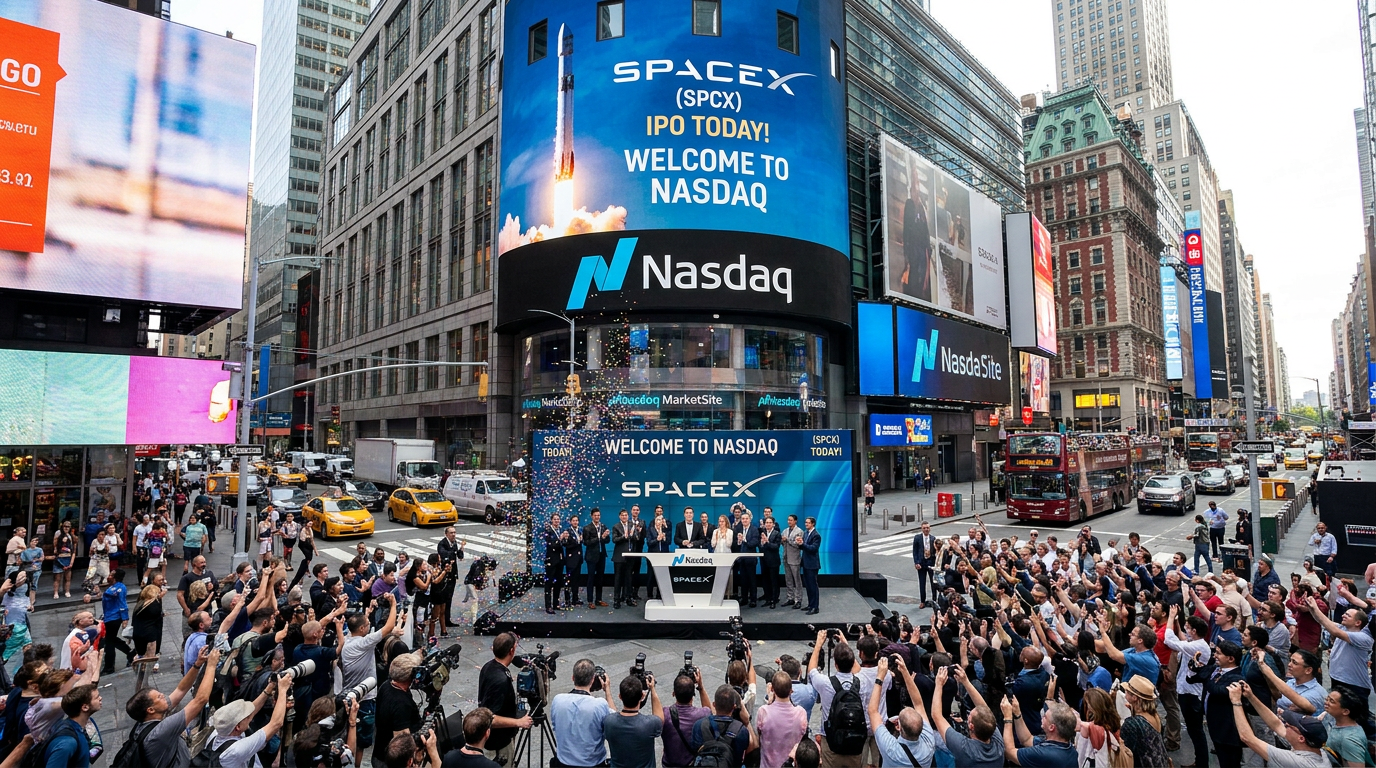
The June 12, 2026, initial public offering of SpaceX rewrote the financial record books. Debuting at $135 per share, the aerospace and artificial intelligence conglomerate achieved a staggering $1.77 trillion valuation, raising $75 billion in the largest public listing in history. Retail investors flooded the market, driving the stock up 19% on its first day and briefly pushing the company's market capitalization past the $2 trillion mark.[1][6]
But as the initial retail frenzy begins to cool, a second, vastly more powerful wave of capital is preparing to strike. This incoming tide has nothing to do with market sentiment, retail enthusiasm, or even the company's fundamental valuation. Instead, it is driven entirely by the rigid, mechanical rules of passive investing.[1][2]
To understand this impending capital wave, one must look at the hidden plumbing of the modern stock market: index funds. Trillions of dollars globally are held in passive vehicles that track benchmarks like the Russell 1000, the Nasdaq-100, and the S&P 500. When a new company is added to one of these indices, every fund tracking that benchmark is forced to buy the stock to match the index's exact weighting.[2][7]
Historically, newly public companies had to wait months or even years to prove their stability before gaining entry into these elite benchmarks. However, SpaceX's unprecedented size forced index providers into a difficult position. Leaving a $2 trillion company out of a "total market" index would cause the benchmark to immediately diverge from the reality of the broader economy.[7]

In response, several major index providers triggered "fast entry" rules designed specifically for mega-cap listings. FTSE Russell and the Center for Research in Security Prices (CRSP) adjusted their frameworks to allow SpaceX to join their respective indices just five trading days after its IPO. Nasdaq similarly altered its rules in March 2026, permitting inclusion in the tech-heavy Nasdaq-100 after just 15 trading days.[4][5][6]
The result is a synchronized, mandatory buying event of historic proportions. Analysts estimate that the combined inclusion into the CRSP US Total Market Index and the Russell 1000 will force between $10 billion and $16 billion in passive fund buying in a single trading session.[7]
Because index inclusion is mechanical, portfolio managers cannot opt out. They must purchase SpaceX shares regardless of the current trading price. Furthermore, because index funds are fully invested, they must sell billions of dollars of their existing holdings—trimming positions in stalwarts like Apple, Microsoft, and Nvidia—simply to free up the cash required to buy SpaceX.[2][7]

Yet, the most famous benchmark in the world has conspicuously refused to participate in the frenzy. S&P Dow Jones Indices, which manages the S&P 500, rejected a May 2026 proposal that would have fast-tracked mega-IPOs into its flagship index.[3][6]
Yet, the most famous benchmark in the world has conspicuously refused to participate in the frenzy.
On June 4, S&P reaffirmed its strict eligibility criteria, which mandate that a company must have a 12-month public trading history and, crucially, must report four consecutive quarters of profitability under Generally Accepted Accounting Principles (GAAP).[3][6]
This profitability requirement is a massive hurdle for SpaceX. Despite generating nearly $18.7 billion in revenue in 2025, the company reported a GAAP net loss of $4.94 billion, driven by massive capital expenditures in its Starship program and orbital AI infrastructure. Consequently, SpaceX will not be eligible for the S&P 500 until at least mid-2027, and only if it manages to turn a sustained GAAP profit.[3][6]
This regulatory schism has created an unprecedented divergence in the passive investing landscape. Investors holding funds benchmarked to the Nasdaq-100 or the Russell 1000 will soon find themselves with significant exposure to SpaceX. Meanwhile, the millions of investors holding S&P 500 tracker funds—the default choice for countless 401(k) plans—will have zero exposure to the sixth-largest U.S. company for at least another year.[2][7]

Complicating the mechanics of this forced buying is SpaceX's exceptionally low public float. During the IPO, the company sold only about 5% of its total outstanding shares to the public.[6]
Index providers weight companies based on their float-adjusted market capitalization—meaning they only count the shares actually available for public trading, not the shares locked up by insiders like CEO Elon Musk, who retains over 80% voting control. Therefore, while SpaceX is a $2 trillion entity on paper, its float-adjusted footprint in the indices will initially be much smaller, limiting its day-one weight in broad funds.[2][6]
Even with a float-adjusted weighting, the sheer volume of forced buying against a limited supply of available shares creates a classic supply-demand imbalance. Financial analysts note that this dynamic is a primary reason why the stock has maintained a significant premium over its $135 offering price, as active traders front-run the anticipated index flows.[1][7]
For everyday investors, the SpaceX IPO serves as a stark reminder of how modern retirement accounts actually function. As Morningstar analysts point out, when a behemoth lists on the public markets, it is inevitably absorbed into superannuation and pension funds via benchmark-linked mandates.[2]

This means that millions of people will become SpaceX shareholders in the coming weeks, absorbing the financial risks and rewards of space exploration and AI infrastructure, entirely by default.[2][7]
Ultimately, the coming weeks will test the resilience of market plumbing as billions of dollars mechanically slosh from legacy tech giants into the aerospace newcomer. But once the fast-entry index flows settle, the narrative will inevitably shift back to fundamentals.[7]
How we got here
Feb 2026
SpaceX acquires xAI, merging Elon Musk's AI infrastructure into the aerospace company ahead of its listing.
May 20, 2026
SpaceX files its S-1 prospectus, revealing plans for the largest initial public offering in history.
June 4, 2026
S&P Dow Jones Indices officially rejects a proposal to fast-track mega-IPOs, maintaining its 12-month seasoning rule.
June 12, 2026
SpaceX debuts on the Nasdaq at $135 per share, achieving a $1.77 trillion valuation.
Late June 2026
Fast-entry rules trigger billions of dollars in forced buying as SpaceX is added to the Russell 1000 and Nasdaq-100 indices.
Viewpoints in depth
Fast-Entry Index Providers
Indices that prioritize immediate representation of mega-cap companies.
Providers like Nasdaq and FTSE Russell argue that benchmark indices must accurately reflect the real-world economy. When a $1.77 trillion company enters the public market, excluding it for a year makes a 'total market' index fundamentally inaccurate. By utilizing fast-entry rules, they ensure their passive funds immediately capture the growth and market footprint of historic mega-IPOs, even if it requires waiving traditional seasoning periods.
Strict-Criteria Index Providers
Indices that prioritize financial stability and proven track records over immediate inclusion.
S&P Dow Jones Indices maintains that benchmark integrity relies on strict, unbending rules. By enforcing a 12-month seasoning period and requiring four consecutive quarters of GAAP profitability, S&P protects its passive investors from post-IPO volatility and speculative valuations. They argue that a company losing nearly $5 billion annually, regardless of its market cap, has not yet proven the financial stability required to sit alongside the established blue-chip constituents of the S&P 500.
Passive Fund Investors
Everyday individuals whose retirement accounts are mechanically tied to index rules.
For the average retail investor holding a 401(k) or superannuation fund, index inclusion removes the element of choice. Those in Nasdaq-100 or total-market funds will automatically become SpaceX shareholders, absorbing the company's future risks and rewards. Conversely, those heavily invested in S&P 500 trackers will miss out on any early post-IPO gains, highlighting how the obscure rulebooks of index providers directly dictate the composition of everyday retirement portfolios.
What we don't know
- How the massive influx of forced passive buying will impact SpaceX's stock volatility given its exceptionally low 5% public float.
- Whether SpaceX can achieve the four consecutive quarters of GAAP profitability required to eventually unlock S&P 500 inclusion.
- How the mandatory selling of other mega-cap tech stocks by index funds will affect the broader market.
Key terms
- Passive Investing
- An investment strategy that tracks a market-weighted index or portfolio rather than relying on a fund manager to pick individual stocks.
- Index Inclusion
- The process by which a stock is added to a benchmark index, forcing all funds that track that index to purchase the stock.
- Public Float
- The portion of a company's shares that are freely available to trade on the open market, excluding locked-up shares held by insiders.
- GAAP Profitability
- Earnings calculated according to Generally Accepted Accounting Principles, a standard set of accounting rules required by the SEC and the S&P 500.
- Seasoning Period
- A required length of time a company must trade publicly before it is eligible to be added to certain major stock indices.
Frequently asked
When will SpaceX be added to the S&P 500?
SpaceX will not be eligible for the S&P 500 until at least mid-2027. S&P requires a 12-month public trading history and four consecutive quarters of GAAP profitability, which SpaceX does not currently meet.
Why are index funds forced to buy SpaceX stock?
Passive index funds are legally mandated to replicate the performance of their benchmark index. When a new company is added to the index, the funds must buy its shares to match its exact mathematical weight in the benchmark.
What is a float-adjusted market cap?
It is a valuation metric that only counts the shares available for public trading. Because SpaceX only sold about 5% of its shares in the IPO, its float-adjusted weight in indices is much smaller than its $1.77 trillion total valuation implies.
How much money will be forced into SpaceX stock?
Analysts estimate that inclusion in the CRSP and Russell indices alone will trigger between $10 billion and $16 billion in forced buying from passive funds.
Sources
Source coverage
7 outlets
4 viewpoints surfaced







[1]MarketWatchMarket Plumbers & Analysts
The initial SpaceX frenzy is cooling off — but a new wave of cash is waiting to strike
Read on MarketWatch →[2]MorningstarValuation Skeptics
Why SpaceX is coming to your Super Fund
Read on Morningstar →[3]S&P Dow Jones IndicesTraditional Benchmark Defenders
S&P U.S. Indices Methodology Update: Seasoning and Profitability Requirements Maintained
Read on S&P Dow Jones Indices →[4]NasdaqFast-Entry Advocates
Nasdaq-100 Index Fast Entry Rules for Mega-Cap Listings
Read on Nasdaq →[5]FTSE RussellFast-Entry Advocates
Russell 1000 June 2026 Reconstitution: Fast Entry Guidelines
Read on FTSE Russell →[6]WikipediaMarket Plumbers & Analysts
Initial public offering of SpaceX
Read on Wikipedia →[7]Factlen Editorial TeamMarket Plumbers & Analysts
Synthesis by Factlen editorial team
Read on Factlen Editorial Team →

More in finance
See all 5 stories →Retirement Strategy
The 'Income-Only' Retirement: How to Live Off Dividends and Shield Your Wealth from 2026 RMD Taxes
8 sources

Retirement Taxes
The 2026 Playbook for Minimizing Taxes on Required Minimum Distributions
8 sources

SpaceX IPO
The Initial SpaceX Frenzy Is Cooling, But a Massive Wave of Index Cash Is About to Strike
6 sources
Every angle. Every day.
Get finance stories with full source coverage and perspective breakdowns delivered to your inbox.