
The Era of On-Device AI: How to Run Powerful LLMs Locally in 2026
Advances in open-weight models and consumer hardware have made running AI directly on personal laptops and phones a reality, offering unprecedented privacy and zero subscription costs.
By Factlen Editorial Team
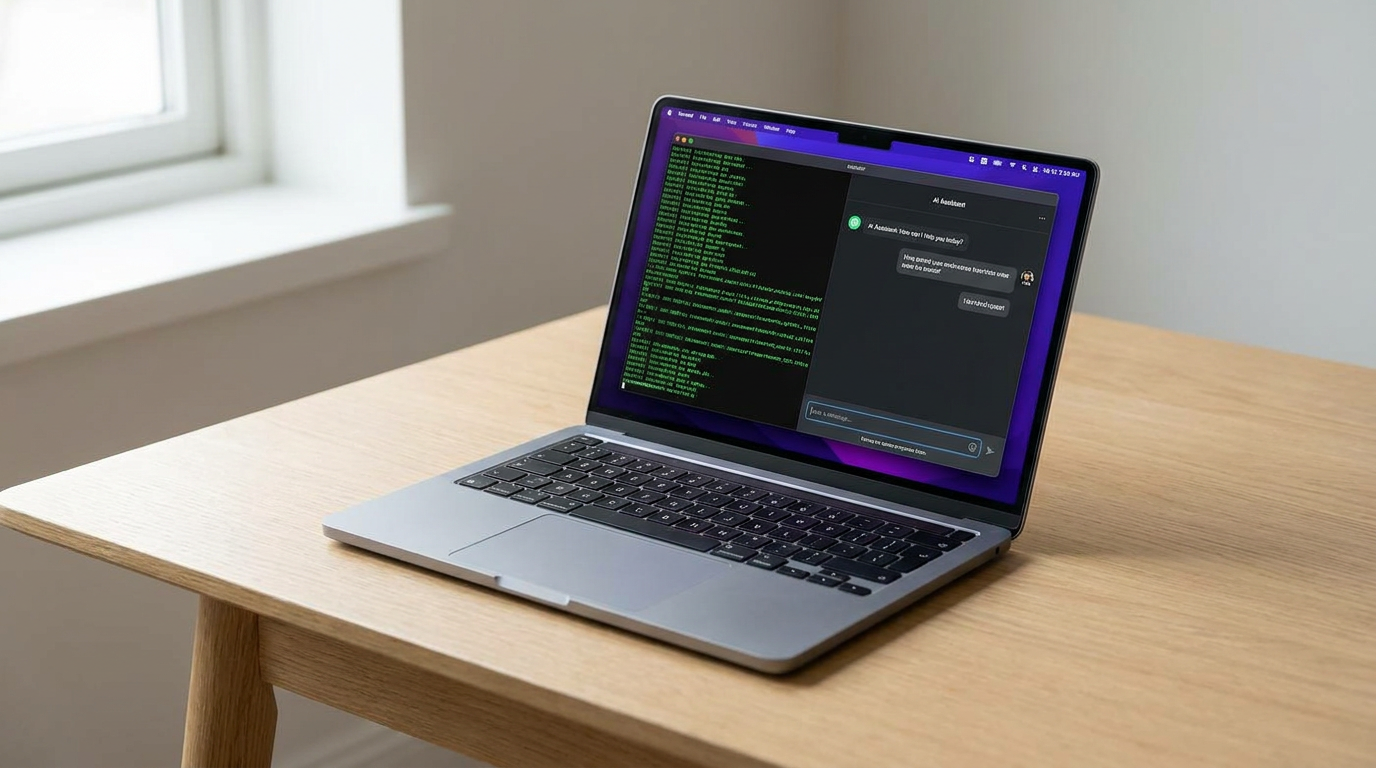
- Privacy Advocates
- Argue that local execution is essential for data sovereignty, protecting sensitive personal and corporate information from cloud surveillance.
- Open-Source Developers
- Value the ability to build, tinker, and integrate local models into custom applications using command-line tools and APIs.
- Everyday Consumers
- Prioritize ease of use, polished graphical interfaces, and seamless integration without needing technical expertise.
What's not represented
- · Cloud Infrastructure Providers
- · Enterprise Compliance Officers
Why this matters
Running AI locally means you no longer have to pay monthly subscription fees or surrender your private data to cloud servers. It transforms your personal laptop into a secure, offline intelligence hub that you completely control.
Key points
- Local AI tools allow users to run powerful language models entirely on their own devices.
- Running models locally ensures complete data privacy, as prompts never leave the machine.
- Tools like Ollama cater to developers, while LM Studio provides a beginner-friendly desktop interface.
- Advances in quantization allow models to run efficiently on standard 16GB laptops.
- Local execution eliminates the recurring API costs associated with cloud-based AI services.
For years, artificial intelligence felt like a distant oracle. You typed a prompt into a web browser, the text was beamed to a massive server farm hundreds of miles away, and an answer materialized moments later. But in 2026, a quiet revolution has fundamentally rewired how we interact with machine learning. The oracle has moved into your laptop.[1]
The shift toward "local AI" or "on-device AI" means that large language models (LLMs) are now running entirely on consumer hardware. Instead of renting computing power from tech giants via monthly subscriptions, everyday users are downloading models directly to their MacBooks, Windows PCs, and even smartphones.[2]
This transition was triggered by a convergence of two major trends: highly optimized "open-weight" models and increasingly powerful consumer silicon. Models released in mid-2026, such as Google's Gemma 4, Meta's Llama 4, and Alibaba's Qwen 3.5, have crossed a critical threshold. They offer frontier-level intelligence but are compressed enough to fit inside the memory of a standard laptop.[3]
The mechanism making this possible is a technique called quantization. In simple terms, quantization reduces the mathematical precision of an AI model's neural network, shrinking a massive 50-gigabyte file down to a manageable 8-gigabyte file, often using the GGUF format. This compression allows the model to run efficiently on a standard CPU or integrated graphics chip without requiring a massive, expensive server GPU.[7]

For consumers and professionals alike, the primary driver of this shift is privacy. When an AI model runs locally, the data never leaves the machine. There are no vendor logs, no third-party retention policies, and no risk of sensitive information being used to train future models.[2]
This absolute data sovereignty is transforming industries like healthcare, law, and finance, where uploading confidential client documents to a cloud-based chatbot is a severe compliance violation. With a local LLM, a lawyer can summarize a sensitive contract on an airplane with the Wi-Fi turned off, knowing the data is physically contained within their device.[1]
Apple has aggressively leaned into this privacy-first architecture. With its 2026 software updates, the company has doubled down on its "Apple Intelligence" framework, ensuring that the vast majority of Siri's new agentic capabilities are processed directly on the iPhone's Neural Engine.[5]
By keeping intelligence local, Apple minimizes exposure to data breaches and surveillance, contrasting sharply with the cloud-heavy approaches of its competitors. When a task is too complex for the phone's hardware, Apple utilizes "Private Cloud Compute," a hybrid system that processes data ephemerally without storing it.[5]
By keeping intelligence local, Apple minimizes exposure to data breaches and surveillance, contrasting sharply with the cloud-heavy approaches of its competitors.
Beyond privacy, the financial incentive of local AI is undeniable. Cloud-based API bills scale with every token generated, which can quickly become expensive for developers or power users. A local model, by contrast, has a fixed hardware cost. Once downloaded, it generates infinite text, code, or analysis without any per-request fees or monthly subscription tiers.[3]
The software ecosystem enabling this local revolution has matured rapidly, splitting into two distinct philosophies. For developers and power users, a tool called Ollama has become the industry standard. Operating primarily through a command-line interface, Ollama allows users to download and run models with a single line of code.[4]

Ollama acts as a lightweight background service, using roughly 100 megabytes of memory, and exposes an OpenAI-compatible API. This means developers can easily swap out paid cloud services for free local models in their applications, scripts, and automation pipelines.[6]
On the other end of the spectrum is LM Studio, a polished desktop application designed for everyday consumers. LM Studio requires no terminal commands or coding knowledge. It functions like an app store for AI, allowing users to browse a visual library of models, click to download, and immediately start chatting in a familiar interface.[4]
LM Studio handles the complex hardware acceleration in the background, automatically detecting whether to use an Nvidia GPU, an AMD chip, or Apple Silicon to maximize response speed. It has democratized access to open-weight models, making local AI accessible to writers, students, and researchers who simply want a private assistant.[6]
For those who want the power of Ollama but prefer a graphical interface, the open-source community has built sophisticated frontends. Applications like Open WebUI and Jan connect to local models and provide features like document analysis, web search, and multi-user support, effectively allowing anyone to host a private version of ChatGPT on their own hardware.[2]

Despite these massive leaps, running AI locally still faces physical constraints. The primary bottleneck in 2026 is Unified Memory or RAM. While a 12-billion parameter model like Gemma 4 runs beautifully on a machine with 16GB of RAM, larger, more capable models still require 32GB or 64GB to function without slowing down the entire computer.[3]
Battery life is another significant hurdle for mobile devices. Running complex neural networks requires intense computational power, which generates heat and drains batteries faster than traditional web browsing. Hardware manufacturers are racing to build more efficient Neural Processing Units (NPUs) to offset this energy cost.[5]

The speed of local inference has also become a battleground. While cloud models can generate text almost instantly using massive server farms, local models are bound by the user's hardware. However, optimizations in inference engines like llama.cpp have pushed consumer hardware to generate up to 85 tokens per second—faster than most humans can read.[7]
Ultimately, the rise of on-device AI represents a fundamental shift in the balance of power in the tech industry. Intelligence is no longer a service you have to rent from a centralized authority; it is a utility you can own and operate on your own terms.[1]
As open-weight models continue to shrink in size and grow in capability, the default assumption that AI requires the cloud is fading. The future of personal computing in 2026 is increasingly private, highly capable, and running quietly in the background of the devices we already own.[1]
How we got here
Early 2024
Local AI is largely restricted to researchers with expensive, high-end GPU clusters.
Late 2024
The llama.cpp project popularizes running quantized models on standard consumer CPUs.
2025
Open-weight models like Llama 3 and Mistral prove that smaller models can rival proprietary cloud APIs.
Mid 2026
Highly optimized models like Gemma 4 and Qwen 3.5 release, running flawlessly on standard 16GB laptops.
Viewpoints in depth
Privacy Advocates
Focus on data sovereignty and the elimination of cloud surveillance.
For privacy advocates, the shift to local AI is a necessary correction to the data-harvesting practices of the early generative AI boom. By executing models entirely on-device, users eliminate the risk of their sensitive documents, personal queries, and proprietary code being logged by third-party servers or used as training data for future models. This absolute data sovereignty is seen as the only viable path forward for integrating AI into highly regulated fields like healthcare and law.
Open-Source Developers
Focus on flexibility, API access, and building custom integrations.
The developer community views local LLMs as foundational building blocks rather than just chat interfaces. Tools like Ollama and llama.cpp allow engineers to run models as background services, exposing local APIs that mimic cloud providers but cost nothing per request. This camp prioritizes the ability to script, automate, and deeply integrate AI into existing software pipelines without being tethered to the rate limits or pricing changes of centralized tech giants.
Everyday Consumers
Focus on accessibility, user experience, and battery efficiency.
For the average user, the underlying technology of quantization and inference engines is secondary to the user experience. This perspective values tools like LM Studio and Apple's native on-device integration, which abstract away the complexity of command lines and hardware allocation. Consumers want AI that feels like a natural, responsive extension of their operating system—delivering smart summaries and offline assistance without draining their laptop's battery or requiring a computer science degree.
What we don't know
- How quickly hardware manufacturers can improve NPU efficiency to prevent local AI from draining mobile batteries.
- Whether future frontier models will eventually outgrow the memory constraints of consumer laptops.
Key terms
- Local LLM
- A large language model that is downloaded and run directly on a user's personal computer or smartphone, rather than on a remote cloud server.
- Quantization
- A compression technique that reduces the mathematical precision of an AI model, allowing massive neural networks to fit into the limited memory of consumer laptops.
- Inference
- The process of an AI model generating a response or prediction based on a user's prompt.
- GGUF
- A popular file format specifically designed for storing quantized AI models so they can be run efficiently on standard consumer hardware.
Frequently asked
Do I need an internet connection to use a local LLM?
No. Once the model is downloaded to your device, it runs entirely offline, ensuring complete privacy and functionality without Wi-Fi.
Is my data sent to the cloud when using tools like LM Studio?
No. These tools process your prompts and generate responses using your computer's own hardware. Your data never leaves your machine.
What kind of computer do I need to run AI locally?
While older computers can run small models slowly, a modern laptop with at least 16GB of Unified Memory (like an Apple M-series Mac) or a dedicated GPU is recommended for smooth performance.
Sources
Source coverage
7 outlets
3 viewpoints surfaced







[1]Factlen Editorial TeamPrivacy Advocates
Synthesis by Factlen editorial team
Read on Factlen Editorial Team →[2]AyautomateOpen-Source Developers
8 Best Local LLM Tools to Run LLMs Locally in 2026
Read on Ayautomate →[3]PinggyEveryday Consumers
Top 5 Local LLM Tools in 2026
Read on Pinggy →[4]PromptQuorumEveryday Consumers
Ollama vs LM Studio 2026: CLI vs GUI — Speed, API, Privacy & Setup Compared
Read on PromptQuorum →[5]MacDailyNewsPrivacy Advocates
Apple doubles down on on-device AI in privacy and security masterstroke
Read on MacDailyNews →[6]DevToolReviewsOpen-Source Developers
We compare Ollama, LM Studio, and LocalAI for running LLMs locally
Read on DevToolReviews →[7]GitHubOpen-Source Developers
Open Source Inference Engines and Local LLMs
Read on GitHub →

Every angle. Every day.
Get ai stories with full source coverage and perspective breakdowns delivered to your inbox.