
The End of the Drill: How Biomimetic Peptides and Nano-Hydroxyapatite Are Regenerating Tooth Enamel
New biomimetic technologies, including self-assembling peptides and nano-hydroxyapatite, are allowing dentists to regrow early tooth enamel from the inside out, offering a painless alternative to traditional drilling and filling.
By Factlen Editorial Team
- Biomimetic Researchers
- Advocates for shifting dentistry from a surgical model to a regenerative one.
- Traditional Preventive Dentists
- Emphasizes the proven, population-level track record of fluoride.
- Holistic & Pediatric Patients
- Prioritizes non-toxic, biocompatible treatments with minimal side effects.
What's not represented
- · Dental Insurance Providers
- · Low-Income Clinic Operators
Why this matters
For the 61% of people who experience dental anxiety, these non-invasive treatments mean early cavities can now be reversed painlessly in minutes, preserving natural teeth and eliminating the need for drills and injections.
Key points
- Dentistry is shifting from a surgical "drill and fill" model to a preventive, regenerative approach.
- Nano-hydroxyapatite (nHAp) particles are small enough to physically replace lost minerals deep inside microscopic enamel cracks.
- Clinical trials confirm nHAp is statistically non-inferior to fluoride for cavity prevention and highly effective for sensitivity.
- Self-assembling peptides (like P11-4) create a biological scaffold inside early cavities, pulling minerals from saliva to regrow enamel.
For decades, a routine dental checkup has carried a familiar, anxiety-inducing script. A dentist spots a tiny shadow on an X-ray, declares it an "early cavity," and suggests they "watch and wait." Eventually, the decay breaches the tooth's structural integrity, triggering the inevitable: the high-pitched whine of a drill, an injection of local anesthetic, and a synthetic filling.[6]
But a quiet revolution is upending this surgical approach to oral care. Dentistry is rapidly shifting toward a medical, preventive model—one that aims to regenerate human tissue rather than amputate and replace it. At the forefront of this shift are two biomimetic breakthroughs: nano-hydroxyapatite (nHAp) and self-assembling peptides.[4][6]
To understand how these technologies work, it helps to understand the battlefield. Tooth enamel is the hardest substance in the human body, composed of 97 percent hydroxyapatite—a crystalline calcium phosphate. However, unlike bone, enamel contains no living cells. Once it is fully formed, it cannot biologically repair itself when dissolved by the acidic byproducts of oral bacteria.[5]
For over half a century, fluoride has been the gold standard for defending this static shield. When introduced to the mouth, fluoride interacts with saliva to form fluorapatite on the tooth's surface. This new mineral layer is highly resistant to acid attacks, effectively armor-plating the tooth against future decay.[1][4]

Yet, while fluoride is exceptional at protecting the outer surface, it does not rebuild the complex, three-dimensional mineral structure that has already been lost to early decay. This is where nano-hydroxyapatite enters the picture.[4]
Originally developed by NASA in the 1970s to help astronauts restore bone and tooth density lost in zero gravity, nHAp has recently become a star ingredient in preventive dentistry. Because it is the exact same mineral that teeth are made of, the body recognizes it as native tissue rather than a foreign substance.[6]
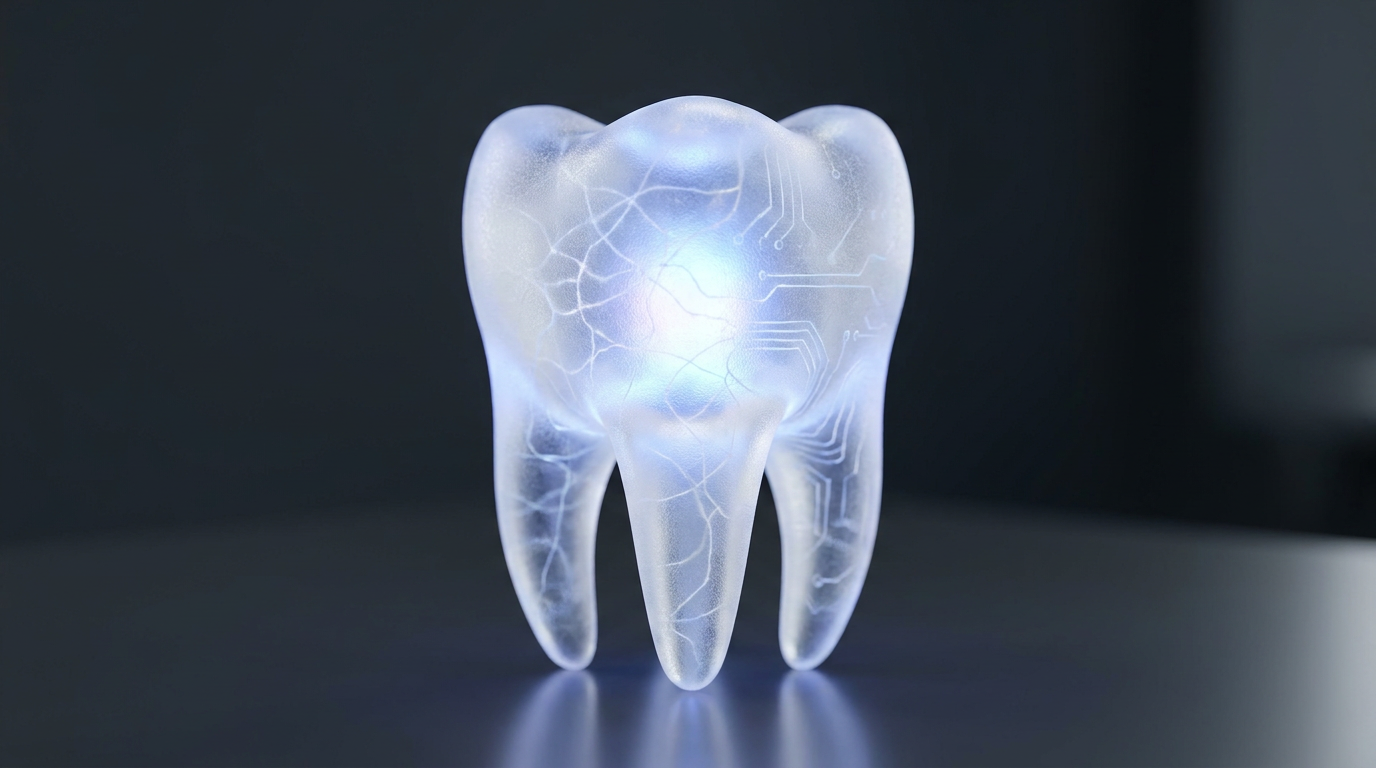
The magic of nHAp lies in its size. At roughly 20 nanometers, the particles are small enough to physically wedge themselves into the microscopic cracks and demineralized pores of a damaged tooth. Instead of just shielding the surface, nHAp directly replaces the lost minerals, integrating seamlessly into the existing enamel matrix.[3][5]
At roughly 20 nanometers, the particles are small enough to physically wedge themselves into the microscopic cracks and demineralized pores of a damaged tooth.
The clinical evidence backing nHAp has reached a tipping point. Recent systematic reviews and meta-analyses, including comprehensive data published in the Journal of Dentistry, have demonstrated that nHAp is statistically non-inferior to fluoride in preventing cavities and remineralizing early lesions. For patients seeking fluoride-free alternatives—particularly young children prone to swallowing toothpaste—it offers a highly effective, non-toxic solution.[1][5]

Beyond cavity prevention, nHAp has proven remarkably adept at treating dentin hypersensitivity. When enamel wears thin, microscopic channels called dentinal tubules are exposed, allowing hot and cold stimuli to strike the tooth's nerve. While traditional sensitivity pastes temporarily numb the nerve, nHAp physically plugs these tubules with natural mineral, permanently blocking the pain pathway.[3]
But the most futuristic development in the field goes beyond toothpaste. Researchers have cracked the code on "guided enamel regeneration" using self-assembling peptides, most notably a molecule known as P11-4.[2][6]
When a tooth first begins to decay, it forms a "white-spot lesion"—a porous, chalky area where minerals have been leached away, leaving a fragile, hollowed-out shell. Historically, dentists could only apply fluoride varnish and hope the shell didn't collapse.[4][6]
Peptide therapy changes the equation. Applied as a liquid drop onto the lesion, the P11-4 peptide seeps deep into the porous enamel. Within minutes, the acidic environment of the decay triggers the peptides to self-assemble into a three-dimensional biological scaffold.[2]

This scaffold mimics the original protein matrix that guided the tooth's growth during childhood. Once deployed, it acts as a microscopic magnet, pulling calcium and phosphate ions from the patient's saliva. Over the course of several weeks, brand new hydroxyapatite crystals grow along the scaffold from the inside out, effectively reversing the cavity.[2][4]
For the patient, the clinical experience is entirely painless. Products utilizing this technology require a simple chairside application that takes about ten minutes. There is no drilling, no injection, and no removal of healthy tooth structure.[6]
Despite the immense promise, these biomimetic tools have strict limitations. Neither nHAp nor peptide scaffolds can regrow a tooth that has fully cavitated. If the decay has broken through the enamel and created a physical hole, a traditional drill-and-fill restoration is still required. Furthermore, peptide regeneration relies heavily on the mineral content of the patient's saliva, meaning hydration and diet remain critical variables.[1][2][6]

How we got here
1970s
NASA develops early synthetic hydroxyapatite to help astronauts recover bone and tooth mass lost in microgravity.
2006
The first commercial nano-hydroxyapatite toothpastes begin gaining widespread popularity in Japan as a fluoride alternative.
2019
Clinical trials demonstrate that self-assembling peptide P11-4 successfully regenerates enamel in early white-spot lesions.
2024–2026
Multiple systematic reviews confirm nano-hydroxyapatite is statistically non-inferior to fluoride for caries prevention, accelerating global adoption.
Viewpoints in depth
Biomimetic Researchers
Advocates for shifting dentistry from a surgical model to a regenerative one.
This camp argues that the traditional 'drill and fill' method is fundamentally flawed because it replaces biological tissue with synthetic materials that eventually fail. They point to the success of P11-4 peptides and nHAp as proof that the body can be coaxed into repairing its own enamel, provided the right biological scaffolding is introduced. Their ultimate goal is to make the dental drill obsolete for early-stage decay.
Traditional Preventive Dentists
Emphasizes the proven, population-level track record of fluoride.
While optimistic about biomimetic advancements, this camp cautions against abandoning fluoride. They note that fluoride has over 70 years of longitudinal data proving its efficacy in reducing community caries rates, especially through water fluoridation. They view nHAp and peptide gels as excellent adjunct therapies—particularly for high-risk patients or those with early lesions—but argue they should complement, rather than completely replace, standard fluoride protocols.
Holistic & Pediatric Patients
Prioritizes non-toxic, biocompatible treatments with minimal side effects.
This growing demographic of patients and parents actively seeks out nHAp because it eliminates the risk of fluorosis (mottled enamel caused by ingesting too much fluoride during childhood) and acute toxicity from swallowing toothpaste. They value treatments that use the body's native minerals and appreciate the non-invasive nature of peptide therapies, which spare children the trauma of dental injections and drilling.
What we don't know
- Long-term clinical longevity: While peptide scaffolds show excellent short-term remineralization, decades-long data on the durability of this regrown enamel in a real-world oral environment is still being collected.
- Efficacy in severe dry mouth: Because peptide regeneration relies on pulling calcium and phosphate from saliva, it remains unclear how effective the treatment is for patients with severe xerostomia (dry mouth).
- Insurance standardization: As a novel medical treatment rather than a surgical procedure, dental insurance billing codes and reimbursement rates for guided enamel regeneration remain inconsistent.
Key terms
- Biomimetic
- Human-made processes, substances, or devices that imitate nature's biological designs.
- Hydroxyapatite
- A naturally occurring crystalline calcium phosphate that makes up 97 percent of human tooth enamel.
- Dentin Hypersensitivity
- Sharp tooth pain caused when the microscopic tubules in the dentin layer are exposed to hot, cold, or acidic stimuli.
- Self-Assembling Peptide
- Short chains of amino acids designed to automatically organize themselves into specific 3D structures, like a biological scaffold, under certain environmental conditions.
- White-Spot Lesion
- The earliest visible sign of tooth decay, appearing as a chalky white spot where minerals have been stripped from the enamel.
Frequently asked
Can these treatments fix a large cavity?
No. Biomimetic regeneration only works on early-stage, non-cavitated lesions (like white spots). If the decay has created a physical hole in the tooth, a traditional filling is still required.
Is nano-hydroxyapatite safe to swallow?
Yes. Because hydroxyapatite is the exact mineral your teeth and bones are naturally made of, it is highly biocompatible and non-toxic, making it especially popular for children's toothpaste.
How long does a peptide regeneration treatment take?
The clinical application of self-assembling peptides (like P11-4) takes about 5 to 10 minutes chairside. The actual remineralization process then continues over the following weeks as the scaffold pulls minerals from your saliva.
Does insurance cover peptide regeneration?
Coverage varies widely. Because it is a newer medical treatment rather than a traditional surgical procedure, some insurers bill it under preventive codes, while others require out-of-pocket payment. However, the cost is generally lower than a standard filling.
Sources
Source coverage
6 outlets
3 viewpoints surfaced






[1]Journal of DentistryTraditional Preventive Dentists
Clinical evidence of caries prevention by hydroxyapatite: an updated systematic review and meta-analysis
Read on Journal of Dentistry →[2]MDPIBiomimetic Researchers
Self-Assembling Peptide P11-4 for Guided Enamel Remineralisation: A Review
Read on MDPI →[3]BDJ OpenHolistic & Pediatric Patients
Efficacy of nano-hydroxyapatite on caries prevention and dentin hypersensitivity
Read on BDJ Open →[4]Frontiers in Oral HealthBiomimetic Researchers
Biomimetic approaches in preventive dentistry: Hydroxyapatite vs. Fluoride
Read on Frontiers in Oral Health →[5]National Institutes of HealthHolistic & Pediatric Patients
Efficacy of Nano Hydroxyapatite on remineralization of enamel: A Systematic Review
Read on National Institutes of Health →[6]Factlen Editorial TeamBiomimetic Researchers
Synthesis by Factlen editorial team
Read on Factlen Editorial Team →
More in health
See all 6 stories →Paternal Brain
How Fatherhood Rewires the Brain: The Emerging Science of Paternal Neuroplasticity
6 sources

Paternal Neuroscience
The Paternal Brain: How Fatherhood Structurally Changes Men's Minds
6 sources

Men's Health
Closing the Male Longevity Gap: The Evidence Behind Why Men Die Younger and How to Fix It
7 sources

Paternal Neuroscience
How Fatherhood Physically Rewires the Male Brain
5 sources

Every angle. Every day.
Get health stories with full source coverage and perspective breakdowns delivered to your inbox.