
Commercial Shipping Returns to Wind Power with High-Tech Autonomous Sails
The global maritime industry is rapidly adopting wind-assisted propulsion systems, retrofitting cargo ships with towering rotor and suction sails to slash fuel consumption and meet strict emissions targets.
By Factlen Editorial Team
- Shipowners & Operators
- Focused on the immediate fuel savings, return on investment, and regulatory compliance that wind retrofits provide.
- Wind Technology Providers
- Focused on proving the aerodynamic efficiency, autonomous reliability, and scalability of modern sail systems.
- Maritime Regulators & Analysts
- Focused on tracking the industry's progress toward decarbonization targets and validating the emissions reductions of new technologies.
What's not represented
- · Port authorities managing the clearance and loading logistics for vessels with towering deck structures.
- · Crews navigating the day-to-day realities of altered deck visibility.
Why this matters
Maritime shipping accounts for roughly 3% of global greenhouse gas emissions. Retrofitting the existing fleet with wind technology offers an immediate, proven way to slash fuel use and carbon output without waiting decades for next-generation alternative fuels to scale.
Key points
- The global fleet of wind-assisted commercial vessels surpassed 100 installations by the end of 2025.
- Modern systems use autonomous rotor cylinders and suction wings rather than traditional canvas sails.
- Maersk Tankers is installing 20 massive suction sails across five medium-range vessels in 2025 and 2026.
- Long-term data proves the technology's durability, with early adopters logging years of continuous, low-maintenance operation.
- Wind assistance helps ships comply with tightening IMO regulations and the EU Emissions Trading System.
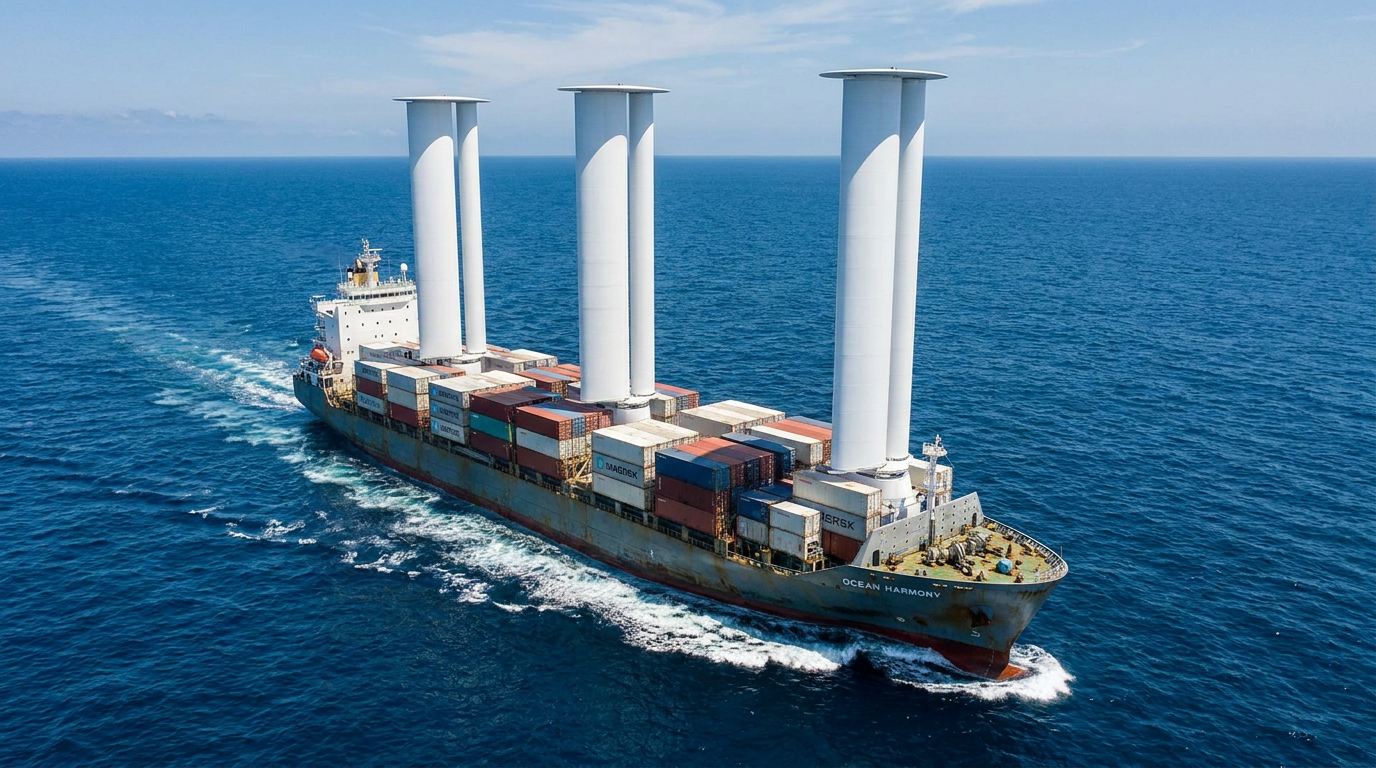
The silhouette of global shipping is changing. For over a century, the maritime industry relied exclusively on fossil fuels to power massive steel hulls across the oceans, leaving the age of sail firmly in the history books. Now, a distinctly historical concept is making a high-tech return to the high seas: wind power. Driven by the urgent need to decarbonize and the rising costs of traditional fuels, shipowners are looking backward to move forward. But the vessels leading this transition do not look like the canvas-draped clippers of the nineteenth century. Today’s commercial ships are being retrofitted with towering, autonomous aerodynamic structures that look more like industrial smokestacks or vertical airplane wings than traditional rigging.
This resurgence, known as Wind-Assisted Ship Propulsion (WASP), is rapidly transitioning from experimental pilot projects to mainstream commercial deployment. The technology is no longer a fringe environmental concept; it is a proven industrial tool. By the end of 2025, the global commercial fleet surpassed 100 large-vessel wind propulsion installations, marking a critical tipping point for the sector. With shipyards scaling up their retrofit capabilities, hundreds more systems are already on order for delivery throughout 2026 and beyond.[4]
The growth trajectory is steep. The International Windship Association projects that between 3,700 and 10,700 wind-assisted systems could be installed globally by 2030. This exponential adoption curve is driven by a powerful convergence of tightening environmental regulations, corporate sustainability mandates, and the sheer economic reality of burning thousands of tons of heavy fuel oil.[4]
Maritime transport is responsible for approximately 3% of global anthropogenic greenhouse gas emissions. With the International Maritime Organization (IMO) mandating strict decarbonization targets and the European Union incorporating shipping into its Emissions Trading System, shipowners face mounting financial penalties for their carbon output. The regulatory framework is shifting from voluntary guidelines to hard economic consequences, forcing operators to find immediate efficiency gains.[5]

While the industry is investing heavily in alternative zero-carbon fuels like green methanol and ammonia, those supply chains are still scaling up and the fuels themselves remain highly expensive. Wind, by contrast, is free, abundant, and immediately available along established global trade routes. This makes wind-assist technology the most viable near-term solution for operators looking to improve a vessel's Carbon Intensity Indicator (CII) rating without waiting decades for next-generation engine technology to mature.[5]
The technology generally falls into a few primary categories, with rotor sails and suction sails currently leading commercial adoption. Rotor sails, also known as Flettner rotors, are tall, spinning cylinders mounted vertically on a ship's deck. They are mechanically simple but aerodynamically highly effective, making them a popular choice for bulk carriers and tankers with ample deck space.[8]
Rotor sails utilize the Magnus effect—the same aerodynamic principle that causes a spinning tennis ball to curve in flight. As the wind hits the rotating cylinder, it drags air along one side while opposing the flow on the other. This creates a massive pressure differential that generates forward thrust perpendicular to the wind direction, significantly reducing the load on the ship's main engines.[3]
The long-term viability of rotor sails was recently validated by the bulk carrier M/V Afros. In April 2026, the vessel completed an eight-year continuous operation survey, providing independent verification of the technology's durability. The survey confirmed that the ship's four Anemoi rotor sails remained structurally sound and free of operational issues after nearly a decade of harsh ocean conditions.[3]
The long-term viability of rotor sails was recently validated by the bulk carrier M/V Afros.
The operational data from the M/V Afros provides a compelling business case. Over 154 voyages, the rotor system delivered 1,340 tonnes of fuel savings and prevented nearly 5,000 tonnes of well-to-wake CO2 emissions. Crucially, the system maintained a 95% operational availability rate across 200 port calls, proving that wind-assist structures can integrate seamlessly into standard commercial trading patterns without disrupting loading or unloading operations.[3]
Meanwhile, suction sails are gaining massive traction, particularly in the medium-range tanker segment. These systems resemble rigid, vertical airplane wings. Rather than spinning, they operate by drawing air across an aerodynamically optimized surface to generate lift. This suction mechanism prevents the airflow from separating from the sail, generating propulsive forces significantly greater than conventional rigid sails of the same size.[2]

Unlike traditional sails that require constant manual adjustment by a dedicated crew, modern suction sails are fully autonomous. They utilize integrated sensors and software to continuously adjust their orientation and aerodynamic performance based on prevailing weather conditions. This automation is critical for commercial adoption, as it allows ships to harness wind power without requiring specialized sailing competencies or additional crew members.[2]
Danish shipping giant Maersk Tankers is currently executing one of the industry's most ambitious rollouts of this technology. Partnering with Spanish wind propulsion specialist bound4blue, Maersk is installing 20 massive suction sails across five of its medium-range product tankers. The project represents a major vote of confidence from one of the world's largest operators.[1][2]
The retrofits began with the Maersk Trieste and the Maersk Tahiti in early 2026 at shipyards in China. Each vessel is being fitted with four 24-meter to 26-meter automated suction sails. Drawing on its previous experience with wind propulsion, Maersk expects these installations to yield double-digit percentage reductions in both fuel consumption and emissions per vessel.[1][7]

To maximize the efficiency of these autonomous systems, the maritime industry is increasingly relying on advanced meteorological data. On conventional vessels, wind data is typically used only for navigation and safety. But for WASP-enabled ships, the wind is a direct propulsion input. Inaccuracies caused by turbulence or poor sensor placement can directly compromise the system's thrust and fuel savings.[6]
Recent industry surveys indicate a massive shift in how operators view weather data. Nearly 90% of operators now consider local, undisturbed wind data essential for optimizing wind propulsion. Technologies like lidar-based remote wind monitoring are being deployed to capture upstream conditions before the wind hits the ship, allowing the autonomous sails to make predictive, micro-second adjustments for maximum efficiency.[6]
The economic case for wind assistance is becoming undeniable. Depending on the vessel type, the specific route, and the number of sails installed, operators are consistently seeing fuel savings ranging from 10% to over 20%. As carbon taxes increase and the technology scales, the return on investment for these multi-million-dollar retrofits is shrinking from decades to just a few years.[1][5]
As the technology matures, the industry's focus is expanding from retrofitting existing ships to designing 'wind-ready' newbuilds. By integrating wind propulsion into the initial naval architecture, engineers can optimize hull designs, weight distribution, and route planning to extract even greater efficiencies from the wind, pushing the boundaries of what hybrid vessels can achieve.[4]
The return of wind power to commercial shipping represents a rare alignment of environmental necessity and economic pragmatism. By combining ancient principles with cutting-edge automation and aerodynamics, the maritime industry is proving that sometimes the most innovative path forward involves looking back to the forces of nature that launched the industry in the first place.
How we got here
2018
The M/V Afros becomes the world's first bulk carrier fitted with Anemoi Rotor Sails.
2024
The International Maritime Organization's tightening Carbon Intensity Indicator (CII) rules accelerate interest in wind retrofits.
Late 2025
The global commercial fleet surpasses 100 large-vessel wind propulsion installations.
Early 2026
Maersk Tankers completes the first installations of 24-meter automated suction sails on its medium-range fleet in China.
April 2026
The M/V Afros completes its eight-year survey, proving the long-term durability and fuel savings of rotor sail technology.
Viewpoints in depth
Shipowners & Operators
Focused on the immediate fuel savings, return on investment, and regulatory compliance that wind retrofits provide.
For commercial operators, the transition to wind is fundamentally an economic calculation. With the European Union incorporating shipping into its Emissions Trading System and the IMO enforcing strict Carbon Intensity Indicator (CII) ratings, carbon output now carries a direct financial penalty. Shipowners view wind-assist as a critical bridge technology—a way to immediately slash fuel consumption by 10% to 20% while waiting for zero-carbon alternative fuels to become globally available and cost-competitive.
Wind Technology Innovators
Focused on proving the aerodynamic efficiency, autonomous reliability, and scalability of modern sail systems.
Technology providers emphasize that modern wind propulsion is an exercise in advanced industrial automation, not just aerodynamics. Companies like bound4blue and Anemoi highlight that their systems require zero manual intervention from the crew, utilizing integrated sensors and lidar data to continuously optimize thrust. Their primary goal is scaling manufacturing and shipyard partnerships to meet the projected demand of thousands of installations by the end of the decade.
Environmental Regulators
Focused on tracking the industry's progress toward decarbonization targets and validating the emissions reductions of new technologies.
Regulatory bodies and classification societies view wind propulsion as a vital component of the maritime industry's pathway to net-zero. Organizations like Lloyd's Register and the IMO are focused on standardizing how wind-assisted thrust is calculated and verified during sea trials. They emphasize that while wind alone cannot fully decarbonize shipping, it is currently the most mature and immediately deployable technology to bend the industry's emissions curve downward.
What we don't know
- How quickly global shipyards can scale their retrofit capacity to meet the projected demand of thousands of vessels by 2030.
- The exact long-term maintenance costs of complex autonomous sail systems across decades of harsh ocean conditions.
- How the widespread adoption of wind-assist will impact the pricing and demand for emerging alternative fuels like green ammonia.
Key terms
- Wind-Assisted Ship Propulsion (WASP)
- The integration of aerodynamic technologies on commercial vessels to generate auxiliary thrust and reduce engine load.
- Rotor Sail (Flettner Rotor)
- A tall, spinning cylinder mounted on a ship's deck that uses the Magnus effect to generate forward thrust from crosswinds.
- Suction Sail
- A rigid, wing-like structure that draws air across its surface to generate aerodynamic lift and propel the ship forward.
- Magnus Effect
- The observable phenomenon where a spinning object drags air with it, creating a pressure difference that generates a perpendicular force.
- Carbon Intensity Indicator (CII)
- An IMO rating system that measures how efficiently a ship transports goods or passengers, heavily influencing regulatory compliance.
Frequently asked
Can these ships sail on wind alone?
No, they are 'wind-assisted.' The sails provide auxiliary thrust to reduce the load on the main engines, lowering fuel consumption, but the engines still run to maintain consistent speeds.
Do the sails require extra crew to operate?
No. Modern wind propulsion systems are fully autonomous, utilizing integrated sensors and software to continuously adjust to weather conditions without manual input.
Can wind systems be installed on older ships?
Yes. Retrofitting existing vessels is currently the primary market for this technology, allowing older ships to improve their efficiency and comply with new emissions regulations.
Sources
Source coverage
8 outlets
3 viewpoints surfaced








[1]Seatrade Maritime NewsShipowners & Operators
bound4blue secures five-ship WAPS order from Maersk Tankers
Read on Seatrade Maritime News →[2]Robotics and Automation NewsWind Technology Providers
Automated wind propulsion moves into commercial deployment
Read on Robotics and Automation News →[3]iMarine NewsWind Technology Providers
Anemoi Rotor Sails Complete 8-Year Survey on M/V Afros
Read on iMarine News →[4]International Windship AssociationMaritime Regulators & Analysts
Wind-Assisted Ship Propulsion Market Overview 2025-2026
Read on International Windship Association →[5]Lloyd's RegisterMaritime Regulators & Analysts
Retrofitting with wind-assisted ship propulsion
Read on Lloyd's Register →[6]VaisalaWind Technology Providers
Optimizing wind-assisted vessel performance through accurate wind measurements
Read on Vaisala →[7]XinhuaShipowners & Operators
Maersk Tankers vessel fitted with wind propulsion sails at Chinese shipyard
Read on Xinhua →[8]InsightAce AnalyticMaritime Regulators & Analysts
Wind Assisted Propulsion Market Size and Forecast
Read on InsightAce Analytic →
Every angle. Every day.
Get transportation stories with full source coverage and perspective breakdowns delivered to your inbox.