
How SpaceX's Record IPO is Forcing a Trillion-Dollar Divide in Index Funds
Following SpaceX's historic $1.77 trillion public debut, major index providers are splitting on when to include the aerospace giant, creating a massive divergence for everyday passive investors.
By Factlen Editorial Team
- Fast-Track Advocates
- Indexes must immediately reflect the reality of the market, even if it means bending historical rules.
- Traditionalist Protectors
- Strict seasoning and profitability rules protect passive investors from the volatility of newly listed companies.
- Market Mechanics Analysts
- Mechanical forced buying into a low-float stock creates dangerous supply-and-demand imbalances.
What's not represented
- · Retail Investors
Why this matters
If your retirement or brokerage account holds broad market index funds, the rules dictating when those funds buy SpaceX will directly impact your exposure to the company's early market performance and volatility.
Key points
- SpaceX's $1.77 trillion IPO is the largest in history, but only 4.24% of its shares are available for public trading.
- Nasdaq and FTSE Russell have altered their rules to fast-track SpaceX into their indexes within weeks.
- S&P Dow Jones Indices refused to change its methodology, meaning S&P 500 funds will not hold SpaceX until at least June 2027.
- The divergence means investors holding different broad-market index funds will experience vastly different exposure to the company's early performance.
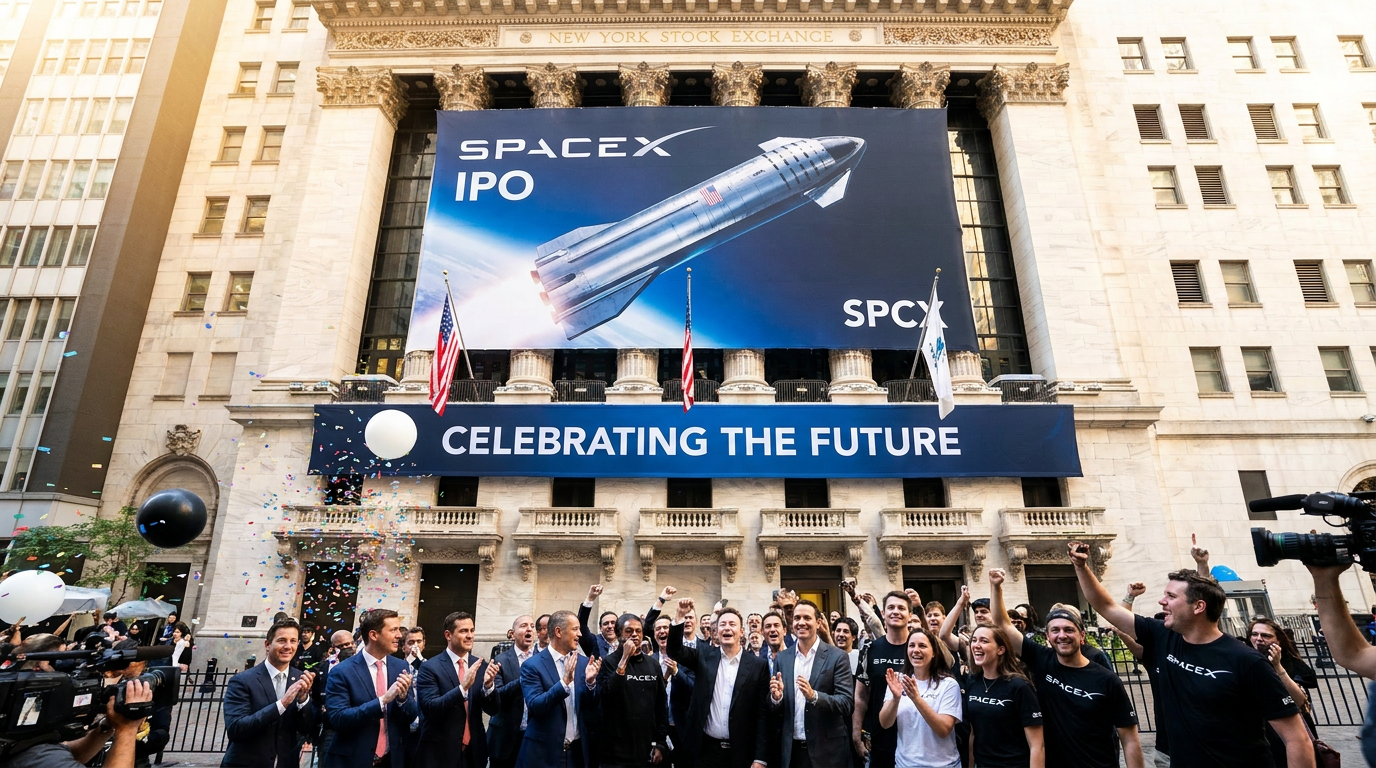
The initial retail frenzy surrounding SpaceX’s historic June 12 initial public offering has begun to settle, but a second, entirely mechanical wave of capital is preparing to strike the aerospace giant's stock. Valued at $1.77 trillion at its debut, SpaceX immediately became one of the ten largest publicly traded companies in the world, raising $75 billion in the largest public equity offering in financial history. The sheer scale of the listing has forced Wall Street to confront an unprecedented structural challenge. Because founder Elon Musk, employees, and early private backers retained the vast majority of the equity, only about 4.24% of the company's total shares are currently available for public trading. This combination of a massive market capitalization and a tiny free float has triggered a methodological crisis for the institutions that build the world's most popular stock market indexes, forcing them to decide whether to rewrite their rulebooks to accommodate a single corporate titan.[1][2][5]
To understand the magnitude of the disruption, it is necessary to look at the sheer gravity of the SpaceX listing. Prior to the IPO, the company acquired Musk’s artificial intelligence venture, xAI, in a massive merger that positioned the combined entity as a dual-threat juggernaut in both orbital infrastructure and advanced machine learning. When the company finally listed its Class A common stock on the Nasdaq under the ticker symbol SPCX, it priced at $135 per share. On its first day of trading, the stock surged 19% to close at $161, pushing the company's market capitalization past the $2.1 trillion mark and cementing Musk's status as the world's first trillionaire. Yet, despite this staggering valuation, the actual number of shares changing hands remains a fraction of the company's total footprint, creating a bottleneck that is about to collide with the rigid rules of modern passive investing.[4][5]
The core of the issue lies in the mechanics of free float—the percentage of a company's shares that are freely tradable on the open market, excluding locked-up shares held by insiders and early investors. In a typical public offering, a company might float 15% to 20% of its equity to ensure adequate liquidity. SpaceX, however, floated less than 5%. Furthermore, in an unusual move designed to reward individual supporters, underwriters allocated an unprecedented 20% to 30% of that already tiny float directly to retail investors. Because retail investors often buy and hold rather than actively trade, the actual pool of shares available for large institutional buyers is exceptionally constrained. This scarcity sets the stage for a severe supply-and-demand imbalance when the world's largest index funds are inevitably forced to buy in.[4][5][6]

For decades, passive index funds have operated on a predictable autopilot, mechanically buying and selling shares to perfectly mirror benchmarks like the S&P 500, the Nasdaq-100, or the Russell 1000. When a company grows large enough to enter an index, every mutual fund and exchange-traded fund tracking that benchmark is forced to buy the stock, regardless of its current price, valuation, or underlying fundamentals. Historically, newly public companies were required to trade for months or even years to prove their stability before gaining entry into these elite clubs. However, SpaceX’s immediate multi-trillion-dollar valuation means that excluding the company renders broad-market indexes fundamentally unrepresentative of the actual U.S. equity landscape. Faced with this reality, major index providers are now sharply diverging on how to handle the listing.[3][4][6]
Opting for immediate inclusion, Nasdaq and FTSE Russell have effectively rewritten their eligibility rules to accommodate the mega-cap listing. Both providers have implemented Fast Entry protocols that bypass traditional waiting periods and relax historical minimum float requirements. Under these updated methodologies, SpaceX is slated for inclusion in the Russell 1000 after just five days of public trading, and the Nasdaq-100 after 15 trading days. For the Nasdaq-100, the index provider adopted a specific rule for low-float giants: SpaceX will be introduced at a weight reflecting three times its freely tradeable shares. This calculation gives SpaceX an effective index market capitalization of approximately $225 billion, placing it in the top 30 constituents alongside established heavyweights like T-Mobile and PepsiCo, with an estimated index weight of roughly 0.6%.[3][4][6]
Opting for immediate inclusion, Nasdaq and FTSE Russell have effectively rewritten their eligibility rules to accommodate the mega-cap listing.
This fast-track inclusion forces passive vehicles—such as the massive Invesco QQQ Trust, which tracks the Nasdaq-100—to mechanically purchase billions of dollars of SpaceX stock to maintain accurate replication. Because index funds must remain fully invested and cannot simply print new money to buy a new constituent, they must fund these mandatory purchases by selling existing holdings. Consequently, passive funds will be forced to sell fractional portions of their positions in other major technology constituents, including Apple, Microsoft, and Nvidia, to make room for SpaceX. This creates a ripple effect across the broader market, where the sheer size of the new entrant forces a mandatory rebalancing of the world's most widely held technology stocks.[3][4]

The impending wave of forced buying has raised significant concerns among market analysts regarding near-term volatility. Because the available pool of trading shares is restricted to that narrow float, the mechanical demand from passive funds will hit a market with very limited supply. Options trading on the stock, which officially began on June 16, adds another layer of complexity. Market makers who sell options must constantly buy and sell the underlying stock to hedge their own risk—a process known as delta hedging. Analysts warn that this concentrated buying pressure from both index funds and options dealers, directed at a stock with such limited public availability, could amplify price swings in the weeks following the index inclusions, creating a turbulent environment for early investors.[1][4]
In stark contrast to its peers, S&P Dow Jones Indices has refused to alter its methodology for the aerospace giant. Following a formal market consultation, the provider announced it will maintain its strict 12-month seasoning period, its requirement for GAAP profitability, and its 10% minimum float threshold for the flagship S&P 500 index. Despite generating $18.67 billion in revenue in 2025, SpaceX reported a GAAP net loss of $4.94 billion, largely due to massive capital expenditures on its Starship launch vehicle and orbital data center infrastructure. Furthermore, its 4.24% float falls well short of the S&P requirement. As a result, the world's most widely tracked index will completely ignore one of the largest publicly traded companies in the United States until at least June 2027.[2][4][6]
This methodological split has created a trillion-dollar divide in the passive investing landscape, fundamentally altering what it means to buy the market. Historically, the performance gap between a total market fund, a large-cap Russell fund, and an S&P 500 fund has been relatively narrow, as they generally hold the same massive companies at the top. Now, the presence or absence of a $2 trillion constituent will drive a wedge between these popular investment vehicles. For investors holding Nasdaq and Russell trackers, their portfolios will immediately capture SpaceX's early price action, absorbing both the potential upside of the company's ambitions and the inherent volatility of a newly listed, low-float equity.[2][4][6]

Conversely, funds tracking the S&P 500—including massive vehicles like the SPDR S&P 500 ETF (SPY) and Vanguard's VOO—will sit entirely on the sidelines during SpaceX's first year on the public markets. These S&P 500 investors are effectively shielded from the immediate volatility and forced-buying premiums associated with the low-float IPO. However, they also risk missing out on significant potential upside if SpaceX shares appreciate steadily before its eventual inclusion. When SpaceX finally does qualify for the S&P 500, those index funds will be forced to buy in at whatever price the market has established over the preceding year, potentially paying a steep premium compared to the funds that gained fast-track entry.[2][4][6]
The divergence highlights a growing tension in modern finance: as private companies stay private longer and debut at valuations that immediately disrupt the mechanics of public markets, the supposedly neutral rules of passive investing are increasingly shaping the outcomes for everyday retail investors. The SpaceX listing is widely viewed as a test case for a new era of mega-cap public debuts. With artificial intelligence leaders like OpenAI and Anthropic reportedly preparing for their own massive public offerings, the decisions made by index providers today will establish the blueprint for how the stock market absorbs the next generation of trillion-dollar tech giants.[3][6]
How we got here
February 2026
SpaceX acquires Elon Musk's xAI, merging orbital infrastructure with advanced machine learning.
May 20, 2026
SpaceX files its S-1 prospectus, revealing plans for the largest IPO in financial history.
June 4, 2026
S&P Dow Jones Indices announces it will not fast-track SpaceX into the S&P 500, maintaining its 12-month seasoning rule.
June 12, 2026
SpaceX officially lists on the Nasdaq at $135 per share, achieving a $1.77 trillion valuation.
June 16, 2026
Options trading on SpaceX stock begins, introducing new hedging dynamics to the stock's price action.
Early July 2026
SpaceX is scheduled to enter the Nasdaq-100 index, triggering billions in forced buying from passive funds.
Viewpoints in depth
Fast-Track Advocates
Indexes must immediately reflect the reality of the market, even if it means bending historical rules.
Providers like Nasdaq and FTSE Russell argue that the primary purpose of a broad-market index is to accurately represent the current economic landscape. When a company debuts at a $1.77 trillion valuation, excluding it makes the index fundamentally unrepresentative of the broader market. By implementing Fast Entry rules, these providers ensure their benchmarks remain relevant, arguing that forcing passive funds to wait months or years deprives investors of exposure to one of the world's most significant technology companies during its critical early growth phase.
Traditionalist Protectors
Strict seasoning and profitability rules protect passive investors from the volatility of newly listed companies.
S&P Dow Jones Indices maintains that the S&P 500 is not just a measure of size, but a benchmark of established, profitable American enterprise. Traditionalists argue that newly public companies, regardless of their private-market valuation, require a period of price discovery to settle their true market value. By enforcing a strict 12-month seasoning period and requiring GAAP profitability, they aim to protect everyday index fund investors from the severe volatility, lock-up expirations, and forced-buying premiums that often characterize a stock's first year on the public market.
Market Mechanics Analysts
Mechanical forced buying into a low-float stock creates dangerous supply-and-demand imbalances.
The institutions actually tasked with managing the trillions of dollars in passive ETFs and mutual funds view the situation as a mechanical headache. When an index provider mandates the inclusion of a massive company with a tiny 4.24% float, fund managers are forced to execute billions of dollars in buy orders into a market with very little available supply. They warn that this rigid, rules-based buying can artificially inflate the stock's price in the short term, forcing everyday investors to buy in at a premium simply because the index methodology demanded it.
What we don't know
- How severely the mechanical forced buying from Nasdaq and Russell index funds will impact SpaceX's stock price given the extremely limited float.
- Whether S&P Dow Jones Indices will face pressure from institutional investors to reconsider its 12-month seasoning rule if SpaceX's stock appreciates significantly.
Key terms
- Free Float
- The percentage of a company's total shares that are freely available to be traded by the public, excluding locked-up shares held by insiders.
- Passive Index Fund
- An investment vehicle, like an ETF or mutual fund, that automatically buys and sells stocks to perfectly mirror a specific market benchmark, rather than relying on a human manager to pick stocks.
- Seasoning Period
- A required length of time a newly public company must trade on the open market before it is eligible to be included in certain stock indexes.
- Delta Hedging
- A strategy used by options dealers where they buy or sell the underlying stock to reduce the risk associated with the options contracts they have sold.
Frequently asked
Why is SpaceX's float so small?
Elon Musk, company employees, and early private investors retained the vast majority of the company's equity. Only about 4.24% of the total shares were made available to the public during the IPO.
Will my S&P 500 index fund buy SpaceX?
Not immediately. S&P Dow Jones Indices requires newly public companies to trade for at least 12 months and prove GAAP profitability, meaning S&P 500 funds won't hold SpaceX until at least June 2027.
How does this affect funds tracking the Nasdaq-100?
Nasdaq changed its rules to allow Fast Entry for mega-cap IPOs. Funds tracking the Nasdaq-100 will be forced to buy billions of dollars of SpaceX stock roughly 15 trading days after the IPO.
Why does forced buying cause volatility?
Because index funds must buy the stock regardless of price, their massive buy orders are hitting a market with very few available shares, which can drive the price up artificially in the short term.
Sources
Source coverage
6 outlets
3 viewpoints surfaced






[1]MarketWatchMarket Mechanics Analysts
The initial SpaceX frenzy is cooling off — but a new wave of cash is waiting to strike
Read on MarketWatch →[2]World AdvisorsTraditionalist Protectors
SpaceX is the largest IPO in financial history
Read on World Advisors →[3]Pengana Capital GroupMarket Mechanics Analysts
The Forced Buying Window
Read on Pengana Capital Group →[4]SpotGammaFast-Track Advocates
SpaceX IPO Index Inclusion Analysis
Read on SpotGamma →[5]WikipediaFast-Track Advocates
Initial public offering of SpaceX
Read on Wikipedia →[6]Hargreaves LansdownTraditionalist Protectors
SpaceX's record IPO could reshape indices
Read on Hargreaves Lansdown →

More in finance
See all 7 stories →Crypto Regulation
Global Crypto Markets Enter Regulated Era as Europe's MiCA Framework Takes Full Effect
7 sources

Market Mechanics
The Hidden Mechanics of the SpaceX IPO: Why Index Funds Are Forced to Buy
7 sources
Market Mechanics
What Happens After a Blockbuster IPO? The Mechanics of SpaceX's Index Inclusion
6 sources
Market Mechanics
The Hidden Mechanics of the 'Index Inclusion Effect' Driving Billions to SpaceX
6 sources
Every angle. Every day.
Get finance stories with full source coverage and perspective breakdowns delivered to your inbox.