
Induction vs. Gas Cooktops: The 2026 Efficiency, Health, and Cost Comparison
As induction technology matures and health concerns over indoor air quality rise, the debate over home cooktops has shifted from culinary preference to a major infrastructure decision. Here is the data-driven breakdown of how induction and gas ranges compare on efficiency, cost, and performance.
By Factlen Editorial Team
- Health & Environmental Advocates
- Prioritizes the elimination of indoor air pollutants and greenhouse gas emissions.
- Efficiency & Tech Proponents
- Focuses on the thermodynamic superiority, speed, and long-term energy savings of magnetic heating.
- Traditional Culinary Loyalists
- Values the tactile control, cookware versatility, and grid-independent reliability of open-flame cooking.
What's not represented
- · Electricians and contractors handling retrofits
- · Landlords managing appliance upgrades in rental units
Why this matters
Choosing between gas and induction impacts not only your monthly energy bills and cooking speed, but also your household's long-term respiratory health. Understanding the precise trade-offs helps homeowners make an investment that aligns with their budget, local power reliability, and culinary habits.
Key points
- Induction cooktops transfer up to 90% of their energy directly to cookware, compared to roughly 40% for gas.
- Gas stoves emit nitrogen dioxide and benzene, which are linked to respiratory issues and childhood asthma.
- Boiling water on an induction range takes roughly half the time of a traditional gas burner.
- Switching to induction often requires a 240-volt electrical upgrade and magnetic-compatible cookware.
- Gas stoves remain preferred for techniques requiring an open flame and provide resilience during power outages.
The debate between gas and induction cooktops has evolved from a matter of culinary preference into a critical household infrastructure decision. As building codes shift and the electrical grid modernizes in 2026, consumers are increasingly weighing the tactile familiarity of an open flame against the rapid advancements in electromagnetic cooking. Choosing the right appliance requires navigating a complex matrix of upfront costs, long-term energy efficiency, and emerging data on indoor air quality.[1][2]
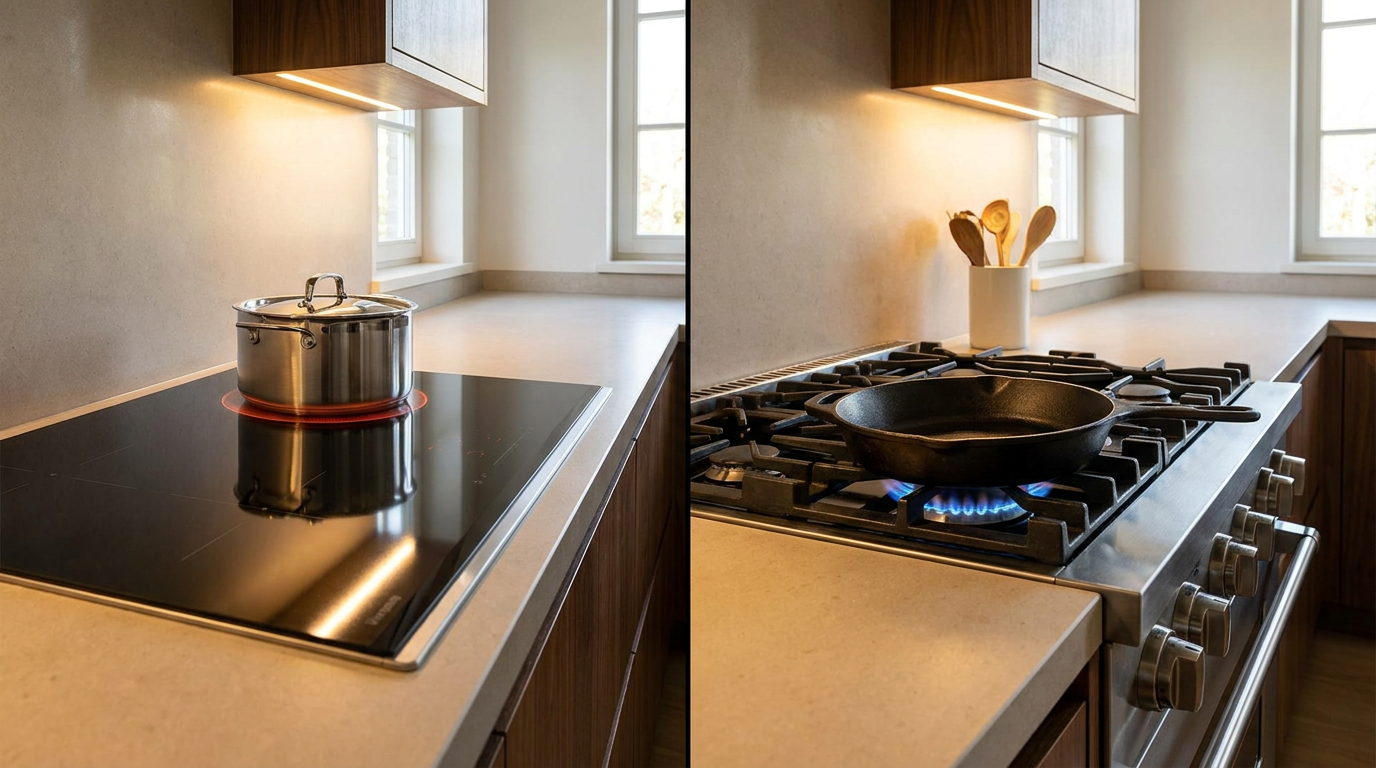
The fundamental difference between the two technologies lies in how heat is generated and transferred. Gas stoves rely on the combustion of fossil fuels to create an open flame, which heats the air, the grates, and eventually the cookware. Induction cooktops, by contrast, use copper coils beneath a glass surface to generate an oscillating magnetic field. This field induces an electrical current directly inside ferromagnetic pots and pans, turning the cookware itself into the heat source while the surrounding glass remains relatively cool.[1][6]
When evaluating energy efficiency, the argument for induction centers on the elimination of wasted ambient heat. Proponents argue that because induction heats the pan directly, it drastically reduces the amount of energy required to cook a meal and prevents the kitchen from becoming uncomfortably hot during the summer months.[2][6]
The evidence heavily supports the efficiency claims of induction. Data shows that induction cooktops operate at 85 to 90 percent thermodynamic efficiency, meaning nearly all the energy consumed goes directly into the food. Gas stoves operate at just 32 to 40 percent efficiency, losing more than half of their heat to the surrounding air. Consequently, an induction range can bring a large pot of water to a boil in roughly four to five minutes, whereas a traditional gas burner requires eight to twelve minutes for the same task.[2][6]

Regarding indoor air quality, the argument against gas and for induction focuses on the respiratory hazards of combustion byproducts. Environmental and public health advocates argue that burning natural gas indoors releases invisible pollutants that compromise lung health, making gas stoves a hidden danger, particularly in smaller homes or apartments lacking industrial-grade ventilation.[3][4]
The evidence for this health risk is substantial and quantified. Studies from Columbia University and the Environmental Protection Agency reveal that gas stoves emit nitrogen dioxide (NO2), carbon monoxide, and benzene—a known carcinogen. Research links gas cooking to roughly 13 percent of childhood asthma cases in the United States. Controlled tests demonstrate that switching from a gas stove to an induction model reduces indoor NO2 concentrations by more than 50 percent, with induction producing zero combustion emissions.[3][4][5]

The evidence for this health risk is substantial and quantified.
Conversely, the primary argument against induction centers on the steep financial barriers to entry and the logistical friction of retrofitting older kitchens. Critics point out that the transition is rarely as simple as swapping one appliance for another, often requiring a cascade of hidden costs that deter budget-conscious homeowners.[2][6]
The evidence highlights significant upfront cost disparities. While the appliances themselves are reaching price parity, installing an induction range often requires a dedicated 240-volt electrical circuit. For older homes, upgrading the electrical panel to support this load can add anywhere from $500 to several thousand dollars to the installation cost. Furthermore, induction requires magnetic cookware; traditional aluminum, copper, and glass pots are incompatible, forcing many consumers to purchase entirely new kitchenware sets.[1][6][7]
From a culinary perspective, the argument for gas is championed by traditionalists and professional chefs who value versatility and tactile control. Proponents of gas argue that an open flame provides immediate visual feedback and accommodates a wider variety of global cooking techniques that flat glass surfaces simply cannot replicate.[7]
The culinary evidence shows that gas remains superior for specific applications. An open flame allows cooks to char vegetables directly on the burner, tilt pans without losing the heat connection, and use round-bottomed woks or traditional clay pots. However, induction counters with its own culinary advantages, offering precise digital temperature control that excels at holding a steady, ultra-low simmer without the risk of a flame blowing out.[1][7]

In terms of household resilience, the argument for gas highlights its independence from the electrical grid. In regions prone to severe weather or rolling blackouts, a gas stove can often be lit manually with a match, providing a reliable way to boil water and cook food during extended power outages. Induction cooktops, entirely dependent on electricity, become non-functional the moment the power drops.[7]
Ultimately, induction fits well when a household prioritizes indoor air quality, desires the fastest possible cooking speeds, and values a kitchen that stays cool during heavy meal preparation. It is the optimal choice for consumers who have the budget to absorb potential electrical upgrade costs and who live in regions with reliable power grids.[2][6]
Conversely, induction does not fit well when homeowners face prohibitive electrical rewiring costs, experience frequent power grid failures, or rely heavily on traditional cooking techniques that require an open flame. In these scenarios, or when a household possesses a large collection of non-magnetic copper or aluminum cookware, a traditional gas range remains the more practical and cost-effective choice.[4][7]

How we got here
Early 2020s
Induction technology matures from a niche premium product to a mainstream consumer option.
2023
Major health studies link gas stove usage to 13% of childhood asthma cases in the U.S., sparking national debate.
2024
Columbia University research demonstrates a 50% reduction in indoor nitrogen dioxide when switching to induction.
2025–2026
New building codes in over 100 jurisdictions begin restricting gas hookups in new construction, accelerating the shift to electric.
Viewpoints in depth
Health & Environmental Advocates
Prioritizes the elimination of indoor air pollutants and greenhouse gas emissions.
This camp, heavily supported by public health researchers and climate scientists, views the gas stove as a significant public health vulnerability. They point to peer-reviewed data linking gas combustion to elevated rates of childhood asthma and dangerous indoor concentrations of nitrogen dioxide and benzene. For these advocates, the transition to induction is less about culinary preference and more about treating the kitchen as an indoor air quality zone, while simultaneously reducing the residential reliance on fossil fuels.
Efficiency & Tech Proponents
Focuses on the thermodynamic superiority, speed, and long-term energy savings of magnetic heating.
Engineers, energy analysts, and consumer testing groups champion induction for its sheer thermodynamic efficiency. By transferring up to 90 percent of energy directly into the cookware, induction bypasses the massive heat waste inherent to open flames. This camp emphasizes the practical daily benefits—boiling water in half the time, keeping the kitchen physically cooler, and utilizing precise digital temperature controls that respond instantly to adjustments.
Traditional Culinary Loyalists
Values the tactile control, cookware versatility, and grid-independent reliability of open-flame cooking.
Comprising professional chefs, traditional home cooks, and appliance repair specialists, this group defends the gas range for its unmatched versatility. They argue that the visual feedback of a flame is essential for intuitive cooking. Furthermore, they highlight the practical limitations of induction, noting that it renders traditional aluminum, copper, and round-bottomed woks useless, and leaves households completely vulnerable to power outages where a gas stove would otherwise provide a reliable backup.
What we don't know
- How quickly the electrical grid in various regions will decarbonize to maximize the source-energy benefits of induction.
- Whether future building codes will universally mandate electrical infrastructure upgrades in older homes to lower the barrier to entry.
- The long-term durability of newer induction touch-panels compared to the mechanical simplicity of traditional gas knobs.
Key terms
- Induction Cooking
- A method that uses electromagnetic fields to heat ferrous metal cookware directly, rather than heating the surface beneath it.
- Nitrogen Dioxide (NO2)
- A toxic gas produced by combustion that can irritate the lungs and is linked to the development of asthma.
- Ferromagnetic Cookware
- Pots and pans containing iron, such as cast iron or magnetic stainless steel, which are required for induction cooktops to function.
- Source Energy
- The total amount of raw fuel required to operate an appliance, including the energy lost during electricity generation and transmission.
Frequently asked
Do I need to buy all new pots and pans for an induction stove?
Only if your current cookware is not magnetic. Cast iron and most stainless steel work perfectly, while pure aluminum, copper, and glass will not.
Is induction cooking cheaper than gas?
Induction uses less energy per meal due to its high efficiency, but overall monthly savings depend on local electricity versus natural gas rates. However, the upfront installation cost is usually higher.
Are induction cooktops safe for pacemakers?
Modern induction ranges emit electromagnetic fields well below hazardous levels, but individuals with pacemakers should consult their doctor and maintain a safe distance as a precaution.
Sources
Source coverage
7 outlets
3 viewpoints surfaced







[1]Consumer ReportsEfficiency & Tech Proponents
The pros and cons of induction cooktops, according to Consumer Reports
Read on Consumer Reports →[2]Energy SolutionsEfficiency & Tech Proponents
Induction vs Gas Cooktops: The Definitive Health, Efficiency & Economic Analysis
Read on Energy Solutions →[3]Columbia University Mailman School of Public HealthHealth & Environmental Advocates
Switching from Gas to Electric Stoves Cuts Indoor Air Pollution
Read on Columbia University Mailman School of Public Health →[4]ForbesHealth & Environmental Advocates
What Your Gas Stove Is Doing To Your Health
Read on Forbes →[5]KQEDHealth & Environmental Advocates
Here's What Happened When Scientists Tested the Air With My Gas Stove On
Read on KQED →[6]LeafScoreEfficiency & Tech Proponents
Induction Vs Gas: Which Stove Saves More Energy In Real Life?
Read on LeafScore →[7]TTK PrestigeTraditional Culinary Loyalists
Induction Cooktop vs. Gas Stoves: Which One is Better?
Read on TTK Prestige →

More in shopping
See all 6 stories →EV Tech
The 2026 Electric Motorcycle Buyer's Guide: Range, Charging, and the Solid-State Shift
7 sources

TV Tech
OLED vs. Mini-LED TVs in 2026: The Complete Technology Comparison
7 sources

Summer Sales
Amazon Shifts Prime Day to June, Triggering Massive Summer Retail Showdown
6 sources

Sleep Tech
How Accurate Is Your Sleep Tracker? A Review of the Clinical Evidence
6 sources

Every angle. Every day.
Get shopping stories with full source coverage and perspective breakdowns delivered to your inbox.