
How Accurate Is Your Sleep Tracker? A Review of the Clinical Evidence
Peer-reviewed validation studies reveal that while consumer wearables are highly accurate at detecting when you fall asleep, their ability to track deep and REM sleep stages remains flawed.
By Factlen Editorial Team
- Clinical Sleep Specialists
- Value polysomnography as the only true diagnostic tool, viewing wearables as useful for behavioral nudges but warning against diagnostic reliance.
- Wearable Technologists
- Emphasize the rapid improvement of machine-learning algorithms and the unique value of gathering multi-night, longitudinal data outside of a lab.
- Quantified Self Consumers
- Rely heavily on daily recovery scores to dictate training and lifestyle, occasionally risking 'orthosomnia' by over-optimizing their metrics.
What's not represented
- · Regulatory bodies evaluating software as a medical device
- · Primary care physicians fielding patient questions about sleep scores
Why this matters
Millions of people alter their daily routines, workout intensities, and bedtimes based on a wearable's morning sleep score. Understanding exactly where these devices succeed—and where they hallucinate data—prevents unnecessary anxiety and helps you use the hardware effectively.
Key points
- Consumer wearables are highly accurate (≥95%) at detecting when you fall asleep and wake up.
- Differentiating between light, deep, and REM sleep remains a significant challenge for all wrist and finger-based devices.
- The Oura Ring Gen 3 currently leads peer-reviewed validation studies for sleep staging accuracy.
- Devices frequently underestimate deep sleep and struggle to detect quiet wakefulness in the middle of the night.
- Raw physiological inputs like heart rate and respiratory rate are tracked with near-clinical precision.
- Experts recommend using wearables to monitor long-term trends rather than fixating on single-night scores.
Every morning, millions of people wake up and immediately check their wrists or fingers to find out how they slept. Consumer sleep trackers have evolved from simple pedometers into sophisticated physiological monitors, driving a massive wellness industry centered on recovery and optimization. But as these devices increasingly dictate our daily behaviors—telling us when to rest, when to train, and why we feel groggy—a critical question remains: are the numbers on the screen actually true?[6]
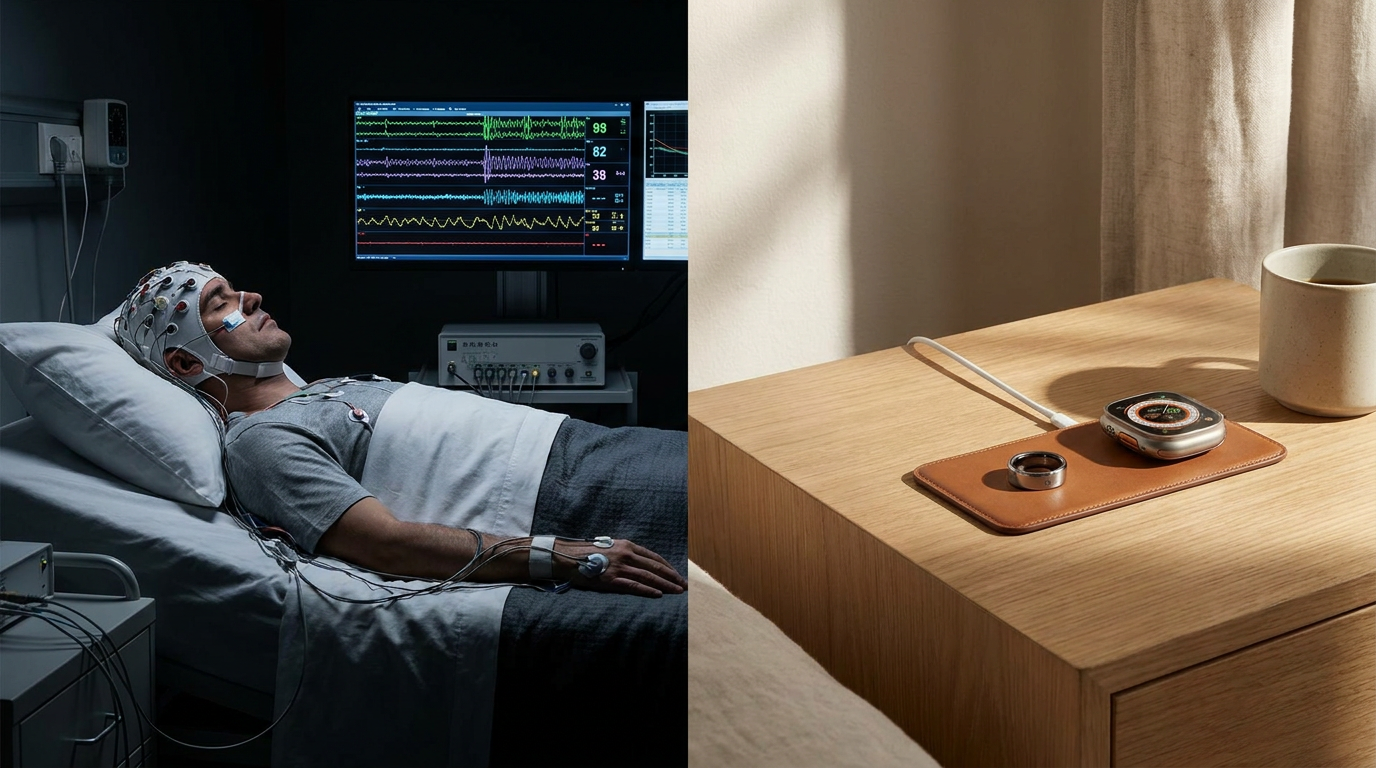
To answer this, independent researchers have spent the last several years running validation studies, pitting popular consumer wearables against the clinical gold standard: polysomnography (PSG). A PSG study takes place in a sleep lab, where technicians attach electrodes to a patient's scalp to measure brain waves (EEG), sensors near the eyes to track eye movement (EOG), and monitors on the jaw to measure muscle tone (EMG). This multi-sensor array provides a definitive, objective map of human sleep architecture.[4][5]
Consumer wearables, by contrast, must guess what the brain is doing based entirely on peripheral signals from the wrist or finger. They rely on photoplethysmography (PPG)—the green and red LED lights flashing against your skin—to measure heart rate and blood oxygen, combined with highly sensitive accelerometers to track micro-movements. Translating a resting pulse and a still wrist into a complex neurological sleep stage requires immense algorithmic heavy lifting.[5][6]
When it comes to binary classification—simply determining whether you are asleep or awake—the evidence shows that modern wearables are exceptionally accurate. A 2024 peer-reviewed study published in Sensors evaluated the Oura Ring Gen 3, Fitbit Sense 2, and Apple Watch Series 8 against clinical PSG. The researchers found that all three devices achieved a sensitivity of 95 percent or higher for detecting sleep. If your device says you fell asleep at 11:15 PM and woke up at 6:30 AM, you can generally trust that timeline.[1]

However, the accuracy drops significantly when devices attempt "four-stage classification"—the process of dividing your night into Light Sleep, Deep Sleep, REM (Rapid Eye Movement) Sleep, and Wakefulness. Because wearables cannot directly measure the slow-wave brain activity that defines deep sleep, or the muscle paralysis that characterizes REM sleep, they must infer these stages from subtle shifts in heart rate variability and respiration.[1][4]
Among the devices tested in recent clinical literature, the Oura Ring Gen 3 consistently performs at the top of the consumer pack for sleep staging. A comprehensive validation study published in Sleep Medicine analyzed over 420,000 sleep epochs and found the Oura Ring achieved between 76 and 79.5 percent sensitivity across the different sleep stages. The ring showed strong agreement with PSG for calculating total time spent in both light and deep sleep, making it one of the most reliable consumer options currently available.[1][2]
The Apple Watch, despite its dominance in the smartwatch market, struggles more prominently with deep sleep detection. Validation data presented at the IEEE Engineering in Medicine and Biology conference revealed that while the Apple Watch is excellent at identifying sleep-wake states, its algorithm frequently confuses deep sleep with core (light) sleep. In clinical testing, the Apple Watch correctly identified deep sleep only about 62 percent of the time, meaning the device systematically underestimates how much restorative deep sleep a user actually gets.[1][3]
Fitbit devices exhibit their own unique algorithmic biases. In the same comparative studies, the Fitbit Sense 2 tended to overestimate light sleep by an average of 18 minutes per night while underestimating deep sleep by roughly 15 minutes. While these margins of error might seem small in isolation, they can heavily skew the proprietary "Sleep Scores" that these companion apps generate each morning, potentially misleading users about their true recovery status.[1]
Interestingly, while the final sleep stage classifications are often flawed, the raw physiological inputs gathered by these devices are remarkably precise. Studies evaluating the Whoop 4.0 and the Apple Watch have found that their measurements for resting heart rate, heart rate variability (HRV), and respiratory rate are frequently within a single unit of truth when compared to clinical electrocardiograms. The hardware sensors are capturing clinical-grade data; the bottleneck lies entirely in how the software interprets that data.[3][4]
Interestingly, while the final sleep stage classifications are often flawed, the raw physiological inputs gathered by these devices are remarkably precise.
One of the most universal blind spots across all consumer trackers is a metric known as Wake After Sleep Onset (WASO). This refers to the brief periods during the night when you wake up, shift positions, and fall back asleep. Wearables heavily rely on movement to detect wakefulness. If you wake up in the middle of the night but lie perfectly still in the dark, the lack of accelerometer data often tricks the device into scoring that period as light sleep.[1][5]

This reliance on motion also explains why reading a book or watching television in bed can ruin the accuracy of your sleep data. If your heart rate drops to a resting baseline and your wrist remains stationary while holding a book, the algorithm will frequently log that quiet wakefulness as the first stage of sleep, artificially inflating your total sleep time.[5][6]
Beyond daily tracking, many consumers hope their wearables can act as early warning systems for medical conditions like Obstructive Sleep Apnea (OSA). Modern devices track blood oxygen saturation (SpO2) and can flag frequent drops in oxygen levels. A clinical review in CHEST Physician noted that while consumer SpO2 sensors have high sensitivity for detecting breathing disturbances, they suffer from low specificity—meaning they generate a significant number of false positives.[5]
Because of this, sleep specialists emphasize that wearables are screening tools, not diagnostic instruments. A smartwatch can tell you that your breathing was irregular, prompting a conversation with a doctor, but it cannot replace the airflow sensors and respiratory effort belts used in a formal home sleep apnea test or an in-lab PSG.[5][6]
Clinicians also warn about the "black box" nature of consumer sleep algorithms. Unlike medical devices, which undergo rigorous regulatory approval and remain static, consumer tech companies frequently push over-the-air software updates that alter how sleep is scored. A user might wake up to find their average deep sleep has suddenly dropped by 20 percent, not because their physiology changed, but because the manufacturer quietly tweaked the underlying machine-learning model overnight.[5]

This algorithmic opacity has contributed to a rising psychological phenomenon known as "orthosomnia"—an unhealthy obsession with achieving a perfect sleep score. Sleep specialists increasingly report treating patients who experience severe anxiety when their wearable tells them they had a poor night's sleep, even if they woke up feeling entirely rested. The anxiety of trying to optimize the tracker's metrics ironically leads to insomnia.[5][6]
Despite these limitations, the clinical consensus is not to abandon wearables, but to reframe how we use them. The true value of a consumer sleep tracker lies not in the absolute accuracy of a single night's data, but in its ability to establish a personal baseline and highlight longitudinal trends. If your device consistently reports two hours of deep sleep and suddenly drops to 45 minutes for three consecutive nights, the exact minute count matters less than the clear deviation from your norm.[5][6]
By focusing on macro-trends—such as consistent bedtimes, the impact of late-night meals on resting heart rate, or the effect of alcohol on overnight HRV—users can extract immense value from these devices. The hardware is highly capable of showing you how your lifestyle choices impact your physiology, provided you don't treat the morning sleep score as an infallible medical diagnosis.[6]
Ultimately, consumer sleep trackers are powerful behavioral tools masquerading as clinical instruments. They excel at holding us accountable to our routines and providing a window into our autonomic nervous systems. As long as users understand that the line between light and deep sleep is an algorithmic best guess rather than a neurological certainty, these devices remain one of the most effective wellness investments available.[5][6]

Viewpoints in depth
Clinical Sleep Specialists
Medical professionals who view wearables as useful behavioral tools but warn against relying on them for diagnostic purposes.
Sleep physicians emphasize that true sleep staging requires measuring brain waves (EEG), which consumer devices cannot do. They caution that proprietary algorithms are opaque and frequently updated without clinical oversight, meaning a sudden drop in a patient's 'deep sleep' score might reflect a software patch rather than a physiological problem. However, they increasingly value wearables for their ability to track long-term behavioral patterns, such as consistent bedtimes and the effects of alcohol on resting heart rate, which are difficult to capture in a single-night lab study.
Wearable Technologists
Engineers and researchers focused on the rapid advancement of machine learning in consumer health hardware.
Technologists argue that while wearables may not match the epoch-by-epoch accuracy of a $5,000 polysomnography setup, they offer something a sleep lab cannot: continuous, multi-year data collection in a natural environment. By leveraging massive datasets and advanced neural networks, these companies are continuously refining how peripheral signals (like heart rate variability and micro-movements) correlate with brain states. They view the current limitations in sleep staging as a temporary software hurdle rather than a permanent hardware ceiling.
What we don't know
- How proprietary algorithms from companies like Apple and Fitbit weigh different sensor inputs to generate their final sleep scores.
- Whether future consumer devices will incorporate miniaturized EEG sensors to directly measure brain activity without compromising comfort.
- The exact clinical threshold at which wearable SpO2 data becomes reliable enough to formally diagnose mild sleep apnea.
Key terms
- Polysomnography (PSG)
- The clinical gold standard for sleep testing, involving sensors attached to the head and body to directly measure brain waves, eye movement, and muscle activity.
- Photoplethysmography (PPG)
- The optical sensor technology used in smartwatches and rings that shines light into the skin to measure blood flow, heart rate, and oxygen levels.
- Wake After Sleep Onset (WASO)
- A clinical metric measuring the amount of time a person spends awake after initially falling asleep, which wearables frequently struggle to track accurately.
- Orthosomnia
- A psychological condition characterized by an unhealthy obsession with achieving perfect sleep metrics, often leading to anxiety that worsens actual sleep quality.
- Heart Rate Variability (HRV)
- The variation in time between consecutive heartbeats; a key metric wearables use to estimate nervous system recovery and infer transition between sleep stages.
Frequently asked
Can a smartwatch accurately track deep sleep?
Only moderately. Clinical studies show devices like the Apple Watch correctly identify deep sleep about 62% of the time, often underestimating it by confusing it with light sleep.
Which sleep tracker is the most accurate?
According to recent peer-reviewed validation studies, the Oura Ring Gen 3 currently demonstrates the highest sensitivity (76-79.5%) for four-stage sleep classification among consumer wearables.
Can my wearable diagnose sleep apnea?
No. While devices can flag drops in blood oxygen (SpO2) and irregular breathing, they generate false positives and cannot replace a clinical sleep study for a formal diagnosis.
Why does my tracker say I was asleep when I was just reading?
Wearables rely heavily on movement. If your heart rate is at a resting baseline and you are lying perfectly still, the device's accelerometer assumes you have entered light sleep.
Sources
Source coverage
6 outlets
3 viewpoints surfaced






[1]Sensors (MDPI)Wearable Technologists
Accuracy of Oura Ring Gen3, Fitbit Sense 2, and Apple Watch Series 8 Compared to Polysomnography
Read on Sensors (MDPI) →[2]Sleep Medicine
Validity and reliability of the Oura Ring Generation 3 with Oura sleep staging algorithm 2.0
Read on Sleep Medicine →[3]IEEE Engineering in Medicine and BiologyWearable Technologists
Apple Watch Sleep and Physiological Tracking Compared to Clinically Validated Actigraphy and Polysomnography
Read on IEEE Engineering in Medicine and Biology →[4]Sleep (Oxford University Press)Clinical Sleep Specialists
Performance of six consumer wearable sleep-tracking devices compared to polysomnography
Read on Sleep (Oxford University Press) →[5]CHEST PhysicianClinical Sleep Specialists
Clinical validation and regulatory limitations of consumer sleep trackers
Read on CHEST Physician →[6]Factlen Editorial TeamQuantified Self Consumers
Synthesis by Factlen editorial team
Read on Factlen Editorial Team →
More in shopping
See all 6 stories →E-Bike Tech
The 2026 E-Bike Buying Guide: Motors, Classes, and the Safety Specs You Can't Ignore
7 sources
EV Tech
The 2026 Electric Motorcycle Buyer's Guide: Range, Charging, and the Solid-State Shift
7 sources

TV Tech
OLED vs. Mini-LED TVs in 2026: The Complete Technology Comparison
7 sources
Summer Sales
Amazon Shifts Prime Day to June, Triggering Massive Summer Retail Showdown
6 sources
Every angle. Every day.
Get shopping stories with full source coverage and perspective breakdowns delivered to your inbox.