
Trail Runners vs. Hiking Boots: The Modern Backpacking Footwear Debate
As ultralight backpacking gains popularity, many hikers are ditching traditional leather boots for lightweight trail runners. We break down the trade-offs in durability, support, and water management to help you choose the right footwear for your next trek.
By Factlen Editorial Team
- Ultralight Backpackers
- Prioritize speed, efficiency, and weight reduction above all else.
- Traditional Hikers
- Value durability, ankle support, and environmental protection.
- Gear Analysts & Retailers
- Focus on matching footwear to specific terrain, load weights, and user experience levels.
What's not represented
- · Cobblers and shoe repair professionals who deal with the end-of-life disposal of unrepairable synthetic shoes.
- · Podiatrists treating the specific foot injuries associated with both overly rigid boots and under-supported minimalist shoes.
Why this matters
Footwear is arguably the most critical gear decision a hiker makes, directly impacting comfort, safety, and endurance on the trail. Choosing the wrong shoe for your specific body, pack weight, and terrain can lead to trip-ending blisters, joint pain, or costly mid-trek replacements.
Key points
- Trail runners offer a roughly 40% weight savings over traditional hiking boots, significantly reducing leg fatigue over long distances.
- Because they use softer materials, trail runners require virtually no break-in period, reducing the risk of early-trip blisters.
- Hiking boots provide vastly superior durability, often lasting years compared to the 300-500 mile lifespan of a typical trail runner.
- Stiff boots remain the recommended choice for hikers carrying packs heavier than 35 pounds or navigating off-trail, technical terrain.
- Non-waterproof trail runners are favored for wet environments because they drain and dry quickly, whereas soaked waterproof boots can stay wet for days.
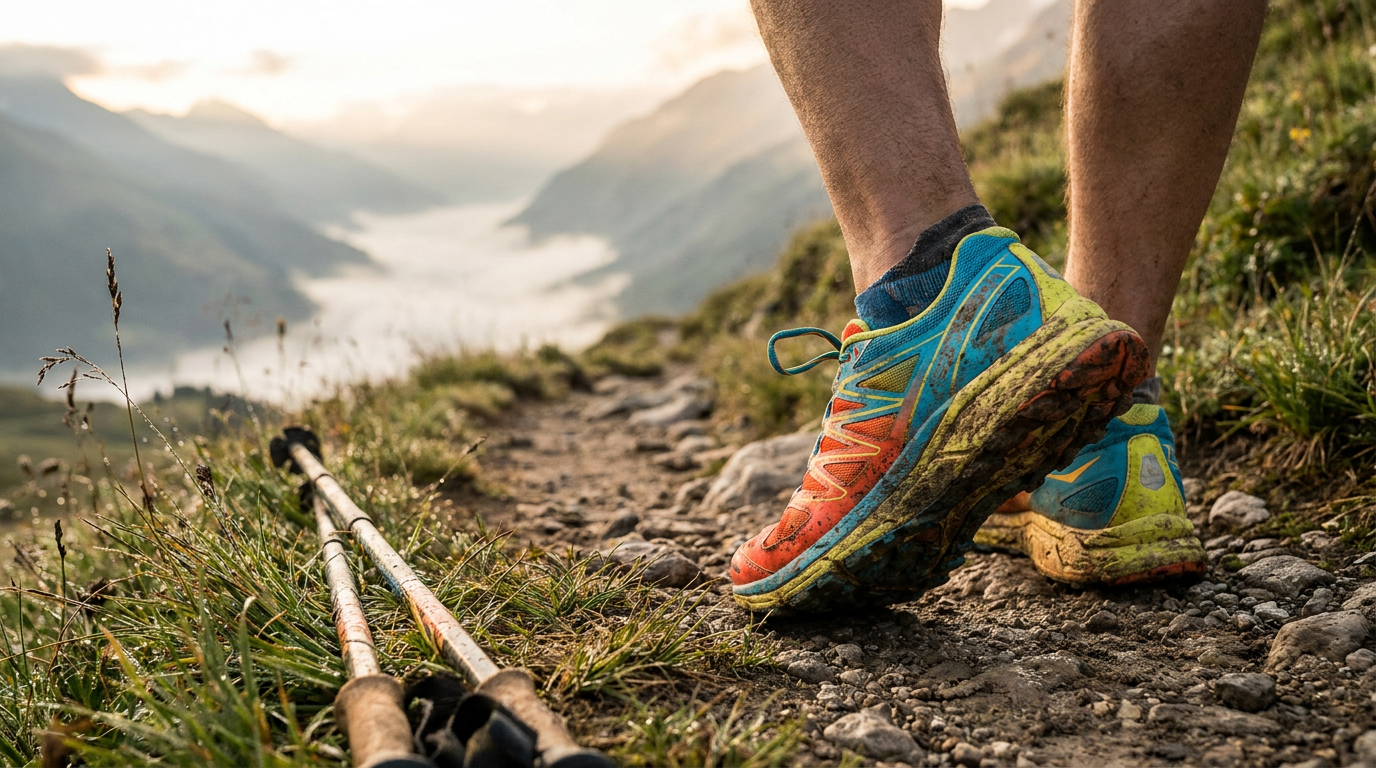
The image of a backpacker used to be universally synonymous with heavy, rigid leather boots, thick wool socks, and a towering external frame pack. Today, a glance at the feet of thru-hikers on the Pacific Crest Trail or the Appalachian Trail reveals a drastically different story: a sea of brightly colored, low-cut, lightweight trail running shoes. This shift from traditional heavy-duty boots to minimalist runners represents one of the most significant gear revolutions in modern outdoor recreation, mirroring the broader industry trend toward ultralight backpacking. As hikers increasingly prioritize speed and efficiency over absolute bomb-proof durability, the debate over what belongs on your feet has become the most fiercely contested topic at trailheads and in online gear forums. Understanding this shift requires looking beyond mere aesthetics and examining the biomechanics of how we move through the backcountry.[3][7]
The core of this footwear debate centers on a fundamental design trade-off between agility and armor. Traditional hiking boots are built like miniature tanks, specifically designed to isolate the foot from the punishing realities of the trail. They utilize thick, hard rubber lugs, rigid internal shanks, and high, padded ankle collars to provide maximum stability and protection against jagged rocks and roots. Trail runners, conversely, are essentially beefed-up athletic shoes engineered for forward momentum. They prioritize flexibility, breathability, and natural foot movement over absolute structural protection. By stripping away the heavy leather uppers and stiff midsoles, trail runners allow the foot to flex and grip the terrain dynamically, adapting to the trail rather than simply bulldozing over it. This fundamental difference in design philosophy dictates how each shoe performs under the stress of a multi-day trek.[1][2]
When analyzing the case for trail runners, the primary and most compelling argument is raw weight reduction. A common backpacking adage, backed by physiological studies, states that one pound of weight carried on your feet requires the same energy expenditure as carrying five pounds on your back. A top-tier pair of modern trail runners typically weighs around 18 to 24 ounces for the pair, representing a roughly 40 percent weight savings compared to a standard mid-cut hiking boot, which often tips the scales at over 40 ounces. Over the course of a 15-mile day, a hiker takes roughly 30,000 steps. Lifting that extra pound of leather and rubber thousands of times leads to significantly more leg fatigue, slower paces, and a higher likelihood of exhaustion-related stumbles late in the afternoon.[2][3]

Beyond the mathematical advantage of weight savings, trail runners offer immediate, out-of-the-box comfort that traditional boots simply cannot match. Because they are constructed with pliable synthetic meshes, seamless overlays, and softer EVA foam midsoles, they require virtually no break-in period. Hikers can often purchase a pair of trail runners, take them straight to the trailhead, and hike a dozen miles without suffering the severe, trip-ending blisters that frequently accompany the first few outings in stiff leather boots. This forgiving fit, often combined with a wider toe box that allows the foot to naturally swell and splay during long days of walking, has made trail runners the undisputed footwear of choice for long-distance thru-hikers who routinely cover twenty to thirty miles a day across varied terrain.[1][4]
However, the case against trail runners is heavily rooted in their lack of long-term durability and their inherent exposure to the elements. The softer, stickier rubber outsoles that provide such excellent grip on slick granite slabs wear down rapidly under the friction of the trail. Similarly, the lightweight, breathable mesh uppers are highly prone to tearing when repeatedly scraped against sharp scree, thorny brush, or exposed roots. Most trail runners will only survive 300 to 500 miles of rugged backcountry use before the EVA foam compresses flat and the tread disappears. For a thru-hiker completing a 2,000-mile trail, this means burning through four or five pairs of shoes in a single season, making them a recurring expense and generating significant synthetic waste.[2][4][6]
However, the case against trail runners is heavily rooted in their lack of long-term durability and their inherent exposure to the elements.
Furthermore, the low-cut profile of a trail runner leaves the ankle and lower leg entirely exposed to the hazards of the environment. While the sports medicine debate over whether high collars actually prevent mechanical ankle sprains remains highly contested, there is no denying that boots offer vastly superior protection against physical abrasions. Bushwhacking through dense, thorny undergrowth, navigating unstable talus fields, or accidentally stepping into ankle-deep mud puddles can be a painful and messy experience in low-cut shoes. Without the addition of aftermarket protective gaiters, trail runners easily collect small pebbles, dirt, and pine needles, requiring hikers to frequently stop and empty their shoes to prevent friction blisters from forming.[2][5]

This brings the analysis to the enduring, time-tested case for traditional hiking boots. For hikers carrying heavy loads—typically defined as a total pack weight exceeding 35 pounds—the stiff midsole and rigid internal shank of a boot provide absolutely essential underfoot support. When hauling a heavy, multi-day pack loaded with winter gear or climbing equipment, a highly flexible trail runner can cause the small muscles of the foot to overwork in an attempt to stabilize the load. This overexertion frequently leads to bruised soles, arch pain, and debilitating conditions like plantar fasciitis. Boots act as a stable, unyielding platform, transferring the heavy weight of the pack more evenly across the ground and protecting the foot from the repetitive impact of sharp stones.[1][4]
Hiking boots also win decisively in the longevity and economic value category. A high-quality pair of full-grain leather boots requires a substantial upfront investment, often exceeding $200, but they are built to last for many years of regular, punishing use. The dense, hard-wearing rubber outsoles degrade incredibly slowly compared to running shoe foam, and the leather uppers can be repeatedly treated with wax to maintain their integrity. Crucially, many premium traditional boots are constructed with a welted sole, meaning they can be completely resoled by a skilled cobbler once the tread finally wears flat. Over a decade of hiking, a single pair of well-maintained leather boots is almost always a more economical and environmentally friendly choice than constantly replacing blown-out trail runners.[2][4][6]
Perhaps the most contentious battleground in this footwear debate is the issue of water management. Traditional boots frequently employ waterproof-breathable membranes, such as Gore-Tex, sandwiched between the inner lining and the outer leather. In cold, muddy conditions, during spring snowmelts, or when crossing shallow streams, these membranes excel at keeping feet perfectly dry and warm. However, this impermeability comes with a severe drawback: if water overtops the ankle collar during a deep river crossing, or if sweat accumulates heavily on a hot day, the boot effectively becomes a heavy, sloshing bucket. Because the materials are thick and specifically designed to keep moisture out, a thoroughly soaked waterproof boot can take multiple days to dry in the backcountry, leaving the hiker susceptible to trench foot.[3][5][6]

Trail runners take the exact opposite approach to moisture management, embracing a philosophy of rapid drainage rather than impenetrable defense. Most experienced ultralight hikers intentionally choose non-waterproof versions of trail runners. When faced with a river crossing, they simply walk straight through the water, accepting that their feet will get completely soaked. Because the shoes are constructed from highly breathable, non-absorbent synthetic mesh, the water physically squishes out of the fabric with every subsequent step. Paired with high-quality merino wool socks that retain their insulating properties even when wet, these minimalist shoes can completely dry out within a few hours of continuous hiking in warm, breezy weather, keeping the skin healthier over the long term.[3][6]
Ultimately, choosing between these two distinct footwear philosophies requires an honest, realistic assessment of your specific hiking style, fitness level, and intended environment. Trail runners fit perfectly when your overall base weight is low, your intended pace is fast, and you are traveling primarily on well-maintained, established trail networks. They are the undisputed champions of hot, dry climates and long-distance thru-hikes where biomechanical efficiency and maximum breathability are the highest priorities. For hikers who have taken the time to strengthen their feet and ankles, the freedom and agility offered by a lightweight runner fundamentally transforms the experience of moving through the mountains.[1][4][7]
Conversely, traditional hiking boots remain the superior, safer choice when environmental conditions turn harsh or unpredictable. They fit exceptionally well when you are carrying a heavy multi-day pack, navigating off-trail wilderness terrain, or hiking in snow, freezing rain, and deep mud. For beginners whose feet, ankles, and stabilizing muscles have not yet adapted to the unique rigors of uneven backcountry trails, the structured, rigid support of a boot provides a forgiving margin of error that a minimalist shoe simply cannot match. In the end, there is no single perfect shoe for every scenario, which is why many dedicated outdoor enthusiasts maintain a gear closet that includes both.[1][2][7]
How we got here
Late 1990s
Ray Jardine publishes 'The Pacific Crest Trail Hiker's Handbook', popularizing the concept of hiking in lightweight running shoes.
Early 2010s
The rise of the ultralight backpacking movement sees a mass migration of thru-hikers switching from boots to trail runners.
2020s
Major outdoor footwear brands begin releasing 'hybrid' hiking shoes, blending the lightweight foam of runners with the rugged uppers of boots.
Viewpoints in depth
The Ultralight Philosophy
Advocates for minimizing weight to maximize distance and reduce body fatigue.
This camp argues that the traditional hiking boot is an outdated relic for most three-season conditions. They point to the biomechanical advantage of lifting less weight with each step, arguing that lighter footwear significantly reduces overall body fatigue and joint strain over a 20-mile day. For ultralight hikers, the inevitability of wet feet is managed through breathable mesh and wool socks, rather than relying on waterproof membranes that eventually fail or trap sweat. They view the frequent replacement of trail runners as a worthwhile subscription cost for superior daily comfort.
The Traditionalist Approach
Emphasizes the necessity of structural support and long-term durability in the backcountry.
Hikers who carry heavy loads or venture off-trail into rugged, unpredictable terrain maintain that boots are essential safety equipment. They argue that the stiff shank of a boot prevents foot fatigue when carrying 40-pound packs, and that thick leather uppers are necessary to protect against snake bites, sharp scree, and freezing mud. To this group, the frequent replacement cycle of trail runners is both economically and environmentally wasteful, preferring gear that can be repaired and resoled over years of use.
The Pragmatic Middle Ground
Seeks a balance of immediate comfort and versatile performance without extreme commitments.
For the casual weekend hiker or gear analyst, the debate often comes down to accessibility and specific trip conditions. This group increasingly favors trail runners or hybrid 'hiking shoes' because they require no painful break-in period and can be worn comfortably on the drive to the trailhead. However, many in this camp still prefer the peace of mind that comes with a waterproof membrane, opting for Gore-Tex versions of trail runners to handle occasional mud puddles without fully committing to the 'embrace the wet' philosophy of the ultralight community.
What we don't know
- Whether the long-term use of highly cushioned, zero-drop trail runners prevents or contributes to chronic joint issues compared to supportive boots.
- How emerging materials, such as graphene-infused rubber outsoles, might eventually close the durability gap between lightweight runners and traditional boots.
- The exact threshold of pack weight where the biomechanical benefits of a lightweight shoe are negated by the lack of underfoot support.
Key terms
- EVA Foam
- Ethylene-vinyl acetate, a lightweight, shock-absorbing foam commonly used in the midsoles of running shoes.
- Shank
- A stiff, supportive insert located in the midsole of a hiking boot that provides load-bearing rigidity and prevents the shoe from bending too easily.
- Lugs
- The deep rubber indentations on the outsole of a shoe or boot designed to provide traction on loose dirt, mud, and rock.
- Zero-drop
- A shoe design where the heel and the ball of the foot are at the exact same height from the ground, promoting a more natural stride.
- Thru-hiking
- The act of hiking a long-distance trail, such as the Appalachian Trail or Pacific Crest Trail, from end to end in a single continuous journey.
Frequently asked
Do trail runners provide enough ankle support for backpacking?
Trail runners offer minimal mechanical ankle support compared to high-cut boots. They rely on the hiker's natural foot and ankle strength, making them better suited for lighter packs and established trails.
Should I buy waterproof trail runners?
Many experienced hikers avoid waterproof trail runners for summer backpacking. While they keep light rain out, once water gets inside from a deep puddle or river crossing, they trap the moisture and take much longer to dry than breathable mesh shoes.
How long do hiking boots last compared to trail runners?
A quality pair of leather hiking boots can last for years and over 1,000 miles of use, and can often be resoled. Trail runners typically need replacing every 300 to 500 miles as the foam midsole compresses and loses its cushioning.
Can I wear trail runners if I have a heavy backpack?
It is generally not recommended. If your total pack weight exceeds 35 pounds, the flexible sole of a trail runner can lead to foot fatigue and arch pain, making a stiff boot a safer choice.
Sources
Source coverage
7 outlets
3 viewpoints surfaced







[1]REI Co-opGear Analysts & Retailers
Hiking Boots vs. Trail Runners: How to Choose
Read on REI Co-op →[2]Appalachian Mountain ClubTraditional Hikers
Hiking Boots vs. Trail Runners: Which is Better?
Read on Appalachian Mountain Club →[3]The Hiking LifeUltralight Backpackers
Trail Runners Vs. Hiking Boots: A 30 Year Perspective
Read on The Hiking Life →[4]Paddy PallinGear Analysts & Retailers
Hiking Boots vs Trail Runners: The Best Footwear for Hiking
Read on Paddy Pallin →[5]Academy Sports + OutdoorsTraditional Hikers
Hiking Boots vs. Trail Runners
Read on Academy Sports + Outdoors →[6]Emma Gets OutsideUltralight Backpackers
Trail Runners vs Hiking Boots: Which is Better?
Read on Emma Gets Outside →[7]Factlen Editorial TeamGear Analysts & Retailers
Synthesis by Factlen editorial team
Read on Factlen Editorial Team →

More in shopping
See all 8 stories →E-Bike Tech
The 2026 E-Bike Buying Guide: Motors, Classes, and the Safety Specs You Can't Ignore
7 sources
EV Tech
The 2026 Electric Motorcycle Buyer's Guide: Range, Charging, and the Solid-State Shift
7 sources
TV Tech
OLED vs. Mini-LED TVs in 2026: The Complete Technology Comparison
7 sources

Summer Sales
Amazon Shifts Prime Day to June, Triggering Massive Summer Retail Showdown
6 sources

Every angle. Every day.
Get shopping stories with full source coverage and perspective breakdowns delivered to your inbox.