
The Science of Culinary Emulsions: How to Master Mayonnaise, Vinaigrettes, and Pan Sauces
Understanding the chemistry of amphiphilic molecules and surface tension can help home cooks create perfect, stable sauces and rescue broken ones.
By Factlen Editorial Team
- Food Scientists
- Views emulsions purely as thermodynamic systems governed by surface tension and amphiphilic molecules.
- Culinary Traditionalists
- Believes that perfect emulsions are achieved through classical technique, patience, and sensory feedback.
- Modern Home Cooks
- Prioritizes foolproof, science-backed methods that guarantee results without the anxiety of traditional techniques.
What's not represented
- · Industrial Food Manufacturers
Why this matters
Sauces are the foundation of sophisticated cooking, but they are notoriously prone to separating. By understanding the underlying chemistry of how oil and water interact, home cooks can eliminate the anxiety of broken sauces, fix mistakes effortlessly, and elevate their everyday meals.
Key points
- Oil and water naturally repel each other due to differing molecular polarities.
- Mechanical force, like whisking, breaks oil into tiny droplets to form a temporary emulsion.
- Emulsifiers, such as the lecithin in egg yolks, act as molecular bridges to permanently stabilize the mixture.
- Adding oil too quickly or using cold ingredients can overwhelm the emulsifiers, causing the sauce to break.
- A broken sauce can almost always be rescued by slowly whisking it into a fresh base of water or egg yolk.
The magic of cooking is often just applied chemistry disguised as culinary art. You take two completely different liquids, agitate them, and suddenly they transform into a thick, luxurious sauce that coats the back of a spoon. This is the secret behind a glossy hollandaise draped over poached eggs, a sharp vinaigrette clinging to delicate salad greens, and the rich, creamy spreadability of homemade mayonnaise. But as any home cook who has watched a beautiful sauce suddenly turn into a greasy, separated nightmare knows, this magic is fragile. When a sauce fails, it feels like a personal culinary defeat. Yet, the failure is rarely about a lack of talent; it is almost always a simple misunderstanding of molecular physics.[1]
The core conflict in these recipes is chemical. Oil and water are famously immiscible, meaning they naturally refuse to mix. Water molecules are polar, possessing a slight electrical charge that makes them highly attracted to one another, much like microscopic magnets. Oil molecules, on the other hand, are non-polar and carry no such charge. When the two substances are combined in a bowl, the water molecules aggressively cling to each other, effectively squeezing the oil out of their network and forcing it to pool into a separate, distinct layer.[4][5]
To create a cohesive sauce, cooks must force these molecular enemies to coexist. This resulting mixture is called an emulsion—a delicate suspension where one liquid is dispersed as tiny, isolated droplets throughout another. In the culinary world, this almost always takes the form of an oil-in-water emulsion, where microscopic beads of liquid fat are suspended within a continuous phase of water, vinegar, or lemon juice. When executed correctly, the liquid transforms, taking on a thick, creamy texture and an opaque appearance as the suspended droplets scatter light.[6]
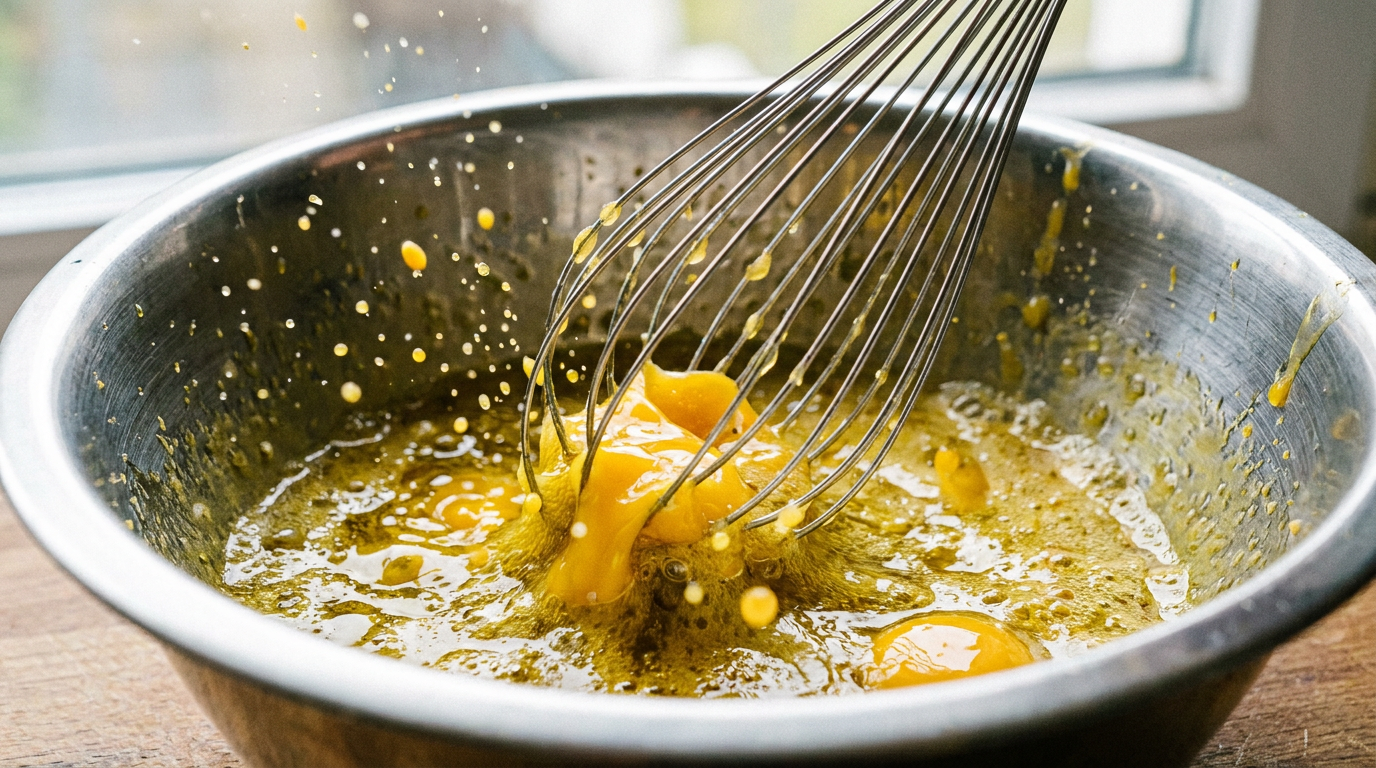
The first step in forcing this unnatural truce is the application of mechanical energy. When a cook vigorously whisks oil and vinegar together, or blitzes them in a food processor, the intense shearing force physically shatters the oil into microscopic droplets. The smaller these droplets become, the thicker and creamier the resulting liquid feels on the palate, as the densely packed oil beads struggle to move past one another within the water phase. This mechanical dispersion is the absolute foundation of any vinaigrette or pan sauce.[2][4]

However, mechanical force alone only creates a temporary emulsion. If you leave a vigorously shaken vinaigrette sitting on the kitchen counter for ten minutes, the oil droplets will inevitably find each other. Driven by thermodynamics and surface tension, the droplets merge back together in a process called coalescence, seeking their lowest energy state. Before long, the dressing has completely separated back into a layer of oil floating stubbornly on top of a layer of vinegar. To defy thermodynamics permanently, the mixture requires a chemical mediator.[4]
Enter the emulsifier, the unsung hero of the kitchen. Emulsifiers are a specific type of surfactant made of amphiphilic molecules. This scientific term simply means the molecule possesses a split personality: one end of the molecular structure is hydrophilic, meaning it is highly attracted to water, while the opposite end is hydrophobic, meaning it repels water and aggressively seeks out oil. This unique dual nature allows the molecule to act as a bridge between two substances that otherwise refuse to interact.[5][6]
When introduced to a vigorously whisked mixture of oil and water, these amphiphilic emulsifiers immediately rush to the boundary interface between the two liquids. They embed their oil-loving tails deep into the microscopic fat droplets while leaving their water-loving heads facing outward into the surrounding liquid. This creates a protective chemical armor around each individual droplet of oil, drastically lowering the surface tension and physically preventing the droplets from fusing back together when they inevitably bump into one another in the bowl.[5]
When introduced to a vigorously whisked mixture of oil and water, these amphiphilic emulsifiers immediately rush to the boundary interface between the two liquids.
The most famous and powerful culinary emulsifier is lecithin, a complex phospholipid found abundantly in egg yolks. A single egg yolk contains a staggering amount of lecithin—enough, in fact, to stabilize up to a gallon of mayonnaise, provided the cook adds enough water to maintain the continuous phase. This is why egg yolks form the structural backbone of the most notoriously rich and stable sauces in the classical French repertoire, from thick garlic aiolis to the warm, buttery embrace of a classic béarnaise.[2][3]
But eggs are far from the only chemical stabilizers hiding in the pantry. Mustard and garlic contain mucilage, a complex carbohydrate that acts as a highly effective mild emulsifier, which is exactly why a spoonful of Dijon mustard helps a classic vinaigrette stay cloudy and thick for hours. Milk proteins naturally stabilize the butterfat suspended in heavy cream, while soy lecithin is frequently extracted and used by modern food scientists to keep commercial chocolates and ice creams perfectly smooth on supermarket shelves.[4]

Understanding this underlying science explains the strict, sometimes intimidating rules of classical recipes. Traditional mayonnaise recipes demand that the oil be added drop by agonizing drop initially. If too much oil is added at once, the water and emulsifiers become completely overwhelmed, unable to coat the rapidly expanding volume of fat. The continuous water phase shatters under the strain, the unprotected oil droplets rapidly coalesce, and the sauce "breaks," instantly reverting to a sloshing bowl of separated oil and egg.[2][3]
Temperature also plays a critical, often overlooked role in the stability of these mixtures. Emulsions form most easily and reliably when all the ingredients are resting at room temperature. Cold oil is highly viscous and stubbornly difficult to shatter into the necessary microscopic droplets, while cold egg yolks straight from the refrigerator are stiff and reluctant to release their stabilizing lecithin into the mixture. Allowing ingredients to warm up slightly is one of the easiest ways to guarantee a successful sauce.[1][2]
Conversely, excessive heat introduces an entirely different danger, particularly for warm, butter-based emulsions like hollandaise or beurre blanc. If a hollandaise sauce is heated beyond 149 degrees Fahrenheit (65 degrees Celsius) over a double boiler, the delicate proteins within the egg yolk begin to permanently coagulate and scramble. Once these proteins clump together into solid microscopic masses, they lose their structural integrity and can no longer hold the liquid butterfat in suspension, resulting in a weeping, greasy mess that tastes more like buttery scrambled eggs than a refined, velvety sauce.[3]
Even armed with a deep understanding of food science, emulsions will occasionally fail in the kitchen due to a rushed pour or a momentary lapse in attention. A broken sauce looks entirely ruined, but because it is fundamentally a mechanical and chemical failure, it can almost always be mechanically and chemically repaired. The expensive ingredients haven't spoiled, burned, or degraded; they have simply lost their structural matrix. Recognizing that a broken sauce is just a temporary thermodynamic imbalance is the first step to rescuing it without throwing the ingredients away in frustration.[1]

To rescue a broken mayonnaise or hollandaise, the cook simply needs to re-establish the continuous water phase and slowly reintroduce the fat. By placing a single teaspoon of boiling water or a fresh, room-temperature egg yolk in a clean bowl, and slowly whisking the broken, greasy sauce into it drop by drop, the oil can be systematically re-dispersed. The fresh water or yolk provides a new foundation, allowing the emulsifiers to coat the fat droplets once again, miraculously restoring the sauce to its former glory.[1][2]
Modernist cooks and culinary scientists have taken these principles even further, utilizing high-powered immersion blenders to generate immense, consistent shear force. By placing an egg, a splash of acid, and a cup of oil in a narrow jar and blending from the bottom up, the rapidly spinning blades create such microscopic oil droplets that a perfect, incredibly thick mayonnaise can be formed in under ten seconds. This technique proves that high mechanical shear can entirely replace the tedious, anxiety-inducing drop-by-drop whisking of the past.[2]
Ultimately, mastering culinary emulsions elevates everyday home cooking from a stressful game of chance to an empowering exercise in applied chemistry. By understanding the invisible molecular forces of polarity, surface tension, and amphiphilic surfactants, cooks can abandon the anxiety of broken sauces and unpredictable textures. Whether whipping up a simple weeknight mustard vinaigrette or attempting a complex, buttery holiday hollandaise, wielding fat and water with absolute scientific confidence transforms the kitchen into a laboratory of delicious, predictable, and highly satisfying results.[1][6]
Viewpoints in depth
Culinary Traditionalists
Believes that perfect emulsions are achieved through classical technique, patience, and sensory feedback.
For classically trained chefs following the Escoffier tradition, making a butter sauce or mayonnaise is an exercise in sensory awareness. They rely on the sound of the whisk, the changing viscosity of the liquid, and the visual sheen of the sauce to know when an emulsion is stable. Traditionalists argue that while immersion blenders and chemical stabilizers offer shortcuts, the manual process of slowly incorporating fats yields a superior, more delicate texture that machines cannot replicate.
Food Scientists
Views emulsions purely as thermodynamic systems governed by surface tension and amphiphilic molecules.
From a biochemical perspective, an emulsion is simply a battle against the second law of thermodynamics. Oil and water inherently want to separate to reach their lowest energy state. Food scientists focus on optimizing the hydrophilic-lipophilic balance (HLB) by introducing precise ratios of surfactants like polysorbates or soy lecithin. To this camp, a broken sauce isn't a failure of culinary technique; it is simply a mathematical imbalance of shear force, temperature, or emulsifier concentration.
Modern Home Cooks
Prioritizes foolproof, science-backed methods that guarantee results without the anxiety of traditional techniques.
Popularized by figures like J. Kenji López-Alt, this pragmatic camp uses food science to bypass the anxiety of classical cooking. They champion the 'immersion blender mayonnaise'—where all ingredients are combined in a jar and blitzed into a perfect emulsion in seconds—proving that high mechanical shear can replace tedious drop-by-drop whisking. For the modern home cook, understanding the science is a tool for efficiency and stress reduction in the kitchen.
What we don't know
- While the basic mechanics of lecithin are well understood, the exact thermodynamic interactions of complex, multi-ingredient restaurant sauces remain difficult to model mathematically.
- Food scientists are still exploring how to perfectly replicate the mouthfeel of egg-based emulsions using purely plant-based, clean-label surfactants.
Key terms
- Emulsion
- A mixture of two liquids that normally do not combine, such as oil and water, where one is suspended in the other.
- Surfactant
- A compound that lowers the surface tension between two liquids, allowing them to mix more easily.
- Amphiphilic
- A molecule possessing both water-loving (hydrophilic) and oil-loving (hydrophobic) properties.
- Lecithin
- A powerful natural emulsifier found abundantly in egg yolks and soybeans.
- Coalescence
- The process where small droplets of oil in a broken emulsion merge back together into larger pools.
Frequently asked
Why did my mayonnaise separate into a greasy mess?
Your emulsion 'broke,' usually because the oil was added too quickly, the ingredients were too cold, or there wasn't enough water to suspend the oil droplets.
Can I fix a broken hollandaise or mayonnaise?
Yes. Start with a fresh egg yolk or a teaspoon of boiling water in a clean bowl, and slowly whisk the broken sauce into it drop by drop to re-establish the emulsion.
Does mustard actually help vinaigrette stay mixed?
Yes. Mustard contains complex carbohydrates called mucilage that act as mild emulsifiers, helping to stabilize the mixture of oil and vinegar.
Sources
Source coverage
6 outlets
3 viewpoints surfaced






[1]Factlen Editorial TeamModern Home Cooks
Synthesis by Factlen editorial team
Read on Factlen Editorial Team →[2]The Food Lab (Serious Eats)Modern Home Cooks
The Science of Emulsions in Cooking
Read on The Food Lab (Serious Eats) →[3]On Food and CookingCulinary Traditionalists
On Food and Cooking: The Science and Lore of the Kitchen
Read on On Food and Cooking →[4]University of TasmaniaFood Scientists
Shake it 'til you make it: The science of salad dressings and emulsions
Read on University of Tasmania →[5]Biolin ScientificFood Scientists
Emulsifiers as Surfactants: The Role of Surface Tension
Read on Biolin Scientific →[6]International Research Journal of Food ScienceFood Scientists
Formulation and stability of food emulsions
Read on International Research Journal of Food Science →
Every angle. Every day.
Get lifestyle stories with full source coverage and perspective breakdowns delivered to your inbox.