
Smart Ring vs. Smartwatch: The 2026 Guide to Choosing the Right Health Tracker
As wearable technology fractures into distinct form factors, the choice between a smart ring and a smartwatch comes down to a trade-off between passive sleep optimization and active workout tracking.
By Factlen Editorial Team
- Passive Health Optimizers
- Prioritize invisible, continuous tracking with minimal screen distraction.
- Active Training Athletes
- Rely on real-time feedback, GPS, and on-device displays for workout optimization.
- Medical Monitoring Advocates
- Value clinical-grade safety features like ECGs, fall detection, and sleep apnea alerts.
What's not represented
- · Traditional watch enthusiasts who wear smart rings to keep their wrists free for mechanical timepieces.
- · Users with skin sensitivities or sensory processing issues who cannot tolerate silicone wristbands.
Why this matters
Choosing the wrong wearable form factor often leads to device abandonment. Understanding the structural trade-offs between rings and watches ensures you invest in a tool that actually matches your daily habits, improving your long-term health tracking compliance.
Key points
- Smart rings excel at sleep and recovery tracking due to their lightweight design and superior sensor contact on the finger.
- Smartwatches dominate active fitness tracking, offering real-time feedback, built-in GPS, and heart rate zone displays.
- Rings typically boast a five-to-eight-day battery life, ensuring continuous data collection without daily charging gaps.
- Wrist-based devices struggle with deep sleep accuracy but offer FDA-cleared medical features like ECGs and sleep apnea detection.
- A smart ring is best for passive, distraction-free monitoring, while a smartwatch is ideal for interactive, active training.
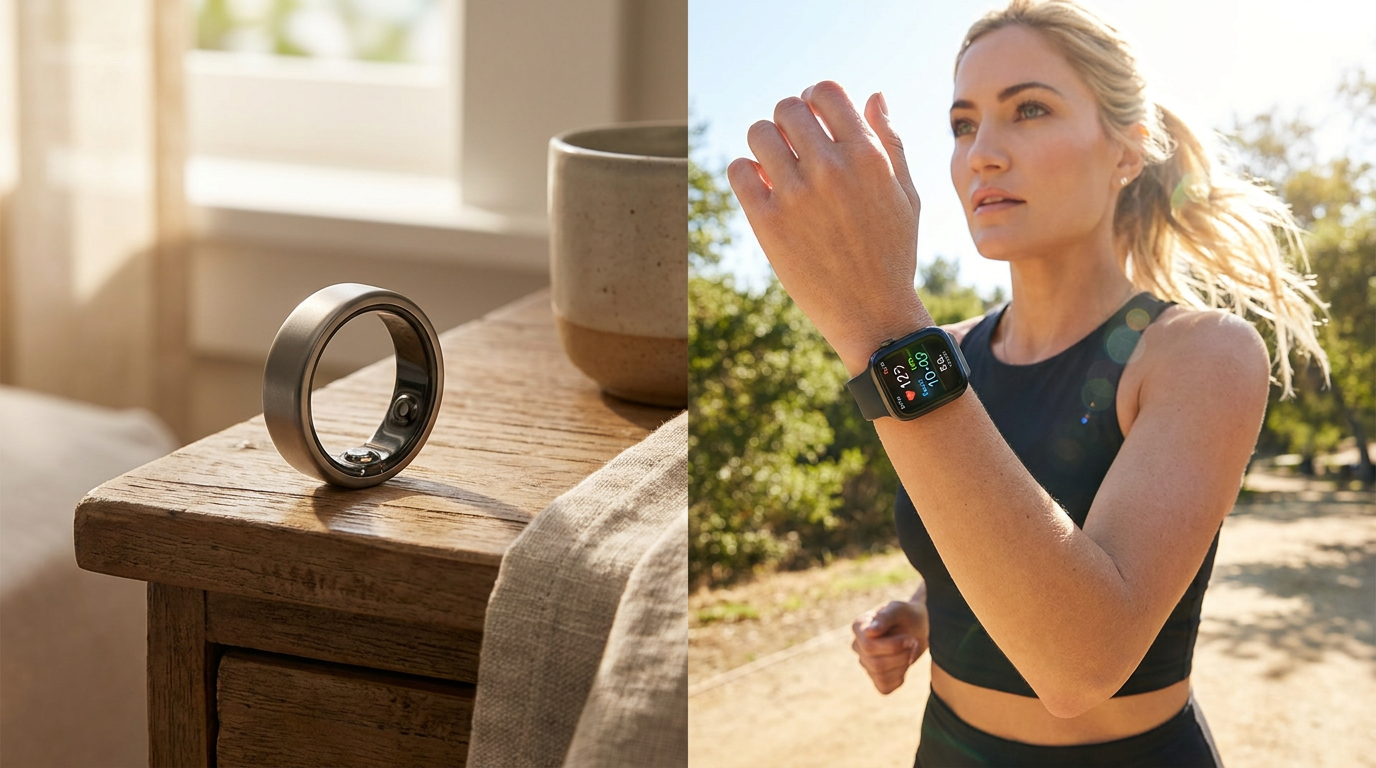
The wearable technology landscape in 2026 has evolved past simple brand loyalty, presenting consumers with a fundamental choice of form factor: the smart ring or the smartwatch. Devices like the Oura Ring 4 and Samsung Galaxy Ring represent a philosophy of passive, invisible health monitoring, while the Apple Watch Series 11 and Galaxy Watch 7 serve as active, interactive fitness dashboards. Shoppers are no longer just comparing battery life and step counts; they are deciding how they want technology to integrate into their daily lives. This side-by-side trade-off analysis examines the structural advantages and limitations of both form factors, quantifying their performance across sleep tracking, workout accuracy, and daily convenience to help buyers make an informed decision.[1][2]
When evaluating overnight recovery and sleep tracking, the evidence heavily favors the smart ring approach. For the smart ring, the primary advantage is physiological placement and physical comfort. Weighing between four and eight grams, a ring is virtually unnoticeable during the night, leading to near-perfect user compliance. Because the digital arteries in the finger are closer to the skin surface and feature a denser capillary network than the wrist, the ring's photoplethysmography (PPG) sensors receive a significantly cleaner signal. Clinical validation studies comparing smart rings to medical-grade polysomnography demonstrate that rings achieve 92 to 95 percent accuracy in tracking sleep stages and resting heart rate, largely because fingers move less than wrists during deep sleep.[3][5][15]
Against the smartwatch in the sleep domain, the primary drawbacks are physical bulk and sensor confusion. Weighing between 40 and 80 grams, smartwatches are frequently removed before bed due to discomfort, creating massive gaps in recovery data. Furthermore, the evidence shows that wrist-based devices struggle with precise sleep stage classification. Data indicates that the Apple Watch correctly identifies deep sleep only 50 to 62 percent of the time, frequently confusing it for light sleep due to wrist motion artifacts. While watches are highly accurate at detecting the exact moments a user wakes up in the middle of the night, their overall ability to map the architecture of a night's sleep falls short of the precision offered by a dedicated ring.[4][8]
However, the smartwatch retains a specific, highly valuable edge in overnight medical monitoring. For the smartwatch, the inclusion of advanced algorithms allows for the detection of severe breathing disturbances. The latest Apple Watch models monitor these disturbances over a rolling 30-day window to identify patterns indicative of moderate-to-severe sleep apnea. In clinical validation trials, this specific algorithm demonstrated an incredible 98.5 percent specificity, meaning that if the watch alerts a user to potential sleep apnea, there is an extraordinarily high probability that a medical sleep study will confirm the diagnosis. Rings track blood oxygen and respiratory rate, but they currently lack this FDA-cleared diagnostic specificity.[2][4]

Transitioning to active fitness tracking, the smartwatch presents an overwhelming case for adoption. For the watch, the inclusion of a high-resolution display, built-in GPS, and real-time processing power makes it an indispensable tool for athletes. Runners and cyclists can glance at their wrists to check heart rate zones, pace, distance, and interval timers without breaking stride. The physical design of a watch strap also ensures that the optical sensors remain firmly pressed against the radial artery during vigorous movement. Independent testing shows that during moderate exercise, wrist devices maintain a 94 to 97 percent accuracy rate compared to medical-grade chest straps, providing reliable data when the heart is working its hardest.[1][5]
Transitioning to active fitness tracking, the smartwatch presents an overwhelming case for adoption.
Against the smart ring in the gym environment, physical movement and form factor create significant data gaps. Gripping a barbell, holding a dumbbell, or gripping bicycle handlebars causes the fingers to constantly change shape and flex. These movements shift the ring away from the skin, interrupting the sensor's connection to the blood vessels and resulting in dropped heart rate readings. Furthermore, because smart rings lack screens and built-in GPS, they are entirely useless for real-time pacing or route tracking unless the user is also carrying a smartphone and checking its screen. For active, mid-workout feedback, the ring simply cannot compete.[7][14]
The trade-off in battery life fundamentally alters how these devices collect continuous health data. For the smart ring, the lack of a display allows for exceptional energy efficiency, with devices like the Oura Ring and Galaxy Ring lasting five to eight days on a single charge. This longevity ensures that biometric data is collected continuously, without daily interruptions. Against the smartwatch, the requirement for daily charging—typically every 18 to 36 hours—creates inevitable data blind spots. Users typically place their watches on the charger during their morning routine or right before bed, which often results in missed resting heart rate baselines or incomplete sleep tracking.[3][6][9]

Beyond basic fitness, the smartwatch offers a suite of active safety features that rings cannot physically support. For the smartwatch, the inclusion of electrical heart sensors allows users to take an on-demand electrocardiogram (ECG) to detect atrial fibrillation, a potentially life-saving feature. Additionally, the larger internal volume of a watch accommodates advanced accelerometers and gyroscopes capable of detecting severe car crashes or hard falls, automatically dialing emergency services if the user is unresponsive. Against the ring, the miniaturized form factor simply does not have the space for these advanced safety mechanisms, limiting the ring to passive biometric observation rather than active emergency intervention.[2][3][10]
The financial and ecosystem trade-offs also require careful consideration. For the smart ring, buyers must navigate a fragmented market where hardware costs are often paired with ongoing software subscriptions. The Oura Ring, for example, requires a $5.99 monthly fee to access detailed sleep and recovery insights, though competitors like Samsung and RingConn have recently introduced subscription-free models. For the smartwatch, the upfront cost is generally higher—ranging from $250 to $800—but the accompanying health software, such as Apple Health or Samsung Health, is entirely free to use. Furthermore, smartwatches offer deep integration with third-party apps, music streaming, and mobile payments, providing utility far beyond health tracking.[3][10]
Ultimately, the decision comes down to how the user intends to interact with their data. A smart ring fits well when the user prioritizes sleep optimization, recovery tracking, and long-term health awareness over real-time workout metrics. It is the ideal choice for individuals who want a device that disappears into their daily life, collecting data passively without the distraction of glowing screens or vibrating notifications. The ring also fits perfectly for traditional watch enthusiasts who want to track their health without sacrificing the ability to wear a mechanical timepiece on their wrist. If the goal is frictionless, 24/7 biometric monitoring, the ring is the superior tool.[1][11][12]
Conversely, a smartwatch fits well when the user trains regularly and requires real-time feedback during active workouts. It is the definitive choice for runners who need GPS tracking, weightlifters who want to log sets on their wrist, and anyone who values the convenience of smartphone notifications, apps, and on-wrist payments. The smartwatch also fits well when the user is specifically looking for active medical safety features, such as ECG readings and fall detection. While it requires the friction of daily charging and is bulkier to wear to bed, the smartwatch remains the ultimate all-in-one wearable for those who view health tracking as an active, engaged pursuit.[1][12][13]

Increasingly, the wearable market is seeing a trend where serious health optimizers refuse to choose, opting instead to wear both devices. In this dual-device ecosystem, the smartwatch is worn during the day to manage notifications, track active gym sessions, and provide GPS data during runs. At night, the watch is placed on its charger, and the smart ring takes over to seamlessly track sleep architecture, skin temperature, and resting heart rate without the bulk of a wristband. While this approach requires a higher financial investment and careful data syncing through central hubs like Apple Health or Google Fit, it effectively eliminates the trade-offs of both form factors, providing a comprehensive, uninterrupted picture of human health.[2][9]
How we got here
2015
The original Apple Watch launches, establishing the wrist as the primary location for consumer health tracking.
2018
Oura releases its second-generation ring, proving that miniaturized sensors can accurately track sleep from the finger.
2022
Apple introduces temperature sensing and advanced sleep stages to the Apple Watch, directly competing with ring metrics.
2024
Samsung launches the Galaxy Ring, bringing major tech ecosystem integration to the smart ring form factor.
2026
The wearable market fractures into distinct 'active' (watch) and 'passive' (ring) categories as users optimize for specific health goals.
Viewpoints in depth
Passive Health Optimizers
Advocates for invisible, continuous tracking with minimal screen distraction.
This camp argues that the best health tracker is the one you forget you are wearing. They view the constant notifications, glowing screens, and daily charging requirements of smartwatches as counterproductive to wellness, often increasing anxiety rather than reducing it. By relying on a smart ring, they prioritize long-term trends—such as resting heart rate, heart rate variability (HRV), and sleep architecture—over the immediate gratification of closing daily activity rings.
Active Training Athletes
Athletes who rely on real-time feedback, GPS, and on-device displays for workout optimization.
For serious runners, cyclists, and gym-goers, passive nighttime data is secondary to active exertion metrics. This viewpoint emphasizes that a wearable must be an interactive tool. They argue that without a screen to display mid-run pacing, heart rate zones, or interval timers, a device cannot actively improve athletic performance. To this camp, the smartwatch is an indispensable dashboard that dictates the intensity of their training in real time.
Medical Monitoring Advocates
Users and clinicians who value clinical-grade safety features like ECGs and fall detection.
This perspective focuses on the life-saving potential of wearable technology. They highlight that while rings are excellent for wellness trends, smartwatches possess the physical space required for advanced medical sensors. The ability to take an on-demand electrocardiogram (ECG) to detect atrial fibrillation, or to rely on built-in gyroscopes for hard fall detection and automatic emergency SOS dialing, makes the smartwatch a critical safety device rather than just a fitness accessory.
What we don't know
- Whether upcoming software updates will allow smart rings to achieve FDA clearance for sleep apnea detection.
- How the long-term durability of smart rings compares to smartwatches when exposed to daily wear and tear like weightlifting.
- If future smartwatches can miniaturize their batteries enough to become comfortable for universal overnight wear.
Key terms
- Photoplethysmography (PPG)
- An optical sensor technology that uses light to measure changes in blood volume, commonly used in wearables to track heart rate.
- Heart Rate Variability (HRV)
- The variation in time between consecutive heartbeats, used as a key indicator of physical recovery and stress levels.
- Polysomnography
- A comprehensive, medical-grade sleep study used as the gold standard for testing the accuracy of consumer sleep trackers.
- Electrocardiogram (ECG)
- A medical test that records the electrical signal from the heart to check for different conditions, available on advanced smartwatches but not rings.
Frequently asked
Can I use a smart ring for running without my phone?
Most smart rings lack built-in GPS and a display, meaning they cannot track your exact route or provide real-time pacing without a connected smartphone nearby.
Do smart rings require a monthly subscription?
It depends on the brand. The Oura Ring requires a $5.99 monthly subscription for full data access, while the Samsung Galaxy Ring and RingConn currently do not charge ongoing fees.
Which device is better for tracking weightlifting?
A smartwatch is significantly better. Gripping dumbbells or barbells can cause a smart ring to shift, interrupting the heart rate sensor, whereas a wrist-strapped watch maintains consistent skin contact.
Sources
Source coverage
15 outlets
3 viewpoints surfaced















[1]Vora BlogPassive Health Optimizers
Smart Ring or Smartwatch? How to Choose the Right Wearable in 2026
Read on Vora Blog →[2]WareableMedical Monitoring Advocates
Oura Ring vs. Apple Watch: Key differences revealed
Read on Wareable →[3]Garage Gym ReviewsActive Training Athletes
Expert Comparison: Oura Ring vs Apple Watch (2026)
Read on Garage Gym Reviews →[4]PutnamsPassive Health Optimizers
Oura Ring vs Apple Watch for Sleep Tracking: Which Gives Better Sleep Insights?
Read on Putnams →[5]J-StyleActive Training Athletes
Smart Ring vs Fitness Tracker vs Smartwatch: Ultimate Comparison 2026
Read on J-Style →[6]ForbesPassive Health Optimizers
Oura Ring Vs. Apple Watch: Which Is The Better Health Tracker?
Read on Forbes →[7]RunmefitActive Training Athletes
Smart Rings vs. Smart Watches: Pros, Cons & Future Trends
Read on Runmefit →[8]RedditMedical Monitoring Advocates
Sleep tracking accuracy on oura vs Apple Watch
Read on Reddit →[9]ZDNETActive Training Athletes
I put the Galaxy Ring to the test - and it's better than my Apple Watch in one critical area
Read on ZDNET →[10]SamsungMedical Monitoring Advocates
Smart Ring vs Smartwatch | Find the Best Wearable Tech for You
Read on Samsung →[11]RingConnPassive Health Optimizers
Smart Ring vs Smartwatch: Which Is Better for Sleep and Health Tracking?
Read on RingConn →[12]Sensio's AIMedical Monitoring Advocates
Which Is Better: A Smart Ring or a Smart Watch?
Read on Sensio's AI →[13]VaylenTechStudiosActive Training Athletes
The HONEST TRUTH About Health And Fitness Tracking: SmartWatch VS Smart Rings
Read on VaylenTechStudios →[14]KospetActive Training Athletes
Are Smart Rings Better than Smart Watches? Pros and Cons
Read on Kospet →[15]Journal of Medical Internet ResearchPassive Health Optimizers
Validation of the Oura Ring for Nocturnal Heart Rate and Heart Rate Variability
Read on Journal of Medical Internet Research →


Every angle. Every day.
Get shopping stories with full source coverage and perspective breakdowns delivered to your inbox.