
Xbox, PlayStation, and Nintendo Announce Historic Cross-Platform Accessibility Standard
The 'Universal Play Initiative' will allow adaptive gaming controllers to work seamlessly across all major consoles and PC, breaking down expensive hardware barriers for disabled gamers.
By Factlen Editorial Team
- Accessibility Advocates
- View the initiative as a long-overdue victory that eliminates the financial burden of buying redundant hardware for different consoles.
- Tech & Industry Analysts
- Focus on the unprecedented technical collaboration required to make rival hardware communicate seamlessly without input lag.
- Mainstream Observers
- Highlight the cultural shift of accessibility moving from a niche consideration to a foundational pillar of the entertainment industry.
What's not represented
- · Third-party peripheral manufacturers
- · Indie game developers
Why this matters
For decades, disabled gamers had to purchase expensive, specialized adaptive equipment for each individual console. This unprecedented agreement eliminates that financial burden, ensuring that a single accessible setup will work across the entire gaming ecosystem.
Key points
- Microsoft, Sony, and Nintendo have agreed to a standardized protocol for adaptive gaming controllers.
- The Universal Play Initiative allows specialized accessibility hardware to work across all major consoles and PC.
- The agreement eliminates the need for disabled gamers to purchase separate, expensive setups for different platforms.
- Firmware updates enabling the cross-platform features are scheduled for Fall 2026.
- Third-party peripheral manufacturers are invited to adopt the open API standard.
In a rare moment of industry-wide unity, the traditional console wars were set aside this weekend as Microsoft, Sony, and Nintendo jointly announced the 'Universal Play Initiative.' Revealed during the closing keynote of the 2026 Summer Game Fest in Los Angeles, the landmark agreement establishes a standardized protocol for adaptive gaming controllers. Starting this fall, specialized accessibility hardware designed for one console will work natively on all others, as well as on PC. The announcement drew a standing ovation from the crowd and immediate praise from accessibility advocates worldwide, marking a historic shift in how the $200 billion gaming industry approaches inclusive design.[1][2]
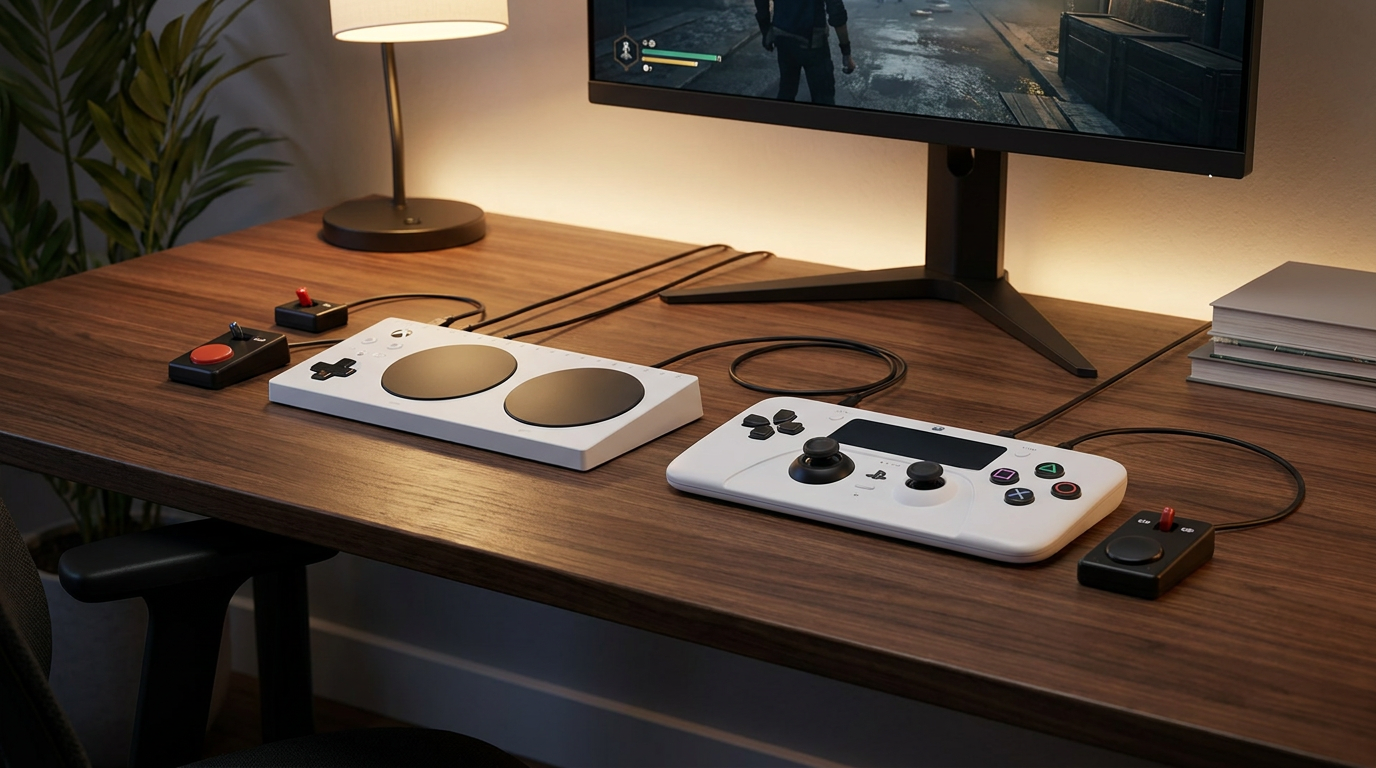
For years, disabled gamers have faced a frustrating and expensive 'walled garden' ecosystem. Players who rely on customized setups—which often include specialized switches, joysticks, and mounting equipment—had to purchase entirely separate ecosystems if they wanted to play a PlayStation exclusive like Spider-Man and an Xbox title like Halo. The Universal Play Initiative dismantles this barrier entirely. By implementing a shared application programming interface (API) and a unified Bluetooth handshake protocol, the major platform holders are ensuring that hardware like the Xbox Adaptive Controller and the PlayStation Access controller will be recognized instantly by competing consoles.[2][4]
The financial implications for the disabled gaming community are profound. A fully customized adaptive gaming setup can easily cost between $300 and $1,000, depending on the specific mobility needs of the player. Requiring a user to duplicate that setup for a second console was widely considered an unfair 'accessibility tax.' Industry analysts note that this agreement effectively cuts the hardware cost of multi-platform gaming in half for players with motor disabilities. Advocacy groups have spent years lobbying for this exact change, arguing that accessibility tools should be treated like essential medical devices rather than proprietary console accessories.[4][6]

The journey to this moment has been a decade in the making. Microsoft took the first major step in 2018 with the release of the Xbox Adaptive Controller, a highly customizable hub that allowed players to plug in various third-party switches and buttons. Sony followed suit in 2023 with the PlayStation Access controller, a highly modular circular device designed to be operated with limited mobility. While both devices were celebrated as massive leaps forward, their inability to communicate with rival consoles remained a glaring limitation. The new initiative bridges that final gap, turning proprietary innovations into industry-wide standards.[1][5]
Behind the scenes, the collaboration required unprecedented technical cooperation between direct competitors. Engineers from Xbox, PlayStation, and Nintendo reportedly spent the last eighteen months co-developing the universal firmware update. The resulting protocol allows the host console to translate the inputs from a rival's adaptive controller without introducing input lag—a critical factor for gamers playing fast-paced titles. Furthermore, the system is designed to be 'plug-and-play,' eliminating the need for complex third-party dongles or workarounds that players previously relied upon to force cross-compatibility.[2][3]
Behind the scenes, the collaboration required unprecedented technical cooperation between direct competitors.
The announcement also signals a broader cultural shift within the gaming industry. Mainstream observers note that accessibility is no longer viewed as a niche charitable endeavor, but rather a foundational pillar of game development and hardware design. With an estimated 400 million disabled gamers worldwide, platform holders are increasingly recognizing that inclusive design is both a moral imperative and a sound business strategy. By removing hardware barriers, the industry is opening its doors to a massive demographic of players who were previously sidelined by physical limitations.[3][6]
Reaction from the gaming community has been overwhelmingly positive. Social media platforms were flooded with messages from disabled gamers sharing their excitement and relief. The AbleGamers charity, a leading voice in gaming accessibility, called the initiative 'a new era of inclusive gaming,' praising the platform holders for prioritizing players over proprietary ecosystems. Developers have also chimed in, noting that a unified hardware standard will make it easier for them to design universally accessible software interfaces, knowing that players across all platforms will have access to similar control schemes.[4][6]

While the initial rollout focuses on first-party hardware from Microsoft and Sony, the Universal Play Initiative is designed to be an open standard. The consortium has published the API guidelines, inviting third-party peripheral manufacturers like Logitech, Razer, and 8BitDo to adopt the protocol. This open-door policy is expected to spur a wave of innovation in the accessibility space, as smaller hardware startups can now design specialized controllers knowing they will have a guaranteed market across all major gaming platforms.[1][5]
Nintendo's involvement in the initiative has also drawn significant attention. While the company has historically been slower to adopt industry-wide hardware standards, their commitment to the Universal Play Initiative ensures that their upcoming next-generation console will be fully compatible with existing adaptive setups from day one. This inclusion is particularly vital for younger disabled gamers, for whom Nintendo's family-friendly catalog is often an entry point into the medium.[1][3]
Despite the widespread celebration, some logistical questions remain. The exact timeline for the firmware updates has been vaguely slated for 'Fall 2026,' leaving players eager for a concrete release date. Additionally, it remains to be seen how legacy games—those released before the standardization—will map the inputs from rival controllers, particularly in titles that rely heavily on console-specific features like the PlayStation DualSense's haptic feedback or the Nintendo Joy-Con's motion controls.[2][4]
To address these concerns, the consortium has announced the formation of a joint accessibility task force. This cross-company team will be responsible for maintaining the unified API, certifying new third-party adaptive devices, and providing guidance to game developers on how to optimize their software for cross-platform accessibility. The task force will also host regular town halls with the disabled gaming community to gather feedback and identify areas for future improvement.[5][6]

Ultimately, the Universal Play Initiative represents a rare and uplifting triumph of collaboration over competition. By agreeing that accessibility should not be a competitive advantage, the gaming industry's biggest rivals have set a powerful precedent for the broader tech world. As the lines between platforms continue to blur, this historic agreement ensures that the future of interactive entertainment will be fundamentally more inclusive, allowing millions of players to finally game without limits.[3][5]
How we got here
September 2018
Microsoft launches the Xbox Adaptive Controller, setting a new standard for accessible hardware.
December 2023
Sony releases the PlayStation Access controller, bringing highly modular accessibility to the PS5.
Early 2025
Engineers from the major console manufacturers begin secret cross-company collaboration on a unified API.
June 2026
The Universal Play Initiative is officially announced at Summer Game Fest.
Fall 2026
Scheduled rollout of the firmware updates enabling cross-platform compatibility.
Viewpoints in depth
Accessibility Advocates
View the initiative as a long-overdue victory that eliminates the financial burden of buying redundant hardware.
For advocacy groups like AbleGamers, the Universal Play Initiative represents the culmination of years of lobbying. They have long argued that adaptive controllers are not luxury accessories, but essential tools for participation in modern digital culture. By forcing players to buy separate $300+ setups for each console, the industry was inadvertently levying an 'accessibility tax' on its most vulnerable consumers. Advocates celebrate this agreement as a definitive end to that practice, allowing players to invest in a single, high-quality setup that follows them across the entire gaming ecosystem.
Hardware Manufacturers
Focus on the technical achievements and the strategic benefits of an open standard.
From a technical standpoint, getting proprietary hardware to communicate natively with competing consoles without introducing input lag is a massive engineering feat. Hardware developers emphasize that the unified Bluetooth handshake protocol and shared API will drastically reduce development friction. By establishing a universal standard, platform holders are also incentivizing third-party companies to enter the accessibility market, knowing their products will instantly have a multi-platform user base rather than being restricted to a single console's walled garden.
What we don't know
- The exact release date for the firmware updates beyond the 'Fall 2026' window.
- How legacy games that rely heavily on console-specific features (like DualSense haptics) will map inputs from rival controllers.
- Which specific third-party manufacturers will be the first to adopt the new open API standard.
Key terms
- Adaptive Controller
- A highly customizable gaming controller designed specifically to meet the needs of players with limited mobility, often featuring large programmable buttons and ports for external switches.
- API (Application Programming Interface)
- A set of rules and protocols that allows different software applications or hardware devices to communicate with each other.
- Walled Garden
- A closed ecosystem where a company controls the hardware and software, preventing users from using competing products within that environment.
Frequently asked
When will the cross-platform update be available?
The firmware updates enabling cross-platform compatibility are slated to roll out in Fall 2026.
Will this work on PC as well?
Yes, the Universal Play Initiative includes full native support for PC gaming alongside Xbox, PlayStation, and Nintendo consoles.
Do I need to buy a new controller?
No. Existing first-party adaptive controllers, like the Xbox Adaptive Controller and PlayStation Access controller, will receive a firmware update to enable the new features.
Will third-party controllers be supported?
The API is open to third-party manufacturers, meaning companies like Logitech and Razer can adopt the standard for their future accessibility peripherals.
Sources
Source coverage
6 outlets
3 viewpoints surfaced






[1]IGNTech & Industry Analysts
Xbox, PlayStation, and Nintendo Unite for Universal Play Initiative
Read on IGN →[2]The VergeTech & Industry Analysts
The console war pauses for accessibility: Adaptive controllers are going cross-platform
Read on The Verge →[3]BBC NewsMainstream Observers
Gaming giants agree to share accessibility tech in historic deal
Read on BBC News →[4]PolygonAccessibility Advocates
What the Universal Play Initiative means for disabled gamers
Read on Polygon →[5]EurogamerTech & Industry Analysts
Sony and Microsoft's new accessibility pact is a massive win for players
Read on Eurogamer →[6]AbleGamersAccessibility Advocates
A New Era of Inclusive Gaming: The Universal Play Initiative
Read on AbleGamers →

Every angle. Every day.
Get entertainment stories with full source coverage and perspective breakdowns delivered to your inbox.