
The Science of Recovering Lost Art: How AI and X-Rays Are Revealing Hidden Masterpieces
By combining artificial intelligence with advanced chemical imaging, conservators are recovering lost chapters of art history without touching the original canvases.
By Factlen Editorial Team
- Conservation Scientists
- Focus on the objective chemical data and non-invasive preservation of cultural heritage.
- Art Historians
- Focus on the human element, the artist's creative process, and the historical context of the hidden works.
- AI Technologists
- Focus on pushing the boundaries of neural networks and 3D reconstruction to bring lost art back to the physical world.
What's not represented
- · Traditional Art Restorers who rely on physical techniques
- · Museum Curators managing the display of digital vs. physical art
Why this matters
This non-invasive technology allows us to see the false starts, hidden portraits, and creative evolution of master painters. It fundamentally changes how museums study and preserve cultural heritage, proving that even the greatest masterpieces were the result of trial and error.
Key points
- Museums are combining macro X-ray fluorescence (MA-XRF) with AI to reveal hidden paintings beneath famous masterpieces.
- The non-invasive technology maps the chemical elements of pigments, allowing researchers to see underpaintings without damaging the artwork.
- Neural networks untangle overlapping X-ray data, isolating the exact chemical signatures of 500-year-old paint.
- Discoveries include a hidden self-portrait by Artemisia Gentileschi and a lost landscape beneath a Picasso canvas.
- Technologists are now using 3D printing to physically recreate the textured brushstrokes of these lost artworks.
The hidden world beneath the canvas has always tantalized art historians. For centuries, masterpieces hanging in the world's greatest museums have harbored secrets just millimeters below their surfaces. Artists frequently reused canvases to save money on expensive materials, or simply painted over early compositions they had abandoned in frustration.[7]
Until recently, discovering these hidden layers was a fraught and highly restricted process. It required either destructive physical sampling—extracting microscopic cores of paint—or taking fragile, priceless artworks out of their climate-controlled environments to massive particle accelerators for scanning.[4][6]
Even when those high-stakes scans were successful, the resulting images were often blurry, overlapping ghosts. Because traditional X-rays pass through the entire canvas, the resulting image flattens the hidden underpainting and the final visible layer into a single, confusing composite that is incredibly difficult for the human eye to decipher.[5][7]
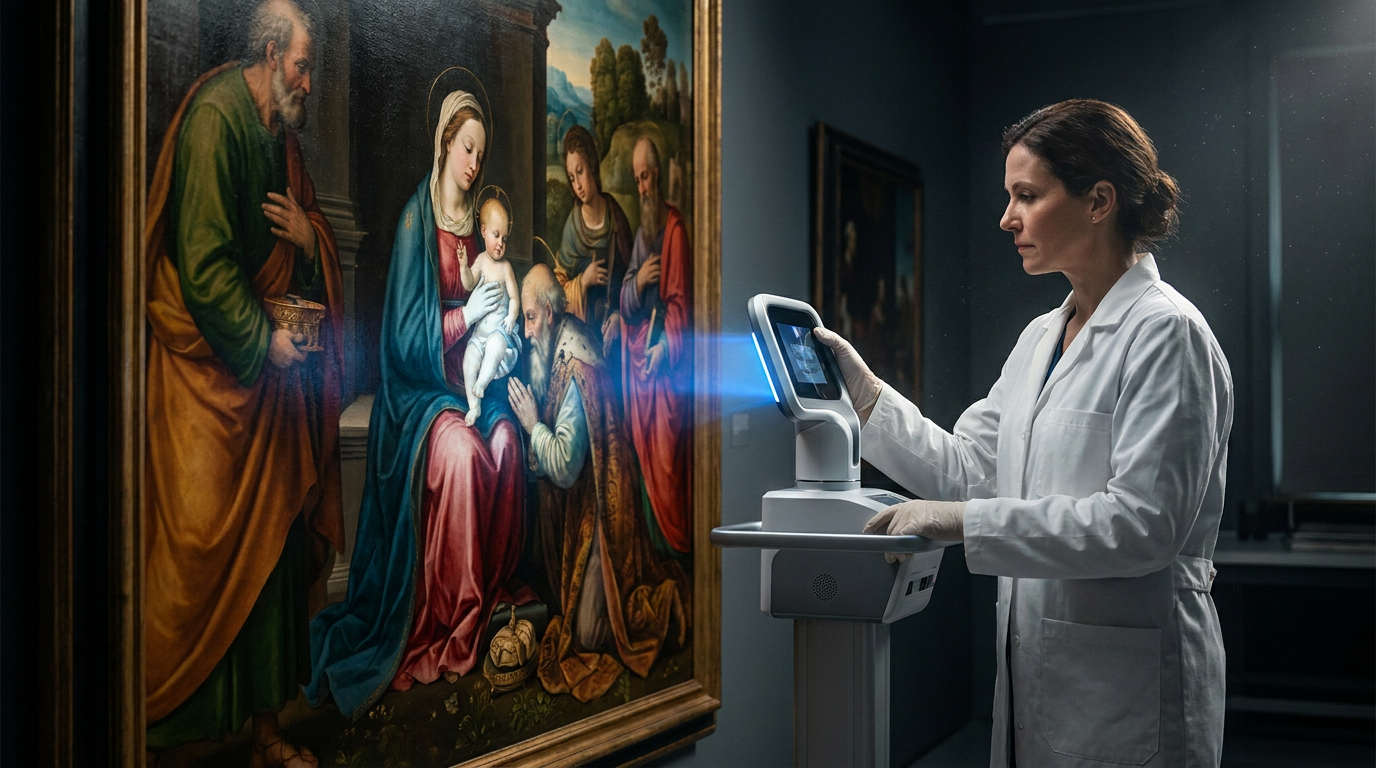
Today, a quiet revolution is taking place in museum conservation labs around the globe. The convergence of macro X-ray fluorescence (MA-XRF) scanning and advanced artificial intelligence is allowing scientists to peel back the layers of history digitally, revealing lost masterpieces without ever touching the paint.[1][5]
The process begins with MA-XRF, a non-invasive chemical imaging technique. When a painting is bombarded with X-rays, the different chemical elements in the pigments—like lead in white paint, mercury in red vermilion, or cobalt in blue—absorb and expel the radiation in distinct, measurable ways.[1][4]

By mapping these elemental signatures across the canvas, researchers can create a precise chemical blueprint of the artwork. Crucially, the development of mobile X-ray scanners now allows this complex analysis to happen right in the museum gallery, sparing fragile works from the risks of transportation.[4]
However, MA-XRF generates a staggering volume of complex data. A single scan can produce millions of overlapping data points, especially when an artist used similar mineral pigments in both the hidden and visible layers of the painting.[5]
This is where artificial intelligence steps in to solve the data bottleneck. Neural networks, designed to mimic the human brain's pattern recognition capabilities, are trained on massive synthetic datasets representing hundreds of thousands of pigment spectra.[1][5]
When fed the raw X-ray data, the AI can untangle the overlapping chemical signals with unprecedented precision. It isolates the specific elements that belong to the hidden underpainting, effectively stripping away the top layer of the masterpiece to reveal the artist's first draft.[1][5]
When fed the raw X-ray data, the AI can untangle the overlapping chemical signals with unprecedented precision.
A recent study published in the journal Science Advances demonstrated this powerful synergy on two panels by the High Renaissance master Raphael. The AI correctly identified the chemical makeup of the 500-year-old paint, distinguishing original motifs from later restorative work that used anachronistic pigments.[1][5]

The neural network even parsed the complex chemistry of the green drapes surrounding the figure of God the Father. It identified a copper-based mineral mixed with a yellow lake pigment, providing a level of material insight that was previously impossible to achieve non-destructively.[1]
Similar techniques have illuminated the early struggles of Vincent van Gogh, who is believed to have painted over roughly one-third of his early canvases. Using synchrotron radiation-based X-ray fluorescence, researchers visualized a woman's head hidden beneath his painting "Patch of Grass."[4][6]
The elemental mapping of mercury and antimony allowed conservators to approximate the original flesh tones of the hidden portrait. This discovery provided a missing link in the evolution of Van Gogh's portraiture style, bridging a gap in his artistic timeline.[6]
The technology is also revealing the personal lives and practical decisions of the artists. Beneath Artemisia Gentileschi's "St. Catherine of Alexandria," X-rays uncovered a partial self-portrait wearing a turban. Experts believe she combined her own features with those of a noblewoman to create the final saint, saving money on a fresh canvas in the process.[3]

Some technologists are now pushing beyond digital visualization into physical recreation. An initiative called Oxia Palus used AI to reconstruct a landscape hidden beneath Pablo Picasso's "The Crouching Beggar," which is believed to have been painted by his contemporary Santiago Rusiñol.[2]
After using style-transfer algorithms to guess the colors and brushstrokes of the hidden landscape, the team used advanced 3D printing to create a physical canvas. The printer layered paint to mimic the thick impasto technique, producing a textured replica of a painting that hasn't been seen in over a century.[2]

Despite these triumphs, the technology has limitations that require careful navigation. AI reconstructions of lost colors and brushstrokes involve a degree of algorithmic guesswork. While the chemical maps are objective data, turning those maps into a full-color image requires the AI to make assumptions based on the artist's other known works.[2][7]
This raises fascinating philosophical questions for the art world. Is an AI-generated reconstruction a true representation of the lost work, or is it a modern interpretation? Conservators emphasize that these tools are meant to augment human expertise, not replace the nuanced eye of the art historian.[7]
As neural networks become more sophisticated and mobile scanners more accessible, the pace of these discoveries will only accelerate. The false starts, abandoned ideas, and hidden portraits of the Old Masters are finally coming to light.[7]
Ultimately, these hidden layers offer a profoundly humanizing glimpse into the creative process. They remind us that even the greatest masterpieces were not born perfect, but were the result of trial, error, and constant revision.[7]
How we got here
1990s
Early X-ray technology reveals blurry, overlapping images of underpaintings, requiring artworks to be moved to specialized labs.
2011
Mobile macro X-ray fluorescence (MA-XRF) scanners are introduced, allowing non-invasive chemical mapping inside museum galleries.
2018
High-definition X-rays reveal a hidden landscape beneath Pablo Picasso's 'The Crouching Beggar'.
2021
Technologists use AI style-transfer and 3D printing to physically recreate the lost landscape hidden beneath Picasso's work.
2024
Researchers publish a breakthrough study using neural networks to perfectly isolate the chemical spectra of 500-year-old pigments in Raphael's paintings.
Viewpoints in depth
Conservation Scientists
Focus on the objective chemical data and non-invasive preservation of cultural heritage.
For conservation scientists, the primary victory of MA-XRF and AI is the preservation of the physical artifact. In the past, confirming an underpainting often required taking microscopic cross-sections of the canvas—a destructive process that permanently altered the masterpiece. By shifting to non-invasive chemical mapping, scientists can gather infinitely more data without risking the artwork. They view the AI not as an artist, but as an advanced calculator capable of untangling millions of overlapping elemental spectra into a clean, objective blueprint.
Art Historians
Focus on the human element, the artist's creative process, and the historical context of the hidden works.
Art historians are less interested in the algorithms and more captivated by the narrative these tools unlock. Discovering that Artemisia Gentileschi painted over her own self-portrait, or that Van Gogh recycled a third of his early canvases, humanizes these legendary figures. It proves that masterpieces are rarely born in a single stroke of genius; they are the result of economic constraints, changing minds, and relentless revision. However, historians remain cautious about treating AI color reconstructions as historical fact, preferring to view them as highly educated hypotheses.
AI Technologists
Focus on pushing the boundaries of neural networks and 3D reconstruction to bring lost art back to the physical world.
For the technologists building these systems, the canvas is the ultimate test of pattern recognition. Training a neural network to differentiate between 500-year-old copper and lead signatures requires massive synthetic datasets and immense computing power. Technologists are eager to push the boundaries further, moving from digital screens to the physical world. By combining style-transfer algorithms with 3D printing, they aim to recreate the tactile experience of lost art, arguing that a physical replica with accurate impasto brushstrokes offers a more immersive experience than a digital scan.
What we don't know
- Whether AI-generated color reconstructions perfectly match the exact hues the original artists intended.
- How many more hidden masterpieces remain undiscovered in the archives of major museums.
- If the high cost of synchrotron scanning and AI analysis will become accessible to smaller, regional galleries.
Key terms
- Macro X-ray fluorescence (MA-XRF)
- A non-invasive imaging technique that maps the distribution of chemical elements in a painting by bombarding it with X-rays.
- Underpainting
- An initial layer of paint applied to a canvas to establish the composition, which is often painted over in the final work.
- Neural network
- An artificial intelligence model designed to mimic the human brain, capable of recognizing complex patterns in large datasets.
- Impasto
- A painting technique where paint is laid on an area of the surface very thickly, leaving visible brushstrokes and texture.
- Synchrotron radiation
- Extremely bright light generated by accelerating electrons, used to produce highly detailed X-ray scans of microscopic paint layers.
Frequently asked
Does X-ray scanning damage the original painting?
No. Modern macro X-ray fluorescence (MA-XRF) is completely non-invasive and does not harm the artwork or alter its pigments.
Can AI perfectly recreate a lost painting?
Not perfectly. While AI can accurately map the chemical elements, choosing the exact colors and brushstrokes involves algorithmic assumptions based on the artist's other works.
Why did famous artists paint over their work?
Artists frequently reused canvases to save money on materials, or simply painted over early drafts and compositions they had abandoned.
Sources
Source coverage
7 outlets
3 viewpoints surfaced







[1]GizmodoAI Technologists
X-Rays and AI Reveal Lost Details in Famous Raphael Paintings
Read on Gizmodo →[2]FreethinkAI Technologists
AI reconstructs lost art painted over by Picasso
Read on Freethink →[3]CBC NewsArt Historians
X-ray reveals hidden painting under Baroque masterpiece
Read on CBC News →[4]Live ScienceConservation Scientists
New Way to Look at Old Paintings: Have X-Rays, Will Travel
Read on Live Science →[5]Science AdvancesConservation Scientists
Deep learning for enhanced spectral analysis of MA-XRF datasets of paintings
Read on Science Advances →[6]Analytical ChemistryConservation Scientists
Visualization of a Lost Painting by Vincent van Gogh Using Synchrotron Radiation Based X-ray Fluorescence Elemental Mapping
Read on Analytical Chemistry →[7]Factlen Editorial TeamArt Historians
Synthesis by Factlen editorial team
Read on Factlen Editorial Team →
Every angle. Every day.
Get culture stories with full source coverage and perspective breakdowns delivered to your inbox.