
The Science of the Maillard Reaction: How Heat Transforms Food
Understanding the chemical reaction between amino acids and sugars can help home cooks unlock deeper, more complex flavors in their everyday meals.
By Factlen Editorial Team
- Professional Chefs
- Emphasizes practical kitchen applications, heat management, and the crucial importance of moisture control.
- Culinary Scientists
- Focuses on the molecular breakdown, pH manipulation, and the precise chemical pathways that generate flavor.
- Health & Nutrition Experts
- Highlights the thermal limits of browning and the importance of avoiding pyrolysis and carcinogenic acrylamides.
What's not represented
- · Industrial Food Manufacturers
Why this matters
Mastering this single chemical principle allows home cooks to predictably build restaurant-quality flavor profiles, turning pale, bland ingredients into deeply savory dishes without relying on extra salt or fat.
Key points
- The Maillard reaction is a chemical process between amino acids and sugars that creates savory flavors and brown colors in cooked food.
- The reaction requires temperatures between 280°F and 330°F to properly activate.
- Surface moisture prevents browning because water boils at 212°F, capping the temperature below the Maillard threshold.
- Unlike caramelization, which only involves sugars, the Maillard reaction requires proteins to create complex, umami-rich profiles.
- Temperatures above 355°F lead to pyrolysis (burning), which creates bitter flavors and potentially harmful acrylamides.
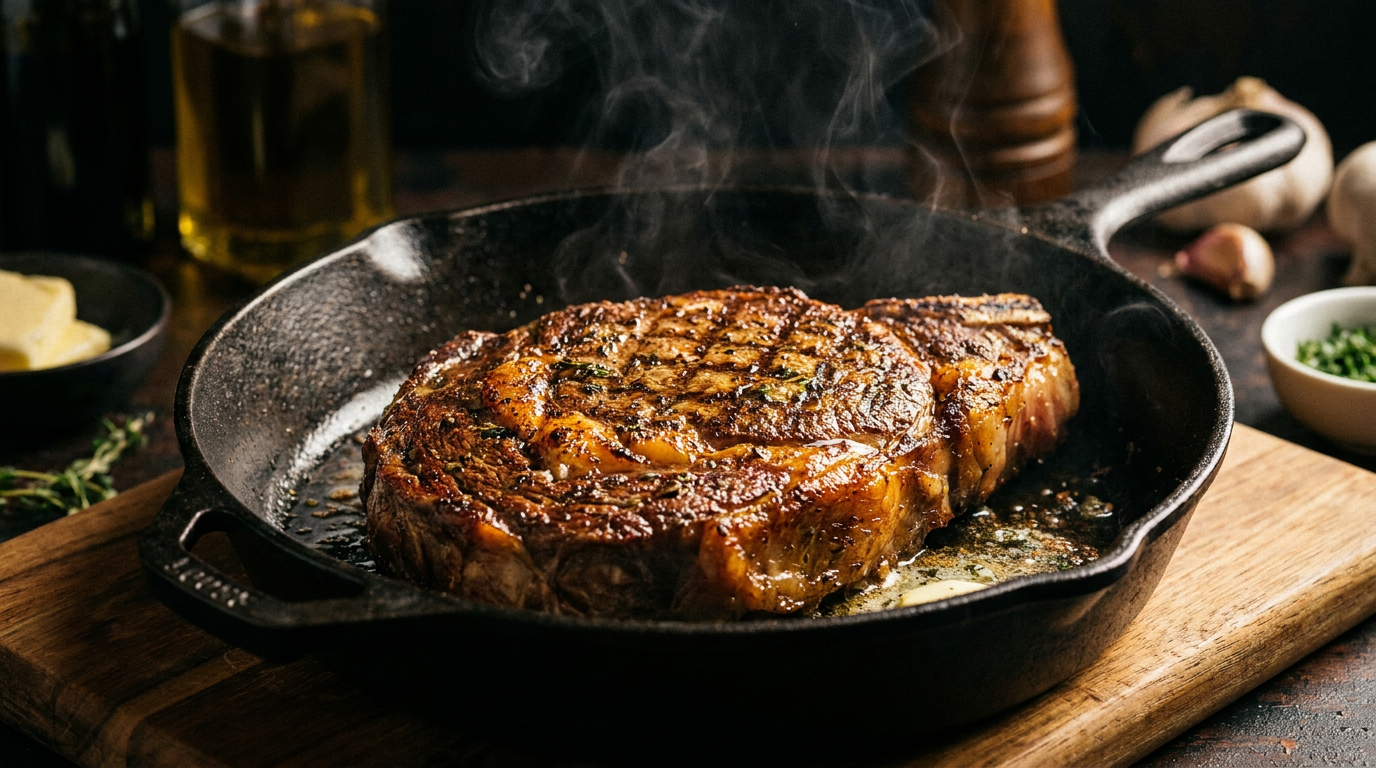
The sizzle of a steak hitting a hot cast-iron skillet, the golden crust of a freshly baked loaf of bread, and the intoxicating aroma of roasting coffee beans all share a common origin. These sensory experiences are not just random culinary occurrences; they are the direct result of what chemists consider the most widely practiced chemical reaction in the world.[1][7]
Known as the Maillard reaction, this complex process is the secret behind the savory, complex flavors and appealing brown colors that define our favorite cooked foods. Without it, our meals would be pale, bland, and entirely uninspiring, lacking the depth that transforms mere sustenance into a culinary delight.[1][2]
First described in 1912 by French chemist Louis-Camille Maillard, the reaction was initially an accidental discovery while he was attempting to reproduce biological protein synthesis in a laboratory. Today, it stands as the foundational pillar of culinary science, explaining exactly why high heat transforms raw, flavorless ingredients into aromatic masterpieces.[1][2]
The mechanism itself is a marvel of thermal alchemy. At its core, the Maillard reaction is a non-enzymatic browning process that occurs when amino acids—the fundamental building blocks of proteins—collide with reducing sugars, such as glucose and fructose, under the stress of heat.[1][4]

When exposed to high temperatures, the reactive carbonyl group of the sugar interacts with the nucleophilic amino group of the amino acid. This initial molecular handshake forms an unstable compound that rapidly undergoes a series of complex rearrangements, cascading into hundreds, and sometimes thousands, of entirely new flavor and aroma molecules.[1][6]
These newly minted molecules include pyrazines, which impart roasted and nutty notes, and furans, which deliver meaty and caramel-like aromas. Eventually, the process produces melanoidins, the brown pigment polymers responsible for the rich, dark crust on a seared scallop, a toasted marshmallow, or a golden french fry.[1][4]
However, this chemical magic does not happen at just any temperature. The Maillard reaction has a strict thermal sweet spot: it typically kicks into high gear between 280°F and 330°F (140°C to 165°C), requiring a concentrated application of heat to initiate the molecular breakdown.[2][3]

However, this chemical magic does not happen at just any temperature.
This specific temperature requirement reveals the greatest enemy of the Maillard reaction in the home kitchen: water. Because water boils and turns to steam at exactly 212°F (100°C), any surface moisture on food acts as a strict thermal ceiling, capping the temperature well below the necessary Maillard threshold.[3][5]
This physical limitation explains why boiling or steaming food never produces a brown crust or a roasted flavor profile. For home cooks, the golden rule of browning is to ruthlessly eliminate surface moisture; patting meat dry with paper towels or leaving it uncovered in the refrigerator overnight ensures that the pan's heat energy goes directly into triggering the reaction rather than merely evaporating water.[3][6]
Another common pitfall that ruins browning is pan crowding. When too many ingredients are crammed into a skillet, the ambient temperature of the pan plummets, and the food begins to release its internal moisture. The ingredients end up steaming in their own juices, entirely bypassing the Maillard zone and resulting in a gray, unappetizing finish.[3][7]

A frequent point of confusion in the culinary world is the distinction between the Maillard reaction and caramelization. While both processes require high heat and result in a browned exterior, they are fundamentally different chemical events with distinct flavor outcomes.[4]
Caramelization is strictly the pyrolytic breakdown of sugars alone, requiring absolutely no proteins to occur. It generally activates at higher temperatures—often above 320°F (160°C)—and yields sweet, nutty, and slightly bitter flavors, such as those found in caramel sauce. The Maillard reaction, by contrast, requires the marriage of both proteins and sugars, resulting in deeply savory, umami-rich profiles.[4][7]
Culinary scientists have also discovered that the Maillard reaction can be manipulated through pH levels. An alkaline environment accelerates the deprotonation of amino groups, drastically speeding up the browning process even at slightly lower temperatures.[1][5]
This chemical shortcut is why traditional pretzels are dipped in a highly alkaline lye solution before baking, giving them their signature dark, glossy exterior. Home cooks can replicate a milder version of this trick by adding a tiny pinch of baking soda to onions, which drastically reduces the hours required to brown them for a rich French onion soup.[1][5]

But there is a strict limit to this thermal alchemy. When temperatures push past 355°F (180°C), the delicate Maillard reaction gives way to pyrolysis—the scientific term for burning and thermal decomposition.[2][3]
Pyrolysis destroys the intricate flavor compounds built during the Maillard phase, leaving behind acrid, bitter carbon. Furthermore, excessive charring, particularly in starchy foods or meats cooked over open flames, can produce acrylamide, a compound that health experts identify as a probable carcinogen.[1][2]
Ultimately, mastering the Maillard reaction is about controlling the micro-environment in your pan or oven. By managing moisture, respecting the temperature sweet spot, and understanding the underlying chemistry, any home cook can elevate their meals from simple sustenance to sensory perfection.[7]
How we got here
1912
French chemist Louis-Camille Maillard first describes the reaction while attempting to reproduce biological protein synthesis.
1953
Chemist John E. Hodge publishes the definitive mechanism of the Maillard reaction, mapping out its complex chemical pathways.
2000s
The modernist cuisine movement popularizes the underlying chemistry of the Maillard reaction, bringing laboratory techniques into home kitchens.
Viewpoints in depth
Culinary Scientists
Focuses on the molecular breakdown and the precise chemical pathways that generate flavor.
For food chemists, the Maillard reaction is a fascinating cascade of molecular instability. They focus on the initial Amadori rearrangement, where the bond between a sugar and an amino acid creates a highly reactive intermediate compound. Scientists study how manipulating variables like pH can drastically alter this pathway. By raising the alkalinity of a food—such as dipping dough in lye—chemists know they can force the amino groups to deprotonate, supercharging the reaction rate and creating a darker, more robust crust without requiring higher oven temperatures.
Professional Chefs
Emphasizes practical kitchen applications, heat management, and the crucial importance of moisture control.
In the professional kitchen, the chemistry of browning is translated into strict operational rules. Chefs view water as the ultimate enemy of flavor development. Their techniques—such as aggressively patting proteins dry, dry-brining meats uncovered in refrigerators, and pre-heating heavy cast-iron pans—are all designed to bypass the 212°F boiling point of water as quickly as possible. Furthermore, chefs strictly enforce pan-spacing; they know that crowding ingredients traps escaping steam, which instantly kills the ambient temperature and ruins the chance of achieving a proper sear.
Health & Nutrition Experts
Highlights the thermal limits of browning and the importance of avoiding pyrolysis and carcinogenic acrylamides.
While dietitians and health experts acknowledge the culinary necessity of the Maillard reaction, they focus heavily on its upper thermal limits. When food is pushed past 355°F, the reaction transitions into pyrolysis, breaking down organic matter into carbon. Beyond ruining the flavor with bitter, acrid notes, excessive charring—especially in starchy foods like potatoes or bread—triggers the formation of acrylamide. Because acrylamide is classified as a probable human carcinogen, health experts advocate for controlled, moderate browning rather than aggressive, open-flame charring.
What we don't know
- The exact chemical composition of every single flavor compound produced during the reaction, as thousands of distinct molecules can form depending on the specific sugars and proteins involved.
- How to perfectly isolate specific savory notes in a home kitchen without inadvertently triggering the creation of other, less desirable flavor compounds.
Key terms
- Amino acids
- The organic molecules that combine to form proteins; they are one of the two essential ingredients required for the Maillard reaction.
- Reducing sugars
- Simple carbohydrates, such as glucose and fructose, that have a free carbonyl group allowing them to easily interact with amino acids under heat.
- Melanoidins
- The complex, brown pigment polymers created at the end of the Maillard reaction that give seared and baked foods their dark color.
- Pyrolysis
- The chemical decomposition of organic materials at highly elevated temperatures; in cooking, this is the threshold where browning turns into burning.
- Caramelization
- A pyrolytic process where sugar molecules break down under high heat without the presence of proteins, yielding sweet and nutty flavors.
Frequently asked
Why doesn't boiled meat turn brown?
Water boils and turns to steam at 212°F (100°C). Because the Maillard reaction requires temperatures of at least 280°F, boiling water acts as a thermal ceiling that prevents browning.
Does the Maillard reaction happen in vegetables?
Yes. Vegetables contain both proteins (amino acids) and natural sugars. When roasted at high heat, they undergo the exact same browning process as a steak.
How does baking soda help onions brown faster?
Baking soda raises the pH of the onions, creating an alkaline environment. This chemical shift accelerates the breakdown of amino acids, allowing the Maillard reaction to occur much faster.
Is caramelization the same thing as the Maillard reaction?
No. Caramelization is the breakdown of sugars alone under high heat. The Maillard reaction requires the interaction of both sugars and proteins to create savory flavors.
Sources
Source coverage
7 outlets
3 viewpoints surfaced






[1]WikipediaCulinary Scientists
Maillard reaction
Read on Wikipedia →[2]MasterClassProfessional Chefs
What Is the Maillard Reaction? 5 Phases of the Maillard Reaction
Read on MasterClass →[3]Modernist CuisineProfessional Chefs
Strategies to Remember: Maximizing the Maillard Reaction
Read on Modernist Cuisine →[4]ChowhoundProfessional Chefs
The Crucial Difference Between The Maillard Reaction And Caramelization
Read on Chowhound →[5]KhymosCulinary Scientists
Speeding up the Maillard reaction
Read on Khymos →[6]Heritage Kitchen LabProfessional Chefs
The Science Behind Flavor Development: Maillard Reaction
Read on Heritage Kitchen Lab →[7]Factlen Editorial TeamHealth & Nutrition Experts
Synthesis by Factlen editorial team
Read on Factlen Editorial Team →



Every angle. Every day.
Get lifestyle stories with full source coverage and perspective breakdowns delivered to your inbox.